
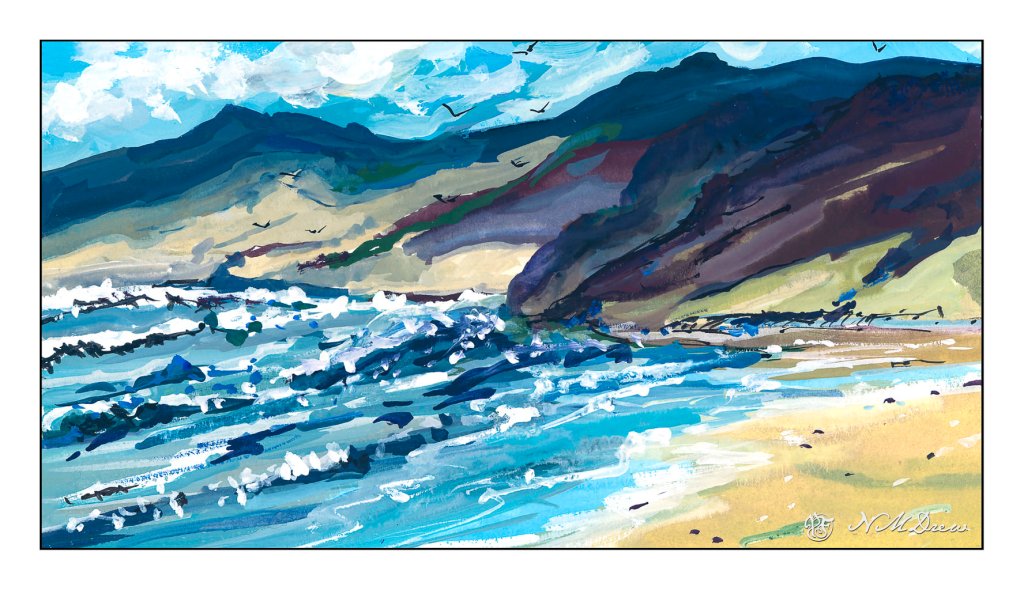
Winter at Jalama Beach

Where have I been these last several weeks? Busy with online classes in drawing as a prelim to painting and hand sewing 18th century stays. So, I have been doing things, but have had so many other distractions that I have not been too active online here. So, today, a gouache, just because paint needs to be used to feel like a normal person.

Jalama Beach is in San Luis Obispo County along the central coast of California. It is a strange, remote beach. Winds blow the sea foam onto the sand, and it can look like very dirty snow. The first time I came here was in my teens – a long, long time ago. Then you could get abalones just by picking them up, and the beach was littered with their shells, big ones easily 8-10 inches in diameter. (Tasty critters, I will say.)

Winter time brings erratic tides, scudding clouds, and wind that can blow fierce and cold. Sandpipers and gulls wheel overhead as the wind beats you back. The wildness of the place is something that anyone who has been to a lonely beach can understand. I think I caught it (for myself at least) here.

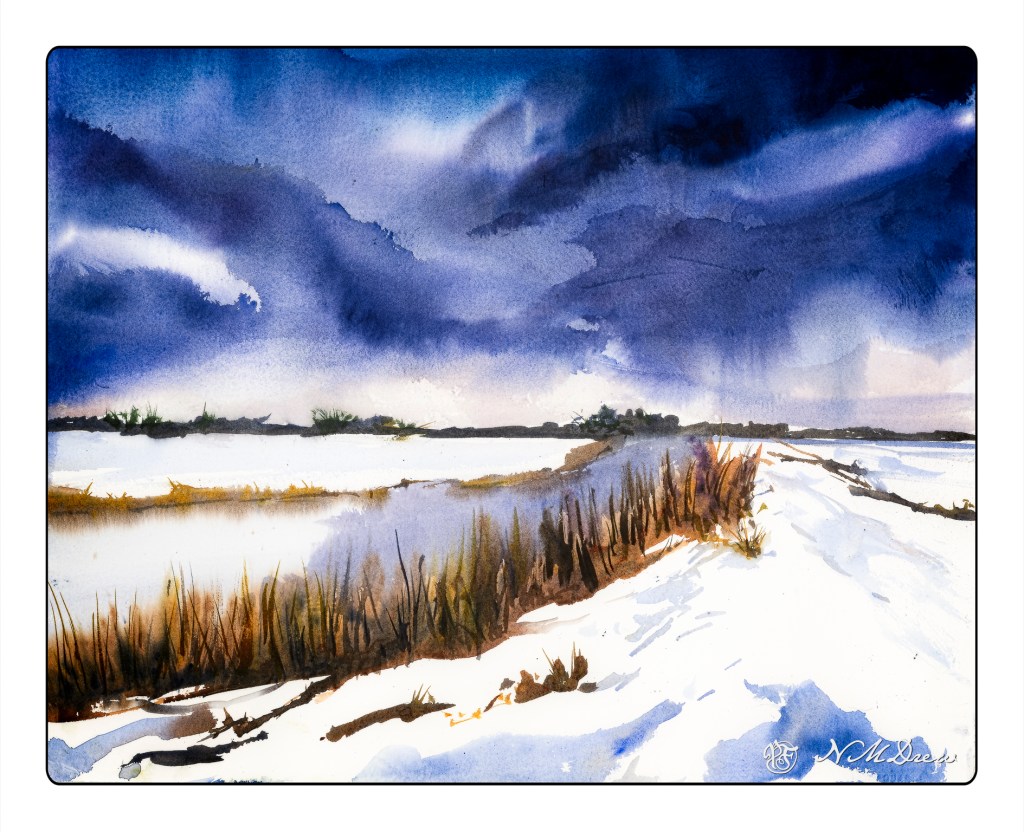
Along the Shore

It is always worthwhile looking at the works of various painters, regardless as the medium in which they are creating. The works of Edward Seago have a charm to them which is old world, peaceful, and hearkens to a quieter and simpler time. This painting is based loosely off one of his oil painting of the eastern English coastline. What attracted me was – and is – his vast skies. The low lying shoreline beneath such a magnificent sky is worth trying out. The same may be said of the watercolors of Edo Hannema – he, too, finds the work of Seago, and Edward Wesson, as sources for inspiration.

In Southern California, the sky, where I live, is almost always blue. No clouds, little haze. Humidity sits at zero. (I won’t discuss the vast amount of lotion I use!) However, the big skies of the midwest with towering clouds, or the piles of clouds over New Mexico, are in my memory, and so the clouds and moist skies of a wetter clime draw me.

Here, I used the 1.5 inch flat brush for 90% of the painting, resorting to a small flat brush – 1/4 inch – for some detail. Large washes, wet into wet, some glazing. Paper is Arches 140# CP, 16×20. The large brush is becoming a favorite for sure!

The large brush helps me keep my colors clean and think about masses rather than details. Big to small. I am also refreshing my water as I move along – this took about 2 or 3 refreshes – and cleaning off my palette, too. With a large brush, large washes, a lot of color is used. Clean palette, clean water, and, of course, a clean brush. The results are beginning to be seen.

Winter Storm

When I first started to paint in watercolor – like when I was a teenager! – the advice was to use a brush bigger than what you think you need. Yeah, right. Over the years, I have resisted this, but lately I have been doing the majority of my painting with a 1.5 inch flat brush. From there, different brushes with different ideas in mind.

Here, 16×20 CP 140# Arches. I sponged the entire paper with water and then set in the sky. From there, the water and grasses along the shore, working to get blurring of colors into the wet paint. Then, the horizon with the same 1.5 inch brush. I let it dry.

From that point, it was a matter of thought. Initially, the sky dried to a pale color, so I laid in more dark paint for the sky, using a spray bottle to move the paint around, and holding the painting by hand, tilted the paper this way and that to run the paint in various directions.

Looking at it upside down always gives a new perspective, sometimes good, sometimes not. I added some dry brush for the weeds, and used a wet mixture of blues for the snow shadows. I also painted a darker version of the same snow blue into the distant water, moving it into the weeds / reeds. Then, more dry brush once the water had dried to overlap the paint I applied.

This is a stronger painting than some of my more more recent ones, and I will credit the large, flat brush forcing me to work simply. It’s actually much more fun, and easier, in many ways, because I am not getting finicky to the point of crazy.

Progress is being made!

Over the Fence

Hanging Fruit
I went out for a walk shortly before the sunset, camera in hand, to catch the first of the spring flowers and to get the flowering pears in bloom before they fade. This lemon tree lives a few houses away, down the hill, and always hangs some fruit over the fence. I find it rather charming and cheerful – and luckily our neighbor provides us with lemons so I don’t feel any temptation to swipe . . .