The Free No. 5 or the Singer 66-1? – Part I

Because The Factory Dress is based on 1920s dress designs, I plan to use either my treadle machine or my 1920 hand crank machine. Both would be appropriate for the time period. Even if electrified, they would be fine, unless you didn’t have electricity.  I’ll hand sew when necessary.

I think it would be fun to give some background on both machines. The Free No. 5 is not famous, but the Singer 66 is. If you go to eBay and search “The Free Sewing Machine” you will find a lot of them for sale. Anyway, a treadle machine allows you to use both hands as you sew. With a hand crank machine, the right hand provides the power, not your feet. Today, we will explore a bit about the The Free No. 5 treadle machine.

The Free No. 5 Treadle Sewing Machine

The Free No. 5 is a knock-off of a Singer 127 vibrating shuttle machine. It is a full-sized machine, having an 8″ harp and a vibrating shuttle mechanism. ISMACS has a number of brief articles about the No. 5 and other models made by Free.

This video shows you most of the basic functions of The Free No. 5, even though the blurb under the YouTube video says it is NOT a No. 5, for all intents and purposes, it is. The model “No. 5” is not painted on the head, but the decal pattern is the same ans the No. 5, the sewing cabinet is the same, and so on.  If you watch the video, listen to the sound of the machine as it sews – I love it!

I bought my No. 5 about 20 years ago from a gentleman in Billings, Montana.  He shipped it freight and it arrived on my doorstep in pristine condition.  It was beautiful, and still is.  Being new to vintage machines, I did not realize it had a long bobbin.  In fact, it was the only long bobbin machine I had ever seen.  I thought all sewing machine bobbins were round!!  Well, eventually they evolved into roundness, but here I was, perplexed and frustrated.  Thanks to the internet, and especially YouTube, I finally learned how to use the vibrating shuttle successfully.  Interestingly, one of my closest friends told me she had grown up sewing on this same machine, but the Singer 27 version!

The story behind my No. 5 is, to me, so interesting.   This man buys and sells  household goods as a living, and this household was a prize.  The story itself seems rather incredible.  He found a household for sale, upstairs, downstairs, and in the basement.  The house was ca. 1920 or earlier, but had been seriously remodeled to the point that new flooring was put in, a trap door about 3’x3′ constructed over the former opening to the basement, and forgotten.  Only a skinny person could manage the staircase.  In he went to find not  only my machine, vintage  and pristine and barely used, but also antique Stickley furniture in the same condition.  How do you get such items out of a 3’x3′ opening?  You take it apart and carry it up the stairs.  The story, he said, was this machine was bought for the former owner who hated sewing – into the basement it went.  And there it stayed until the 1990s.

My machine has proprietary attachments, but it does take a 15×1 sewing needle – at least there I didn’t get a lemon.   I have a bunch of attachments, too, and original long bobbins.  The original bobbins are longer than the new ones being made and are quite nice to use.  Despite the length differences, the new ones work fine with a few tricks.

To be continued . . . .

The Factory Dress

I thought I was going to hand sew a flapper-style drop-waist dress. The sewing gods are in disagreement, saying yes to the 1920s and no to the flappering.

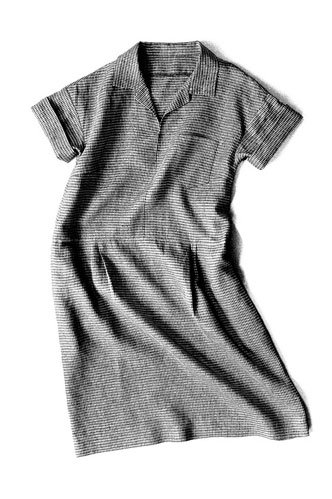
Several years ago I bought a pattern called The Factory Dress by Merchant and Mills, a British enterprise with designs I really like. There is an elegance to them in their designs that is understated, yet practical, like good-sized pockets! The fabric I chose for this dress is a cotton weave from Japan in a darkish color with white woven rectangles. (I’ll photograph this later.) I cut the whole thing out this afternoon. The question is, should I hand sew it like I was planning, or should I sew it by machine? Something to brood about overnight, as well as whether I should line at least the skirt.

You can find this image on their website, along with some variations.  Google “the factory dress” and you will fine even more!

Why a Ham?

Why not a ham?

This video shows you the reasons a tailor’s ham, aka a “pressing ham”, is a useful addition to your sewing (and ironing) wardrobe. I never used one until several years ago when I was on a super sewing binge. That’s when I really tried to improve my slap dash approach to something more sophisticated. While those attempts turned into annoyance, I have found my sewing and pressing aids really add to the pleasure of my sloppy sewing. Things are easier because of the shape of the ham.

And, I still sew, making shirts mostly, but now that I have more time than stress, I do want to make some more sophisticated clothes. Lately I have been wanting to sew a 1920s style dress, and am thinking of either hand stitching the whole thing. I think it would be perfect for summer. The ham will be perfect for anchoring my fabric so I can stitch on my project and put some tension on the fabric.    I may also find my ham useful if I decide to master handsewn buttonholes.

But that is for another time, like when I get started on it. And I really should get started on that dress, come to think of it. The solstice is less than 3 weeks away!

Homemade Ham

My life seems to becoming messier and messier since I retired. I have stuff all over the place or put away neatly and unfindable. Over the last three days, I have had appointments taking up the mornings, and then the afternoons have been filled with other things. When my routines are too unsettled, I get unsettled, and it seems like I just disappear. That introvert just evaporates with too many external activities and a sense of identity vanishes with it. Of course, this makes my chaotic retired life even messier. So, today I am determined to go through the house and put things away. Yesterday, though, I needed to make a ham.

Pork ham? Turkey ham?

Nope.

Tailor’s Ham.

Mine is missing, along with my clapper and sleeve roll. Neatly put away in a bag or a box, or out in the 5th dimension, or being hovered over with exquisite care by the Goddess Annoia.

I did a bit of research on patterns. There are actually a lot out there. YouTube has videos and google has oogles of them. Professor Pincushion on YouTube has a pretty good video, as well as a free pattern on their website that I used.

You can find the paper pattern here, but be warned, you do need to sign up for their free account. If you like their stuff, it’s worth it; I have found many useful tips and bits of information in their videos over the years.

Well, let’s begin. For the pattern, I used the one mentioned above. From my stash I found a piece of tightly woven muslin and a piece of tightly woven cotton flannel. Both are 100% cotton. Each piece was about 1/4 yard – just a scrap. Okay, a list:

    • 2 pieces of cotton material,  one muslin, one flannel, but use what you want – just make sure the fabric can handle high temperatures
    • sewing machine
    • thread
    • hand sewing needle and thread
    • filling material for the ham, also capable of high heat.  Some recommended fillings are old cotton rags, sand, sawdust, or hamster bedding.   (I used sawdust – called “Wood Flour” – which I bought from Amazon)

Easy steps to success!

    • Iron fabric.
    • Lay out pattern with 1/2 inch  margin around it.  I traced around the pattern pieces, marking the fabric with pencil.
    • Pin the pieces together, right sides together.  Sew around, leaving a section about 3-4 inches open for a hole for filling the ham with stuffing.  Back stitch by opening, and then run another bead of sewing around the  critter.   Trim and clip the curves.
    • Turn right side out.
    • Stuff.
      • I  propped the opening to the inside of the ham up with a toilet paper tube, and using a table spoon began shoveling the  sawdust into the  ham.  I felt like I was making goose liver fois gras, which did not feel especially good, but that is what went through my mind.  As I filled up the ham, I pounded and shifted the sawdust into place.  Toward the end, I used my fingers to push the sawdust in even more, changed to a smaller spoon, and continued.  I started at the dining room table, but soon moved outside, donning a medical mask as it was really dusty, and  continued the force feeding.  Finally, 15 minutes later, nearly all 5 quarts of the “wood flour” was gone, and my ham was fat, happy, and very solid.
    • Fold over the opening to the ham and hand stitch it closed.
    • Admire your ham.

This was a really simple project.  It took a couple of days to get my order in from Amazon, but that was okay.  I was too busy to worry about it and figured an afternoon would produce a most satisfying result, which it did.    If you look in the photo above, taken by me of course, you can admire my fine ham, toilet paper tube, and vintage Singer 403A sewing machine.

Hotter Than Hell, So I’m Gonna Sew!

I think it must be about 100F (38C) where I live, so the air conditioning is on and not going out until it is dark.  My dogs aren’t mad, nor am I a Brit, so I am staying indoors, drinking water, and prepping the Maggie Shirt . . . and I am sewing it on my vintage Singer 403a,

I think these machines (the Singer 400 series) date from the mid to late 1950s and into the early 60s.  Mine is like it was never used.  When I bought her, she needed some TLC, heat and oiling, as well as a bit of gear grease, before she was off and sewing.  Unused machines freeze up, but once they have been given the right attention, I think they are the best!  I’ve had my 403a for awhile, and as I cycle through my machines, she hasn’t been out for a spin in quite some time.  Time to put her to work!

There is something to be said for the old Singer sewing machines.  They are well made and pretty straightforward.  The ingenious attachments are fun to play with and many collectors are nutso for them.  I have some, but usually rely on my more modern machines for things like fancy stitches and buttonholes.  Nonetheless, this machine is a blast.  It has cams for stitch patterns – the #0 cam is required to do a zig zag stitch – as well as straight stitch.

The 403a is a member of the “slant-o-matic” series of machines Singer made.  I like the slanted needle – it pushes the needle more into your line of sight.  Many newer computerized machines have the needle tucked back under rather fat upper portions, so they are harder to see.  Still, that doesn’t act as a deterrent.  For the 403a, as it is a slant needle machine, it is important to have the slant-o-matic attachments.  The one I have is the professional buttonholer, but I also have numerous feet that came when I got the machine.

Click on one of the images to open up the slide show . . .

The first two images are of the buttonholer – just a quick picture, really. The first shows you the box with directions, the second is the feed dog cover plate. The 403a has a rather interesting system to remove the throat plate – it is lifted up by a lever and slid out. The buttonholer cover slides in to its place – kind of complicated until you get the feel for it. The last picture shows you the box of feet and cams that came with the machine. The manual shows you just how unused the whole machine was when I got it.

When I buy an old machine, I want one that I know will work.  I like them to look good and to run well.  Some people get off on restoring machines, and while I can work on most of my machines for general maintenance, I really don’t find it a lot of fun to try to fix an ugly, rusted, beat up machine that is covered with rust and has electricals of suspect quality.  Prima donna, yes!

Finally, here is how I spent a few hours this afternoon.  The gauze for the Maggie Shirt is soft and stretchy, as is the characteristic of the critter.  It is also very ravelly.  Perhaps it is a bit of overkill, but I decided to stay stitch (the straight stitch) all around each piece, and zigzag to finish the edges.  I may need to cut out another collar stand as it seems to have gotten a bit warped by all this attention, but I have an extra yard.  Never having sewn with gauze, I bought a bit more to play with and to be sure that I didn’t lose so much to shrinkage that I would not be happy.

To be continued!