Looking Elsewhere

Underneath

The visual elements of life never cease to intrigue me. Returning to painting – albeit more sporadically than I care for – reminds me of this. And this pulls into photography. Because I just purchased the Nikon FT-1 attachment for my Nikon 1 camera. I am now able to attach all my F-mount lenses to this small camera. I have a lovely older lens, an Elicar 55mm macro, which is capable of a 1:1 ratio. Given the crop factor of the Nikon 1, this multiplies my 55mm into about a 150mm equivalent.

Yesterday, having noodled around most of the day, I set up a vase of flowers and misted them with water. Then I started taking pictures. Even with LED lights, it was not easy to do because the light was fading, and I was outdoors. I needed my tripod. Nonetheless, I did get some good pictures. The bright colors were really satisfying – the pinks came out just beautifully, as can see in the picture above.

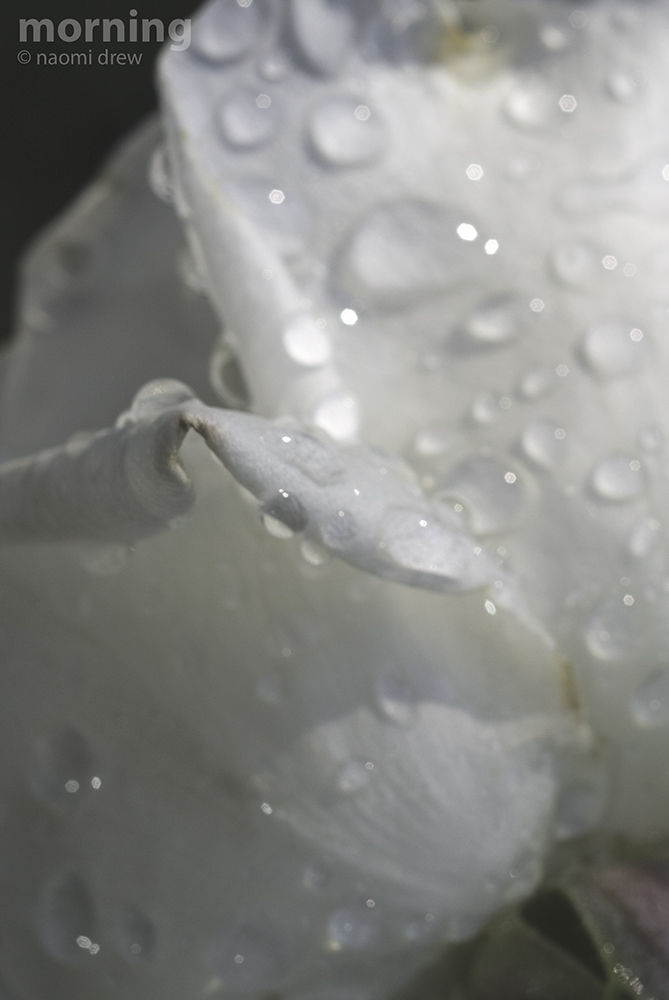
Using the same lens and camera, a few days earlier, after the sprinklers stopped, I took some pictures of my roses. Large water droplets covered the roses, and this white one, in particular, was really pretty. (FYI, it’s a Pope John Paul II, which is a mix of some white rose and Double Delight – and it has a lovely fragrance.)

I like the abstractions of macro photography. Getting into that secret, hidden world normal eyesight does not detect, is fascinating. Minute details become incredibly beautiful. And, it produces a new way of seeing, creating the desire to look more deeply. An intimate view of the world so easily overlooked.
Morning

Life Magazine – A Retrospective

I grew up with Life magazine – from it I saw the world as it was, not as it was supposed to be.  I learned history, about current events, about war, love, drugs, hate.  This magazine epitomized America for 36 years.  This video from BBC 4 is too short – but says so much.

A Day in Zombie Wood

ZA 4

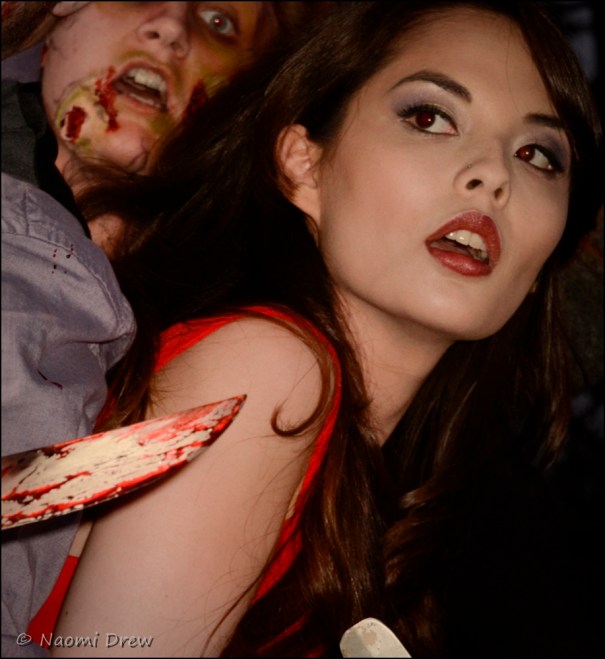
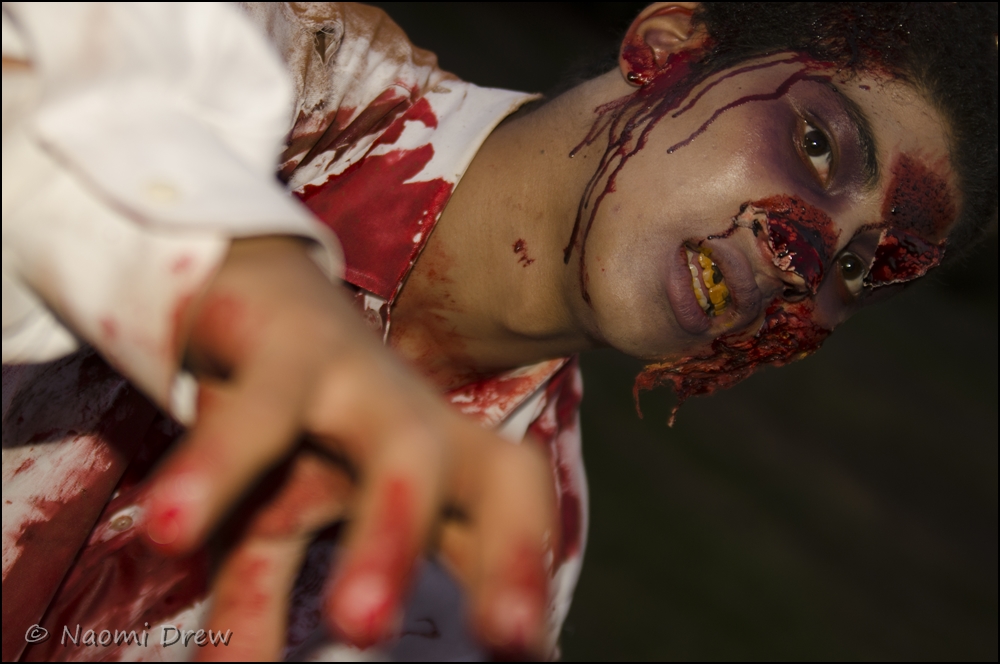
There is a meet-up group in my area for photography.  They have had a number of photo shoots, complete with models, make up, and outfits.  A friend of mine has been to nearly all of them, and says each time he goes, he learns something new.  I’ve been meaning to go, and finally made the commitment for the Zombie Apocalypse shoot.  And, it was worth it, not just because of the phenomenal make up jobs, but because of the people there – all so very nice!

ZA 12

An interesting thing occurred while I was shooting – suddenly, behind the camera, I was envisioning the picture I wanted before I shot it.  That has never happened before, and I cannot help but wonder if this means that I “know” enough now to have an artistic vision.  Shooting was a very fast process – those zombies can really scamper around – and that is when all of this visionary stuff began.  Compositional elements, seeing everything as it occurred, and anticipating what might occur.

ZA 21

Before I got to the zombies, I was photographing the young lovers, and while that was not quite as much fun, it was certainly a worthwhile endeavor.  It proceeded at a slower pace, because they were sitting at the picnic table.  At first, they were a bit stiff, but soon enough got into their roles as they became more used to everyone sticking cameras in their faces and telling them what to do.  That direction-giving probably helped to move them into their roles.

ZA 9

Layers

OnOne Perfect Photo Suite 7 is a rather fun program.  Coupled with the book by Nicole Young and training videos from OnOne University, some of the power of the software becomes apparent.

First of all, I am really a novice with this program, and, indeed, with many more sophisticated programs.  Photoshop eludes me, and I am okay with Lightroom, but only because it is pretty easy to putz through.  Layers, though, are another story.  I get the concept of layers quite readily, but how to produce something using layers is the challenge.  This is one reason why I decided to pick up Perfect Photo Suite 7 – it isn’t over the top with what can be done, but provides a really solid set of tools for neophytes.

I began the book at the beginning, reading the first chapter, Getting Started, and the second one, Perfect Layers. I also watched a video or two about layers, and the results are below. For each, I took two pictures, free from the internet and from my own portfolio. I found skies, and put them into the other image by brushing out or in, to show or hide, the underlying layer. Kind of confusing at first, but I got the hang of it.

Layers 1

Layers 2

The above two images worked out okay, and I played a bit with different available in the Layers module. I tried the different “bugs” – they look great, but I need to practice more with them. There are some limitations that I can see, but I expect with experimentation, the bugs, with multiple layers, can be quite powerful.

Layers 3

This image uses Layers, and then the addtion of Effects. If you look closely, you can see that my erasure of the sky was not very good – there are streaks in the clouds! Important point.

So far, I think that Perfect Photo Suite 7 will be very useful. Certainly easier than Photoshop, and probably an excellent starting point. Nicole’s book is clear, but I think some samples of how something is done, with images to use and modify in a step-by-step sequence, would add to the overall strength of her book, and certainly aid the new user in grasping how things are done.

Vision

I have been pondering just removing this blog from the blogosphere, but haven’t done that.  I have been ignoring it because I am not so sure that it is going in any direction right now.  I am going in some directions, but not necessarily the ones that created the impetus for its existence.  The result is something of a conflict, because I have been “doing” photography for a bit, and ignoring other things I really love.  The fact is, though, photography gets me outdoors more and more, and I have forgotten how much I like that.  Not outdoors at the mall, but outdoors in the wilder parts of town (i.e. places with trees and plants, not crazy drunks!).  Suburbia is sadly lacking in open space at times, and that means actually taking time out to travel and drive somewhere to be outdoors.

On the other hand, photography also means packing things to lug along.  I have always been a minimalist in hobbies.  I don’t like to need a ton of stuff to do anything, but often photography seems to require a few things more than I really want to haul around.  The trade off, though, is producing things that are better than just okay.  I also think I have reached a point where I have a fairly good handle on some of the technical aspects of photography, along with more thought about composition and light, and not just running around pointing and shooting everything I see.

In a nutshell, I have reached a point of dissatisfaction with photography.  That is interesting, don’t you think?  For me it is.  What this means that I am now at a point where it is necessary to push past the do-able to the less do-able.  This may mean making advances in technique.  It also means advances in creativity.  At this point, photography is rather boring.  Sitting at a computer to post process a picture is horribly boring – but useful.  Even that, though,I prefer to keep to a minimum.

For me, the most frustrating part of photography is that it is not as manual as I would like it to be.  Simply put, I like working with my hands.  Cameras are not especially complex when it comes to pushing a button . . . there is not a lot of finesse, as there is in painting.  It is different.  On the other hand, I do get outdoors and crawl around in the bushes.  That is kind of fun.  And I don’t do that when I paint or knit.

The question, here, is what is my vision as a photographer – person – artist – human?  Perhaps by defining my artistic vision I can open the elusive.

So, let me make a start . . .

I want to find the essential and the beautiful in the world around me, whether in nature, in a person, or in an object, whether simple or complex.

Bull?  Let’s see where it goes.