A Tale of Three Paintings

Over the last week I have been painting the same image three times, each time in a different media.   I began with gouache, moved to pastels, and did the final painting in watercolor. Doing such an exercise was really educational as well as pleasurable.
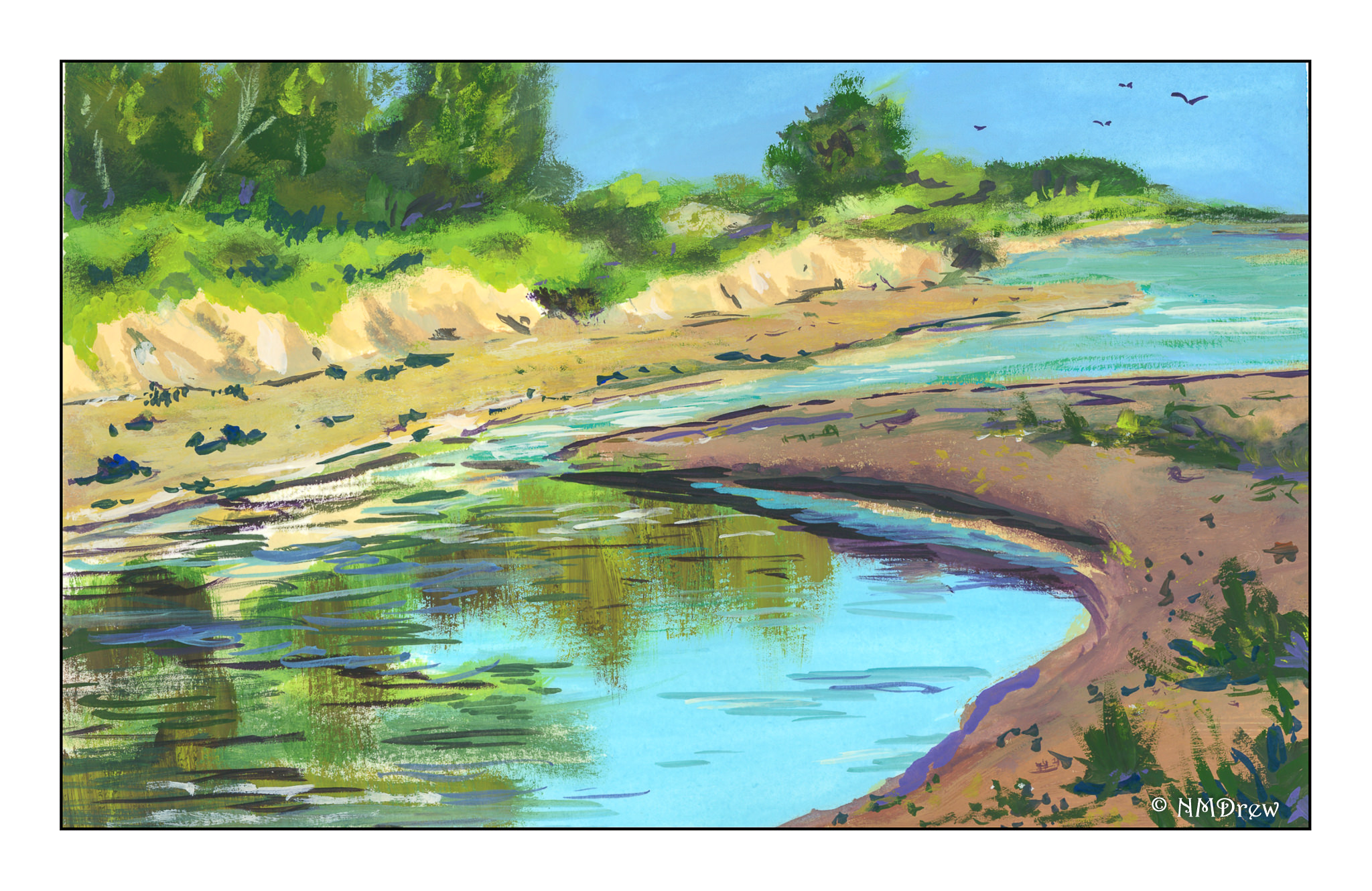
As you can see in the gouache, the perspective is totally off! I didn’t do much of an underdrawing, just a few quick lines, but I didn’t really check this point against that, as well as compare it to the photo. The result was an uphill beach, and a total lack of realistic perspective. I suppose it would look like htat if my head were on its side, lying in the sand or something! Anyway, it was a good lesson as I realized most of my perspective issues are simply the result of poor drawing techniques.
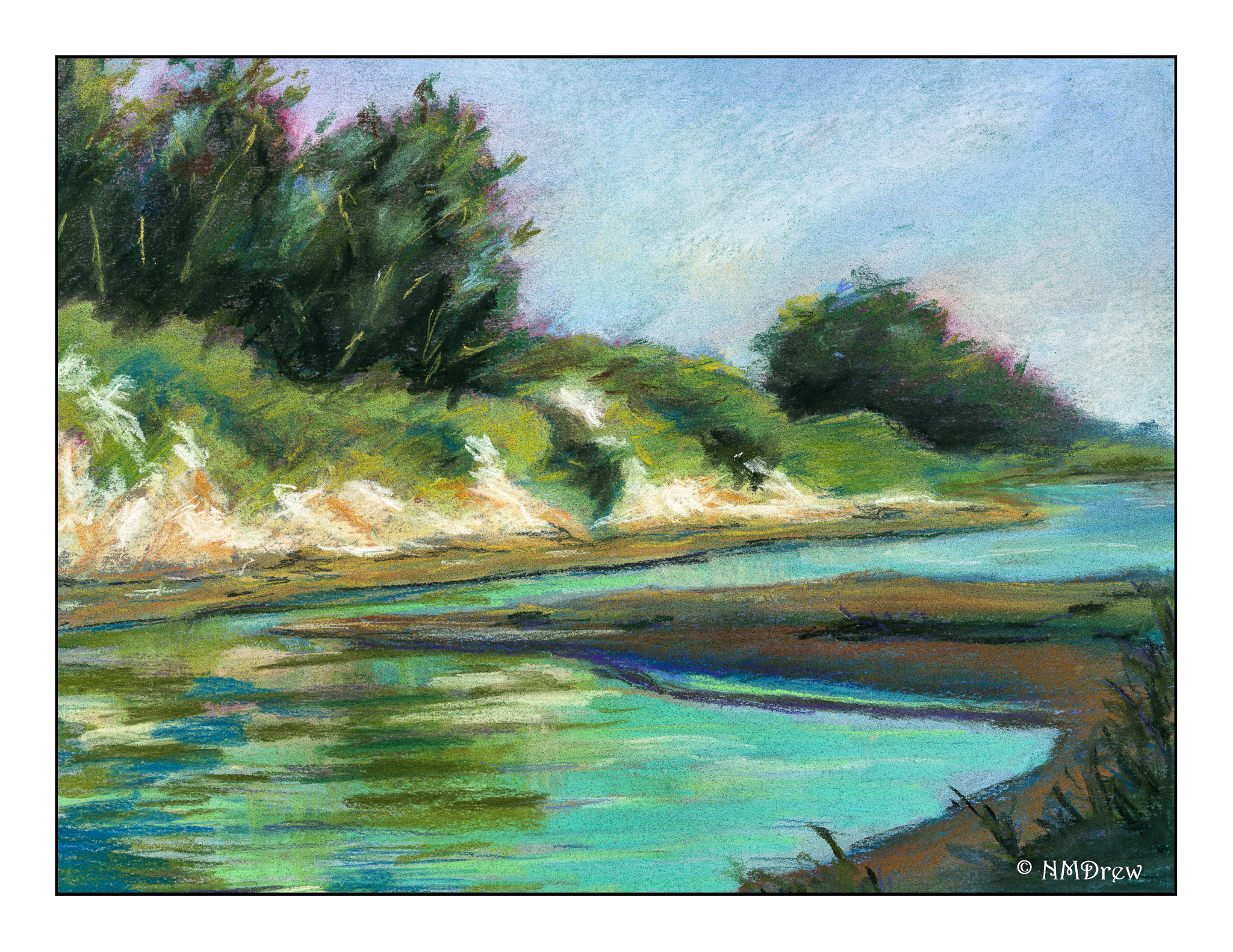
This next one is my favorite. Maybe it’s because I am just learning pastels and totally in love with them. Here, the perspective problem is solved. The cliffs look quite sandy in the picture, and in reality, they are. Along the coast where I live in California, cliffs tend to be friable, made of highly compacted but still fragile sand. They easily collapse, and it is really foolish to sit under them on the beach or to walk along there edges. After rains it can be especially dangerous, and one year a major landslide occurred and several people died. It was not good. So, I think these cliffs are pretty accurate representations of what our cliffs look like here.
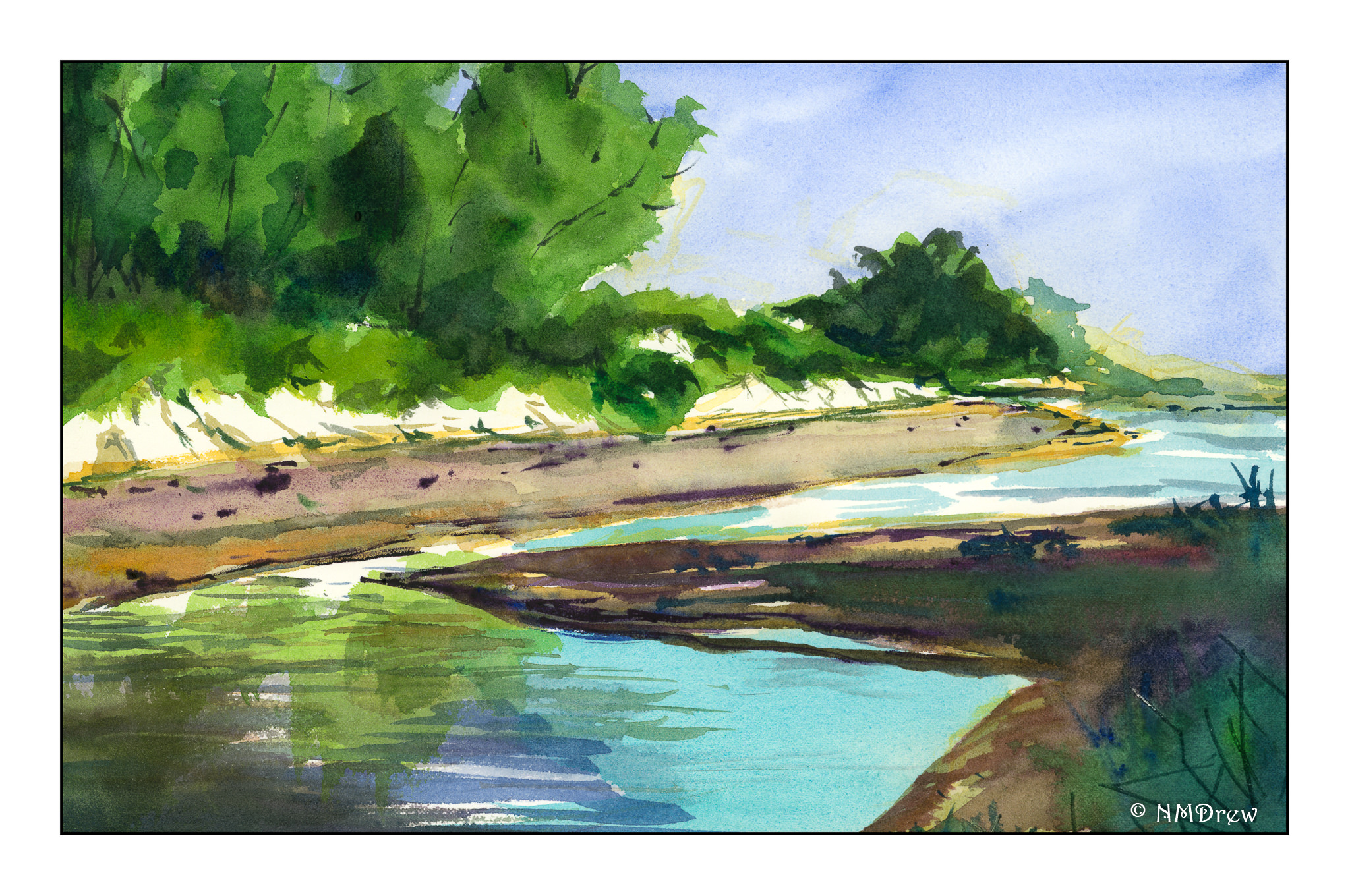
Finally, watercolor. Perspective issues remain resolved, but a sense of distance prevails along the strand of beach on the opposite shore. Rather than overwork it, I left it as it was, still pondering how I could make a sense of distance as the beach veered off to the left and background. More blue? Less detail? I’m still befuddled on that one.

Altogether, using three different mediums to paint the same image was rewarding. Problems occurred in all paintings, many of which could be applied to others. Perspective is always an issue for me, so I really need to focus on it probably more than anything in landscapes. I know the rules, but need to find methods to implement them. Gouache and pastels are more forgiving as you can paint over what is underneath to a reasonable degree; watercolors are pretty much a one-shot deal. I think I will continue the 3 painting studies in the future as I learned far more than if I had only done one study in a single medium.

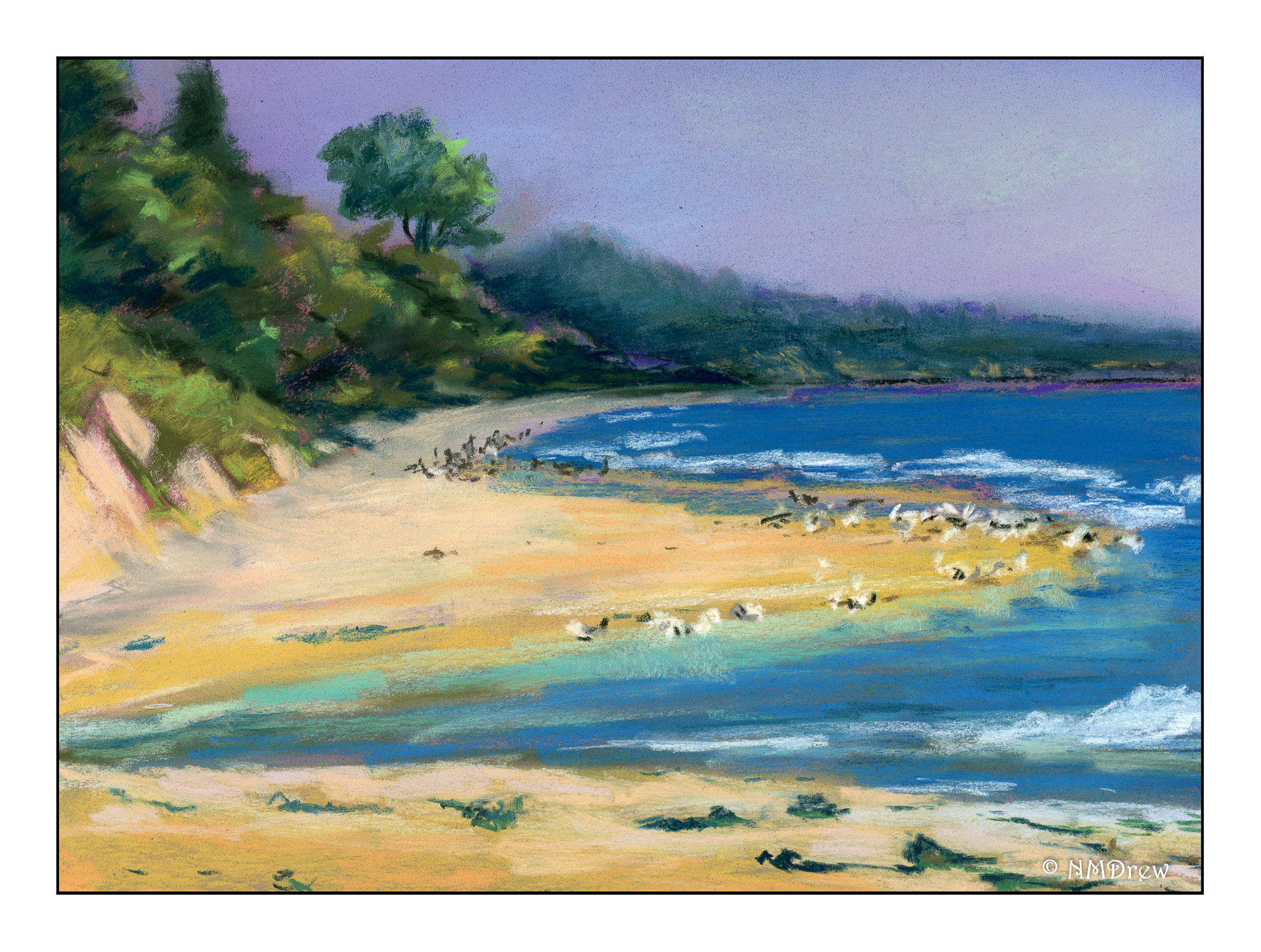
The Slough II (Pastels)

A second rendition of “The Slough, II”, this time in pastels on Mi Teintes 9×12 paper.  Perspective is fixed, and I like this version so much better!

The original “The Slough, II” was done in gouache a few days ago – you can see it in my earlier post.  That version was totally wackadoodle in the world of real perspective – the only part that worked out was the front curve of sand, whereas the midground and background didn’t work.  Fraggy (another blogger!) had some good insights about the issues.

In thinking about Fraggy’s comments as well as reviewing what I did, I really have no excuse.  I just did a very, very poor drawing on the paper, sort of sketching things in without checking their relationships.  So, today, I worked on the drawing a bit, and the result is much better.  I considered vanishing points and straight lines, et cetera, et cetera.

I really feel so at home with pastels.  My only complaint is that the end product is easily smeared, even with the use of “final” fixatives.  I need to research that a bit . . .

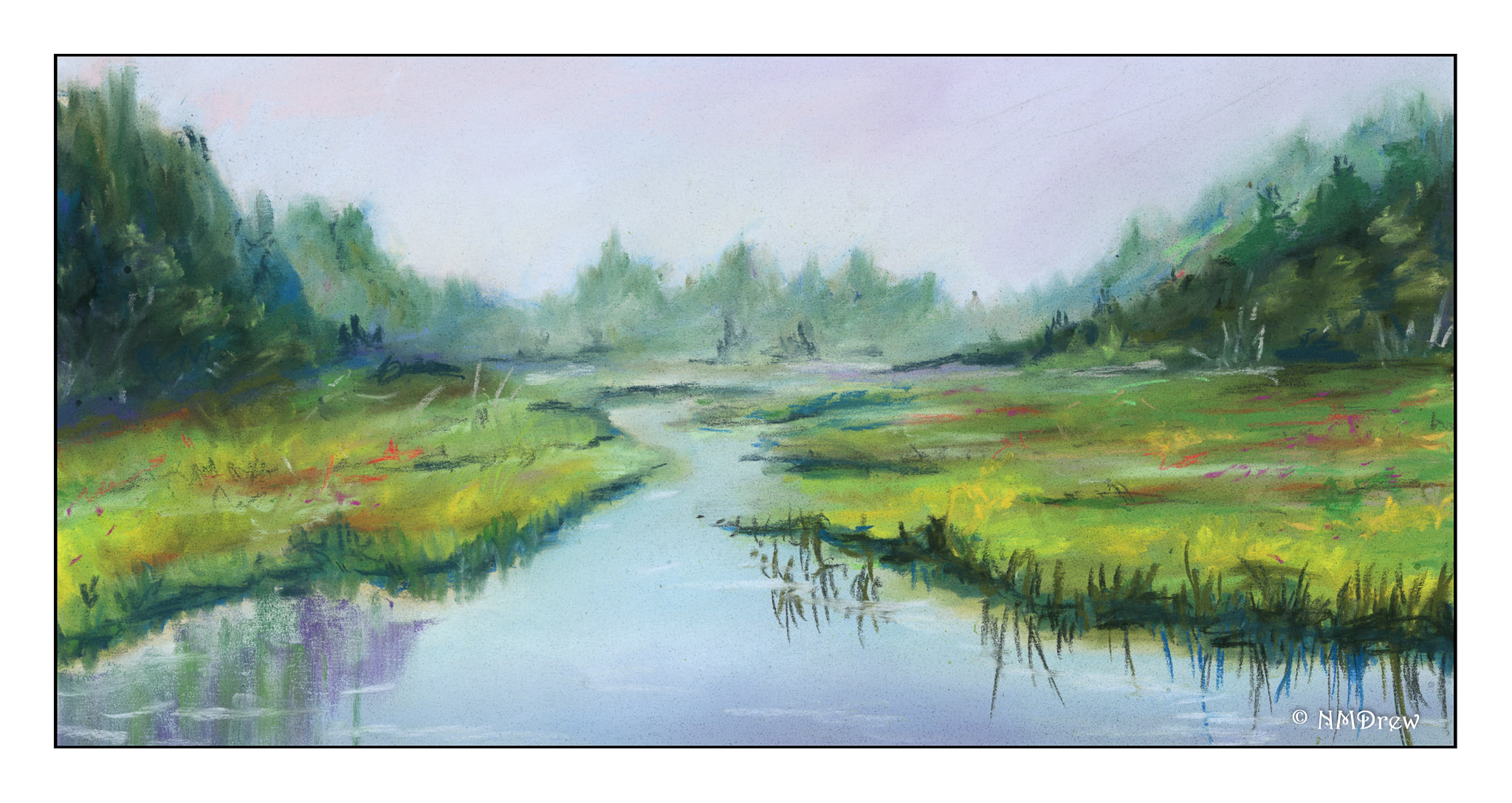
The Slough (Pastels)

I have been busy sewing masks for friends and family, and it’s been a slow process, taking a lot of time. However, I am back to my determination to paint or draw something every day, either in the morning or in the afternoon. As I had an appointment this morning, I used this rainy, rainy afternoon to paint the Goleta Slough. Or part of it. Generally speaking, I rather like it – all those little dabs of white, grey, and black are seagulls and other critters. The sand jutting out needs to be fixed – seems like it is riding upward or something, but …. ?

Lavender Field

Pastels are getting to be addictive.  Unfortunately, this scan for some reason came out a bit too yellow-green, but I wasn’t interesting in putzing with it!

I tried a few different things here – in particular how I made marks.  Vertical and horizontal to contrast.  Obviously the lavender is vertical and tilty, but in between, horizontal helps create some interest.  The trees I used a torchon to scumble and blend the colors, as well as push shapes into the sky.

I know I am getting addicted to this – I just ordered a roll of Uart 600 grit sanded paper – 56 x 10 yards.  That should last awhile!  This was done on a 9 x 12 inch bit of Canson Mi Teintes, which is a very nice paper, but unsanded.  I like them both.

Northern Marsh

Still working in pastel.  I cleaned up the pastels I was using yesterday by putting them in a container of corn meal and shaking them gently.  It did the job.  I also took a different approach to today’s painting, and the difference is evident to me (cuz I did it!).

I decided to use a piece of 7×11 Uart 800 sanded pastel paper, which is the finest grit in the Uart series.  I bought a sample pack a while back, and now that I think I get how to use pastels fairly well, I thought it was time to begin.  Having cleaner pastels also helped.  I also decided to work from light to dark this time, like a watercolor, and it seems to have been a bit more successful.  My colors were getting rather muddy in the last one.  I also did not apply any fixative to the painting until it was done.  In the others I had used workable fixative between layers.

Overall, rather a bit more pleased with this pastel painting than yesterday’s.  It was more pleasant to do, probably in part because I simplified my approach.  Working light to dark – putting in the sky and water first – may also have helped.  The Uart 800 sanded pastel paper was really nice, too, and gave a nice smooth finish as the paper has a very fine tooth to it.  I used a final fixative on it, but I am still unsure how many layers of final fixative are to be used.

Now, time to attach sleeves to the sweater I am knitting!