
Summer’s End

Somewhere I remember reading about a “rosy dawn,” but today’s rosy dawn is because of the fires burning in the San Gabriel area in Southern California. Yesterday as I drove home from Ventura, the billows of smoke from more than 80 miles away could be seen piling up in the sky, much like a volcano’s ash and smoke as it travels upward. This morning, the air is thick, and ash is falling on the streets in very fine particles.

The entire state of California is very vulnerable to these fires, which are part of the eco-system, and the fact that we have had a drought for several years, makes massive fires a very likely probability.

Where we live, we are in a valley surrounded by mountains. So far, we have not had anything major since moving here nearly five years ago, but I wouldn’t be surprised if our time will be soon. So many things can cause a fire, from a spark from electrical equipment to a bird on fire after hitting a power line (yes, it has happened), that you just don’t know where it will occur. You just need to be ready. Fires and earthquakes – a fact of life in California.

This week, our very good friend, Jerry, and his wife, Raka, have been here from Japan. They were married a year ago, and only now is their wedding reception being celebrated by their friends and family in the U.S. And, their first child is on the way! It is so good to see them, and wonderful to have the time to visit. They return to Japan tomorrow.

For me, the end of my all-too-brief summer holiday is winding to a close. I’ve had a few weeks off from students and school, but I still have had to deal with them even though I have tried to keep it to a minimum. We all begin again on 1 September.

I am also becoming a student again. Now that I have finished my teaching credential, the brain finally has time to pick up Japanese once again. I’ve tried different routes, but nothing seems to have been successful. I tried a community college class two nights a week while working on my credential. Beret Patt - First PageToo much work on all levels. Another time I tried a language class offered through a local adult school, but did not learn anything. Now I am trying to do it once more, this time through the Oxnard Japanese Language School. As the course meets state high school language standards, I expect it will be much be more to my liking. My class is for beginning adults; there are five adults, and seven kids, the youngest of whom is thirteen. Once we all settle in, I think it is going to be a lot of fun.
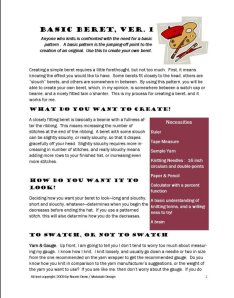
Finally, I’ve written down a very windy “how to” for making your own beret. Take a look at it. The purpose of this “Basic Beret” pattern is to help out the beginning knitter trying to design a hat. You can find the file on Ravelry, or here on the Pattern page, or under the heading of “Matataki Designs” to the right.

Old Vines Scarf: Pattern & Process

Friday was a really big day for me!  I decided to post to Ravelry, and to here, my first “pay for” pattern.  It is the that I wrote about last March.  You can find it on the “Patterns for Sale” page.  Please give some consideration to buying this pattern!

Writing up a pattern takes some time, as does creating the knitting schematic, shooting the pictures, doing a layout, and finally creating the PDF file that goes along with it!  It really is a major process, far more than I anticipated.  And the thing is, the item has to be knitted before you can photograph it.

I used Knit Visualizer for the pattern schematic.  It is a fairly expensive piece of software, but it is really worth the price paid because it is so easy to use.

My camera is a Casio Exilim, and I can get pretty decent pictures with it.  My preferred settings are with all 9 sensors being used, along with soft flash and a +1 light setting.

For the PDF, I begin in MS Publisher, and then create the document using text boxes, clip art, my photos, and Knit Visualizer schematics saved in a PNG format, and then imported to Paint Shop, and saved as a JPEG.  Once I am happy with my Publisher file, I save it, and then, beginning on the first page, I “save as” and create a PNG file.  Finally, I use Acrobat Pro to create the PDF by choosing “create PDF from multiple files.”  My preferred PDF is “highest quality” for better detail.  It works very well.

Photos are really odd creatures.  You think you have a good one, but you don’t.  This is why I love digital pictures and software.  Cutting, editing, whatever – all can be done pretty readily.  Fonts and so on are also important, for headers, subheads, and content.  Everything needs to work well together.  The direction of a model in the layout leads the eye in, or out, of the page.  Busy-ness is distracting.  Too-much-of-the-same, in density and visual rhythm creates a visual yawn.

Anyway, there you go.  Here are some of the more than 40 pictures I took for the photo shoot.  These were some I liked, in addition to the ones you will find in the Old Vines Scarf pattern itself.

Yarns of the City – 27 August 2009

Village Spinning & Weaving

For the fiberholic on a road trip through the central coast area of California – north of Santa Barbara – the Village Spinning and Weaving shop is a must-do. This summer, John and Marsha, the proprietors, celebrated their eighteenth anniversary in the same place by being able to more than double the size of their store by expanding into the retail area next door. When Josh and I visited them in June, they had just broken through the connecting wall.

Some of our closest friends, Stephanie and Jay, were living in Solvang at the time Village Spinning opened. Stephanie is a full-time weaver, and I primarily a spinner/knitter – of course this was heaven for us! And Solvang is always good for a lazy day or a short trip if you live nearby, or need cookies or chocolate or cutlery, or you are on your way to the wine country. (I recommend the large cookie boxes at Mortensen’s Bakery, Ingeborg’s Chocolate, and Nordic Knives, if you need to satisfy some other vices.)

Anyhow!

As you walk in the main door – which will probably still be the only entrance to this fiber wonderland – you enter the current store, filled with yarn, fiber, weaving supplies, looms, spinning wheels, roving, bats, books, dyeing supplies, knitting needles, and on and on. You want it, they probably have it. (Notice, I did not say “need“!)

Getting extra space at Village Spinning & Weaving will benefit everyone. The new space has a lot of lighting, both natural and installed. All this will allow better display of looms and spinning wheels, which is really important if you want to check out how an item looks, or feel how a wheel spins. There will be room for knitters. Some lucky group will get to sit around the fireplace, but the sunny windows are not a bad place to be either. As you can see below, there is a lot to look forward to – at least there was in June. I hope they are all moved in and ready to go!

The service you get at Village Spinning & Weaving is wonderful. And they have a lot of stuff – dangerous! This is what they say on their “About Us” page:

Solvang’s Village Spinning & Weaving Shop was started in 1992 by John Novak and Marsha Mullaney-Novak. This shop grew out of our desire to simplify our lives and provide the best possible service and products — something we find lacking in much of today’s world.

Whether you are looking for a new loom or some cochineal for dyeing or maybe a new tatting book, check here or give us a call.

We carry much more than we can possibly list here, so… we have several different print catalogs – you can download a pdf file from this website for many of them. As things change, sometimes too quickly, prices in our printed catalog may not always be completely up to date.

John and Marsha are very knowledgeable about the products they sell. Inventory includes so many books you think you have died and gone to heaven, wheels to test drive, looms both large and small. John takes a lot with him when he does shows such as the Black Sheep Festival, Stitches, or Convergence. Many of you may have met them at one of these events.

For those unfamiliar with Solvang, it is a small town off the 154 and 101, about 30 miles north of Santa Barbara. The Sant Ynez valley is a beautiful place, and as you come over San Marcos Pass into the valley on the 154, the view is breathtaking. This valley, toward Santa Ynez, is where the movie “Sideways” was filmed.

I’m looking forward to my next trip to Village Spinning & Weaving, to see how the expansion is going, to finger fibers, play with wheels, peruse books I have never seen. My pocketbook may suffer a bit, but it sure is worth it!

See you there, and tell ’em I sent ya!