I will leave you to ponder what Scalzi writes – and strongly suggest you Scalzi’s post in its entirety by clicking on the link above or anywhere on the quotation below:
The end of the year is here, and a strange year it has been. For me, it has not been a big change in the life I have been living since I retired, but if I were still working, it would have been a big change indeed. For so many others, the world just turned upside down, and not just in the US, but globally.
I feel like I am living in a bubble, but now, the walls are beginning to tighten closer to home. A few people I know have died, some from the virus, some from other issues, but the isolation necessary to keep from becoming infected means not being able to say goodbye or to spend time with others, or even help out if needed. I am of an age where my peers do die, which is just normal, but it is also sad when connections other than a Zoom or a text are not available.
I miss a good cup of coffee and chit-chat at Peet’s! I miss looking people straight in the eye and laughing or getting a hug.
As a result of needing to limit contact with the outside world, a trip to the market is like a major outing. People to talk to! I had my teeth cleaned a couple of weeks ago and it was like a spa day. Yacking with my sister and brother, especially this time of the year, brings back memories from days of yore. Just reading about the thrill of a vaccine – at last – for the Covid-19 virus and the reactions of parents in the 1950s to the polio vaccine is reliving history – so many things to be glad for because of research and science. Little things, big things – our lives are simple, complex, unpredictable, repetitive and dull – but all of these are the fabric of how we define ourselves and our world view. And, we need to find time to think, reflect, be grateful for those around us and our own individual selves. Connections all.
For some reason, while not the dreary parts of Hamlet’s soliloquy, I keep returning to the words:
What piece of work is a man, how noble in reason,
how infinite in faculties, in form and moving,
how express and admirable in action, how like an angel in apprehension,
how like a god!
And that is where my world lies – amorphous, strange, exhilarating, unknown – a fragility to be cherished in the here and now.
Sung to the tune of London Bridge is Falling Down:
Back to prison we must go! We must go! Back to prison we must go, oh dreaded Covid!
As of this writing, 85% of California will be back on lock down. More than 50% of the state’s population is in my neck of the woods, specifically Southern California, and it begins at midnight tonight.
Regulations are designed to reduce the spread of Covid-19 as well to prevent a lack of ICU and hospital beds occurring.
I don’t find our restrictions so draconian as other places, nor are they as restrictive as when the first lock down began last spring. These are restrictions we can live with as we are not changing our lifestyles all that much. The only difference we have is a lack of family gatherings or a beer or coffee with friends. That makes it socially . . . isolated. Social isolation helps and hurts, as we all know.
California state mandates have fine details, which should be read, to get more informed information about the okay and not-okay. For instance, the newspapers are saying that households cannot mingle, but the state website, when I type in my county, states:
Small private gatherings
Are allowed outdoors only with modifications – Masks and physical distancing required – No more than 3 separate households attend (including the host’s) – Gatherings should be 2 hours or less – Those with symptoms must not attend – Those at high risk of severe illness strongly encouraged not to attend – Singing, shouting, chanting, cheering, or exercising strongly discouraged
So, we could have a family Christmas gathering within specific parameters; however, I expect if we have one, it will be very, very small.
What I do not understand, and I would think this way even if I was much younger, is a failure to realize that this is not about me, but about us, meaning the good of everyone. I wonder if this is a characteristic of the American culture, this rugged individualism and selfishness. Do other countries experience this defiance of the collective for individual “rights” which endanger every other person? I expect so, but it seems that a failure to show consideration for others is more and more in the public eye, from the self-aggrandizement of “leaders” to ICU nurses bragging about flaunting safety outside the workplace.
Whatever the situation, we – my household and extended family – will embrace these restrictions for our own good and the good of others. If we stay healthy, we help others stay healthy.
For me, color is an excessively important part of my visual world. I see colors before I see people or things. I think in colors. From there, reality intrudes and I can identify what is around me. Because colors are my primary draw, when I paint, mud has often been the result. Learning to separate colors and learn how one color works with another in painting has been, and continues to be, a difficult lesson for me. My emotions want the color, but reality is that all colors do not create better ones. Thus, “patience, grasshopper”!
According to Wikipedia:
Impressionism is a 19th-century art movement characterized by relatively small, thin, yet visible brush strokes, open composition, emphasis on accurate depiction of light in its changing qualities (often accentuating the effects of the passage of time), ordinary subject matter, inclusion of movement as a crucial element of human perception and experience, and unusual visual angles. Impressionism originated with a group of Paris-based artists whose independent exhibitions brought them to prominence during the 1870s and 1880s.
If you know your art history, Impressionism was ground-breaking and revolutionary. Smooth blending and invisible brush strokes gave way to a different sense of light and its workings on the world seen by the artist. As with all things, evolution occurred, and from this first rebellion against the “acceptable” art of Europe came other schools. A direct off-shoot is Pointillism. Color still is extraordinarily important, but instead of “impressions” being important, the usage of pure color became more distilled. According to Wikipedia:
Pointillism (/ˈpɔɪntɪlɪzəm/) is a technique of painting in which small, distinct dots of color are applied in patterns to form an image.
Below is a short, clear video about Pointillism, its derivation and its influence.
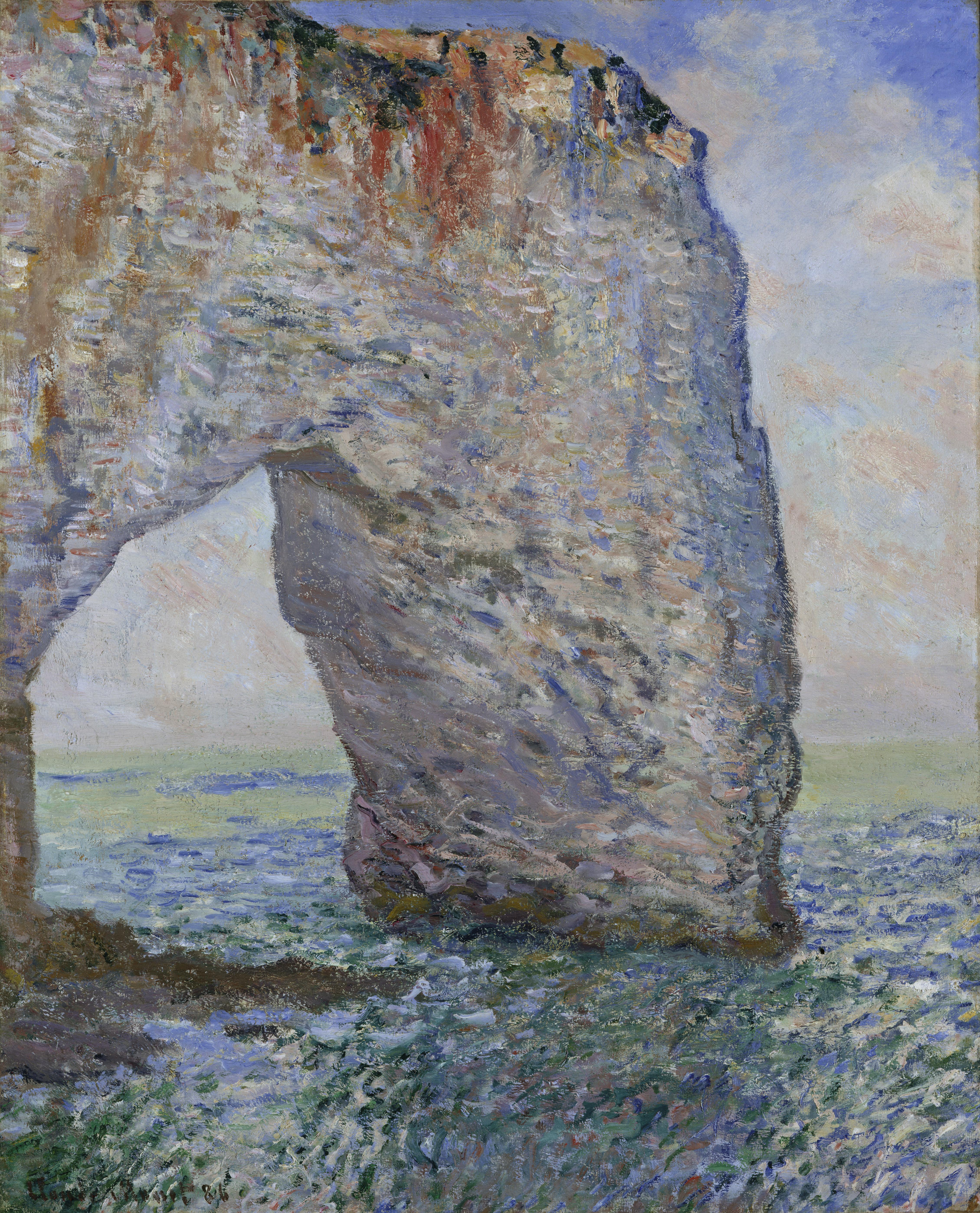
What does this have to do with me? My need to work with color successfully requires a certain amount of intellectualization and rational thought about color – how color works, how colors interact, how Cobalt Teal reacts with Quinacridone Gold, and so on. I find breaking down colors into individuals before combining them helps. So, I decided to turn to the works of Monet and his studies of the ciffs at Etretat. I looked at several Monet studies, but I will use this one in particular:
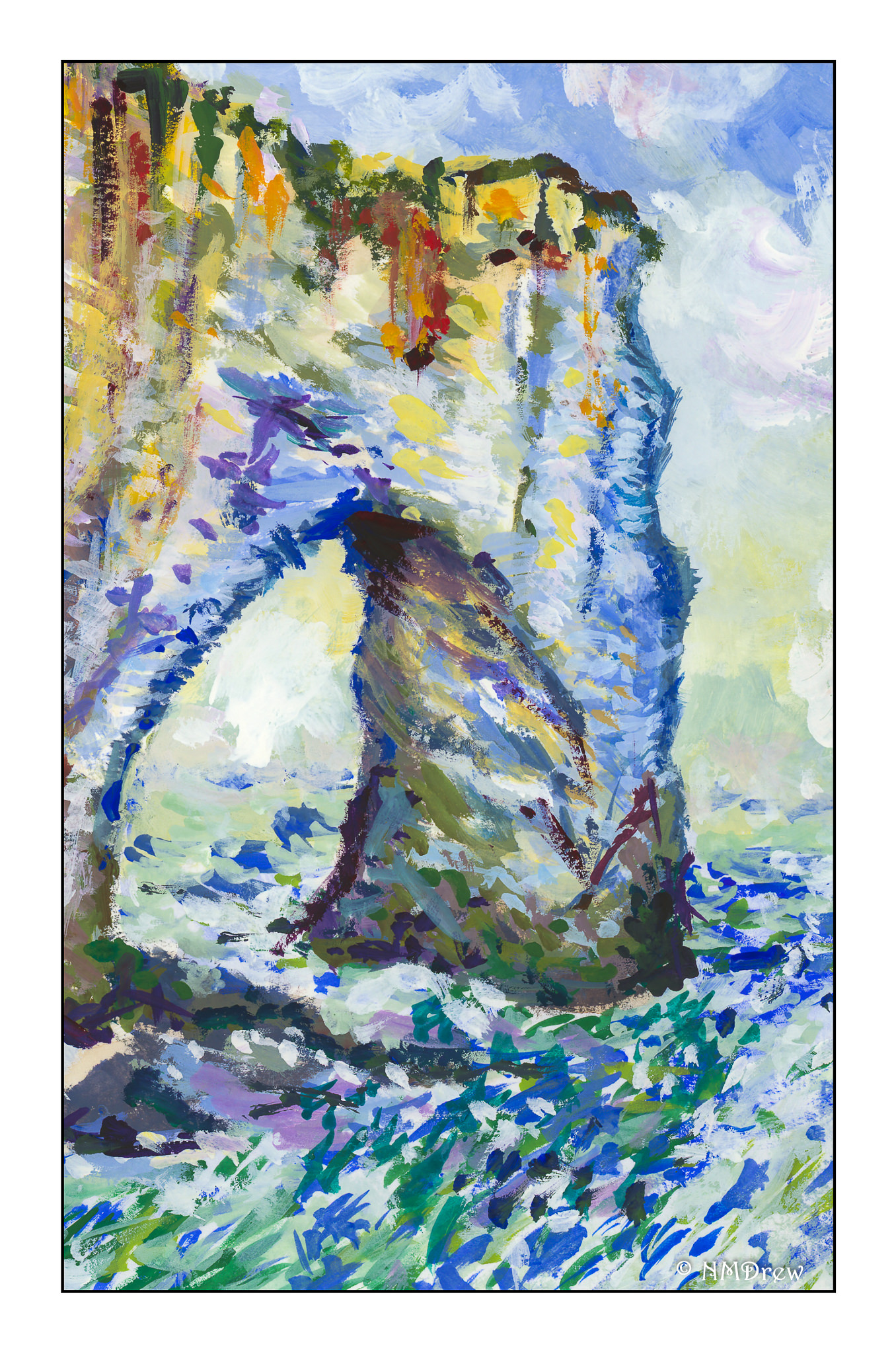
And here is my interpretation of it:
Obviously, my colors are more intense, but the impact of light on surfaces was the focus. After a few “Monet studies” I realized that this was not quite was what I was looking for. I knew of Georges Seurat but do not care much for the start graphic quality of his work. Exploring other Pointillists, I remembered Paul Signac, and it is here that I found my current muse.
Signac’s works vary from graphic and sharp to blurred and “painterly” (for want of a better term). His more purely Pointilistic works have an energy and vitality I prefer to Seurat’s – more modern, more attractive, and more elegant in composition. He also works with the precepts of Pointillism, but still in a more Impressionistic way. I did my first Pointillistic painting by painting a detail of this painting by Signac, Cassis, Cap Lombard:
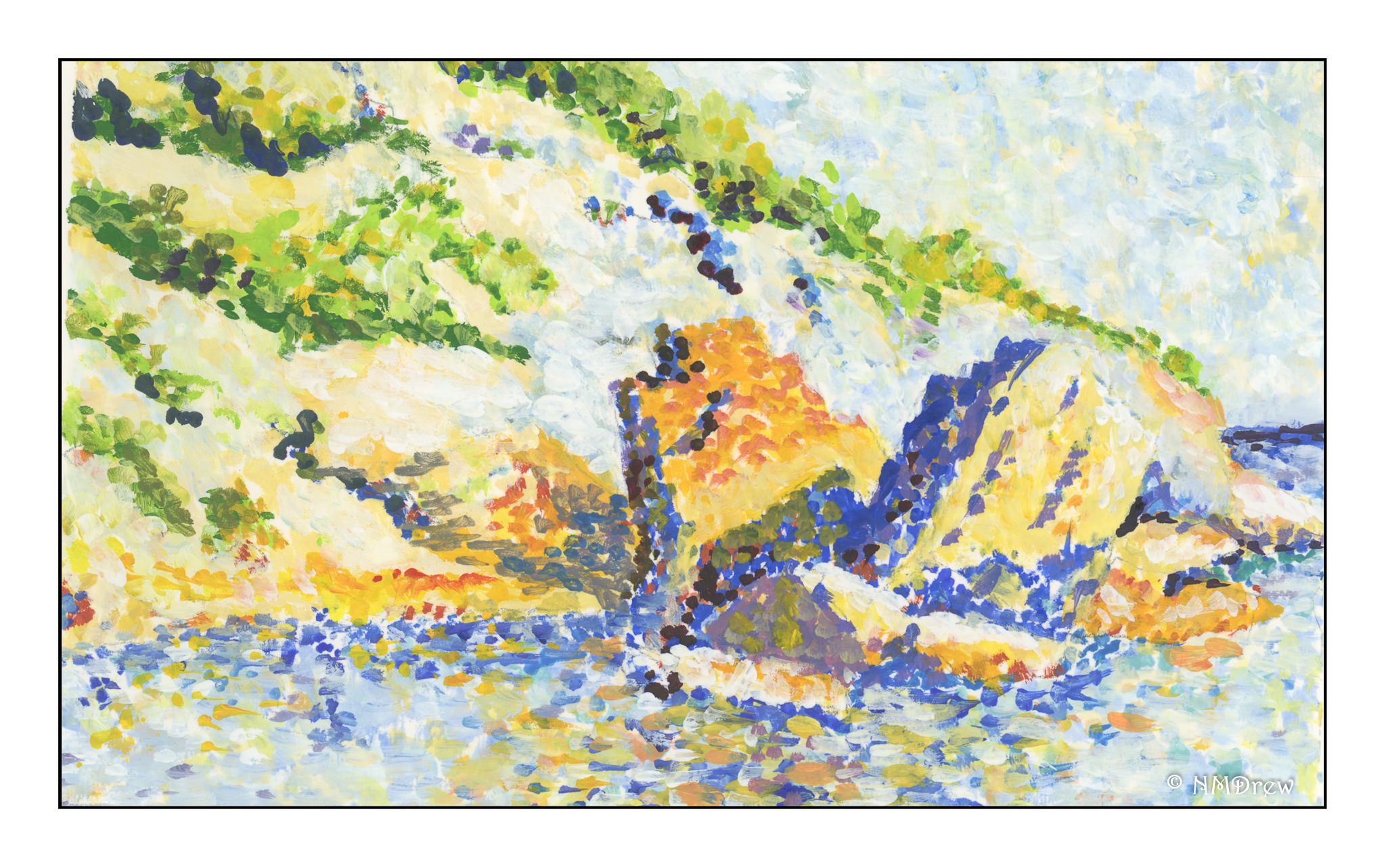
I took a small section, enlarged it, and painted a detail of it without following the exact structure of Signac’s painting. If you click on Signac’s painting above a couple of times, you can enlarge it, and find the blues and oranges together in the shadows, which I studied and used in my sample below. Additionally, I studied both warm and cold blues and oranges to get a sense of the temperature of the painting, but I will admit at this point I am rather befuddled and cannot describe my observations
My goal was to look at the usage of color, in particular, the juxtapositioning of colors. In the stones along the shore, and in the reflections in the sea, you find blues and oranges, complements of each other, in play to create light, shadow, reflected light, and reflections seen in the lap of the waves.
Did I succeed? As far as color usage, yes, to a degree. In doing this study I also learned about making a Pointillistic painting. I began with just dots and soon learned it took forever! So, in further studies, I laid in the primary background colors in given areas and then applied the dots. I am working in gouache, and so I can blend colors into each other on the paper to create new ones since artists gouache is never permanently “dry” unless sealed. Gouache is the perfect medium for this, but I can also see the value of acrylics as each layer can dry and then be painted over without dissolving the layer beneath. The other beauty of gouache is that it is an opaque medium and so painting over other colors can be done, unlike watercolors.
More studies will follow using the principles of Pointillism, and I know that I will evolve into my own methods. Copying from the works of a master is a time-honored tradition and an important part of any student’s learning, no matter the field. Such practice causes one to think, analyze, and apply; it is from this one learns.




 Ink, Yarn & Beer