A Gansey for Autumn

The summer is winding down, and my last two days off work lie ahead.  I have not done much painting as my interest in the visual arts is currently on photography.  On the other hand, knitting, while not prolific, has been steady.  I have been working on a gansey in Rowan’s Felted Tweed for the past several weeks.

The design is sort of original, and sort of not, as it is based on a gansey pattern design by Beth Brown-Reinsel‘s book Knitting Ganseys, specifically the child’s gansey “Snakes and Ladders,” which is pictured on the cover of her book.  I’ve expanded the stitch count – I’m no toddler in size! – and have decided to make it more in the EZ style, with raglan sleeves, and possibly a placket opening in the front or a boat neck, just because in California a high-necked sweater would be too hot for me.

It’s been quite a while since I have made a sweater.  Admittedly, Josh’s sweater fell to the wayside – it was too, too boring.  I needed a brighter color, and texture.  I purchased the Rowan yarn several years ago, but had no idea what I wanted to make out of it, so of course it sat around.  The color is one of my favorites, a rust color or what some might call a spiced pumpkin color, as it is not a deep rust, but more the color of autumn leaves which have not completely faded.

Designing a sweater takes a bit of work!  While the design itself was essentially there in Beth’s book, I needed to expand on it.  In the end, rather than a 6-stitch snake cable, I upped it to an 8-stitch cable.  The bar sections (7 rnds. of stockinette with one rnd. of purl) became 10 stitches.  I thought I had it all set up, and then as I was knitting realized I had not taken into account the fact that centering of a pattern section was critical for success.  Duh!  Once that was solved, though, the body proceeded nicely.

I have finished the body to the point where I am ready to add sleeves.  I am about 2/3 done with the first sleeve, which is knitting up amazingly fast, and I am enjoying the simplicity of the overall sweater pattern quite a bit.  As with the body, the sleeve took a bit of thought, but is going along quite nicely now that I have completed the increases.

It always feels good to see progress on a project – especially after frogging a major sweater elsewhere!

Rye Bread


This is a delicious rye bread, made in the French tradition from a recipe found in The Breads of France by Bernard Clayton. It takes time to make this bread, but is time well spent. It begins with a sponge, which ferments and imparts a wonderful flavor to the final loaf. If you want to make this a lighter loaf, use more white flour, and if you like the taste of dill seed or caraway, do not hesitate to add them to the final product.  I would do it after the sponge has risen, before the first rise.  This recipe is based on Mr. Clayton’s Pain Seigle recipe, with some modifications of my own.

Starter
1 c. dark rye flour (I used Arrowhead Mills Organic Rye Flour)
1 packet active dry yeast (Fleischman’s)
1 c. warm water

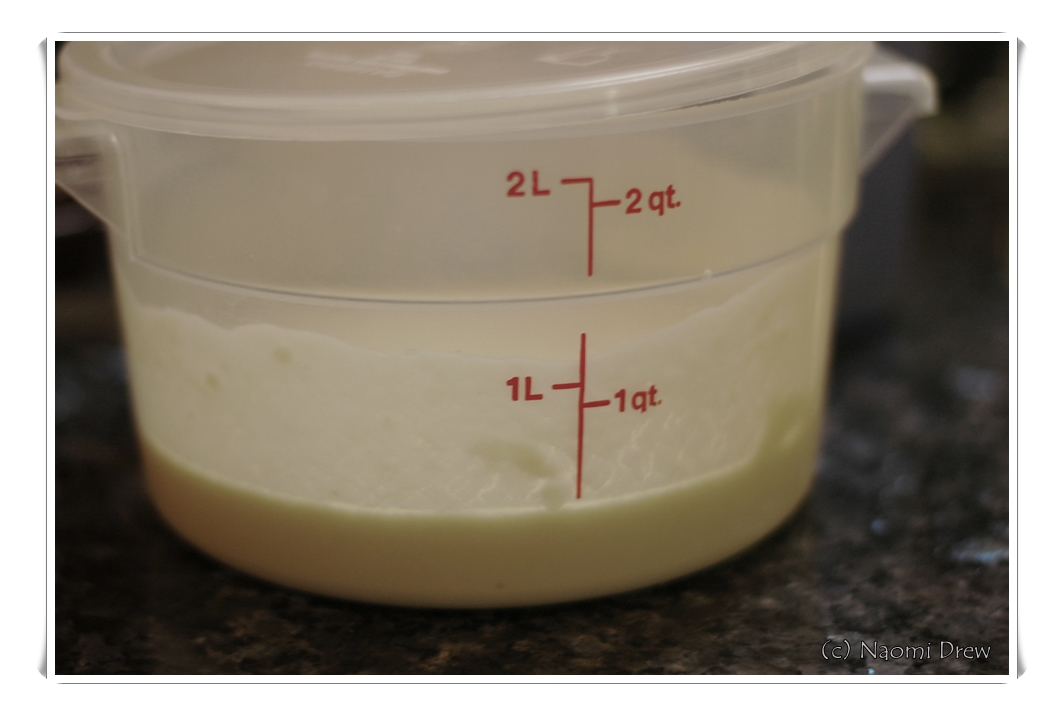
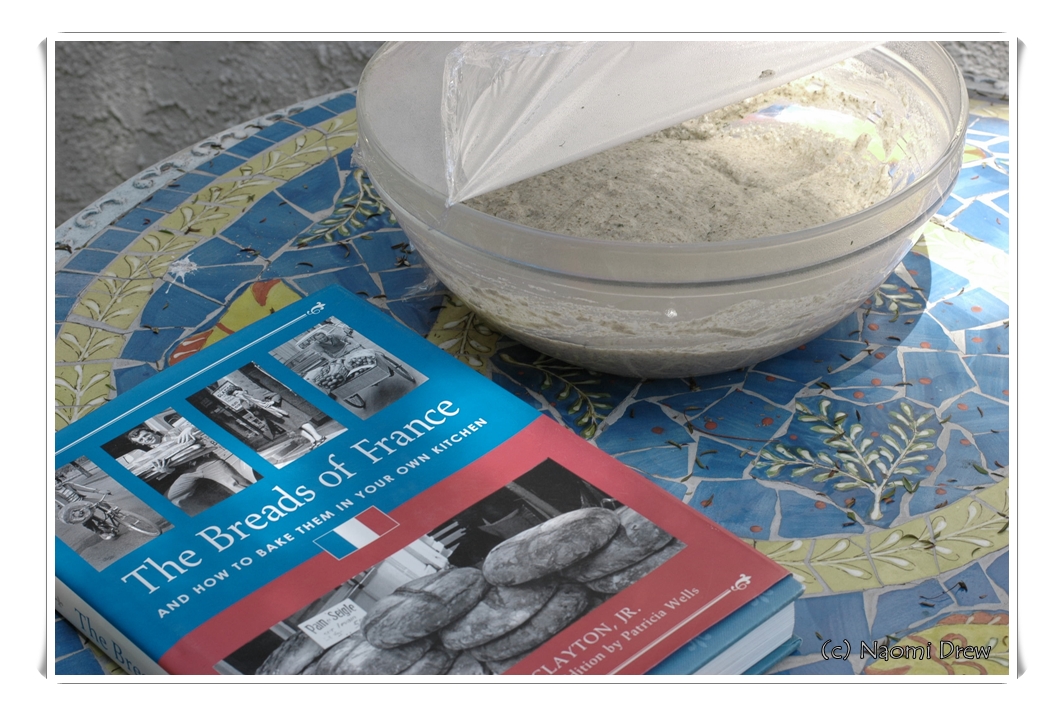
Mix all ingredients together in a bowl. Cover with plastic wrap. Let ferment at least 1 day before bread baking day at room temperature. I set mine outside one day in the sun, and it developed a lovely sour smell. I then let it ferment two more days, so on Day 3 I made my bread.

Sponge
1 1/2 c. warm water
1 c. rye flour
1 c. unbleached white flour (I used King Arthur’s Bread Flour)

Add all the above to the starter, stirring all into starter thoroughly. Add any seeds you might like – caraway, dill, or mustard. Let sit for at least 8 hours before making dough.

Dough
1/2 c. warm water
1 tsp. salt
2 c. rye flour (I used the rest of the small bag of rye flour I had boughten)
2 or more c. unbleached white flour, and more for the bread board when kneading

Pour sponge into large bowl. Add 1 c. of each flour, stir in. Add rest of rye flour. Dough is slimey and wet, but mix in the best you can. Dump out onto a floured bread board – be generous with your flour! Get out a spatula or dough scraper to help slap this wet mess into shape, incorporating more flour as needed. Begin to knead dough, adding more flour until dough is firm, no longer slimey, and does not break into wet spots. Do not over-add flour, as you want a firm but soft dough. Too little flour and your final bread will be rather flat.

First Rising
Shape into ball, then place into greased bowl, coating dough with oil in bowl. Cover with plastic or damp towel and let rise 40-60 minutes.

Shaping and Second Rising
Plop dough out of bowl and back onto a lightly floured bread board. Flatten a bit to remove air bubbles, then shape into another ball. Divide ball into 2 or 3 sections (see picture – I cut mine into thirds for small loaves). Shape into balls, pulling dough into smooth surface on top. Place onto baking sheets sprinkled with corn meal or lined with parchment paper. Cover loaves with waxed paper and let rise another 30 minutes.

Getting Ready to Bake
About ten minutes before the end of the second rise, preheat your oven to 400 F, making sure that the rack is in the middle of the oven.

Mix together a glaze of 1 egg yolk and 1 T. or more of milk.

Take a very sharp knife and slash the tops of the loaves, or make slashes on the outside of the bread. This will create nice visual texture and allow the bread to rise during baking without cracking too much.

Make a mop out of a paper towel, or use a pastry brush, and use the egg-milk glaze to cover the tops of the loaves.

Baking
Set timer for 22 minutes. Place bread in oven. When timer goes off, turn the baking sheet around 180 degrees, and reset timer for another 22 minutes. When timer goes off a second time, pull out bread. With a hot pad, pick up loaf and tap the bottom of the bread. If it sounds hollow, it is done; if not, put in for a few more minutes, and then tap again.

When bread is done, place on wire racks to cool, uncovered.

Notes
This bread freezes well. I made 3 small loaves just in case we got tired of the bread. So far, only one is left! This is great for small sandwiches, with sweet butter, or cheese.

For a first loaf, this is a bit of a challenge as rye bread dough is slimey and wet, and really does not develop gluten like whole wheat flour does. The addition of the bread flour increases the overall gluten content of the loaf, letting it rise a bit higher, but if you were to make a loaf of bread with 100% rye flour, it would be heavy and dense, but incredibly delicious!

I Want Bread!

While in Portland, we went to a bakery for a quick snack before going down to Powell’s Books.  I picked up a loaf of rye bread for the other half – and for myself, I admit.  Good rye bread is a favorite of mine.  I never had “real” bread until I left home, where Wonder Bread was the norm; once I did, though, I could appreciate bread and understand why people raved about different breads.

I am settling back into life in California.  With still a week off before returning to work, the desire to create and work with my hands is overwhelming.  So is the taste for good, fresh food – something we totally enjoyed in Portland.  Given this, I dug out The Breads of France, by Bernard Clayton, an author I adore.  Pain seigle, a French rye, is one of my favorite recipes.  The sponge is set up, outdoors in the sun, to begin its ferment.  It has celery seed and dill weed added to it.  I have let it set for two or three days, but at least 12 to 24 hours minimum will suffice.

Josh started a sour dough which we will add to the sponge, just to see what a sourdough rye might taste like.  The sourdough starter will be used later, for other breads.  Did you know that the yeast cake at the bottom of a fermenting cask also can be used to bake bread?

The thought has crossed my mind it might be fun to bake our own bread for the next several months.  It could be fun to explore each recipe in Clayton’s book.  Then I could attack his other, bigger bread book . . .

Water & Beer

Like I said earlier, there is so much water in Oregon it seems illegal, especially to someone from Southern California where rain is a rare and welcomed experience.  Yesterday we set out from Portland to the wilds of Multnomah Falls and the backwoods of Hood River, home of the Full Sail Brewery and other places of interest.

Leaving Portland – a big city to me! – and heading out along the 84, the buildings of the area soon give way to the inevitable trees and brambles.  The landscape changes, too, from hills to more rugged terrain formed by volcanic action and the relentless activity of the Columbia River.  Moss grows on everything.  Trees and rooftops have moss on them.  Vines trail into every space.  Flowers dot the open fields with pink and white and yellow.  Everywhere I look there is greenery and water, and clouds as well, which can be very different than the unrelenting blue of the sky where I live (unless there is a hurricane in Baja).

We stopped at the Multnomah Falls enroute to Hood River, Oregon.  The falls are narrow, but drop from a great height into a rocky pool.  The fact that this area has been set aside has allowed the natural vegetation to take over, and it is well worth looking at in detail.  The red cedars that grow here are graceful trees – all covered in moss! – and are interspersed amongst deciduous trees and viney undergrowth.  The dampness of the area is apparent everywhere, and provides a lushness for plant life.

We wandered up the path to the bridge – built, not in a WPA project like I thought, but in 1925 – and a bit beyond.  Around every corner were wonderful views, and too many people, but the latter did not really distract that much; that is something to choose whether or not to focus upon.  I took a lot of pictures, sometimes holding up traffic, sometimes having to wait my turn, and thankful for the camera strap as I leaned out here and there!

From Multnomah Falls we continued on to Hood River, which houses many different breweries, the most well known to us being Full Sail Brewing.  Like many breweries, they offer a sample tasting of their beers, and a variety of meals in their restaurant.  Staff were friendly, and the food was delicious.  We also took a tour of their facility, which is small, but very modern, and boasts some very unique characteristics.  One example is the fact they are employee-owned.  Another is their history – how they got started is an amusing story.  The equipment to produce their beer is very modern and high-tech, but their beer, despite the multitudinous gallons produced daily, is still made by hand.  Yes, 1000 lbs. of yeast is a lot – far more than what Josh pitches – but there are also a few tons of barley and hops in the mash tun!

Hood River is on the Columbia River in Oregon.  Across the river is Washington State.  It is a small town, nestled along the river and tucked into the space between the river and mountains.  When we were there, it wasn’t a hoppin’ place, but it was clean and friendly, and the views were spectacular.  This could be a great place to live, I think!

Travelin’

First View of Mt. Shasta

We are off on a road trip for the next few weeks!  It is so exciting to “get out of Dodge” and see other parts of the world, familiar and new.  The morning of the 6th is when we slid out of town, stopping for a fast food breakfast just because we could.  And then out to the I-5 to head up to Chico to stay at our favorite place there, the Goodman House Bed & Breakfast.

I always enjoy the drive up to Chico.  There are so many changes in the landscape on the trip.  Where we live, in the suburbs, we move into the congestion of Los Angeles to connect to the I-5, and from there drive through the craziness of the Grapevine, only to end up in the vast expanses of the Central Valley.  This valley is one of the most productive areas in the country for crops, ranging from rice and cotton to stone fruits and nuts.  Unfortunately, with the drought of the last few years, irrigation has become a problem as water is becoming more scarce and more stringently rationed by the state to farmers.  Some crops require more water than others, which means some farmers suffer more than others.  Fruit and nut trees take time to grow, as do vines, while other crops may be seasonal.  I wonder, though, what the future holds for us as the planet continues to warm – what can we do as far as sustainable food production with more drought-tolerant crops?  Some farmers are blaming it on Congress and the Democrats – there were signs posted along the roadside saying “Thank Obama and Congress for another dust bowl” or something like that.  These days, water is power.

That said, the San Joaquin (another name for the Central Valley) is impressive!  The closer we got to Chico, the closer the hills came, and the more the crops became fruits and nuts.  Orchards never cease to draw my eye; I love trees, and lines of trees are endlessly fascinating to me.  Chico is a college town, with a state university in its midst, as well as the famous Sierra Nevada Brewery.  Walking around Chico is very pleasant as there are tall, old trees lining so many of the streets.  It was rather sticky and muggy, but still worth the bit of sweat we worked up just to be able to enjoy another city.

At the very top of the Central Valley along the I-5, you move into mountains formed by volcanos, the most famous of which is Mt. Shasta.  To me, that first look at that snow-covered ancient volcano is awesome – snow in the middle of summer, pointed, and unlike everything else around it.  That, to me, tells me I am moving into new territory.