Karelian Pies

Karelian Pie

Years ago I met a young Finnish woman named Sirkku, and she made what she called Karelian Pies.  I’ve never forgotten them, but never really knew how to make them.  What I do recall is that the filling was a buttery, creamy rice – unlike anything I had ever tasted before – in a rye dough square that had finger prints on the edges, and was turned over, corner to corner, to contain the rice.  I thought they were absolutely delicious.
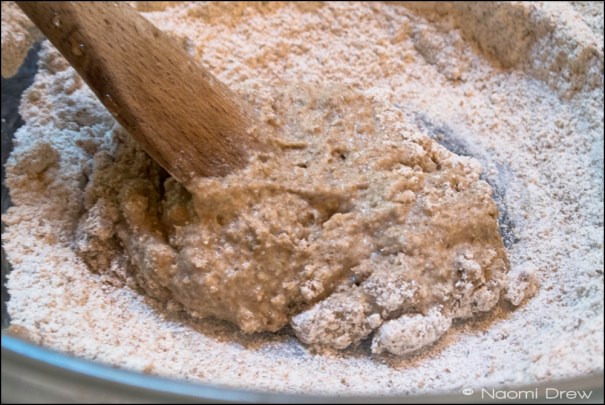
Mixing Flours and Water

Move ahead to the days of the internet and instant gratification.  I decided to look them up, and came across this recipe for the pies at Tofu for Tea:

Karelian pies (makes 12-14 small pies)
120 g rye flour
30 g plain flour
1/8 tsp salt
120 ml water
190 g white rice (she used sushi rice, I used Arborio)
500 ml milk
1/2 tsp freshly grated nutmeg (optional)

If you don’t have a scale, try to keep the portions similar for wet / dry ingredients.  Luckily, I do have a scale, and it worked out nicely.  Use Google to get equivalent non-metric measurements.
Choose a good dark rye flour.  Bob’s Red Mill is one I use for all sorts of baking, and it is always really tasty.  Other brands exist – see what is out there.

Rye Flour
Sift together the rye flour, plain flour and salt in a bowl, or use a whisk to blend the flours and salt.  Add the water to the flour by making a small well in the middle, and stir with a spoon as you pour the water into the well.  Dough will be soft and moist (and I think would be great for crackers!).
Mixing Flours and Water
When all is combined, mush the dough together into a ball and transfer to a board dusted with flour.  Roll the dough into a tube, cut in half, and roll out until long and thin.  My final dough looked like two long tubes, each about 14 inches in length, and about an inch in diameter.  Divide into 12-14 pieces.
Tubular!
Sliced and Ready to Roll Out
Making sure you have plenty of flour on your hands and the board, roll the sliced tubes into balls.  As with pie dough, it is really important to work with a lot of flour, and dry hands.  Flatten each ball slightly, and with a floured rolling pin, very gently flatten the balls into oval shapes.  Flip the dough over after 3 or 4 rolls with the pin, and never put more pressure on the edge of the dough with the pin – you want a light touch.  Spread the dough out from the center to the edges until it is about 1/8 inch thick.  Transfer to cookie sheet lined with parchment paper.  If the dough gets smooshed into the board, or sticks to the rolling pin, scrape it off, and roll it into a ball.  Before reworking it into a flattened shape, remove the sticky dough left on the board or the pin, and redust everything with flour.
Rye Dough Balls
Rolled Out Dough
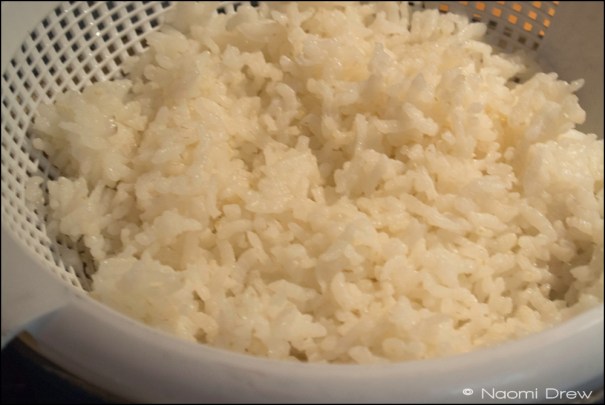
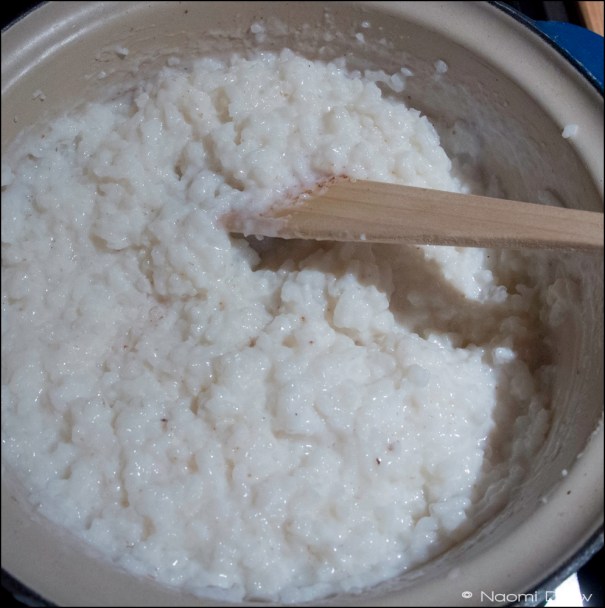
The rice totals about 2 c. dry.  Put into a pan, rinse until clear, and then drain.  Add 1 qt. water (or 1 liter), bring to boil, then drop to low, cover, and cook about 15 minutes.  You will now have a rather watery mix of rice and liquid.  Drain rice and water in a sieve for about 20 minutes.  Return to pan, add milk (about 2 c.) and bring to light boil, drop temperature, cover, and maintain a simmer.
Cooked Rice - First Cooking
Draining Rice
Creamy Rice - Second Cooking with Milk
Check your pot and stove top as milk boils over very easily!  As an aside, this is also an excellent base for stove-top rice pudding, but the crock pot works better because it doesn’t boil over.
Boiled Over!
Boiled-Over Milk
The flattened rye dough doesn’t need to be covered with a damp cloth while the rice cooks.  You might consider cooking the rice and making the rye dough while the rice cooks
Pies Ready to Bake
Once the rice is cooked, stir it up with the grated nutmeg.  You might consider a little butter as well, if you like that richness.  The nutmeg adds a really nice touch to the pies – no idea if it is traditional – and I imagine that, instead of nutmeg, some good, fresh herbs would be nice, such as fresh chervil or savory.  Fill the pies with a nice mound of rice.  You can fill each flattened rye ball, and then do curl the edges of the dough up and around the rice, or do it individually.  Keep your hands dry, so I suggest just dusting them with white flour.  Pinch the dough together around the rice.  When you have made all the pies, left over rice can be added carefully to the pies.

Melt a couple of tablespoons of butter in a dish and stir in a bit of milk.  Brush this over the rice and on the rye dough.

Preheat the oven to 210 C / 400 F.  Bake for about 20 minutes.  I had two racks, so I switched the racks half way between, at the 10 minute mark.  Cool on the pans, or move to wire racks.  When completely cooled, store in a container in the refrigerator.
Cooling Pies on Rack
Notes
It took about 1.5 to 2 hours to make these.  They are rather tasty, and certainly not something most of us eat every day.  I imagine they would be very nice as a side dish, say with fish or a good green salad.  By themselves, they can be a bit bland, but with a good pairing with other foods, would work out very nicely.  Personally, I really like them, and when I want something to do, they could be just the perfect thing to keep my hands out of the devil’s work.

Cool Summer Potato Salad – With a Kick!

radishes

Hot weather means a desire for cool food.  What can be better than cold, homemade potato salad made from scratch with flavorful produce from your own garden – or the neighbor’s?  Potato salad is actually quite good for you, especially if the mayo is homemade with virgin olive oil, or store-bought with canola or olive oil.  The key, though, is a potato salad that is icy cold, and has bits of heat throughout.  Radishes are excellent for this, as are homemade pickled onion, and a bit of hot pepper powder.  If you have fresh hot peppers around, you might give them a try as well.

Recipe

4 Yukon Gold potatoes, about 3 lbs.
7 red radishes, diced
Pickled onions (homemade) – about 1/4 c. diced
5 celery ribs, finely chopped
10 green onions, white and green parts, finely chopped
3 hard-boiled eggs
1/2 c. mayonnaise
2 T. apple cider vinegar
Ground pepper, hot pepper powder, Mrs. Dash, Dijon mustard

Chop potatoes into 1/2 inch dice; bring to boil in water. Cook till firm. Drain, and rinse with cold water. Shake out excess water. Refrigerate.

Bring eggs to boil in salted water. Boil 3 minutes, then leave in hot water (not boiling) for another 10 minutes. Cool in running cold water. Refrigerate until ready to use, then peel and chop. Add to potatoes.

Chop all vegetables into fine dice. Stir into potatoes and eggs.

Dress with seasonings, mayonnaise and vinegar. Stir all together. Refrigerate for several hours.

Progression

Along the Trail

Overall, things have improved in the health arena.  Weight loss, changes in personal habits, and, best of all, lower blood pressure.  Readings are all 120 systolic, plus or minus a few, and 80 or less diastolic.  A 2 mile run is pretty easy.

I began running years ago, but gave it up after a fall.  Much to my pleasure, the old injury that forced my stopping running seems to no longer be an issue.  My run is along dirt trails, in the shade of beautiful oak trees, and it could be the dirt and leaf matter on the trail provide good cushioning.

There is something so pleasant about running under trees!  I visit them 3 to 4 times a week, but with each day, there is something new to notice, or to greet as an old and beloved friend.  It is cool here, when the weather is hot, and though the humidity is higher under the canopy, the smells of earth and dirt, the sounds of the birds, and the sparkle of the sun on leaves always leaves a sense of peace and fulfillment.  If I could, I would live deep in the woods – but since I cannot, I can come here, which is not too far away.

Red Whine

A Tale of BP, Wine, and Food

Red Wine

As I mentioned awhile ago, issues with BP have arisen.  I always had low blood pressure, around 105 / 65, so when it started going up, I was in denial.  However, it kept going up – and down – and up – and down.  Finally, the diagnosis was “labile hypertension” which can be difficult to treat with medication.  So, no treatment.  My last visit to the doc ended with a threat of medication…but the fact is, I get “white coat syndrome” these days when BP is mentioned.  Everything skyrockets – my BP, and my heart rate.  At that visit, BP was 130 / 96 (not good) and my pulse was 98 (very not good).  I argued that it was only in his office that everything went nuts.  A deal was struck:  record your BP and pulse 3 times a day, and I will see you in month.

Ha!  I’ll show him.

Well, even though I am running, and can do 2 miles nonstop after a month, the BP is still up.  Systolic (upper number) doesn’t go over 140, and the diastolic (lower number) hovers between 80 to 90.  Not seriously bad.

“Get into the Mediterranean diet,” he says.  “This means drink red wine.”

I am not a fan of wine, but like Scotch so much more.  But, orders are orders, and . . . I begin to drink 5 oz. of red wine at night.  More alcohol in 4 days than I drink in 6 months.  My scotch intake is minimal, like once a month.  The day I begin the red wine, the BP takes a serious drop, running as low as 113 / 76 and a pulse as low as 66 with occasional moments of stress bringing it up to 88.  Running pulse is toward 160 at the high end, with a rate of about 84 a couple of minutes after resting.  Pretty good recovery rate.

I’m sold.  And, I find I am liking red wine.  The current bottle is a 2011 Syrah from California.  1 drink left.  Oh, dear, I am running out of medicine!!

So, now I drink wine.  I can handle it, but am amused at how lazy it makes me – really, I get so tipsy!  My husband says it is because I don’t drink, and need more practice.

Tracking It

The Mediterranean Diet can be found online in varied formats.  For me, it really is not a difficult thing to do as there are really no major dietary changes necessary.  The biggest shift is less meat, but I can live with that.  I like fish, so I eat that, and try to have tofu once a week.  More fruits and vegetables are easy to do.  What I have given up is sugar, but I do eat dark chocolate.  I really do not miss it, but know that if I give in and eat some cookie or a sweet, I’m hooked back on the worst drug in the food world.  That is my nemesis.

One thing, though, I find a big help is to keep track of what I eat.  I like FitDay.com, which comes with a lot of good things, although their food database is not as good as Fatsecrets.com.  But, I prefer FitDay as there are not forums and emails from the site – they leave me alone!  I can create custom foods, too, and record a lot of different things.

Tracking my food is not rocket science, and I refuse to get specific about weights and amounts.  What I do watch, though, is the daily carbohydrate totals, and work to keep it below 100 g., and the fat to 25-35% of the daily calorie total.  Many foods have fat, so I do watch what I add to my diet, but fat is also necessary for good health.  I don’t eat butter anymore, nor am I using low fat dairy products – all nonfat.  So, I have given up my beloved St. Benoit yogurt and turned to the nonfat Greek yogurt at Trader Joe’s.  It is thick, which is what I like, not thin and runny, which is what regular nonfat yogurt can be unless gelatin has been added.  I seldom eat bread, but prefer grains.  Oatmeal and quinoa are my favorites.  I also eat nuts.  And I eat little, if any, cheese.

An average daily caloric intake is about 1200 calories, which, for me, is fine.  I’ve also lost about 9 lbs. over the past several weeks, and it goes up when I eat salty foods, but has been going down regularly, and holding steady, too, which indicates a metabolic adjustment.

Altogether, life changes are occurring, and certainly ones which are improving my heatlh, my outlook, my activity levels.  Most importantly, they are ones which are quite easy to live with and readily incorporate themselves into my life in general, and ones which are easy to become habitual.

Invasion of the Computer Snatchers

Unless you build a computer from the ground up, you can expect to find software and applications on your new one that you don’t want.  Having just bought a new laptop, I expected this, but was pleasantly surprised to find I needed to get rid of only a few things.  These included McAfee anti-virus software and MS Office in a sampler format.  There were others, too, but I did not spend hours hunting and uninstalling from the control panel in Windows.  I have spent hours doing this in the past – maybe companies are getting wise, or there is just less stuff out there needing to be pre-installed because of our ability to connect so easily to the internet to get what we want.

Invasion

The problem lies in software being forced on you, piggybacked onto the “free” stuff you like to have.  Utilities, software, whatever, often come with applications that you don’t want at all.  Some are easy enough to remove, others are insidiously difficult.  Even if you are careful, checking off boxes to prevent programs from being installed, some creep in.  Constant vigilance!  At times, even uninstalling a program that inserts itself into your browser does not remove it.  Checking off “do not use” in your browser preferences doesn’t get rid of its hijacking your preferred home page.

One of the worse offenders is AVG.  It’s a search engine.  ASK is easy to get rid of, but AVG, no matter what I did and how I searched for cures to get it out of Chrome, I couldn’t.  The simplest solution was to uninstall Chrome, being sure to save my “whatevers” it asked I wanted saved, and then reinstall Chrome.  Problem solved – but it can return if I find something else I like that is “free.”

One program that has really helped is Revo Uninstaller.  You can find it www. revounistallerpro.com.  There is a freeware version, too.  I came across it in my searches on how to get rid of AVG, and while I had already uninstalled AVG at the control panel, and uninstalled Chrome, I have the free version onboard, and will use it whenever I try something new.

Freeware producers create some great things!  Avast antivirus is one.  VLC media player is another.  Other programs I download from online include Auslogics Disk Defrag, Adblocker, Faststone, Foxit Reader, Photoscape, and of course the different browsers.  Freeware does require work on someone’s part, and donations are always welcomed by these people.  I bought a license to Opera 3.12 umpty-ump years ago because I found it worth my while – and now it is free.  And, I still use it – the newest iteration, of course.

So, I am dithering around with crapware and bloatware I don’t want, getting rid of things as I install things I want.  I think I reinstalled Chrome at least three times on the laptop, but soon enough, I will have the critter where I want it, and can be done.  Then it will be time to move onto other things far more interesting to me.