Heat & Sloth


Today both Josh and I were exhausted.  This hot weather is so draining, and instead of the nights cooling off as they usually do in California, it pervades into sleeping hours as well.  Open windows and fans work most of the time, but today the air conditioning is running full time to keep the house at 75, not 81 or so.  The result is fatigue in a very odd way.  The mind is numb.  The body is numb.  It’s like being a reptile in cold weather – moving requires too much effort.  In a bit, around 7:30 p.m., we will be out for a walk – how hot will it be?  Certainly cooler than earlier, but probably in the mid-80s.  How far we go depends on how hot it is.  Both the dogs and we need some exercise.

Such an uneventful day.  So little accomplished or aimed for other than survival.  No dinner cooked, just scrounging around for whatever can be found.  Passive activities such as watching TV and movies in the middle of the day.  The mind is only now becoming a bit more alert.  No sewing, painting, or anything that required too much, although I did pick up a 6th grade math book for the fun of it . . . that took a bit of effort, let me tell you.

And more heat tomorrow . . . it does beat a hurricane, though.  I am grateful for that.  I still have a home.  And, I know enough about heat exhaustion, having had it many times over the past several summers, that I stay hydrated and cool.  Only the other day a hiker died in the nearby mountains while his or her companions called 911 for help with their own heat exhaustion.  But being passive is so tiring in its own way.
Hotter Than Hell, So I’m Gonna Sew!

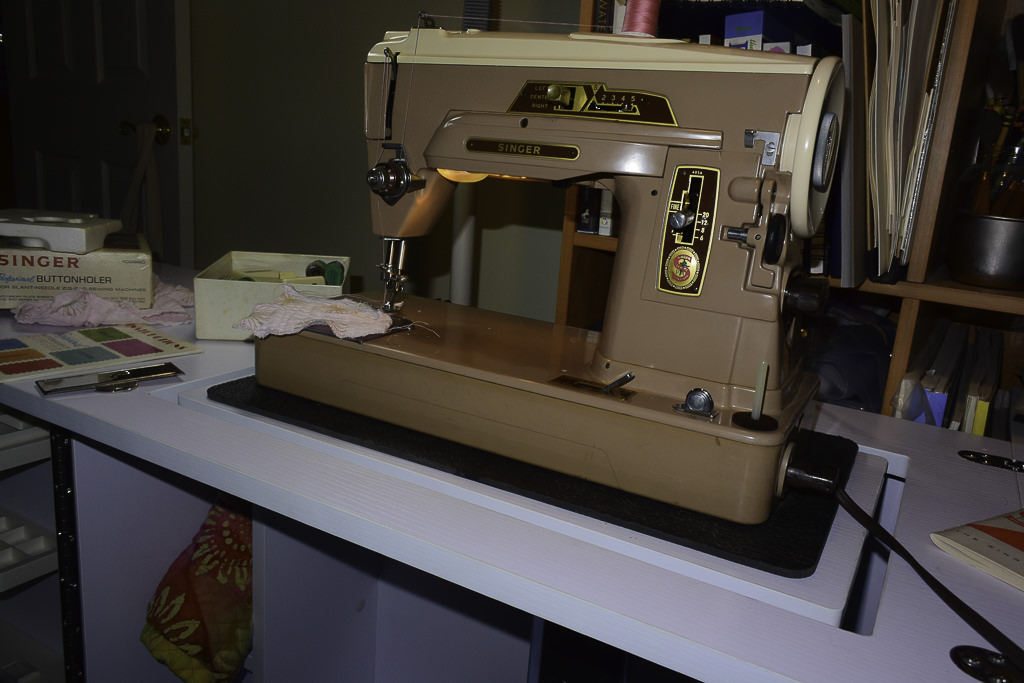
I think it must be about 100F (38C) where I live, so the air conditioning is on and not going out until it is dark.  My dogs aren’t mad, nor am I a Brit, so I am staying indoors, drinking water, and prepping the Maggie Shirt . . . and I am sewing it on my vintage Singer 403a,

I think these machines (the Singer 400 series) date from the mid to late 1950s and into the early 60s.  Mine is like it was never used.  When I bought her, she needed some TLC, heat and oiling, as well as a bit of gear grease, before she was off and sewing.  Unused machines freeze up, but once they have been given the right attention, I think they are the best!  I’ve had my 403a for awhile, and as I cycle through my machines, she hasn’t been out for a spin in quite some time.  Time to put her to work!

There is something to be said for the old Singer sewing machines.  They are well made and pretty straightforward.  The ingenious attachments are fun to play with and many collectors are nutso for them.  I have some, but usually rely on my more modern machines for things like fancy stitches and buttonholes.  Nonetheless, this machine is a blast.  It has cams for stitch patterns – the #0 cam is required to do a zig zag stitch – as well as straight stitch.

The 403a is a member of the “slant-o-matic” series of machines Singer made.  I like the slanted needle – it pushes the needle more into your line of sight.  Many newer computerized machines have the needle tucked back under rather fat upper portions, so they are harder to see.  Still, that doesn’t act as a deterrent.  For the 403a, as it is a slant needle machine, it is important to have the slant-o-matic attachments.  The one I have is the professional buttonholer, but I also have numerous feet that came when I got the machine.

Click on one of the images to open up the slide show . . .

The first two images are of the buttonholer – just a quick picture, really. The first shows you the box with directions, the second is the feed dog cover plate. The 403a has a rather interesting system to remove the throat plate – it is lifted up by a lever and slid out. The buttonholer cover slides in to its place – kind of complicated until you get the feel for it. The last picture shows you the box of feet and cams that came with the machine. The manual shows you just how unused the whole machine was when I got it.

When I buy an old machine, I want one that I know will work.  I like them to look good and to run well.  Some people get off on restoring machines, and while I can work on most of my machines for general maintenance, I really don’t find it a lot of fun to try to fix an ugly, rusted, beat up machine that is covered with rust and has electricals of suspect quality.  Prima donna, yes!

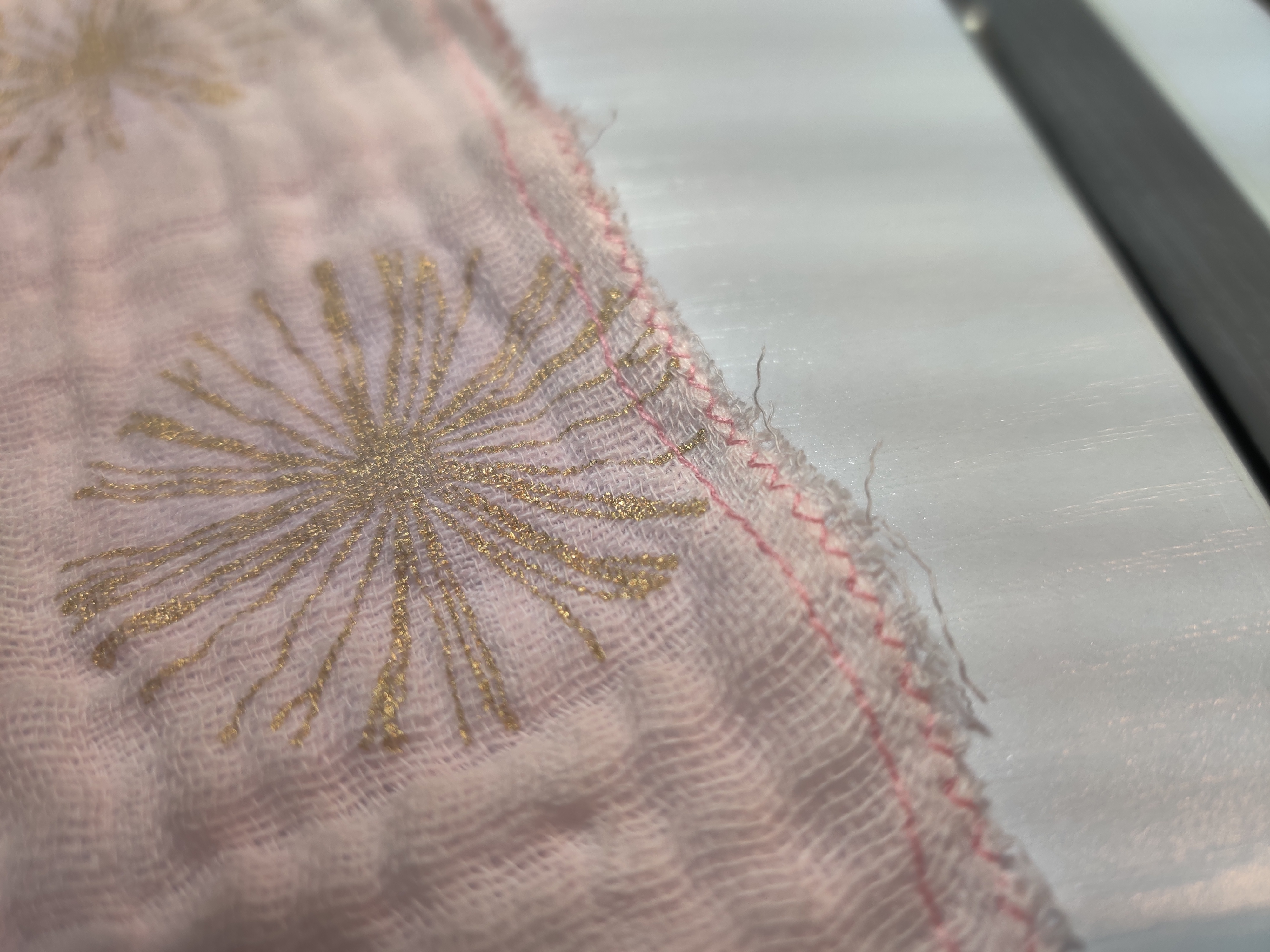
Finally, here is how I spent a few hours this afternoon.  The gauze for the Maggie Shirt is soft and stretchy, as is the characteristic of the critter.  It is also very ravelly.  Perhaps it is a bit of overkill, but I decided to stay stitch (the straight stitch) all around each piece, and zigzag to finish the edges.  I may need to cut out another collar stand as it seems to have gotten a bit warped by all this attention, but I have an extra yard.  Never having sewn with gauze, I bought a bit more to play with and to be sure that I didn’t lose so much to shrinkage that I would not be happy.

To be continued!

Maggie Shirt and Magyar Sleeves

The current project is a baggy shirt, with a front placket, back yoke and pleat, and “Magyar sleeves.”  Never heard of Magyar sleeves, but a trip to Wikipedia gave lots of info.  The pattern is from StyleArc, and is called The Maggie Shirt.  Clicking on the StyleArc link will bring you to the pattern itself.

In addition to making a placket with a slash for the first time (see the front of the shirt), I will be sewing with gauze.  I may be nuts to do it but it will be an adventure in and of itself.  The placket may need a fusible interfacing for it, as you do with the collar, but I will cover that territory as I move along.

Here is a picture of the gauze.  I wonder if it is the “double gauze” I kept reading about as I searched for information on sewing gauze and cutting out patterns with gauze fabric.  Suggestions include not ironing the gauze, but washing it on hot to let it shrink, and letting it dry flat or on a line.  I put mine in the dryer, but didn’t iron it as it will stretch a lot.

When I laid out the pattern, I flattened the material, not trying to smooth it out too much, but getting rid of any folds and letting the material lie as it wanted.  Of course, the pattern has a grainline line in it, but I just eyeballed it because how could I find the grain other than measuring it from the selvedge (which I did the best I could).

You can see how sheer the fabric is as the blue lines of the cutting board show through a single layer, and for this hot weather, it will be a comfortable top to wear – and hopefully relatively modest, as I don’t like my underwear to be too apparent.

The pattern is pretty straightforward, but I am not too sure about the directions and markings.  They are not like the ones found in the 4 big pattern companies here in the US.  I need to read a bit, as well as rely on my own knowledge of sewing.

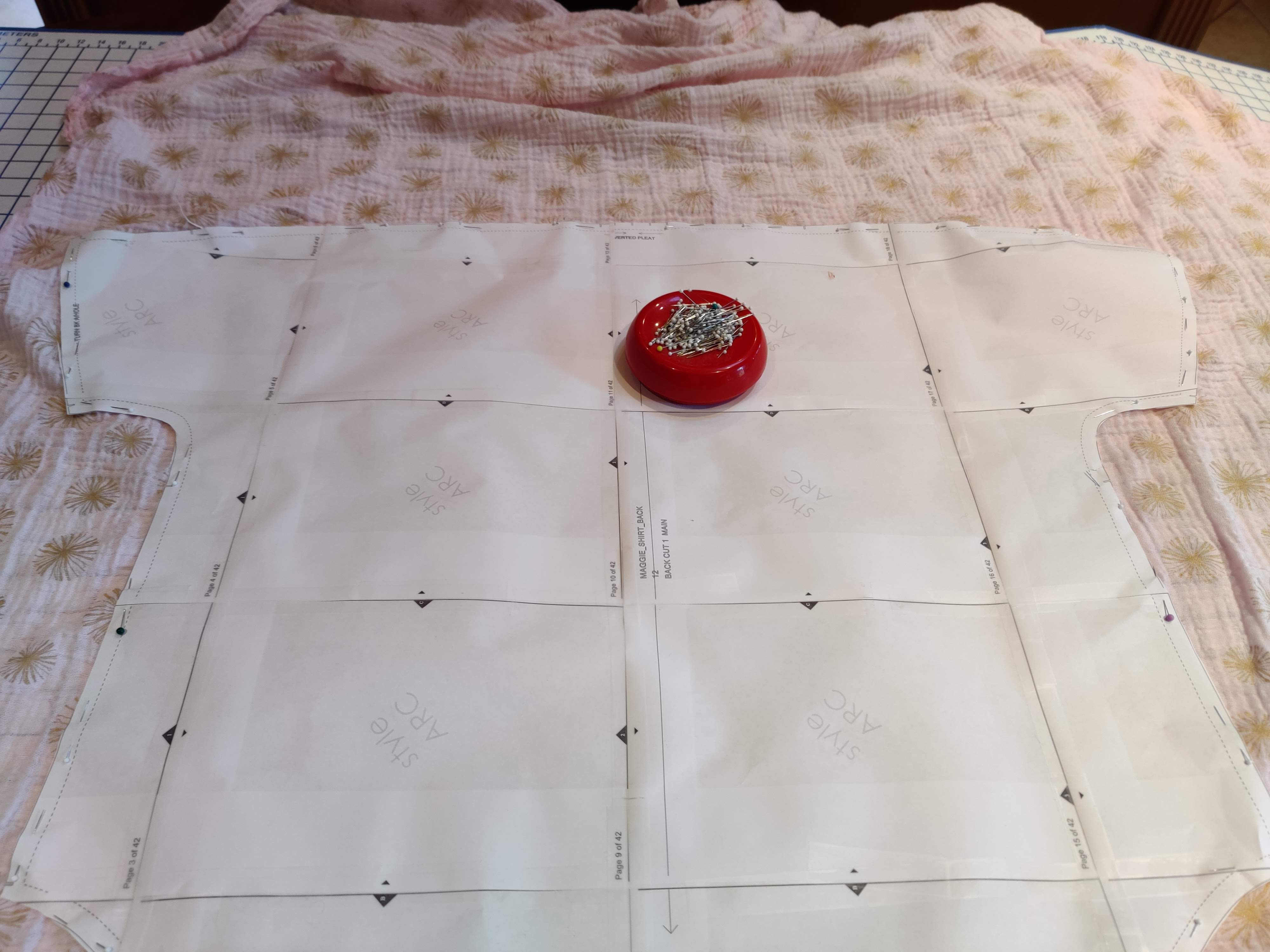
The picture above is of the back of the pattern before I cut it out.  The pattern was printed on 8×11 paper, and then taped together front and back.  Some layers of paper are 3 deep – and a real pain to pin down.  I think I will need to rethink the taping process – pulling out layers as I cut to create only one layer thickness of paper.  Didn’t think about this until the pinning and cutting of the pieces began!  It’s really tough to pin through 3 pieces of 20# bond!

And here are the pieces, ready to be sewn.  That begins tomorrow or Sunday.  I also plan to finish the edges of each piece before I sew, and probably stay stitch all the curves at a minimum.  The long narrow piece is the collar, so I will also fuse it to a lightweight interfacing.

Before any sewing begins, though, I plan to practice sewing and finishing the edges on the gauze to get a sense of how it handles.  I may end up hand basting a lot of it, too, because that may prove to be easier than pinning.  As well, I need to check out my presser foot pressure (lighter pressure for lighter fabrics) and stitch length – longer or shorter for loose weaves?

Now, time to go stretch as bending over a table is hard on the old lower back . . .

Time, Paper, and Tape

The sewing bug has bit me again!  Now that I have time to sit down and think, I also have time to sew.  I just finished a flannel robe in the past couple of weeks, as well as hemmed a couple of pairs of jeans for Josh.  Now the plan is for a new blouse out of some gauzy material with gold printing on it.  Yeah, sounds bizarre, or gaudy, but it really is rather pretty.

I have any number of patterns, but none seemed especially suited for my very first foray into sewing with gauze.  Looking around on the internet, I came across some patterns by StyleArc, an indie pattern company out of Australia.  They get good reviews, so I decided this blouse would be perfect.  A bit of a challenge, but simple enough . . . .

When you buy online patterns, often they are downloadable as a PDF file that you print out at 100% (to make sure you get the right size).  From there you tape everything together to create your pattern pieces, and then cut.  And then tape some more, front and back.  After that, you get to sewing!

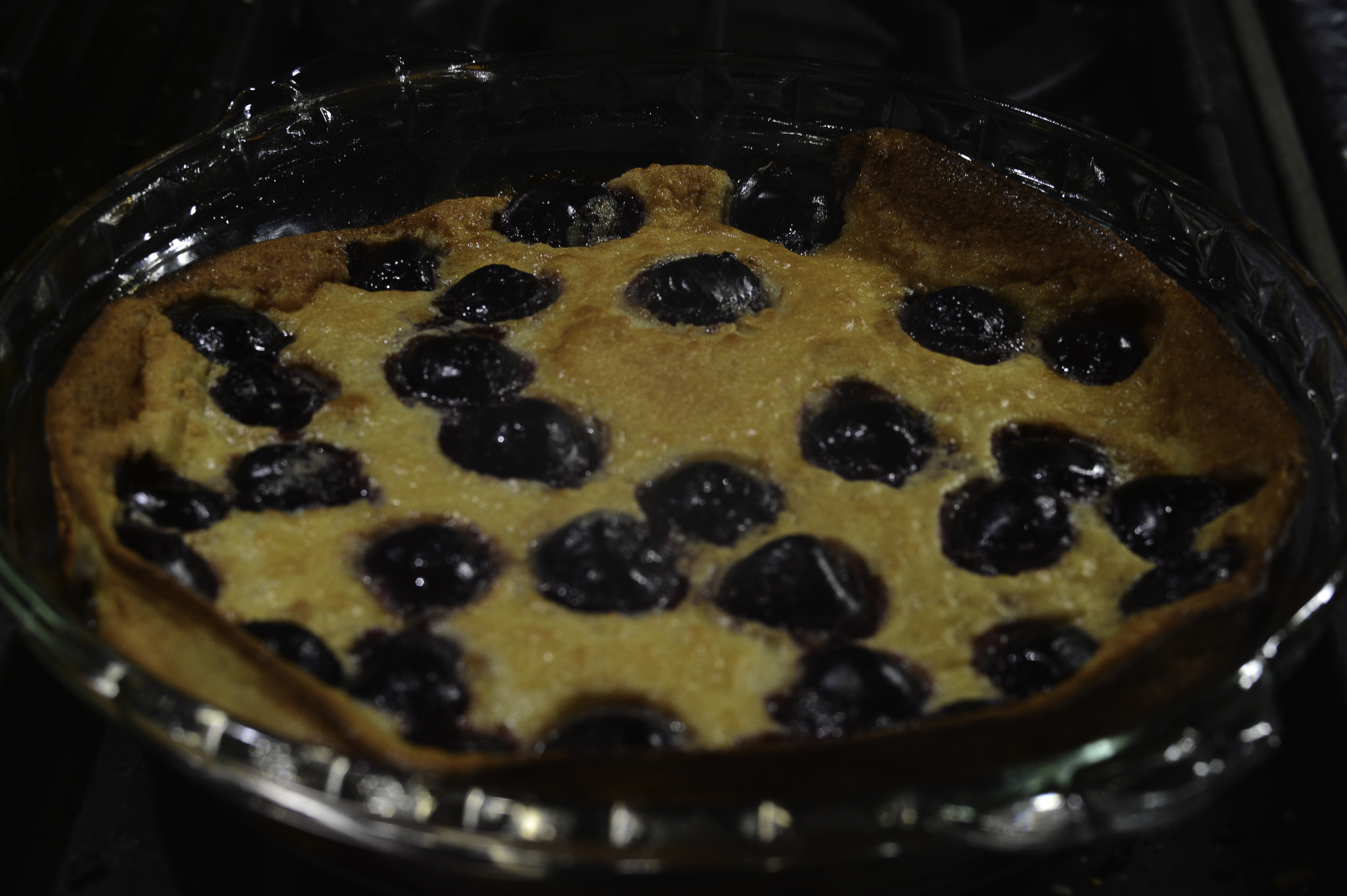
Delicious Dessert: Clafoutis!

I’m a sucker for summertime desserts, especially those involving fresh fruit.  Besides pies and crisps, clafoutis is a brilliant one – simple, not full of sugar, and very tasty.  Most ingredients are right on hand, too.  I made this one for people with gut problems (IBD), but put the non-gut-problem ingredients in ( ).

Clafoutis

  • 2 large eggs, beaten
  • 1/2 c. almond milk (or regular milk, half and half, or cream)
  • 1/4 c. honey (white sugar)
  • 2 T. melted butter
  • zest of 1 lemon, more or less depending on taste
  • 1 tsp. vanilla or almond extract
  • pinch salt
  • 1/2 c. oat flour (regular flour)
  • 2 c. fresh fruit – cherries are traditional – I used frozen (other fruits such as berries, stone fruits, etc.)
  • (1 – 2 T powdered sugar for garnish)

Preheat oven to 325 F.  Grease 9″ pan with butter or non-stick spray.

Beat together eggs, milk, honey, melted butter, lemon, salt, extract.  Mixture will be thick like cream, but not heavy batter.  Use a whisk – save some dish washing.  Whisk in flour gradually to keep a smooth batter.  Pour into pan.  Place fruit in pattern or randomly on top.

Bake on middle rack of oven 40-50 minutes, checking half way through to see if you need to rotate pan.

Remove from oven, cool.  If you want to add the powdered sugar for garnish, wait until clafoutis is cooled so it doesn’t melt.  Serve warm or cold.  Great for dessert or breakfast.

Devour!