Snow in the Sonoran Desert

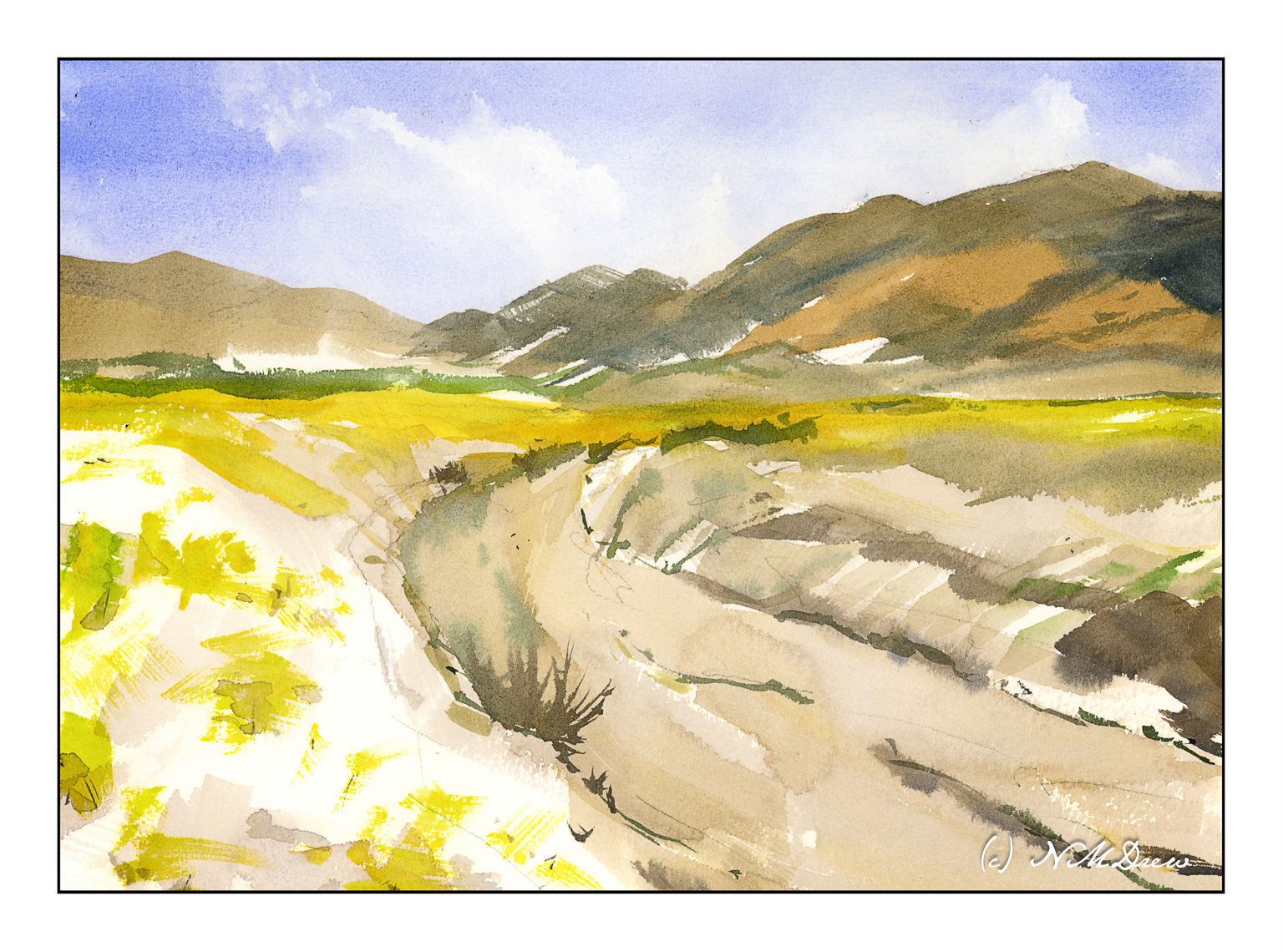
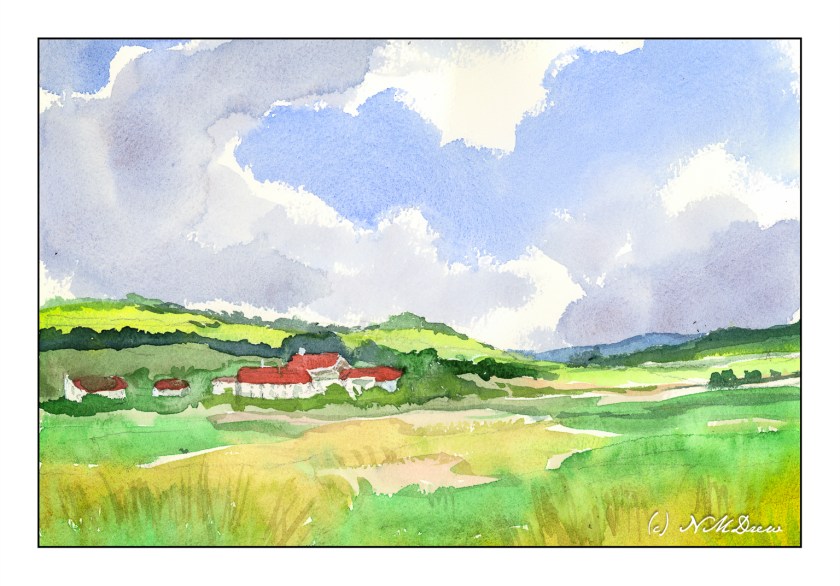
It seems appropriate to do a version of a western snow scene, and what better place than the Sonoran Desert? It is a bit closer to home than New York. I always find snow in the desert or places I don’t think of getting snow to be absolutely fascinating.

Once more, I am using a limited palette. Here, umber, ultramarine, Payne’s grey, and Hooker’s green for the landscape. The sky is ochre with some Indian yellow, quinacridone rose, and cerulean. Some of the Indian yellow is also present in the landscape, partly to lighten things up and to make some variations. Titanium white gouache is used here and there as well.

I am beginning to find limited palettes of color a lot of fun! When I am painting with them, I have not set out to use a triad of colors (such as a red, yellow, and blue), but picked the colors based on my need to succeed, at least in my head, in creating the painting I want. At some point, I will try primary triads, but that may be for warmer weather. Right now it is winter, and winter I shall paint!

In addition to a limited palette, I am also using larger brushes overall and abstracting details into shapes. Pale, pale washes, as for the sky, are also some of my goals. The scan, once more, is not as good as it could be, but in general the stronger colors are well portrayed.

My paintings are getting better, I think. At least I like them better than many others I have done. Yesterday’s painting was meh, but if I consider that 3 out of 4 have pleased me so far, I must be winning. 🙂

Watercolor, limited palette, St. Cuthberts Mill, Bockingford 140# CP, 12×16.

Winter Hill

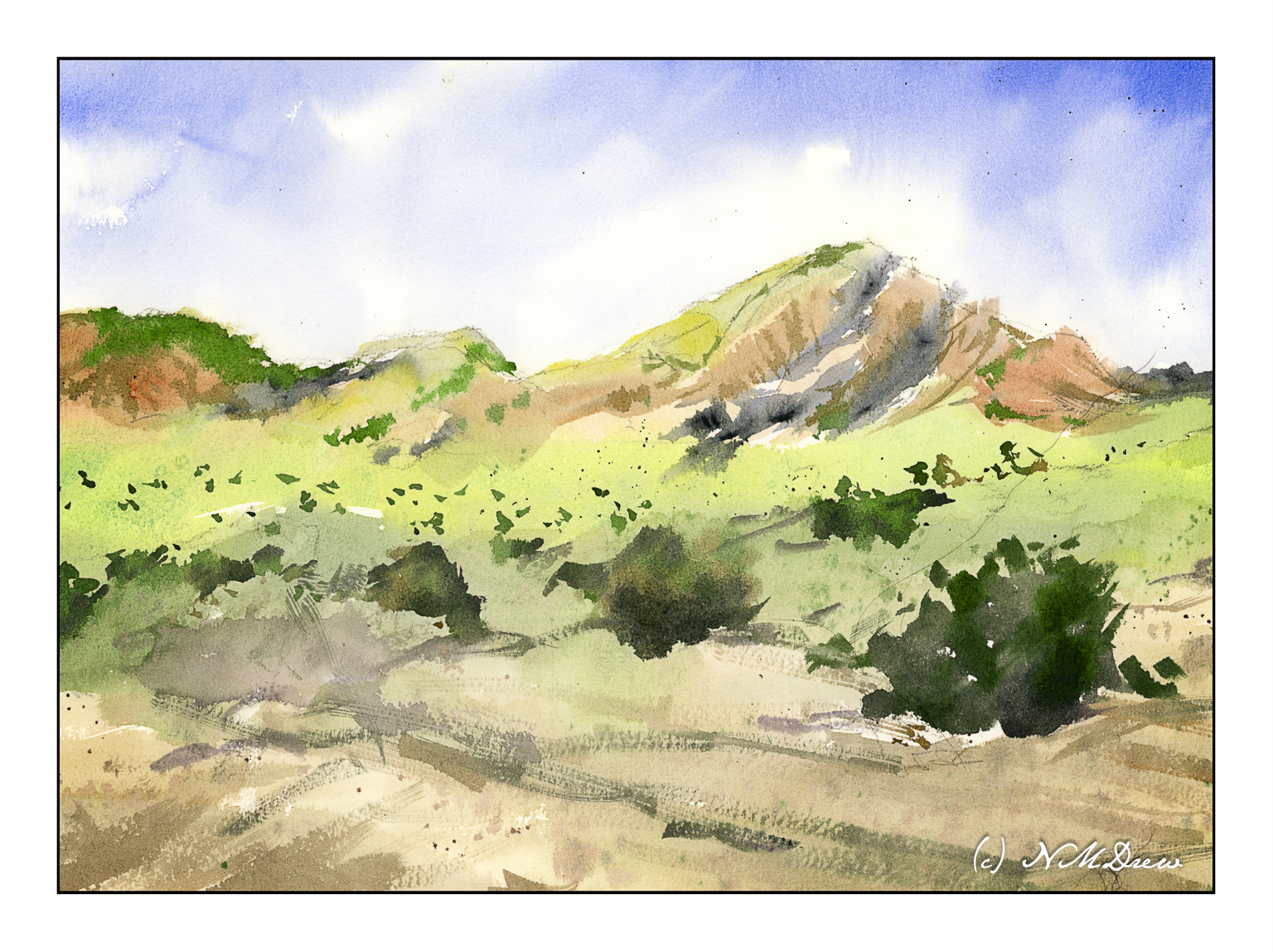
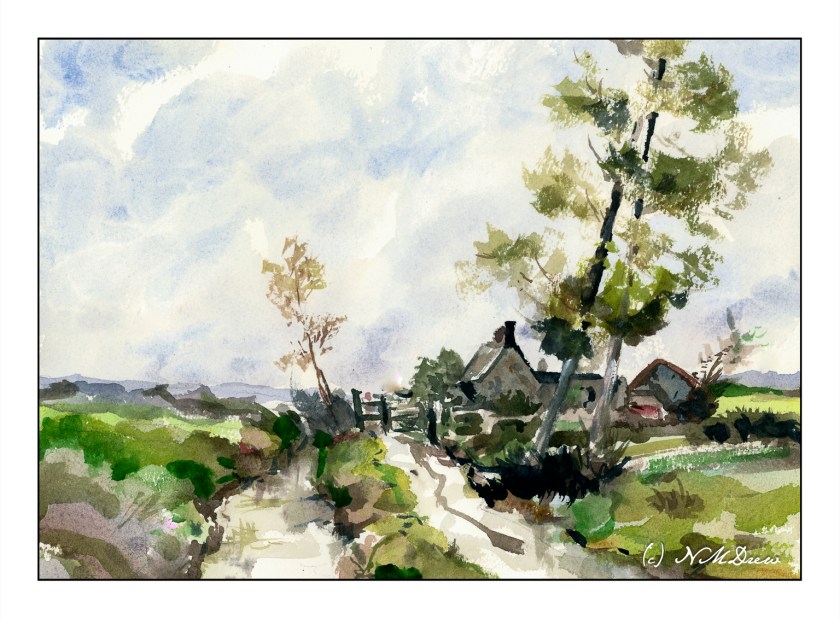
I am working really hard to simplify my paintings. Winter scenes are perfect for this as I have to keep large swaths of paper white and untouched. Contours of the land are suggested by some blues and such for shadows. Additionally, I am trying to keep my brushwork fairly direct and using the brush’s qualities to dictate the result. A bit of a challenge!

This scan seems to be decent, too, as far as matching the painting’s colors.

I added some new colors to my palette for this painting. In addition to ultramarine blue, burnt sienna and Payne’s grey, I added some Winsor Newton brown madder and olive green, and McCracken black by Daniel Smith. I also used some white gouache for the snow on the right hand tree and in the viney-like things in the foreground along the fence. Altogether I am working toward getting comfortable with a limited palette. Winter lends itself well to this.

The wire fence was drawn in with colored pencil – a warm and cool grey.

St. Cuthberts Mill, Bockingford paper, 140# CP, watercolor.

A Bit Later

Now, a bit later, I wondered if that tree on the right was okay. I wondered if it was needed. I don’t think so. Here is the painting without the tree!

Thoughts?

Grand Finale: Christmas Stocking, 4

Overall, I am pleased with the final iteration of my SIL’s Christmas stocking. A lot of work in some ways, just because I didn’t think about what I was doing. I ripped it a few times and had to learn how to knit an “after thought” heel. Watching videos for that really helped a lot.

The pattern this stocking is based upon is from Yarnspirations Festive Fair Isle Stocking. I won’t say it is a difficult pattern if you are used to stranded knitting, but because on a number of occasions there are more than 5 stitches between different colored stitches, the floats can get long and the tension can get messy. As well, if you reach into the stocking with rings with things that stick out, you can catch a float, before, after, or during its making. I will putting a note about this into the package when I send it off to Wisconsin in the next few days.

If you recall in my last post about the stocking, I had knit the foot pattern twice. It was way too long. I cut it off, and then moved into picking up the green stitches to make the toe itself, which is green. I used a circular toe decrease just because I was lazy and using circular needles, first 16 inch, and then 11 inch. You can see the decreases in the image below. I have not yet pulled in the open stitches to cinch the toe closed.

After this, it was time to clean up the mess inside the stocking itself. With all the color changes and dropped stitches here and there, I did not tie off the floats like I usually do. See how messy?

It looks pretty bad, but in reality, it was pretty easy to clean up. I tugged together the loose ends, knotting them (which I would not do if this were a sock to be worn on my foot!) for security. All the long ends were trimmed, and I worked from the top of the sock to the bottom. In the end, it worked out pretty well.

The corners of the after thought heel also needed to be cleaned up and pulled in so there were not any holes. The directions for the stocking do not give you notes that beginners (and non-attentive knitters like me) may need. Having never done this sort of heel, I was confused, but some good YouTube videos proved helpful.

If you are interested, I used size 8 US knitting needles for this project and changed some of the pattern colors and so on. The top of the stocking used a “fur” yarn which is not longer manufactured, so I made an i-cord. The i-cord was made so I could have a loop for hanging the stocking as well as picking up the 60 stitches needed for the pattern itself. The yarn is an acrylic yarn, and may colors were white, warm light grey, green and red. If I were to do this over, I would probably drop down to a 7 US needle. Because I could, I used a 16 inch circular needle, and dropped to an 11 inch needle for the toe.

I did not enjoy the after thought heel. It had me using 4 needles, which I do not like at all. The needles were aluminum and kept sliding out the of the stitches. When I knit socks, I use 3 needles, and ones made of wood or bamboo. I plan to try this heel again, but use a different methodology.

After cleaning up the inside of the sock, securing the heel and toe, and making sure I didn’t have any dropped stitches, it was time to iron the stocking to make it presentable. I sprayed it with water and then pressed it – pushing the iron down on it – between to rather heavy dish towels placed on the ironing board. I had my iron set to linen so the heat could penetrate the towels and set the stitches and shape of the stocking. This was done to both sides. I let it set overnight, to cool and give it some memory.

Years ago, when I was a kid, my mother made Christmas stockings for the four of us. I hung mine in front of the fire and it melted. I will send my SIL a note to that effect! This is also why I misted the stocking and pressed it between heavy towels – I have no desire to peel melted acrylic yarn from my very good iron.

Would I recommend doing this stocking? Yes, I would, but with caveats: know how to do stranded knitting, learn about after thought heels if they are new territory, and either find a fur yarn or make a ribbing or i-cord beginning. And then, enjoy the result.

Trees in Snow

This was an exceedingly hard painting to scan simply because of the very soft usage of blue in the foreground snow. While this scan does not represent the painting very well, the overall image is good enough unless I decided to really play with my scanner’s software. I am not so sure I want to do that.

There are a few “points” to this painting. Using a very limited palette was one point – colors here are ultramarine blue, burnt umber, burnt sienna. There is a touch of a few other colors here but nothing of any significance.

Another point is to keep as much of the paper as white as possible. I managed to do this, but the scan does not do justice to the pale blue of the foreground snow; to compensate for this I used a very light blue graduated filter overlay in my post production software.

And the final point was to work in layers – light to dark – for the trees. Yes, I used titanium white artist’s gouache for the snow on the branches.

St. Cuthberts Mill, Bockingford archival watercolor paper, 12×16, CP 140#.

Christmas Stocking, 3

This stocking for my sister-in-law has been quite the adventure. Mistakes, mistakes, mistakes! I will say, I am responsible for the majority . . . I had to restart the darned thing, and then, I made the foot too long.

If you look, you can see the end of the stocking I cut off – I wasn’t in the mood to ravel all that, so I took my scissors and cut off the toe. I had repeated the pattern twice – misread the directions. Then I picked up, several rows above, the right leg of the V of the stitches I wanted. And I picked up the exact number, much to my relief, and proceeded to finish up the stocking. As you can see below, the amputated foot above the completed foot.

I would have preferred the red strip with diamond in the center – more Christmassy in color – but it was time to bring this to an end. I need to gather up the toe to close it up, and then work on the weaving in of loose ends and looking for dropped stitches. I found one, which I pinned for now, but will secure it when I work on the inside of the stocking. And that is for another day. Like tomorrow.

Happy New Year 2026!