Royal Poinciana Tree

Another tribute to The Highwaymen of Florida.

The Royal Poinciana Tree is native to Madagascar, but because of its vibrant red flowers, it has been transplanted throughout the world. It prefers temperate to semi-tropical climates, so the heat and cold of where I live make it an unlikely candidate. However, we do enjoy the vibrant purple jacaranda tree!

That said, I gessoed Arches 140# CP paper and used acrylic paint this time. I spent hours on this painting, and attempted to do a rather more primitive approach, working for a type of simplicity I seldom employ. Not having painted for some time in acrylics, I needed to work at it. One thing I did do was not the default dabbing I seem to gravitate toward with acrylic. I saved that for the flowers and leaves, in the tree and on the ground.

I am so tired I have no idea if this is a “good” or “bad” or “mediocre” painting – but does it matter? This painting took a lot out of me. The scan, too, is poor – the colors are too extreme – the reds and oranges and greens dominating. Adjustments are not really successful in LR. So, here I think we are limited by the software and its interpretation of such colors in the scan. Still, it’s here for your perusal . . .

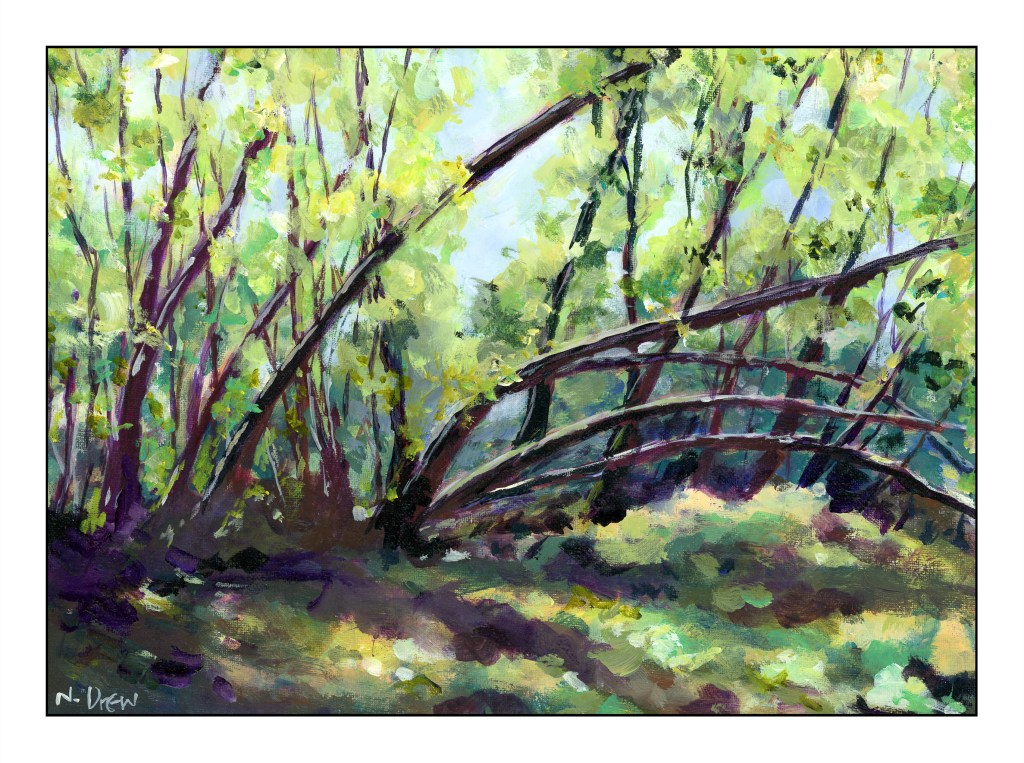
Road through the Hills

About six weeks ago I started this painting and then all the chaos of insurance and plan choices and lost mail brought most of my creative life to a screeching halt. It was emotionally exhausting in a lot of ways, but those details really are not important today. Instead, this painting is finished at last!

Details first: acrylic on gessoed 16×20 CP Arches 140# paper. Borders of paper taped down all the way. I probably spent about 10-12 hours on this painting.

There have been multiple iterations of this painting. In the original, a tree was in the right middle front foreground. That disappeared last night. Then the road, which disappeared dead center, was reworked and made visible through the trees this morning. The suggestions of vineyards in the background disappeared, too. Too many stripes – I was looking for a zebra.

To finish the painting, I decided to work in middle of the night last night, and from 10:30 pm to 2:30 a.m. I painted out nearly everything except the blobby middle that I knew was not what I wanted. My husband, who is no art aficionado, always has good advice on painting problems. He and I agreed on the issues. So, this afternoon, I spent a few hours working and reworking it until you see the finished result above.

I have not done a lot of painting in acrylics, but each painting I do brings new experiences. I still tend to be a dabber, but am working to think about how I move the brush more, such as long horizontal or vertical strokes, or suggestions of something with just a blob (not a dab!) of color. I need to work in acrylics more to build more confidence in my brushwork.

So, here you are, on a gravel road in the backcountry, enjoy vineyards and olive groves, somewhere in a Mediterranean country on a hot day in summer.

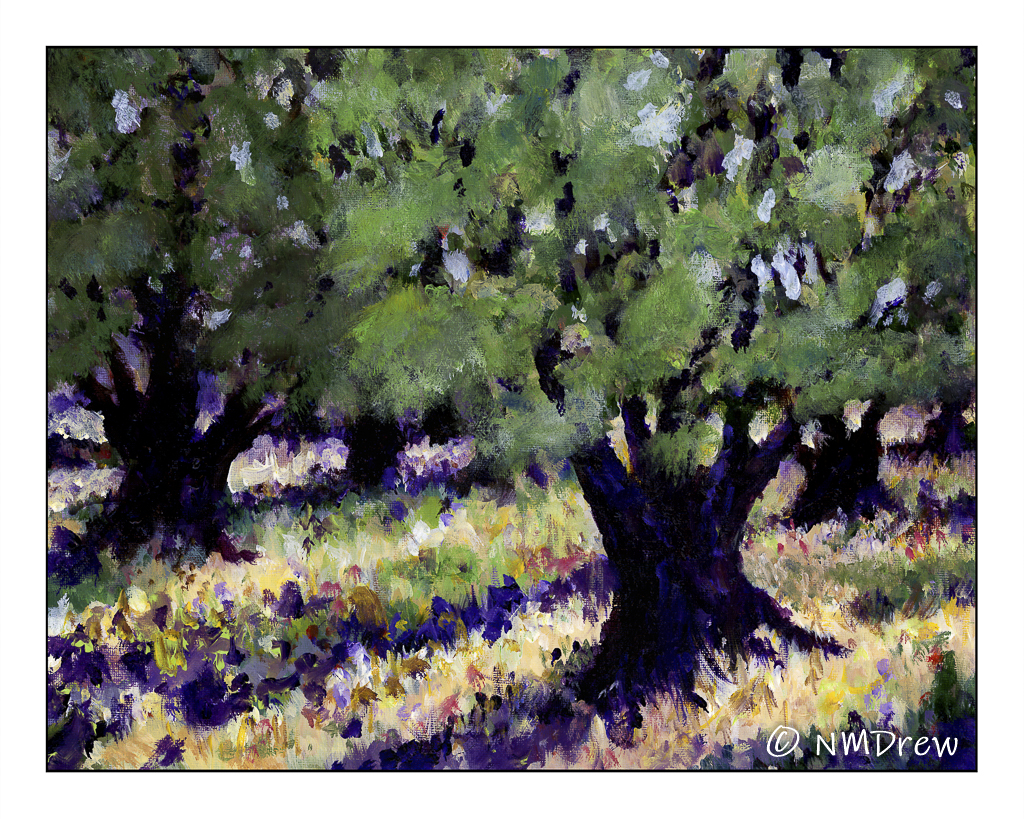
Late Summer in the Olive Grove

I started this painting a couple of months ago at least, but because of life and cataract surgery, I didn’t finish it until today. There have been several iterations of it. The subject itself was inspired by van Gogh, and I had thought to try to copy his style of painting, but found that it was far more difficult than I anticipated.

The painting itself is done on an 11×14 canvas panel by Arteza I gessoed over its primed surface, in part because I like the process of preparing a surface for a painting, in part because I never like something already prepared by someone else. From there, the surface was neutralized with a pale underpainting of yellow ochre and burnt sienna, very thinly applied.

One of my primary issues in painting of ay type is depth of field. Easy to do in photography, but not in painting! Thus, this was a goal in this painting. In general, I think I made it, but had to work and re-work the surface of the painting. This is the pleasure of acrylic – once dried, I can paint over what I don’t like.

I used a variety of techniques, one being glazing to dull own areas by using a cool glaze, and to bring others forward using a warm glaze. It worked, but I realized I needed to go further by using a dullish grey-green for the tree on the left, and a brighter, warmer green for the olive tree in the foreground.

This is the first painting – artwork of any kind – I have done since I had my cataract surgeries in July and August. With new lenses, in my eyes and in my glasses, my sight is much better. However, I may still need a newer prescription in a month or so as it was hard to see what I was painting with my new glasses. Time will tell with this.

Altogether, I am pleased with this attempt. First, I like the painting. I am going to let it stew a bit before I apply any varnishes. So, letting it sit is “second” – already I can see areas which are a bit illogical. Finally, the entire process was fun to do. Acrylic, as with all media, has its good and bad qualities or frustrations, or whatever, but the simple doing it is delight. Painting just removes the outside world and transports me into another dimension which is pure bliss.

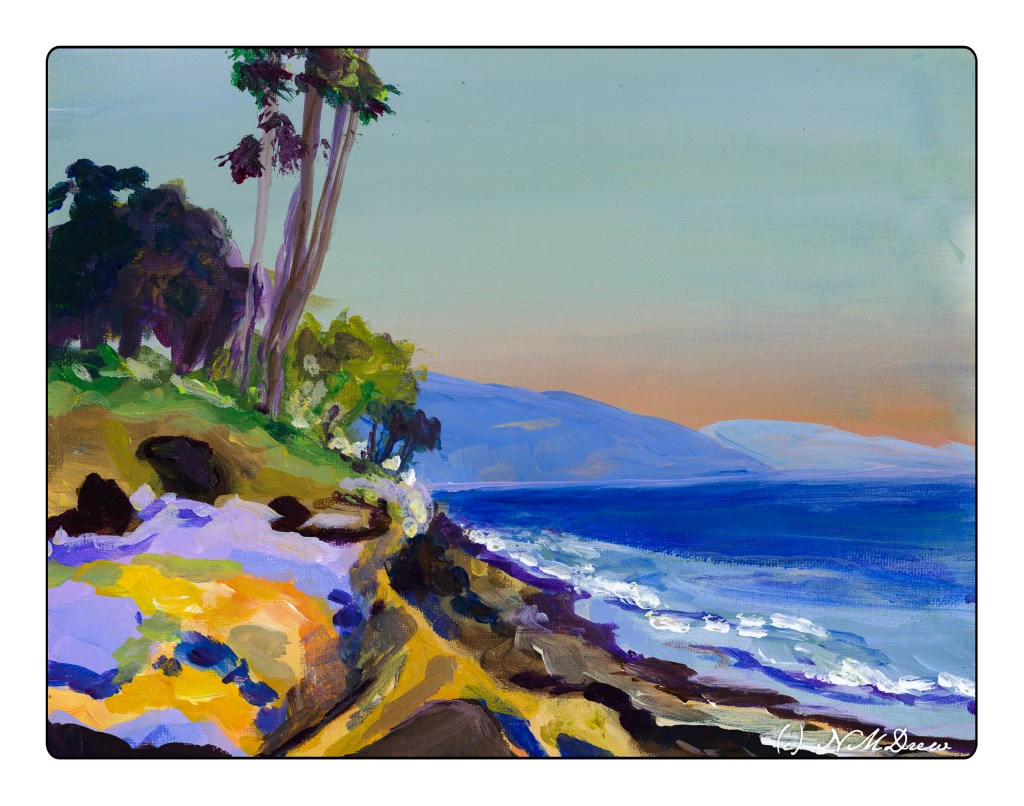
Tanglewood (Acrylic) – the Final Rendition

Here is the finalized rendition of Tanglewood in acrylic. If you look closely, you will see highlights added to the trees on the left nearer the trunks, and along the trunks in the upper area of the painting. I did a few other things, too, but don’t remember.

It is always interesting to see what people think about a painting or drawing. My husband says this version of Tanglewood looks like Mirkwood, from that famous trilogy, and the darkly spotted foliage in the upper right makes him think of lurking goblins. Success? Hmm. But, the photo I used really did make me think of Mirkwood myself, so there ya go!

I always like to have an extra set of eyes for the “final” viewing of a painting before the “final” edition. I am too involved, so another set, or two or three sets, of eyes is a big help. My sister and my teacher both brought up the need to lighten up the trees on the lower left, and to add dappled light on the trunks both high and low.

No goblins were used in the painting of this painting of imaginary goblins.