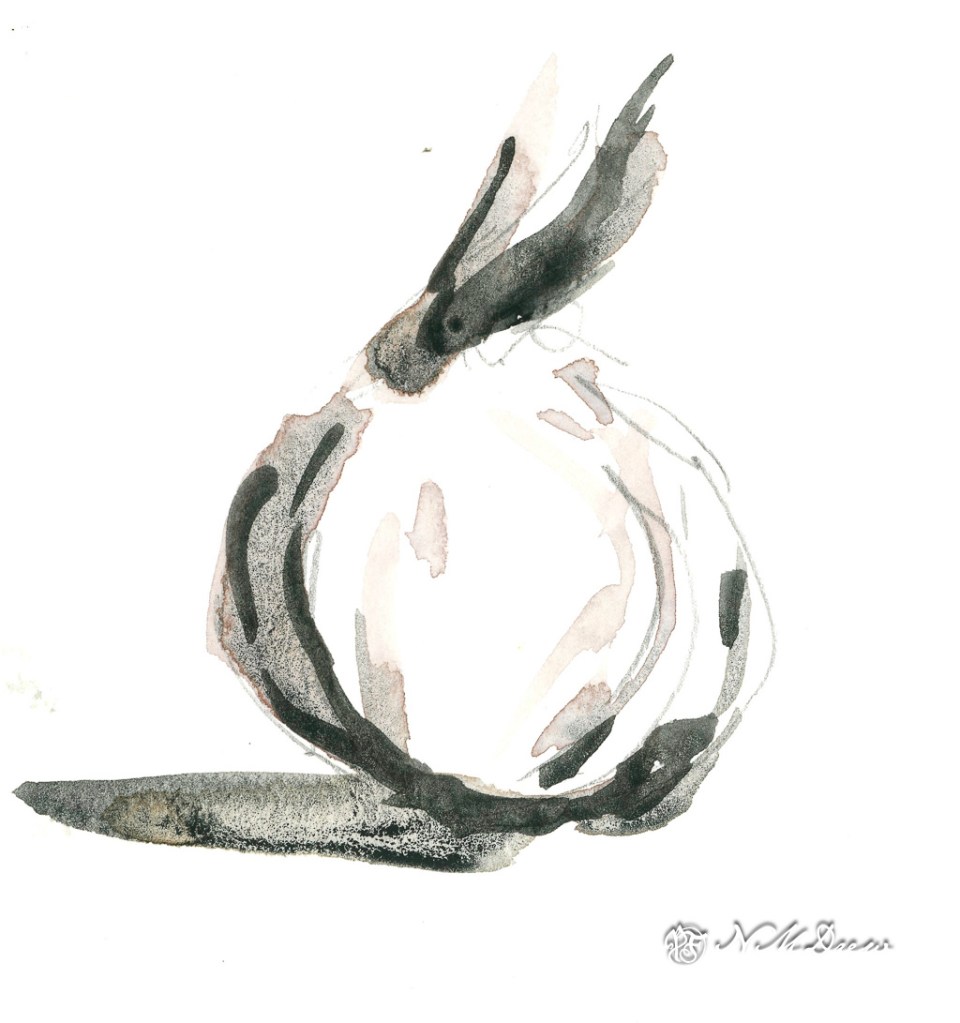
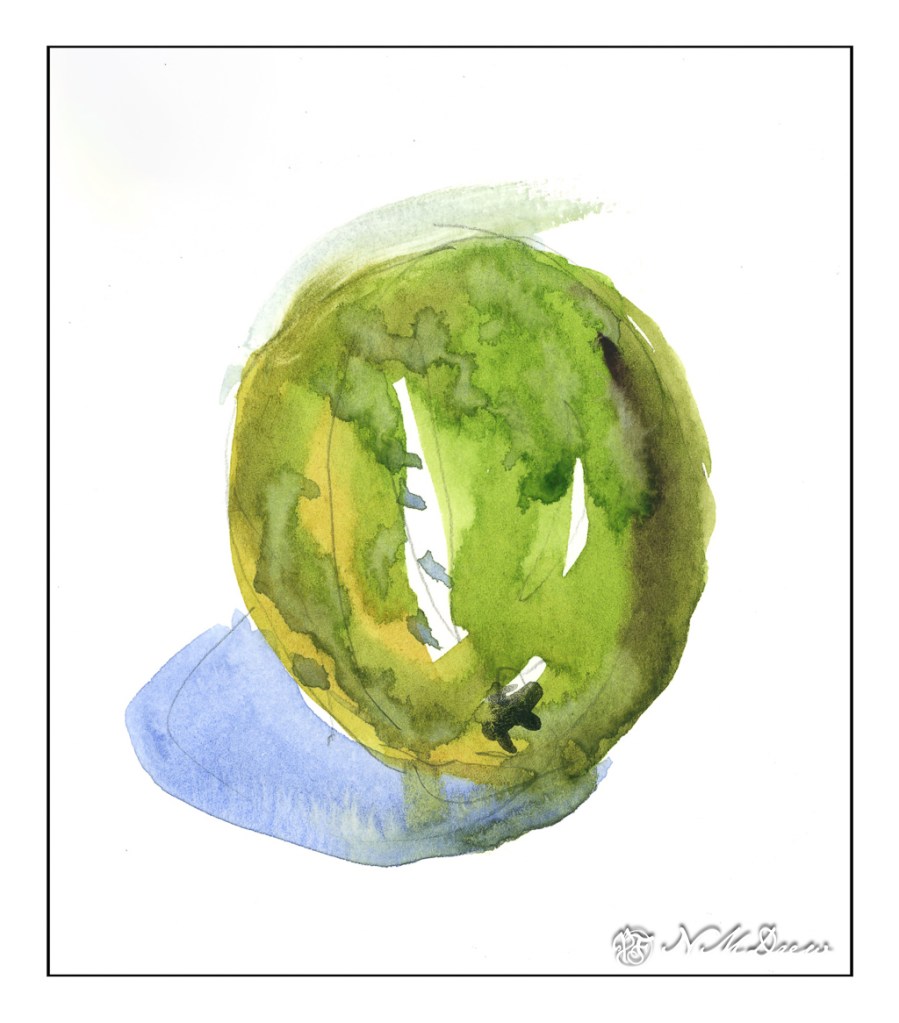
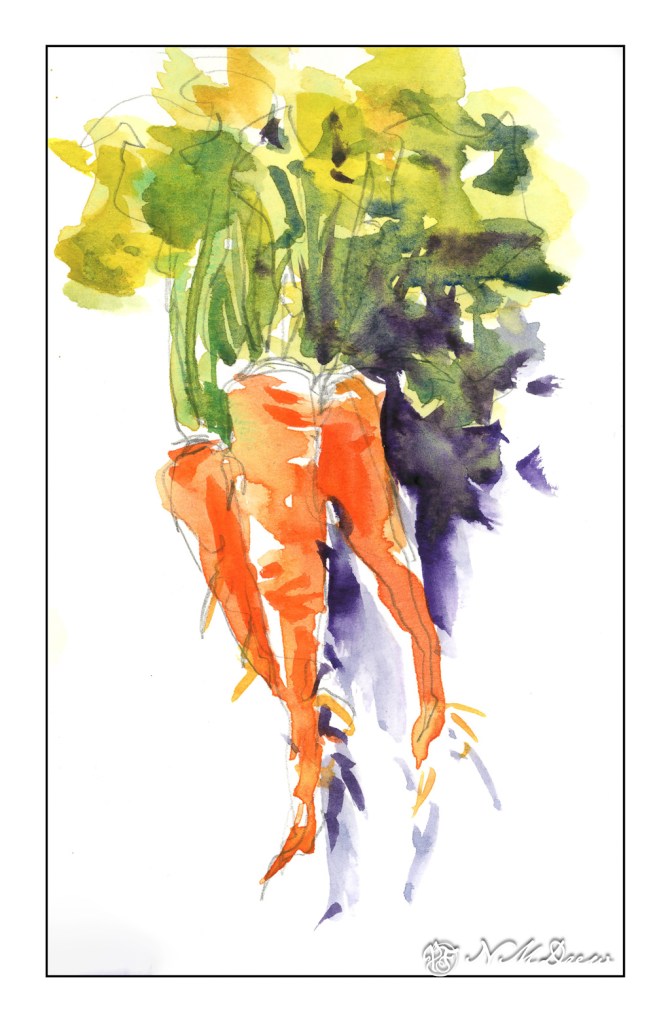
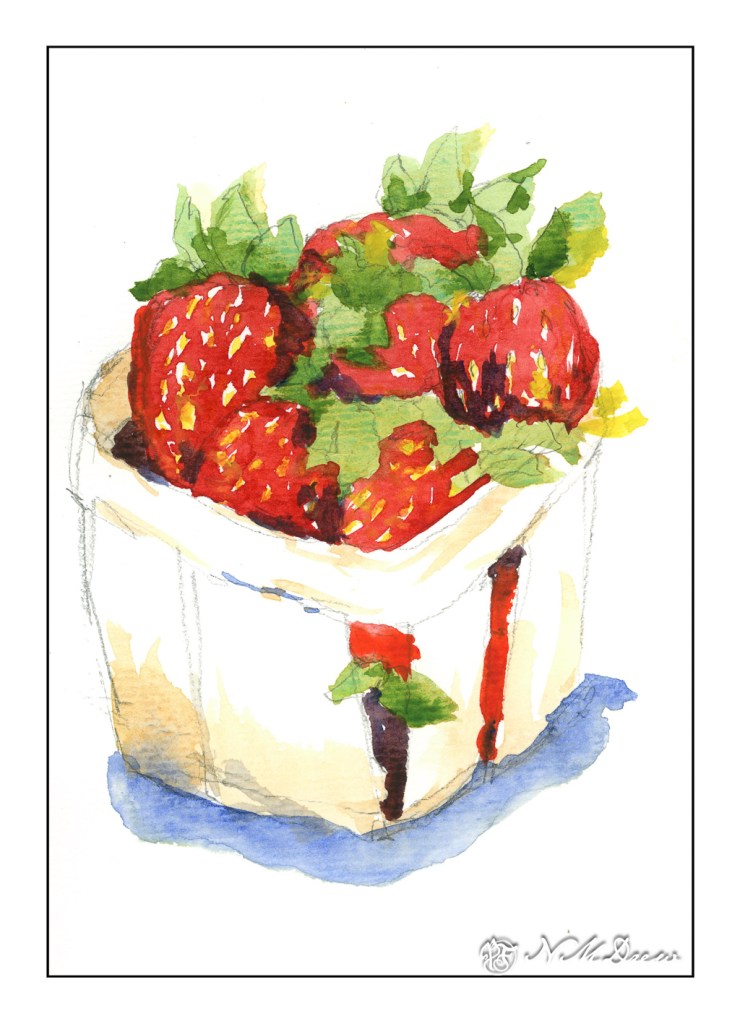
Negative painting can only go so far as other things in watercolor need attention. Shapes and shadows are very important for both realistic and more abstract things if you want to make them somewhat recognizable! Consequently, I have been painting fruit and vegetables all morning, to the point I am feeling crazy. Some subjects are more successful, others not, but the lesson is to paint shapes directly and with some finesse, as well as to create shadows while the subject is either dry or wet. Click through at your convenience for a trip to the market.
One thing I have realized from painting all these things is that patience, once more, and mindfulness, is necessary to get anywhere with these things! What looks spontaneous often is not. Instead, it is made up of experience and thought and so on. Persistence is my only hope . . .
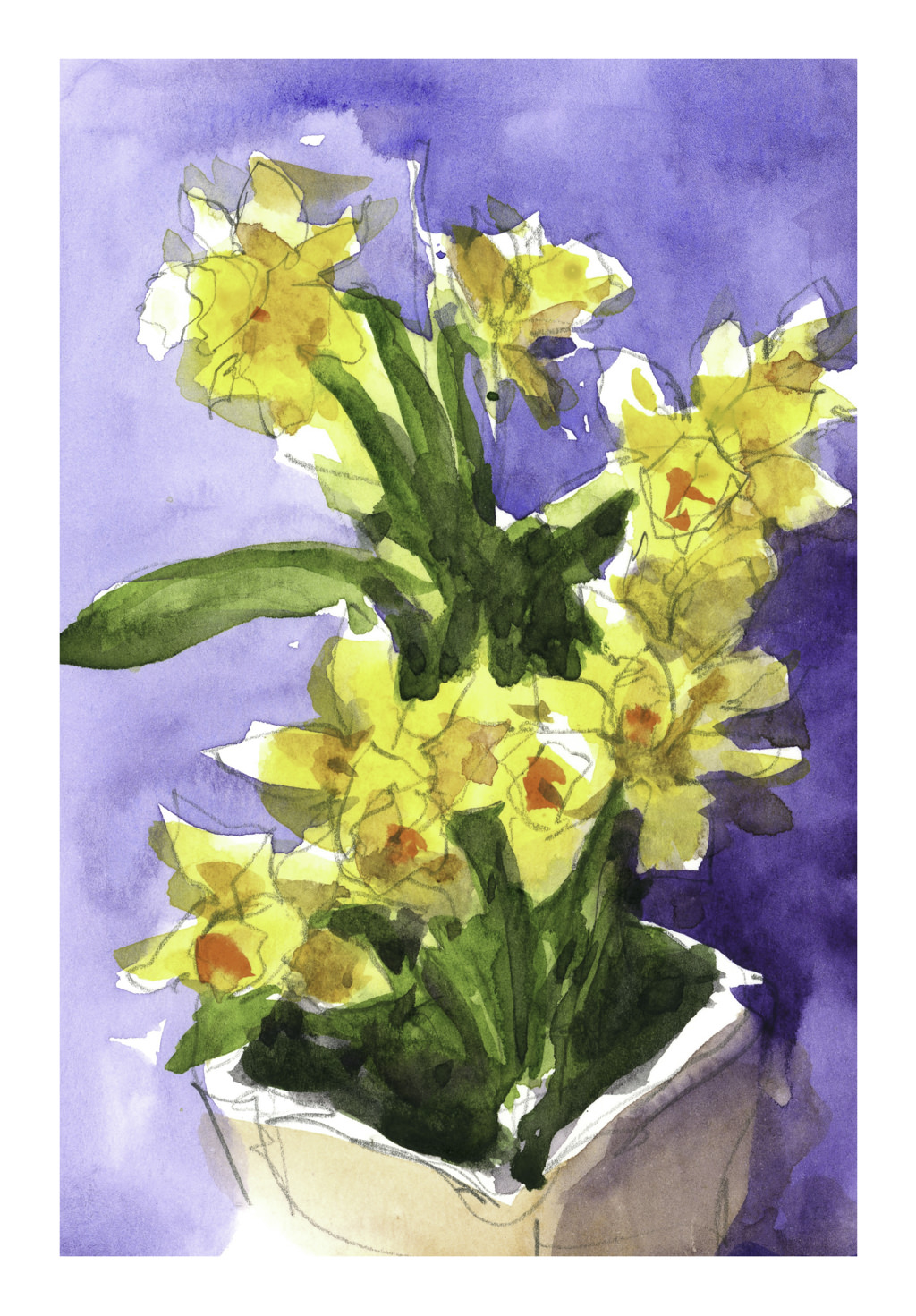
More work on negative painting and flowers. I wanted simple but interesting flowers to paint. Daffodils are perfect for this – beautiful flowers, usually one color, and have a relative simple shape – petals and a tube in the middle.
To begin, I obviously did a sketch, and obviously also depend on the sketch to let the viewer know these are (supposedly) daffodils. I painted the blue around the drawing first – working the dark in against all traditional watercolor rules. Then, the vase. Then a loose blobbing of yellow, darker yellow, some greyed yellow for shadows, and a touch of orange for the centers of the flowers. The leaves happened somewhere, and final daubs of darkestness to accent things.
Not a great painting but it was a good practice piece. Still more practice is needed. Negative painting is getting easier. Color blobs are getting easier, too, to show lighter and darker areas, as practiced in yesterdays press-release brush play. Once more, I am not after a botanical painting with detail, but an ability to have a loose, expressive style that shows things in a painterly manner for what they really are.
For many years I did Chinese painting and sumi-e (Japanese ink painting), and learned a lot about brush strokes. While the brushes used in these schools of painting are brushes, they are constructed differently than western art brushes and have very different characteristics. However, what you do with them is the same in many instances. Both Chinese painting and sumi-e depend on lines made with ink to create shapes and forms, express colors where none exist, and add color, too.
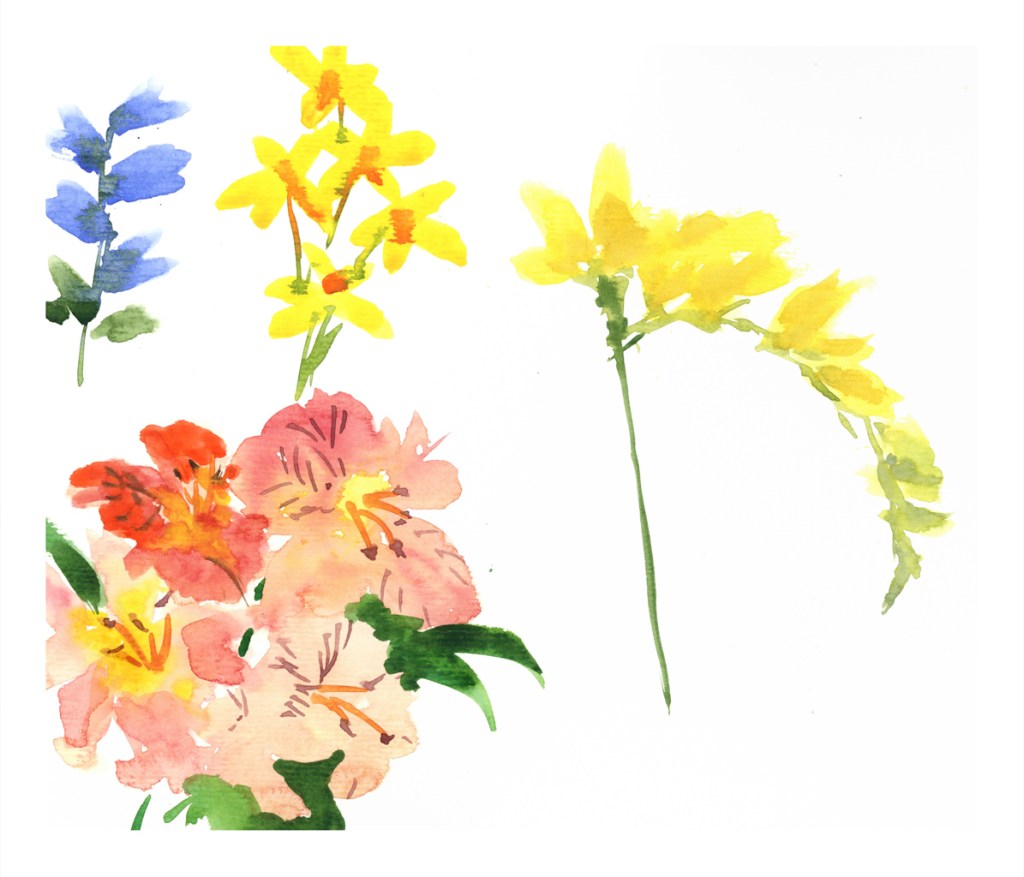
To create the flowers above, I simply loaded my round sable, placed the tip on the paper, and pressed down gently as I moved the brush from a vertical to more horizontal. The point has more color than the body of the brush and this allows for gradation of colors. The point can be near the stem of a flower and leave a lighter tipped petal at the edge, or be the outer edge and lead to the center; the outer petal is then sharp and pointed. As well, paint can be added to vary colors, provide details, and so on.
Above, the blue flowers have the brush point closer to the stem and the yellow daffodils have the point used as the end of the petal. The freesia, the yellow flower, employs both techniques with extra color added. The alstromeria is done with the pressing technique, extra paint added while still damp, and final lines added with a brush point once the paint was dried.
I tend to forget that brush work is as important in watercolor as it is in ink painting. Shapes and lines and textures are expressed as they are in Asian ink painting. The fact that color is always the most attractive element in watercolor keeps me from remembering the importance of good brushwork.
Practice makes perfect. While far from perfect, I have been trying to improve how I do negative painting. Flowers work well for this, but I have also decided to conscientiously work on flower painting.
I looked over at Pixabay and searched for “white flower” – several came up, some too busy with other things, some too simple, some lacking definition. What I wanted were white petals sticking out from something. As I already did daisies, I thought ones a bit simpler but still having interesting characteristics could be nice. Anemones of varying sorts came up, so off I went.
Above is the first one. I drew in the outline of the flower and then painted the center of the flowers but not any shadows on the petals. From there, I worked on the negative painting, trying to paint around the white petals. Then I let it dry and, as you can see in the lower left, put in a darker wash to outline leaves and a stem or two.
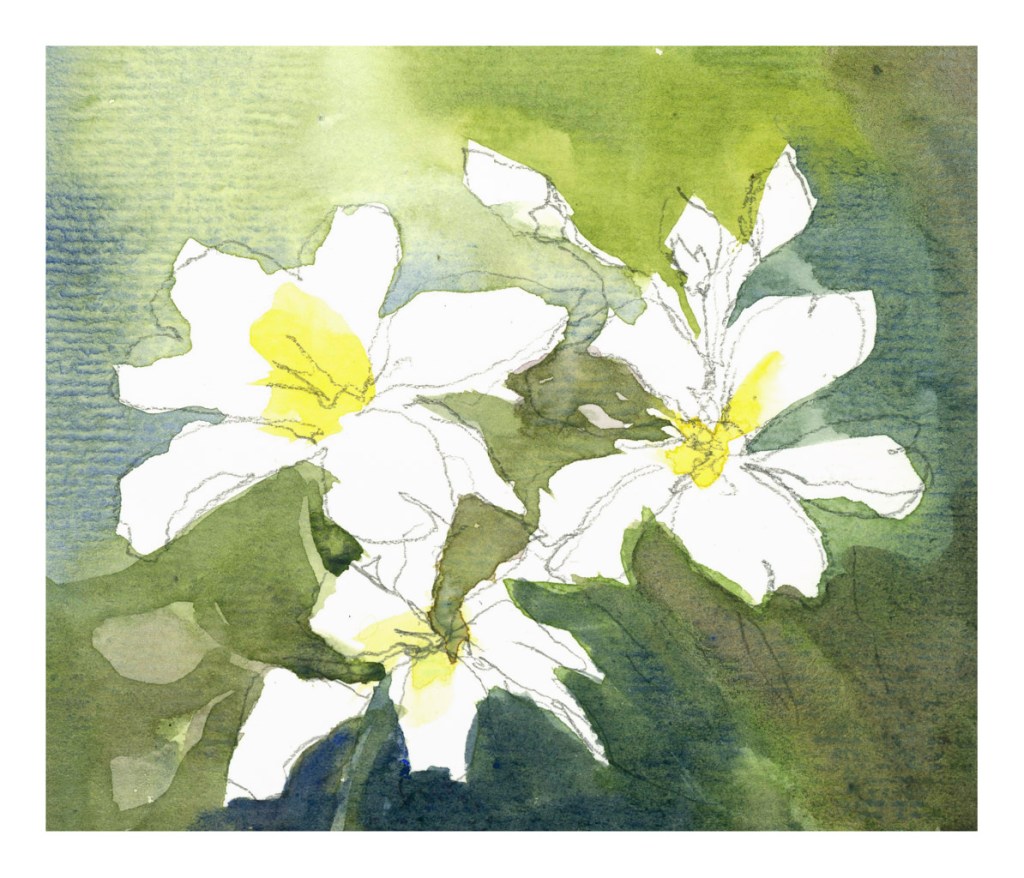
The second painting below was a bit more complex. I did the shadows on the flower petals – still white – after drawing in the basic shapes. You can see my pencil lines throughout. Then I did the leaves and stems in a lighter green. From there, I mixed in greens and blues for the most part and worked to paint around the white and shadowed petals, looking for contrast, coolness and warmth. After I let the painting dry, I went in again with shadows, augmenting a few petals here and there. The final step was to paint in the yellow flower centers with a dab and press of the brush.
I rather like these – they don’t look too overworked compared to the previous ones. My style is looser, which I prefer. As well, I worked with tube paints and a bigger palette so as to mix more colors. The paper this time is 100% cotton, a student grade one, but acceptable.
Just because these are better than previous negative painting studies doesn’t mean I’ve gotten there yet! So much more to learn – and a lot to do in that learning process.
Negative painting is painting around an object, usually using darker paint around a more lightly painted object. Anyone who paints finds this quite often to be a bit of a mind tweak, so it is always worthwhile practicing. For me, negative painting is best done with the subject matter, if a photograph, done upside down. Then it – and everything else – just becomes a shape. Shapes are easy to relate to, more so than a flower or a whatever.
I really cannot paint flowers easily. I don’t want to create realistic paintings of flowers, but impressions of flowers. Being able to express a flower and to know what it is appeals to me far more to me than a scientific flower illustration. Don’t get me wrong – botanical illustration is stunning and something I love to see and admire them – but I want a looser style.
One way to express a flower is to create it in its environment. A field of flowers can dance in the wind. A bouquet of either one type of flower or many has its own beauty – the shape of petals and leaves and stems creating their own designs. Stems and leaves seen through clear glass are distorted fascinating to see.
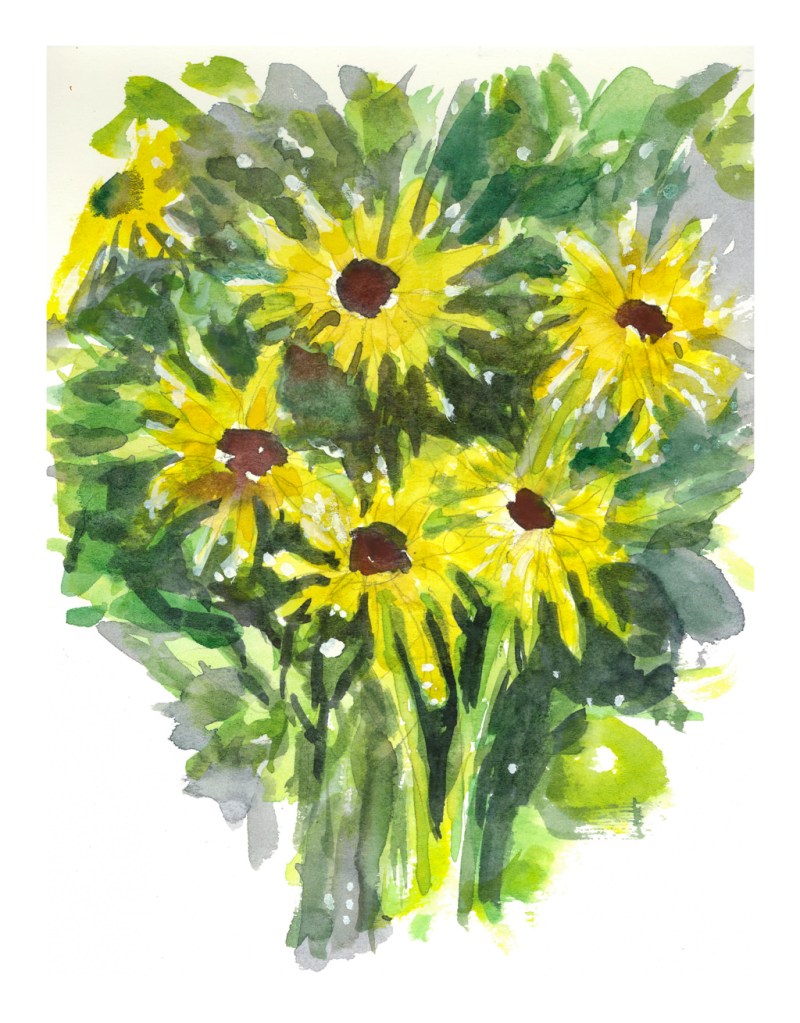
For now, though, I just wanted to practice negative painting. I drew my flowers, and went to work, laying down basic colors and then coming in with darker colors to create shapes, such as leaves and stems. I did the daisies first, and they are rather crude. The poppies were next, and while the colors are muddy in places, it was more successful as far as what I was trying to accomplish.






 Ink, Yarn & Beer