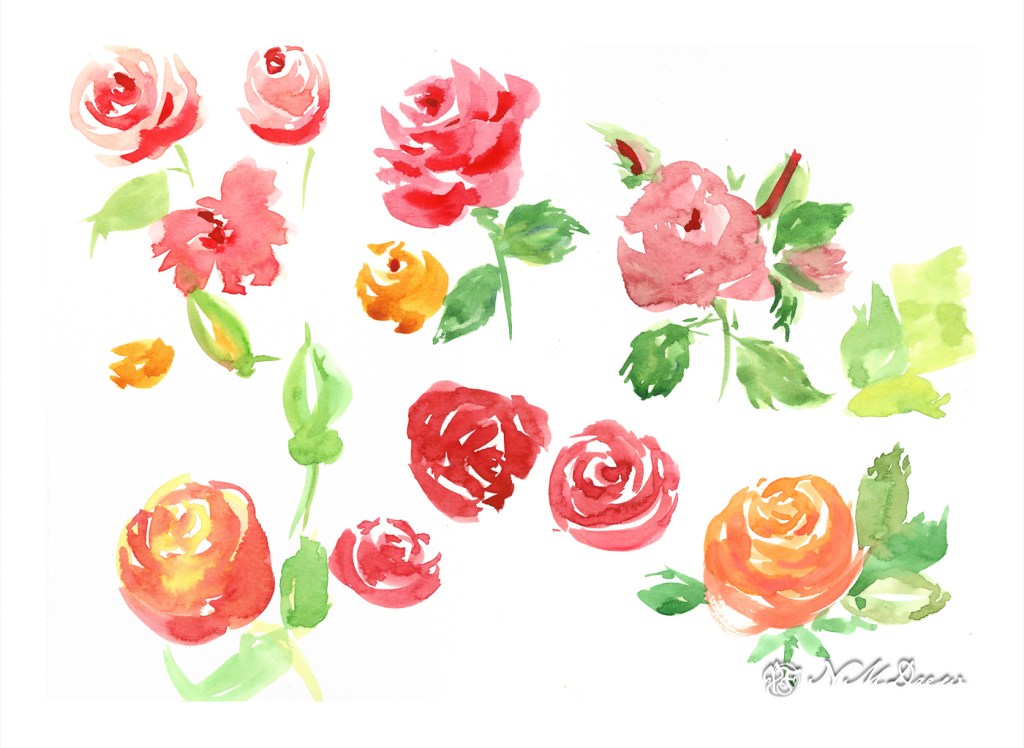
More roses – more C strokes – and then other kinds of strokes to make leaves. For the leaves, brush point on paper, squish down and move, bring brush up to another point. Just as in sumi-e! Then, while the paper and paint are still wet, take the tip of the brush and create little points around the outer edge of each leaf. Some roses have pointy leaf edges, others do not. I don’t think the Rose Police will come knocking on my door, though, so I am safe.
Roses in these kinds of sketches are easy enough to do. However, creating a successful painting of more than one sketchy rose is another story. Light, shadow, shape all begin to play together, and sometimes not very nicely.
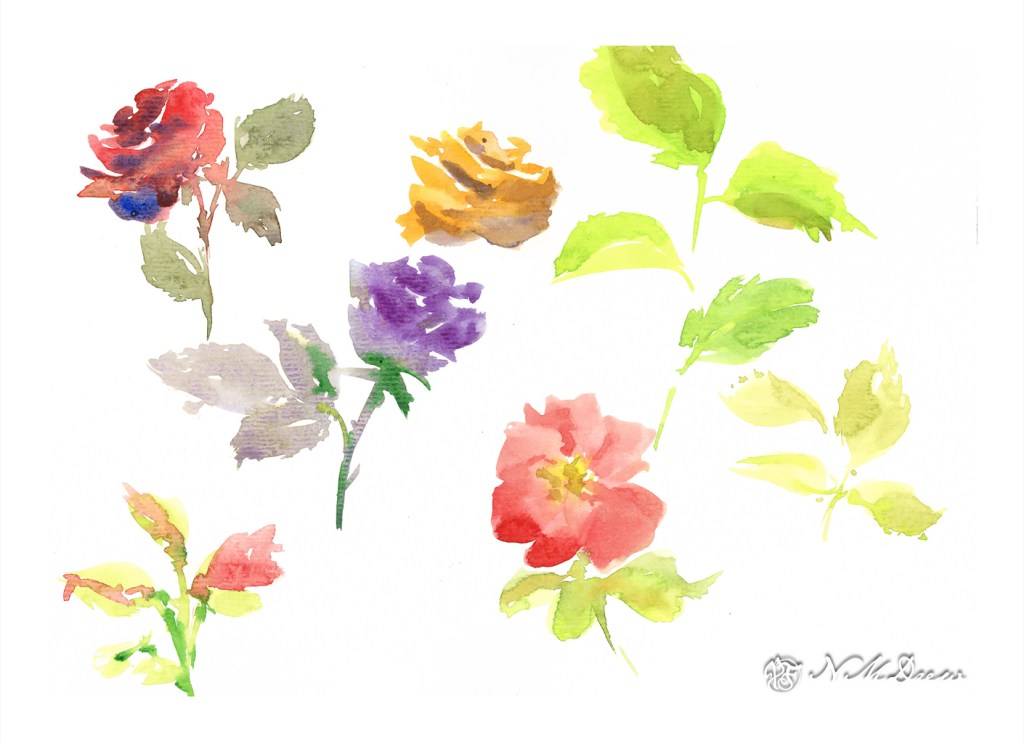
Here, a rose with a simpler petal style than the classical tea rose. As a kid in the midwest there were deep red wild roses throughout the countryside, and here in California there is a bush as above along a local trail. There are about 5 petals around a yellow center, and the wild roses are messy things that are such a pleasure and delight to encounter.
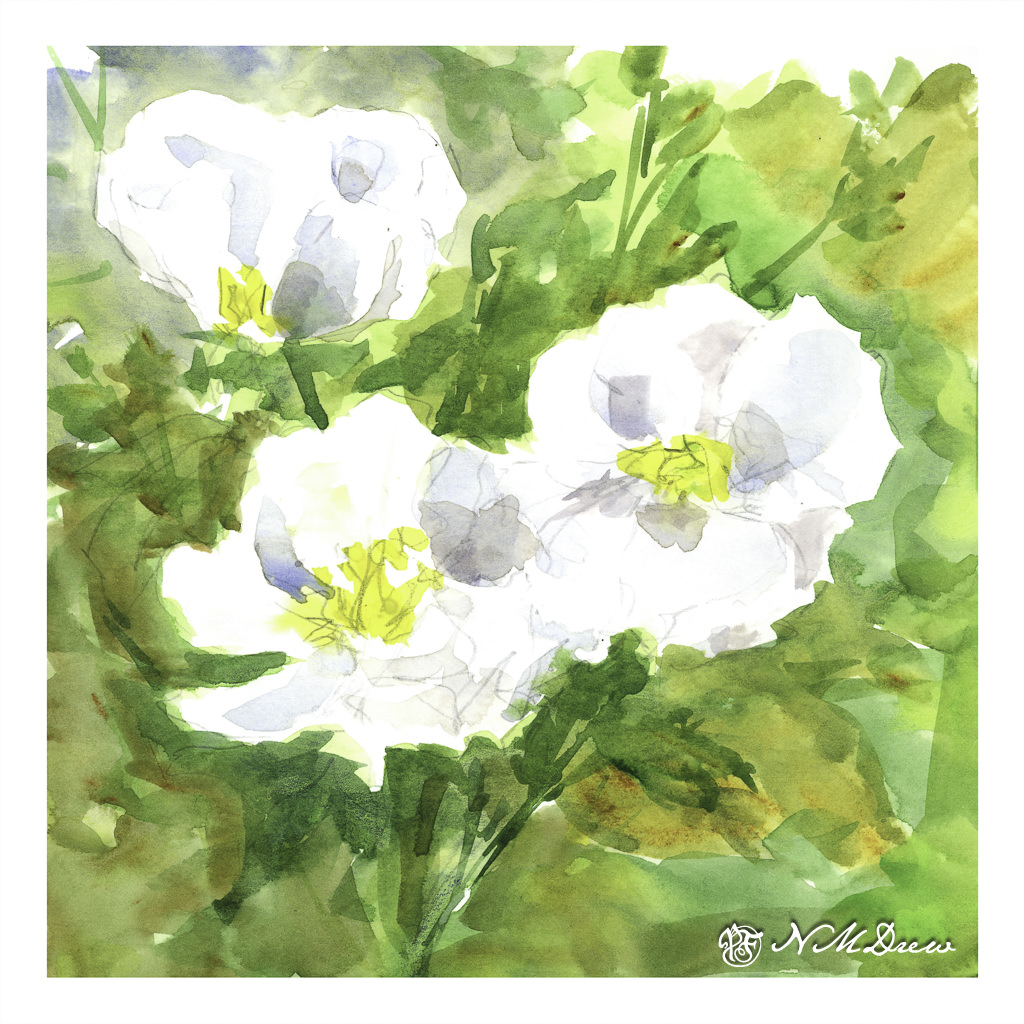
Painting a white rose is not easy because white is influenced by light and shadow and shade. Instead, you have to look at the colors in the white – light? dark? cool? warm?
The above little painting was a success, but it is only a sketch. A bouquet of roses will be far more challenging and I really doubt my ability to succeed there.
Things are made up of shapes, and understanding their shapes and structures should – hopefully! – make them easier to paint.
I have a small rose garden, and it always pleases me to see it in bloom. Most of the roses I chose for fragrance, but some I chose because I like them. So, as my roses come back to life after weeks of rain, it seemed fitting to paint roses.
A few videos later . . . open roses are shaped like tea cups. For me, try a coffee up. Paint them like a series of C shapes, but vary the thickness of the C strokes. These made sense. As well, when looking at the roses, I realized my way of seeing things to paint has shifted over the past year and suddenly they became easier to “see” – if that makes any sense.
In our home, fairies abound. They take things away, hiding them, as well as giving things back, or leaving presents of many sorts, desirable or otherwise. We have Sock Fairies, Cat Fairies, Phone Fairies, Key Fairies, and Amazon Fairies, to name a few. And as today is St. Patrick’s Day, it is worthwhile to celebrate our own Irish heritage by enjoying a shot of good whiskey in the evening and some traditional Irish soda bread.
And letting the fairies run free.
There are very simple recipes of only 4 ingredients for soda bread, to some more complicated. All require the use of baking soda and an acidic liquid – usually buttermilk – to react with the soda to produce the gas which makes the bread rise. So, without further ado:
Irish Soda Bread
4 c. flour
6 T cold butter cut into small pieces
4 T sugar
1 t salt
1 t baking soda
1 c raisins or currants
1 egg
1 3/4 c. buttermilk (can use an appropriate substitute)
Preheat oven to 350-375. Place raisins in hot water to soak for 30 mins. or microwave a minute, soak, drain, pat dry. Line baking sheet or cast iron pan with parchment paper.
Mix together all dry ingredients except raisins. Add butter, cut into flour to make a coarse meal in appearance. Stir in raisins. In a separate bowl beat together egg and buttermilk.
Check to be sure the oven is hot enough. Once you have verified it is to your liking, make a well in your dry ingredients, dump in your wet, and stir with your hand, fingers extended, until you have a soft, sticky dough. Turn dough out onto a floured board, knead a bit as you would a biscuit (but not a yeast bread) working quickly. Shape into a large circular loaf about 1 1/2 – 2 inches in height. Place on parchment lined pan.
Using a sharp knife, slice the bread with gashes about 1/2 inch deep and spread the gashes a bit. The gashes go from one side of the bread to the other, forming a cross. The cross blesses the bread; on a more practical level this allows the center of the bread to bake more quickly. Then, in each quarter of the bread, make a small cut – this allows the fairies to escape and ensures better chances of a successful loaf.
It is important to note that you do not want your bread to sit around, liquid mixed into dry, while your oven heats up. Wait patiently to mix. My oven is a slowpoke and takes a bit of time to get anywhere I want it, and then it often sits around at 350 even with the marker up to 450!
Bake 50-55 mins. at 350. And then, cool the bread on a wire rack. Test for doneness by tapping bottom of bread. Just as with yeast bread, a hollow sound indicates it is baked.
Some people say wait until all is cooled before cutting in for a better loaf, but that can be difficult. Who can resist warm bread and butter?
This was going to be a nice beachy scene with a white house and rocky coastline . . . but things got out of hand. First, a part of me blames the paper – it is student grade and did not seem up to the task of a lot of large swaths of wet washes. Next, I got frustrated. And I was hungry. And getting quite annoyed. So, I just grabbed stuff and sort of scribbled on it – take that, you nasty painting! Anyway, this is the result, and while it is certainly no beauty, it makes me remember I do want to do some nocturnes – night paintings, night colors. How can that be done?!
Masses of color to create suggestions of shapes? Check.
I am pleased with this painting – there are areas which could be better, but is any painting actually “perfect”? Certainly not in watercolor!
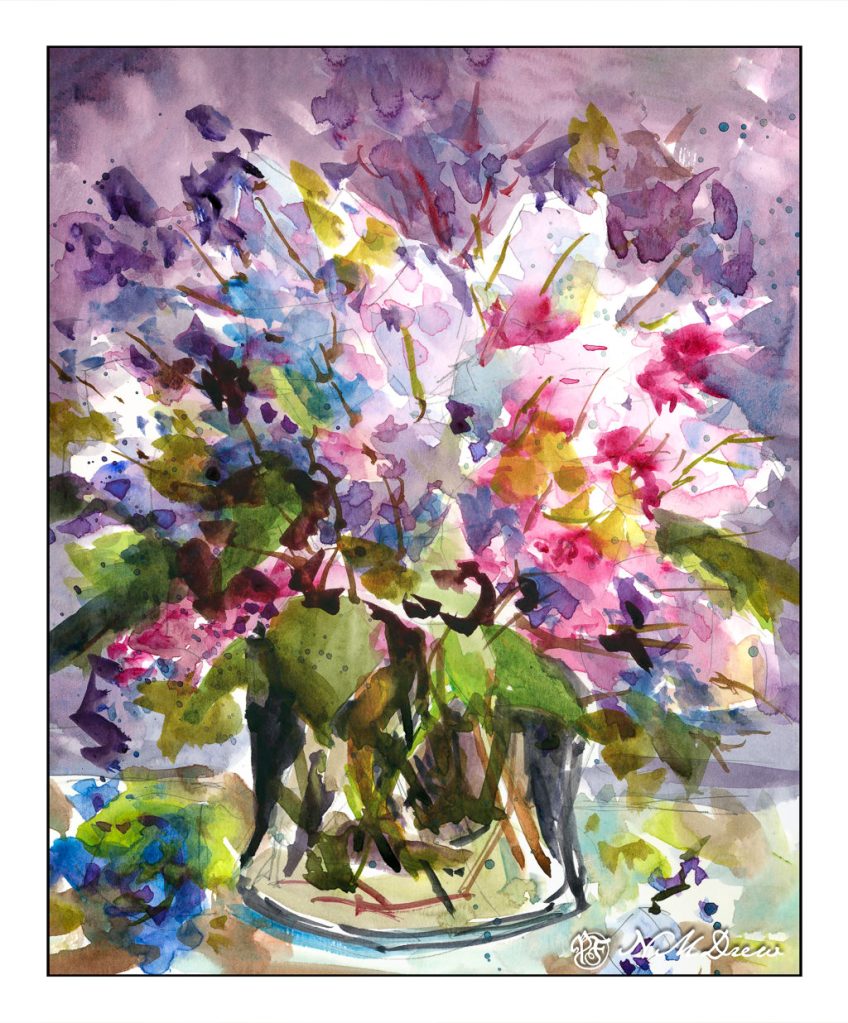
Lilacs are one of my favorite spring flowers. Their fragrance is heavenly and a welcome sight as winter fades away. Sadly, it seems hybridizing them for a coastal SoCal climate is not successful.
I drew the flower masses in pencil, creating general shapes. A few pointy leaf shapes. A glass vase. Dropped petals. From there, the rest happened with lighter washes of color, white areas left behind, and eventual deepening shades of lavender, purple, and pink. Some blue, too. It sort of happened all over rather than section by section.
And then my next painting was a complete disaster!!



 Ink, Yarn & Beer