The Four Treasures: Brush, ii

Quite some time ago, I wrote about brushes used in Asia.  As I am beginning Saturday morning Japanese language classes, I am in conflict with time and distance in being able to attend my Chinese painting class.  I’ll just have to figure that out later.  However, the fact that I am learning hiragana, my preferred practice method is the traditional brush since I enjoy it so much.  It is also said that the strokes used in Asian calligraphy are those used in Asian painting.  Given that, I thought it would be worthwhile to review elements of holding the brush.

Holding the Brush Is Not the Same as Holding a Pen

When I was in school, penmanship was an important part of the daily curriculum.  I practiced my penmanship from first grade through the eighth.  My third grade teacher shamed me by saying “Any one who draws as well as you do should have good penmanship.”  Ooops!  In eighth grade I won a penmanship award.  Over the years, I’ve collected a few manuals on the Palmer Method of penmanship, which is the basis of much of what I was taught in school.  Today, penmanship has been replaced by other methods of handwriting – you might find this article amusing if you remember your penmanship classes.

Enough digressions.  The fact is that Western culture teaches the student to hold the pen at a slant.  These scans from an old Palmer Method manual show what I mean. Additionally, the writing surface is also at a slight angle, tilting gently toward the writer’s lap. Paper is also angled, so that an uphill slope is created for writing left to right.

Illustrations from various books, published in the US, Japan, China and elsewhere demonstrate how to hold the brush. Rather than the slanted wrist resting on the table, the brush is held perpendicular to the writing surface, which is not at all slanted. The forearm is held rather straight, yet relaxed. The brush may be held close to the bristles, or anywhere along the handle, all the way to the top. The paper is also straight, with the idea being writing is vertical, and there is no need for the paper to be slanted.

Ms. Kuroda Holding a Brush

Holding the Brush

Hand Position

To the right, you can see how to hold the brush. This illustration is from a Japanese book on sumi-e painting, and unfortunately the only thing I know about the author is that her name is Kuroda san.

According to H.E. Davey, author of Brush Mediation: A Japanese Way to MInd & Body Harmony,

Grip the Brush Gently and Focus Your Ki through the Brush Tip

Physically speaking, shodo [Japanese calligraphy] begins with the student’s grip on the brush. Unless a suitable technique of gripping is mastered, no advancement is possible . . . First, your elbow should not stick up or out to an excessive degree. This would only create an unsettling of the arm’s weight a s well as produce tension in the muscle of the arm and shoulder. This tension can cause your flow of ki to clog in the shoulders and not be effectively transmitted through the brush into the painting. This point is important, and various Japanese calligraphy authorities have made note of its significance.

At the same time, do not let your elbow sag or droop . . . when your elbow sags heavily toward the ground, it also tends to rub against the body and produces a cramped feeling that is expressed in your in your artwork. You should feel that your elbow is floating in a settled position a few inches from your body. (pgs. 76-77)

Sitting with the Brush

In my opinion, one of the very best books on sumi-e is Sumi-e Self Taught, by Kohei Aida. No longer in print, you might be able to find it through an online used book service; if you are interested, it was published in 1968, by Japan Publications, Inc., of Tokyo, Japan. The text is in English, which is very helpful. The best part of the book is that he shows the artist how to load the brush, how angle and roll it on the ink-water dish’s edge, and many subtleties not illustrated in most English-language sumi books.

Aida san shows how to sit in a western manner (upright at a table) while holding the brush.  H.E. Davey’s book, Brush Meditation, also has several photos on posture and sitting.

Going back to my blurb on knitting, posture, and pain, I suggest that you concentrate on sitting upright and focus on bringing your shoulder blades back toward the spine.  Don’t arch your back, but focus on a gentle backward movement of the shoulder blades, and a focus on a plumb-line approach to your spine.  If you are sloppy like me, this will be unfamiliar, and uncomfortable because you may not do this naturally, and your muscles will not be happy.  However, with time, it gets easier – I’m actually remembering to do it, and occasionally find I’m still upright later on . . .

In this position, you can move your arm as well as your wrist.  Tighter movements will be done with the hand closer to the bristles, while holding the hand at the top of the brush gives a wonderful looseness in the stroke.  In calligraphy, I expect these same results will apply.  If you look at my post about painting the dragon you will also see that the brush can be held at different angles – sideways, for example.  Aida san’s book demonstrates the same.

Aida san Demonstrates Brush Movement

Movement of the Brush

This illustration to the left, from Aida san’s book, shows how the brush may be tilted to achieve a brush stroke while painting.  The hand and wrist may also be tilted to create curves, pressure may be applied at the end of the stroke, and gliding motions similar to an airplane landing and taking off can make thin-to-thick line, and vice versa. Ending a stroke with increasing pressure will also create a certain effect.

The Charles E. Tuttle Company has published wonderful art books about Japan.  One book which has been in print since 1960 is Japanese Painting as Taught by Ukai Uchiyama, Kay Morrissey Thompson.  The reason I mention this is because the next picture is for the artist sitting on the floor, in the traditional manner, to paint.  At the same time you can see that the brush is being held very near the top of the handle.  Looking at Uchiyama san’s work, you will notice a very loose, wild style which is, nonetheless, very controlled and lively.  Mastery of the brush allows for this, and perhaps sitting on the floor adds to the process.

Ukai Uchiyama Painting
Uchiyama Holding Brush

This detail of the photograph shows you how Uchiyama san holds his brush – just the same as Aida san, simply closer to the top of the handle. Practicing this yourself will help you understand the quality of stroke and control obtained by holding the brush at different levels along the handle. Certainly the closer your hand is to the bristles, the more minute control you have. Shoulder and arm movement are more restricted when in this position. Freedom and spontanenaeity increase with distance. However, without a knowledge of how to use the brush, this can be a study in frustration! So, focus yourself, breathe slowly and deeply. Imagine your energy flowing out of the brush tip – your ki – and with practice, your brush may dance with your soul.

Artist in Action

Once more, I believe videos can clearly demonstrate something which is difficult to explain with words. This video will show you how to hold a Chinese (or Japanese, or Korean, or whatever!) brush for calligraphy.

The following video is of the young Japanese artist / calligrapher, Koji Kakinuma.  In particular, watch how he changes from thin to thick lines, as well as how he tilts the brush at different angles; you will observe this by observing the brush tip.  When the brush is perpendicular to the paper, the tip must be considered to be the center of the line.  Tilting the brush, increasing and decreasing pressure – sometimes all combined – vary the appearance of the stroke. Notice, too, that the bristles in the brush are longer in length than a painting brush.  Soft, hard, and mixed-hair brushes may be used, each having its own qualities.

Finally, here is a video about the difference between calligraphy brushes and painting brushes.

A Sweater Amidst the Smoke & Ash: Buttoned Cardigan, ii

The fires east of Los Angeles now cover over 220 square miles, or 140,000 or more acres.  80 miles away, to the west, the air is thick, the sky has a pale color to it, and when the sun manages to hit a surface, it is a sickly, reddish color.  My eyes are burning, my throat hurts, and I am sneezing.  That’s about as far as I will go – let’s just say, if is an altogether unpleasant experience here, I can only imagine how awful it is for people in the middle of it, the fire fighters, and everyone else.

There are a lot of rather snotty comments about California, fires, and so on.  The fact is, every year the fires seem to be worse than those of the previous year, larger, harder to contain.  Some of this is because of the ongoing drought, some is because of global warming, some of it because of the pine beetle, and some of it is because containment of fires has been the general practice, if not total abatement.  Given the population density of the Los Angeles area, this makes sense – but when payback comes, it is nasty.

However, it is not just people who pay the price – wildlife also pays a price for this.  How many wild animals have been burned to death, how many are without water or food?  The cost is far greater people’s homes, it is the entire eco-system which pays the price, from humans to caterpillar, deer and songbird.  The depredation of the environment is global, but so many people do not want to admit to it.  And I am beginning to believe that less and less will be done, can be done, as populations increase, and living space and arable soil and clean water become less and less available.

But enough of this.  Since it is hard to do much in this heat and fouled air, I thought I would take some pictures of the Buttoned Cardigan I have been working on.  I’ve done the lower body, to the arm hole area, and completed the back.  I am now ready to continue with the fronts.  It is knitting up rather quickly, which is something I am rather enjoying right now. This picture shows you the sweater laid out with the sections done to date.

Here is a closer view of the buttons I bought for the sweater, and I think you can see how nicely the green buttons work with the greenish elements in the sweater itself.

And finally, the edging detail, which, admittedly, gets lost in the yarn. Still, I think it has a nice, finished quality to it.

Cornbread

I always forget to buy cornmeal it seems, so Sunday I saw it in the market, and grabbed it.  I like it for its texture and flavor.  And I love cornbread.  Since school begins again tomorrow, I decided to go ahead and make a nice dinner that will carry over into lunch for a day or two.  Meatloaf, cornbread, salad.

There are all sorts of theories about “Northern” versus “Southern” cornbread, with the former being with yellow corn meal and a bit of sugar, while the  latter is made in an iron skillet using white corn meal.

This is a recipe for “Golden Northern Cornbread.”  And another.  Don’t forget to look up cornbread on Epicurious, either.

Here is a recipe for “Ben’s Southern Cornbread.”  Here is an article called “The Great Corn Divide.”  And here is another recipe for Southern cornbread.

Corn has been a staple ingredient in Tex-Mex, Mexican, and Southwestern cooking for a long time – after all, corn originated in the Americas.  So there are other variations of cornbread still to be found.

My version is decidedly a Southwestern-style, as it has green chilis, cheese, and corn in it.  For what it’s worth, here is my recipe.

Naomi’s Southwestern Cornbread

Preheat oven to 350-375 F.

1 c. flour
1.5 c. yellow cornmeal
1 T. sugar
1 T. baking powder
pinch of salt

Combine all of the above together in a large bowl.

1 stick sweet butter
1 large, fresh pasilla pepper, chopped up (you can use other peppers, as hot as you like, and perhaps some onion as well)
1 c. corn (fresh is best, but I used frozen today)

In pan, melt butter, saute peppers and corn. Even if corn is frozen, put it in with the peppers and butter and break apart. Saute till tender.

1 c. milk (can be a combination of milk, cream, yogurt, buttermilk, and water to equal a cup – good way to do it if you are short any one ingredient)
2 eggs

Beat together until well blended. Dump into corn-flour mixture. Stir in a bit, then follow it up with the butter-corn-pepper melange, and finally the grated cheese.

1/2 c. grated Jack cheese (I like a bit of cheese in cornbread – makes it nicely moist.  Use more if you like it gooey!)

Pour into greased bread loaf pan. Bake 30-40 minutes until done. Turn out onto wire rack to cool. Serve plain, with butter, or reheat on skillet in morning, to toast.

Enjoy!

Summer’s End

Somewhere I remember reading about a “rosy dawn,” but today’s rosy dawn is because of the fires burning in the San Gabriel area in Southern California. Yesterday as I drove home from Ventura, the billows of smoke from more than 80 miles away could be seen piling up in the sky, much like a volcano’s ash and smoke as it travels upward. This morning, the air is thick, and ash is falling on the streets in very fine particles.

The entire state of California is very vulnerable to these fires, which are part of the eco-system, and the fact that we have had a drought for several years, makes massive fires a very likely probability.

Where we live, we are in a valley surrounded by mountains. So far, we have not had anything major since moving here nearly five years ago, but I wouldn’t be surprised if our time will be soon. So many things can cause a fire, from a spark from electrical equipment to a bird on fire after hitting a power line (yes, it has happened), that you just don’t know where it will occur. You just need to be ready. Fires and earthquakes – a fact of life in California.

This week, our very good friend, Jerry, and his wife, Raka, have been here from Japan. They were married a year ago, and only now is their wedding reception being celebrated by their friends and family in the U.S. And, their first child is on the way! It is so good to see them, and wonderful to have the time to visit. They return to Japan tomorrow.

For me, the end of my all-too-brief summer holiday is winding to a close. I’ve had a few weeks off from students and school, but I still have had to deal with them even though I have tried to keep it to a minimum. We all begin again on 1 September.

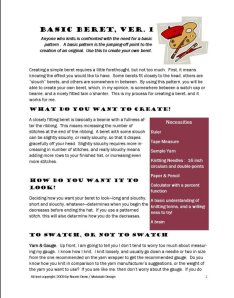
I am also becoming a student again. Now that I have finished my teaching credential, the brain finally has time to pick up Japanese once again. I’ve tried different routes, but nothing seems to have been successful. I tried a community college class two nights a week while working on my credential. Beret Patt - First PageToo much work on all levels. Another time I tried a language class offered through a local adult school, but did not learn anything. Now I am trying to do it once more, this time through the Oxnard Japanese Language School. As the course meets state high school language standards, I expect it will be much be more to my liking. My class is for beginning adults; there are five adults, and seven kids, the youngest of whom is thirteen. Once we all settle in, I think it is going to be a lot of fun.

Finally, I’ve written down a very windy “how to” for making your own beret. Take a look at it. The purpose of this “Basic Beret” pattern is to help out the beginning knitter trying to design a hat. You can find the file on Ravelry, or here on the Pattern page, or under the heading of “Matataki Designs” to the right.

Old Vines Scarf: Pattern & Process

Friday was a really big day for me!  I decided to post to Ravelry, and to here, my first “pay for” pattern.  It is the that I wrote about last March.  You can find it on the “Patterns for Sale” page.  Please give some consideration to buying this pattern!

Writing up a pattern takes some time, as does creating the knitting schematic, shooting the pictures, doing a layout, and finally creating the PDF file that goes along with it!  It really is a major process, far more than I anticipated.  And the thing is, the item has to be knitted before you can photograph it.

I used Knit Visualizer for the pattern schematic.  It is a fairly expensive piece of software, but it is really worth the price paid because it is so easy to use.

My camera is a Casio Exilim, and I can get pretty decent pictures with it.  My preferred settings are with all 9 sensors being used, along with soft flash and a +1 light setting.

For the PDF, I begin in MS Publisher, and then create the document using text boxes, clip art, my photos, and Knit Visualizer schematics saved in a PNG format, and then imported to Paint Shop, and saved as a JPEG.  Once I am happy with my Publisher file, I save it, and then, beginning on the first page, I “save as” and create a PNG file.  Finally, I use Acrobat Pro to create the PDF by choosing “create PDF from multiple files.”  My preferred PDF is “highest quality” for better detail.  It works very well.

Photos are really odd creatures.  You think you have a good one, but you don’t.  This is why I love digital pictures and software.  Cutting, editing, whatever – all can be done pretty readily.  Fonts and so on are also important, for headers, subheads, and content.  Everything needs to work well together.  The direction of a model in the layout leads the eye in, or out, of the page.  Busy-ness is distracting.  Too-much-of-the-same, in density and visual rhythm creates a visual yawn.

Anyway, there you go.  Here are some of the more than 40 pictures I took for the photo shoot.  These were some I liked, in addition to the ones you will find in the Old Vines Scarf pattern itself.