I Want Bread!

While in Portland, we went to a bakery for a quick snack before going down to Powell’s Books.  I picked up a loaf of rye bread for the other half – and for myself, I admit.  Good rye bread is a favorite of mine.  I never had “real” bread until I left home, where Wonder Bread was the norm; once I did, though, I could appreciate bread and understand why people raved about different breads.

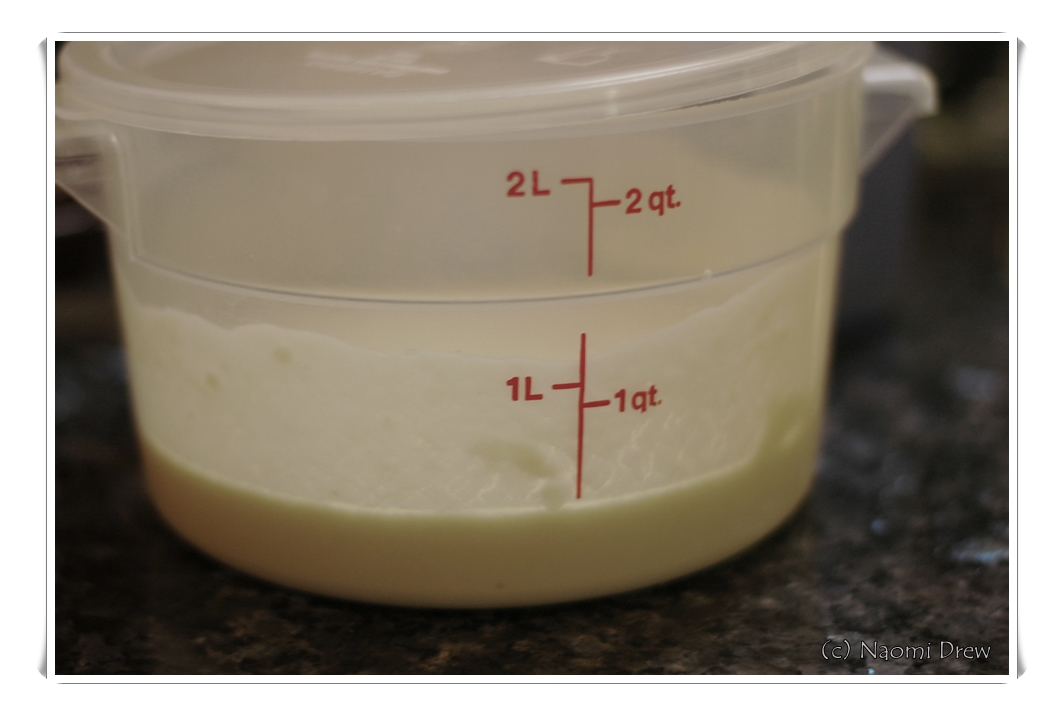
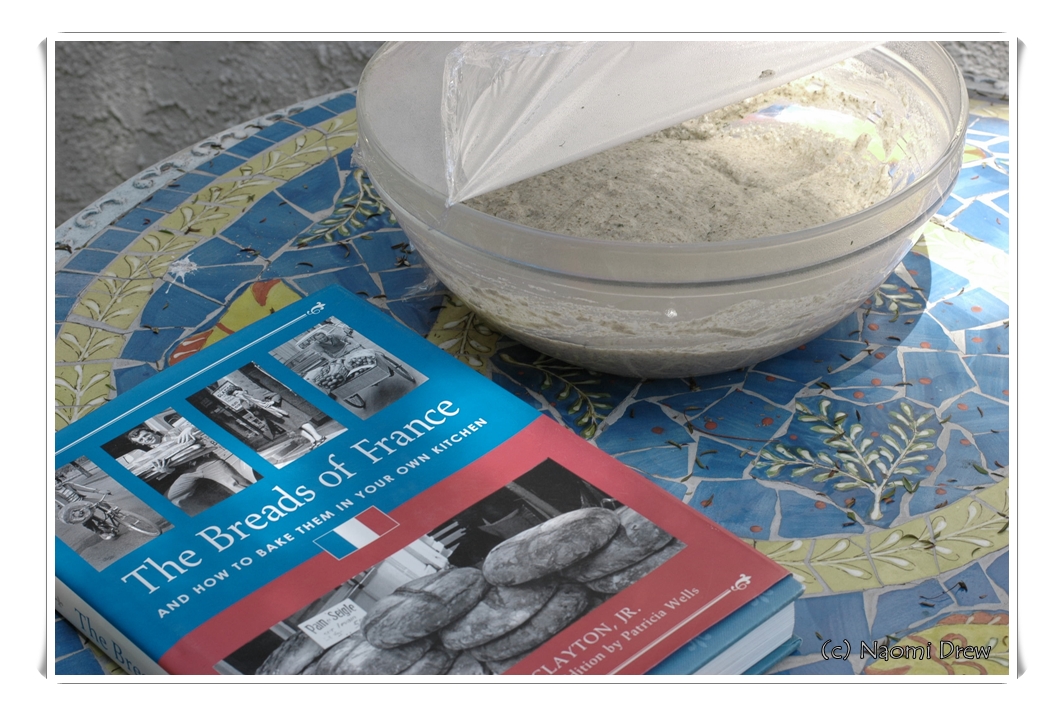
I am settling back into life in California.  With still a week off before returning to work, the desire to create and work with my hands is overwhelming.  So is the taste for good, fresh food – something we totally enjoyed in Portland.  Given this, I dug out The Breads of France, by Bernard Clayton, an author I adore.  Pain seigle, a French rye, is one of my favorite recipes.  The sponge is set up, outdoors in the sun, to begin its ferment.  It has celery seed and dill weed added to it.  I have let it set for two or three days, but at least 12 to 24 hours minimum will suffice.

Josh started a sour dough which we will add to the sponge, just to see what a sourdough rye might taste like.  The sourdough starter will be used later, for other breads.  Did you know that the yeast cake at the bottom of a fermenting cask also can be used to bake bread?

The thought has crossed my mind it might be fun to bake our own bread for the next several months.  It could be fun to explore each recipe in Clayton’s book.  Then I could attack his other, bigger bread book . . .

Water & Beer

Like I said earlier, there is so much water in Oregon it seems illegal, especially to someone from Southern California where rain is a rare and welcomed experience.  Yesterday we set out from Portland to the wilds of Multnomah Falls and the backwoods of Hood River, home of the Full Sail Brewery and other places of interest.

Leaving Portland – a big city to me! – and heading out along the 84, the buildings of the area soon give way to the inevitable trees and brambles.  The landscape changes, too, from hills to more rugged terrain formed by volcanic action and the relentless activity of the Columbia River.  Moss grows on everything.  Trees and rooftops have moss on them.  Vines trail into every space.  Flowers dot the open fields with pink and white and yellow.  Everywhere I look there is greenery and water, and clouds as well, which can be very different than the unrelenting blue of the sky where I live (unless there is a hurricane in Baja).

We stopped at the Multnomah Falls enroute to Hood River, Oregon.  The falls are narrow, but drop from a great height into a rocky pool.  The fact that this area has been set aside has allowed the natural vegetation to take over, and it is well worth looking at in detail.  The red cedars that grow here are graceful trees – all covered in moss! – and are interspersed amongst deciduous trees and viney undergrowth.  The dampness of the area is apparent everywhere, and provides a lushness for plant life.

We wandered up the path to the bridge – built, not in a WPA project like I thought, but in 1925 – and a bit beyond.  Around every corner were wonderful views, and too many people, but the latter did not really distract that much; that is something to choose whether or not to focus upon.  I took a lot of pictures, sometimes holding up traffic, sometimes having to wait my turn, and thankful for the camera strap as I leaned out here and there!

From Multnomah Falls we continued on to Hood River, which houses many different breweries, the most well known to us being Full Sail Brewing.  Like many breweries, they offer a sample tasting of their beers, and a variety of meals in their restaurant.  Staff were friendly, and the food was delicious.  We also took a tour of their facility, which is small, but very modern, and boasts some very unique characteristics.  One example is the fact they are employee-owned.  Another is their history – how they got started is an amusing story.  The equipment to produce their beer is very modern and high-tech, but their beer, despite the multitudinous gallons produced daily, is still made by hand.  Yes, 1000 lbs. of yeast is a lot – far more than what Josh pitches – but there are also a few tons of barley and hops in the mash tun!

Hood River is on the Columbia River in Oregon.  Across the river is Washington State.  It is a small town, nestled along the river and tucked into the space between the river and mountains.  When we were there, it wasn’t a hoppin’ place, but it was clean and friendly, and the views were spectacular.  This could be a great place to live, I think!

Travelin’

First View of Mt. Shasta

We are off on a road trip for the next few weeks!  It is so exciting to “get out of Dodge” and see other parts of the world, familiar and new.  The morning of the 6th is when we slid out of town, stopping for a fast food breakfast just because we could.  And then out to the I-5 to head up to Chico to stay at our favorite place there, the Goodman House Bed & Breakfast.

I always enjoy the drive up to Chico.  There are so many changes in the landscape on the trip.  Where we live, in the suburbs, we move into the congestion of Los Angeles to connect to the I-5, and from there drive through the craziness of the Grapevine, only to end up in the vast expanses of the Central Valley.  This valley is one of the most productive areas in the country for crops, ranging from rice and cotton to stone fruits and nuts.  Unfortunately, with the drought of the last few years, irrigation has become a problem as water is becoming more scarce and more stringently rationed by the state to farmers.  Some crops require more water than others, which means some farmers suffer more than others.  Fruit and nut trees take time to grow, as do vines, while other crops may be seasonal.  I wonder, though, what the future holds for us as the planet continues to warm – what can we do as far as sustainable food production with more drought-tolerant crops?  Some farmers are blaming it on Congress and the Democrats – there were signs posted along the roadside saying “Thank Obama and Congress for another dust bowl” or something like that.  These days, water is power.

That said, the San Joaquin (another name for the Central Valley) is impressive!  The closer we got to Chico, the closer the hills came, and the more the crops became fruits and nuts.  Orchards never cease to draw my eye; I love trees, and lines of trees are endlessly fascinating to me.  Chico is a college town, with a state university in its midst, as well as the famous Sierra Nevada Brewery.  Walking around Chico is very pleasant as there are tall, old trees lining so many of the streets.  It was rather sticky and muggy, but still worth the bit of sweat we worked up just to be able to enjoy another city.

At the very top of the Central Valley along the I-5, you move into mountains formed by volcanos, the most famous of which is Mt. Shasta.  To me, that first look at that snow-covered ancient volcano is awesome – snow in the middle of summer, pointed, and unlike everything else around it.  That, to me, tells me I am moving into new territory.

In Heaven, There Are Limes, Basil, Garlic & Pistachios

And a few more things, like butter and salmon.

Last night, the Beer Man was off building rockets and dining on fine food chez Auntie Am, so I made myself a small dinner. Browsing through Epicurious, using the magic words of “salmon” and “basil” I came across a wonderful recipe for Salmon with Pistachio-Basil Butter.  Sure sounded good!  But!  I had a lot less salmon, didn’t want a lot of butter, and had tons of garlic, basil, and pistachios.  Dutifully, I opened a bottle of 2006 Babich Marleborough Sauvignon Blanc (after fighting with its seal for ten minutes), poured myself a glass, and set to work.

First thought – complementary foods.  Jasmine rice, and a chopped tomato-cucumber salad.

Next thought – how much is enough?  The original recipe called for one stick of butter, which is way too much for two small salmon fillets, but the intensity of garlic and lime and salted pistachios seemed very alluring.  My results were something like this . . .

Pistachio-Basil Butter
1/2 c. roasted, salted pistachios
3 cloves garlic
juice of 1/2 lime
1/2 stick butter, at room temperature, and cut into small pieces
1/4 c. packed basil leaves

Pulse the garlic, lime juice, and basil leaves together. Add the pistachios. When fine, add the softened butter, and blend until as smooth as possible.

Meanwhile . . .
Preheat oven to 400 F. Oil pan. Lay out the salmon fillets in pan and pour about 1/2 c. white wine into the pan. I had a very small pan, and poured in wine to come about a third of the way up the sides of fillets. Bake the salmon for ten minutes, then place about 2 T. of the butter on each fillet. Bake another five minutes. Remove from oven, and serve.

Observation
I had leftovers of the butter mixture, so tried some of the butter after it had baked for 5 minutes, and some which had not. The flavors blended nicely during the time in the oven, and the butter did not melt and dissolve all over the fish. And the unbaked butter? See below.

Caution!
Someone mentioned in the comment area for this recipe it was really difficult to not just sit down and eat the butter mish-mash. Absolutely correct! This stuff is deadly delicious.

Pattern for DIY Diffuser & Reflector

These were very easy to make.  The biggest decision was to glue or not glue parts together.  On the first one, I did, gluing one of the frames to one of the 90 degree elbows, and on the other I did not.  The feet, I glued parts, just because it made sense to have them as stable as possible.

Supplies

  • Ratcheting PVC pipe cutter
  • PVC primer
  • PVC glue
  • Nitrile gloves

For each reflector / diffuser frame you will need:

  • 2 10-foot lengths of PVC pipe, 1/2 inch. Note: if you want heavy-duty feet, use 3/4″ or larger, and adapt the parts accordingly.
  • 4 90-degree elbows, 1/2″ slip
  • 4 T-joints, 1/2″ slip
  • 4 caps, 1/2″ slip

Cut

  • 2 lengths 36″ long (frame)
  • 1 length 24″ long (upper frame)
  • 2 lengths 11.5″ long (lower frame)
  • 2 lengths 3″ long (footing)
  • 4 lengths 6″ long (footing)
Fabric

Choose your fabric to meet your needs.  If you are not familiar with sewing, a few things to note:
  • Be sure how wide your fabric is on the bolt.  It is doubled over, so it will be twice the width as on the bolt.
  • Remember that seams need to be considered in the purchase of your material.  This affects amount of material purchased.
  • Check the fabric.  Does it ravel?  Does it stretch?

Frame will tilt if the lower portion with the T-joint is not glued.

For my frames, I chose a transparent white nylon material, a gold stretchy lame, and a woven silver lame.  This material came in 54″ widths.  Thus, I bought 1 2/3 yards of the transparent white nylon, and 3/4 yard each of the gold and silver fabric, as I backed them against each other.

Frame Assembly

Create a rectangle using the 90-degree elbow joints. Assemble the 36″ lengths for the sides, the 24″ length for the upper portion. For the lower portion, join the two 11.5″ lengths with a T-joint.  Glue the pieces together if you want them to remain rigid in the frame, or do not glue these pieces to the T-joint if you want to be able to tilt your frame. Measure this lower portion against the upper 24″ frame with the elbow joints attached – you may need to adjust the lengths of the pipe to create a good rectangle by trimming the ends of the pipes. Before you glue your pieces together, remember to use the primer first. Then, glue the pieces altogether, or not. If you want to be able to take the frames apart, be judicious in what you decide to glue. Also, glue in a well-ventilated area, and wear your nitrile gloves!

Footing Assembly

Glue the 3″ pieces to either side of a T-joint. Before gluing, attach a T-joint to either side of this piece. Make sure that you place the center joint so it is 90 degrees to the ground – this is the part which goes upward to support the frame – and the side T-joints are flat to the ground. Use a flat surface to place this upon, such as a concrete patio or garage floor. When you are happy with the placements, glue them in place. I did these one at a time, and for the second one, quickly stood on both ends to make sure they were in the same place. Place caps on one end of the four 6″ pieces, and glue in place. These 4 pieces are placed in the T-joints for stability of the footing. You may glue them in place, or not.

Upright Between Footing and Frame

This can be any length.  The shorter ones are more stable, but the longer ones add needed height.  In a windy situation, these are too lightweight to be of much use, but an assistant can hold them if necessary!

Reflector / Diffuser Material

I made pillow slips for the frames.  This allows the covering to be pulled over the frame once it is assembled.  The lower end is open, which allows the frame to be tilted.  It also helps stabilize the frames if you do not glue all the pieces together. Assemble the frame without the footing, and use it to figure out exactly how to cut your fabric.  Allow 1/2″ for each seam.  Cut the fabric as necessary.  If you are a novice to sewing, give yourself room for mistakes – you can always sew more of a seam, but it is not easy to add more material once you have cut off too much! When you sew your slip covers, consider your material.  The white nylon for the diffuser ravelled where it had been cut.  These ends continue to fall out even after sewing, so it is a good idea to finish these edges with zigzag stitching.  This limits the ravelling.  You can do the finishing before or after you have assembled your slips.  I like to do it before I begin sewing, as ravelling threads can get worse as you manipulate the material.  I finished the edges on the silver lame as well, but did not need to do it on the gold lame knit because the structure of the material prevents ravelling from occurring.

For the diffuser, I folded the material over itself, measured it against the frame, pinned it, and sewed it together. When sewn, I turned it so the seams were on the inside.  I also finished the lower edge to prevent ravelling. For the gold and silver reflectors, I placed the front surfaces (the parts I wanted facing outward) toward each other, pinned, and then did the seams.  This way you turn the pieces right side out when done, and the seams are on the inside.  Be sure to make a hem at the bottom of this slip cover as well. Total cost for these two frames was probably less than $30.00.  Total time to assemble was about four hours.  The PVC cutter was the most expensive tool!  Get a good one, not a cheapo for $3.00 like I did.  The blade got worn out, and finally, I had to spend a wopping $13.00 for a new one.