
…of the Zombie Apocalypse!

…of the Zombie Apocalypse!

One of many from a recent photo shoot . . . more to come . . . if I live . . .

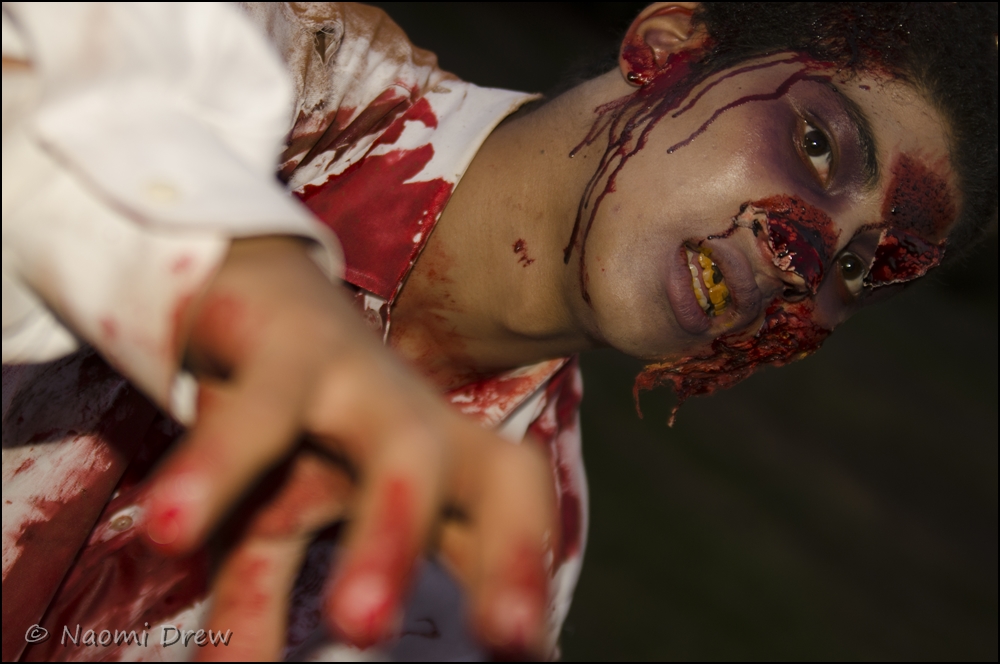
There is a meet-up group in my area for photography. They have had a number of photo shoots, complete with models, make up, and outfits. A friend of mine has been to nearly all of them, and says each time he goes, he learns something new. I’ve been meaning to go, and finally made the commitment for the Zombie Apocalypse shoot. And, it was worth it, not just because of the phenomenal make up jobs, but because of the people there – all so very nice!
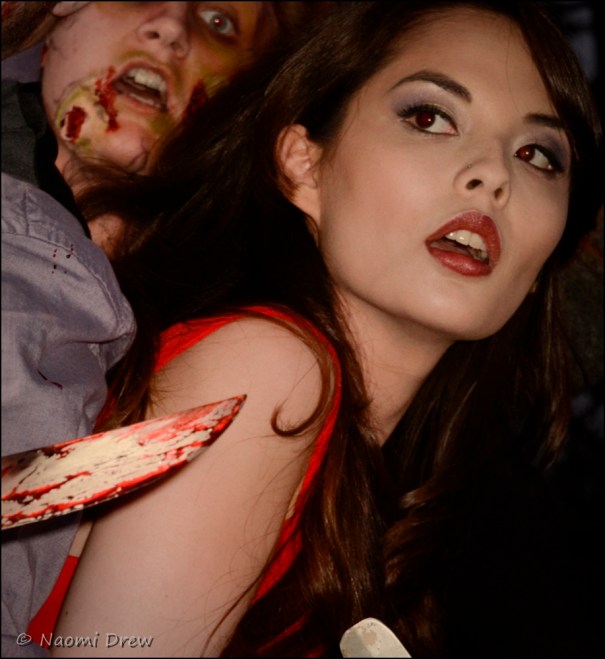
An interesting thing occurred while I was shooting – suddenly, behind the camera, I was envisioning the picture I wanted before I shot it. That has never happened before, and I cannot help but wonder if this means that I “know” enough now to have an artistic vision. Shooting was a very fast process – those zombies can really scamper around – and that is when all of this visionary stuff began. Compositional elements, seeing everything as it occurred, and anticipating what might occur.

Before I got to the zombies, I was photographing the young lovers, and while that was not quite as much fun, it was certainly a worthwhile endeavor. It proceeded at a slower pace, because they were sitting at the picnic table. At first, they were a bit stiff, but soon enough got into their roles as they became more used to everyone sticking cameras in their faces and telling them what to do. That direction-giving probably helped to move them into their roles.

A flowing fountain on Easter Sunday.

If it weren’t for Elizabeth Fluehr, I wouldn’t be in such a state.
I did a search for negative painting on YouTube, and came across a series of three videos on the subject which she did. The first one is pretty simple – it explains what negative space is, and what it is not. Very clear explanation. The heart of the matter is in the second video, all done with a pile of pickles. The third is the actual painting, time lapsed a bit because of the time needed for paper and paint to dry. Check out her website as well as her YouTube channel. You will see some lovely work at her website.

As Elizabeth defines it, you are painting a defined edge, and painting away from it. You can have a lot of edges, or a few. A whole painting may be made of negative space, or integrated inside a painting with positive space. Her suggestion is to paint what is closest – in the video’s case, and in my practice sample, the pickles on the top of the pile. Then work to the next layer, on down, until the very bottom layer is done. She explains, too, that in a landscape, it would be the object closest, such as a barn, and the last painted would be the horizon. I think that would apply for a landscape done entirely in negative painting, which might be worth a try, and could create a really interesting abstract.

For me, negative space is a hard thing to address. Working in sumi-e, one does some work with negative space, but its handling, from my perspective, is a bit different. Partly this is because of color, which for me is altogether a big distraction. However, Elizabeth Fluehr’s pickles are a great exercise, and one which I intend to follow up on with more paintings.

And while I was doing the pickles, in between I tried a bit of a still life, painting around the flowers in the background, and some of the edges, working wet-into-wet. Not a nice painting, but the practice was the purpose.
 Ink, Yarn & Beer