
Author: -N-
Tulip – Day 2
Hmmm. Not so sure that this is going anywhere good. I added veins to the leaves, and then shadows within the tulip itself. The fact is, there are not really any shadows in the picture I am using, so these are totally non-existent. I made them up.

I kind of like the veins. The shadows, though, are weak. I need to do something here – as far as I am concerned, I messed it up big time!

On the other hand, two positives. First, no mud. Second, I am painting.
Tulip Painting – Day 1

This past month has not been what I would have liked it to be. Instead of using my free time as I want to, I have had to use it for things that have to be done. The entire month of June seems to be that way. Sigh.
Today, though, I had time. Lots of it. Starting at 3 this afternoon, and going to 6, I got time to paint. (Yesterday, I did some baking.) The choice was to rummage through some of my paper in the paper portfolio, and see what I have. I have oodles of hot press 140# Arches, so I pulled out a sheet that was already cut, and went to work. Handling wet-into-wet and controlling color is today’s main goal. As I have also been watching some watercolor videos, I thought I would try to work with some of the information I observed, to see if I could remember it, as well as to see how well I could do.
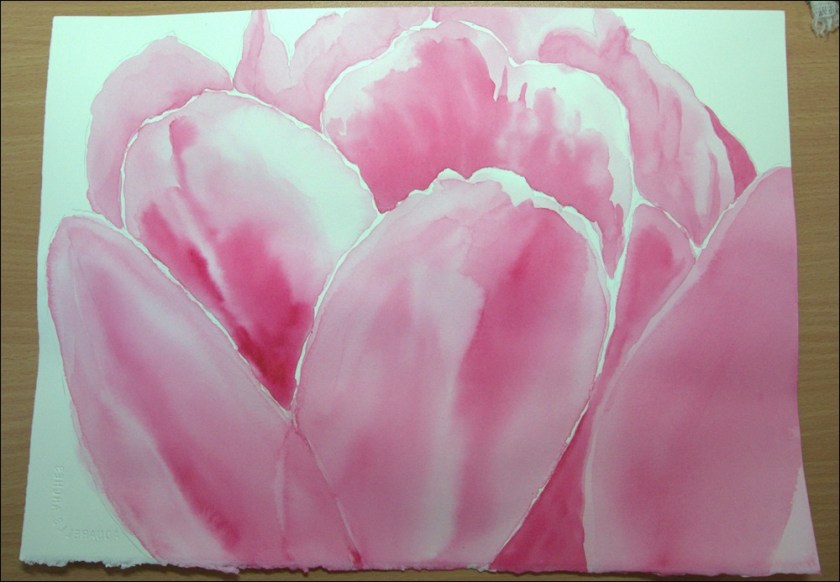
Subject matter is a pink tulip that has hints of yellow. The beginning task was to set down the first layer of washes, using WN Permanent Rose. Different layers of this color were used in increasing intensity to darken the areas. This took a lot of time. I applied clean water, and then worked in the paint as necessary, rotating the paper at times to have the color bleed, and at other times using a dry brush to pull out excess color. Other times, a damp brush was used to blur edges. I let the painting dry between sections.
After the pink was fairly well established, I pulled out some DS New Gamboge. Using clean water, I laid in a little wash in the areas of each of the petals. New Gamboge was blurred into the pinks, and edges softened using a large, dryish brush. Finally, around all of it, a combination of Phthalo blue and Hooker’s Green. Notice, I shaved off some of the tulip in the lower right corner, and probably will do more petal shaving with the next layer of color.

So, that’s it for the day. Tomorrow more is planned to give the tulip more depth and dimension, and to do something with the background.
I’m rather pleased with it so far, but who knows what will happen tomorrow!
Karelian Pie

Delicious!
Karelian Pies

Years ago I met a young Finnish woman named Sirkku, and she made what she called Karelian Pies. I’ve never forgotten them, but never really knew how to make them. What I do recall is that the filling was a buttery, creamy rice – unlike anything I had ever tasted before – in a rye dough square that had finger prints on the edges, and was turned over, corner to corner, to contain the rice. I thought they were absolutely delicious.
Move ahead to the days of the internet and instant gratification. I decided to look them up, and came across this recipe for the pies at Tofu for Tea:
Karelian pies (makes 12-14 small pies)
120 g rye flour
30 g plain flour
1/8 tsp salt
120 ml water
190 g white rice (she used sushi rice, I used Arborio)
500 ml milk
1/2 tsp freshly grated nutmeg (optional)
If you don’t have a scale, try to keep the portions similar for wet / dry ingredients. Luckily, I do have a scale, and it worked out nicely. Use Google to get equivalent non-metric measurements.
Choose a good dark rye flour. Bob’s Red Mill is one I use for all sorts of baking, and it is always really tasty. Other brands exist – see what is out there.

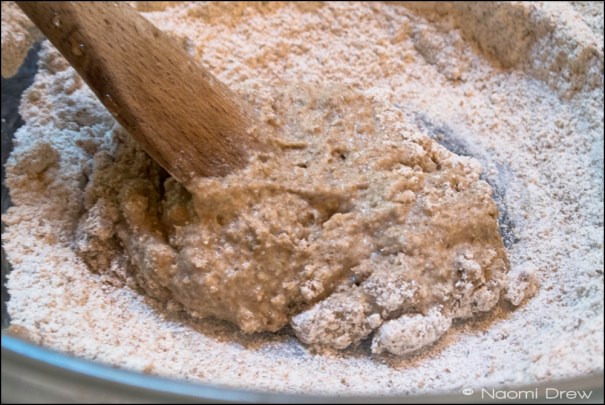
Sift together the rye flour, plain flour and salt in a bowl, or use a whisk to blend the flours and salt. Add the water to the flour by making a small well in the middle, and stir with a spoon as you pour the water into the well. Dough will be soft and moist (and I think would be great for crackers!).
When all is combined, mush the dough together into a ball and transfer to a board dusted with flour. Roll the dough into a tube, cut in half, and roll out until long and thin. My final dough looked like two long tubes, each about 14 inches in length, and about an inch in diameter. Divide into 12-14 pieces.


Making sure you have plenty of flour on your hands and the board, roll the sliced tubes into balls. As with pie dough, it is really important to work with a lot of flour, and dry hands. Flatten each ball slightly, and with a floured rolling pin, very gently flatten the balls into oval shapes. Flip the dough over after 3 or 4 rolls with the pin, and never put more pressure on the edge of the dough with the pin – you want a light touch. Spread the dough out from the center to the edges until it is about 1/8 inch thick. Transfer to cookie sheet lined with parchment paper. If the dough gets smooshed into the board, or sticks to the rolling pin, scrape it off, and roll it into a ball. Before reworking it into a flattened shape, remove the sticky dough left on the board or the pin, and redust everything with flour.


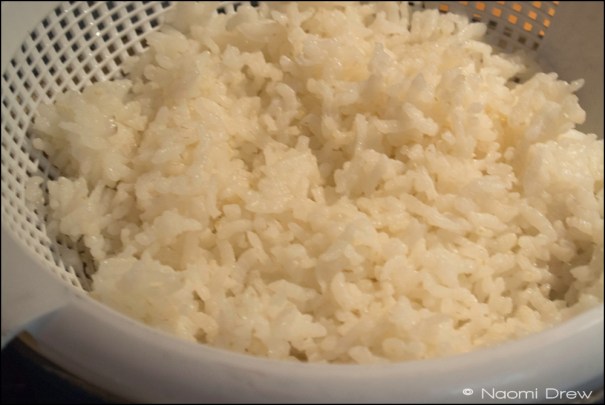
The rice totals about 2 c. dry. Put into a pan, rinse until clear, and then drain. Add 1 qt. water (or 1 liter), bring to boil, then drop to low, cover, and cook about 15 minutes. You will now have a rather watery mix of rice and liquid. Drain rice and water in a sieve for about 20 minutes. Return to pan, add milk (about 2 c.) and bring to light boil, drop temperature, cover, and maintain a simmer.

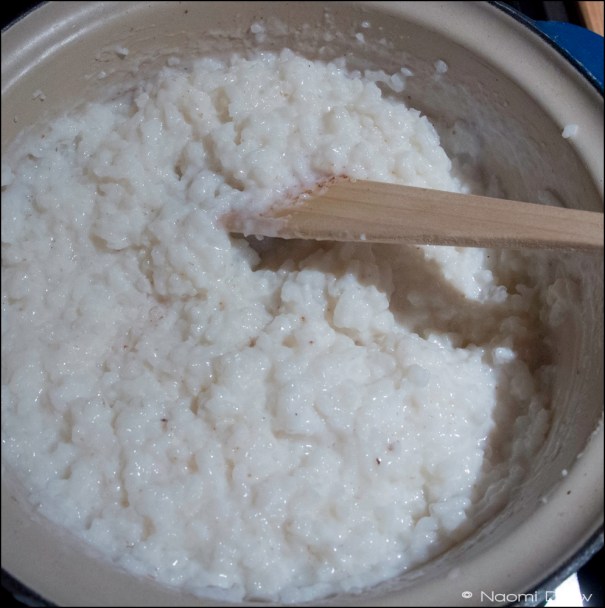
Check your pot and stove top as milk boils over very easily! As an aside, this is also an excellent base for stove-top rice pudding, but the crock pot works better because it doesn’t boil over.


The flattened rye dough doesn’t need to be covered with a damp cloth while the rice cooks. You might consider cooking the rice and making the rye dough while the rice cooks

Once the rice is cooked, stir it up with the grated nutmeg. You might consider a little butter as well, if you like that richness. The nutmeg adds a really nice touch to the pies – no idea if it is traditional – and I imagine that, instead of nutmeg, some good, fresh herbs would be nice, such as fresh chervil or savory. Fill the pies with a nice mound of rice. You can fill each flattened rye ball, and then do curl the edges of the dough up and around the rice, or do it individually. Keep your hands dry, so I suggest just dusting them with white flour. Pinch the dough together around the rice. When you have made all the pies, left over rice can be added carefully to the pies.
Melt a couple of tablespoons of butter in a dish and stir in a bit of milk. Brush this over the rice and on the rye dough.
Preheat the oven to 210 C / 400 F. Bake for about 20 minutes. I had two racks, so I switched the racks half way between, at the 10 minute mark. Cool on the pans, or move to wire racks. When completely cooled, store in a container in the refrigerator.

Notes
It took about 1.5 to 2 hours to make these. They are rather tasty, and certainly not something most of us eat every day. I imagine they would be very nice as a side dish, say with fish or a good green salad. By themselves, they can be a bit bland, but with a good pairing with other foods, would work out very nicely. Personally, I really like them, and when I want something to do, they could be just the perfect thing to keep my hands out of the devil’s work.
 Ink, Yarn & Beer