Moonlight

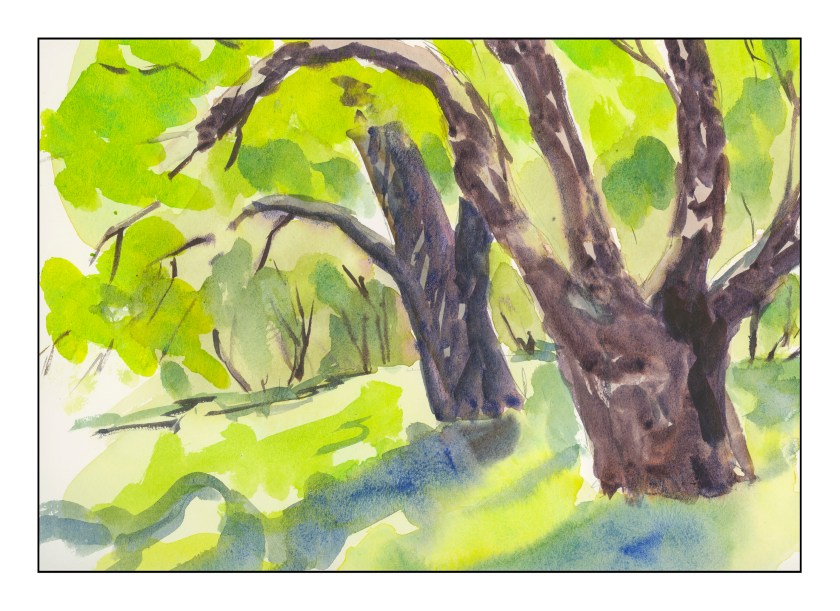
My original “Moonlit Sycamore” is below.  I like it a lot – except for the squiggly black lines I put into it.  They ruined the painting for me.

So, a second attempt, this time on 12×15 paper rather than 9×12.  No squiggles in front of the main trunk.  Instead, this new version is much darker, and the squiggly lines don’t exist, but dark lines, to suggest other trees and branches, exist, but not across the main trunk.  Here is the new version below.

The scan doesn’t really do it justice – the burnt sienna is a bit less intense in the original.

Both painting were designed to work on negative painting.  This is not easy and I expect it takes a lot of practice to do it well.  Years ago, I did take a workshop and saw negative painting and masking fluid for the first time.  It was quite impressive and looked deceptively easy.  I am finding it is not – but it will improve with time!  Funny how a scan makes you see a painting so differently . . . flaws are more apparent, as are areas of success.

Lines of Bodie

Today I ventured out on my own, influenced by practice sketches by Peter Sheeler and his videos.  This is from a photo I took in 2016 up at Bodie, California, when it was moving toward noon on a hot, hot day in August.

I rather like the composition, particularly the lines of poles marching over the hill in the distance.  If you ever have been to Bodie, you know it’s a long drive down a long and bumpy washboard road.  The telephone poles and lines emphasize the town’s isolation.  As far as painting the subject matter, I started out with a line drawing, painted, and then came in again with the ink pen.  It was so, so, so hard to not try to draw and paint every line and rock.  Simplification was a big challenge for me.

As I painted, I worked hard to recall what I have learned doing the practice studies.  Keeping things simple also meant keeping the palette simple, and the brush choice as well.  I started out with sky in Cobalt Blue after wetting it down with a big round brush.  Then I kept myself isolated to a dagger brush – first time to use one, too.  The remainder of the palette included Quin Gold, Burnt Sienna, Ultramarine Blue, Sap and Hooker’s Green, and by accident, a tad of Indrathene Blue.  The paper is 5×7 Arches Hot Press and taped down with a 3M painter’s tape with specialized edge-sealing qualities, which really worked to keep the tape from pulling up as it got wet.

Overall, I like the lack of mud and the contrasts I developed between light and dark.  Pen and ink come to save the day again!

Me and My Cookie Scoop

I love cookies, but of late, dietary issues have forced me to stop eating certain foods after a lifetime of eating them.  Well, that is the way life is.  Luckily, there is the internet, there is imagination, and there is my love for cookies.  If I were to single out two favorite sweets, cookies and homemade fruit pie are the winners.  So, today, I decided I would look for cookies that didn’t use flour or starches, and I came across this recipe for thumbprint cookies by Danielle Walker.  They are designed to be paleo or specific carbohydrate diet (SCD).  They are a great start, but as I didn’t have coconut flour, I changed them a bit.  Here is my take on the recipe.

Thumbprint Cookies

1 egg
6 T. soft butter
1/3 c. honey
1/2 t. vanilla extract
1 egg
2 c. blanched almond flour (mine is from Trader Joe’s)
1/2 c. almond meal
1/2 c. unsweetened flaked coconut
1 tsp. cinnamon
Fruit preserves without sugar (I used some fruit spread sweetened with grape juice and natural pectin from Trader Joe’s)

Preheat oven to 350F. Beat together butter, honey, and egg, for about a minute at medium speed. Beat in at low speed the remaining ingredients until the mix together well.

I suggest you make one test cookie! This will help you adjust time and add ingredients if you need to.

Using a 2 T. cookie scoop, make balls, and place on parchment covered cookie sheet. Press your finger into the cookie to make a deep well. Fill well with just enough fruit spread to fill the indentation – don’t let it run over the sides or overfill. Bake for 15 minutes until lightly brown. Let cool completely on wire rack to allow the fruit spread to cool to a non-liquid state.  Yield:  17 – 18 cookies (I ate some of the dough!).

I think next time around I will add a bit of salt . . . I seldom cook with salt, but these cookies need just a tad.

Damned good cookies if you ask me!