
Any time I see the Sinclair brontosaurus, I can only say it delights me beyond any reasonable measure! I took this a few years back on a road trip and I think it was in central California . . . .
Nikon Z6ii, 40mm, f/2.

Any time I see the Sinclair brontosaurus, I can only say it delights me beyond any reasonable measure! I took this a few years back on a road trip and I think it was in central California . . . .
Nikon Z6ii, 40mm, f/2.
I just realized that if I want to do good – in my eyes, of course – or better ink and watercolor drawings, I need to work a bit more on my colors. For many years my colors were anemic and paintings ended up pale and wan. To compensate, I made my colors more intense – more pigment, less water. However, I think if I really want to do ink and wash, I need to learn to moderate the color intensity a lot. Next painting I do will have color swatches on another piece of paper before applying them to the paper.
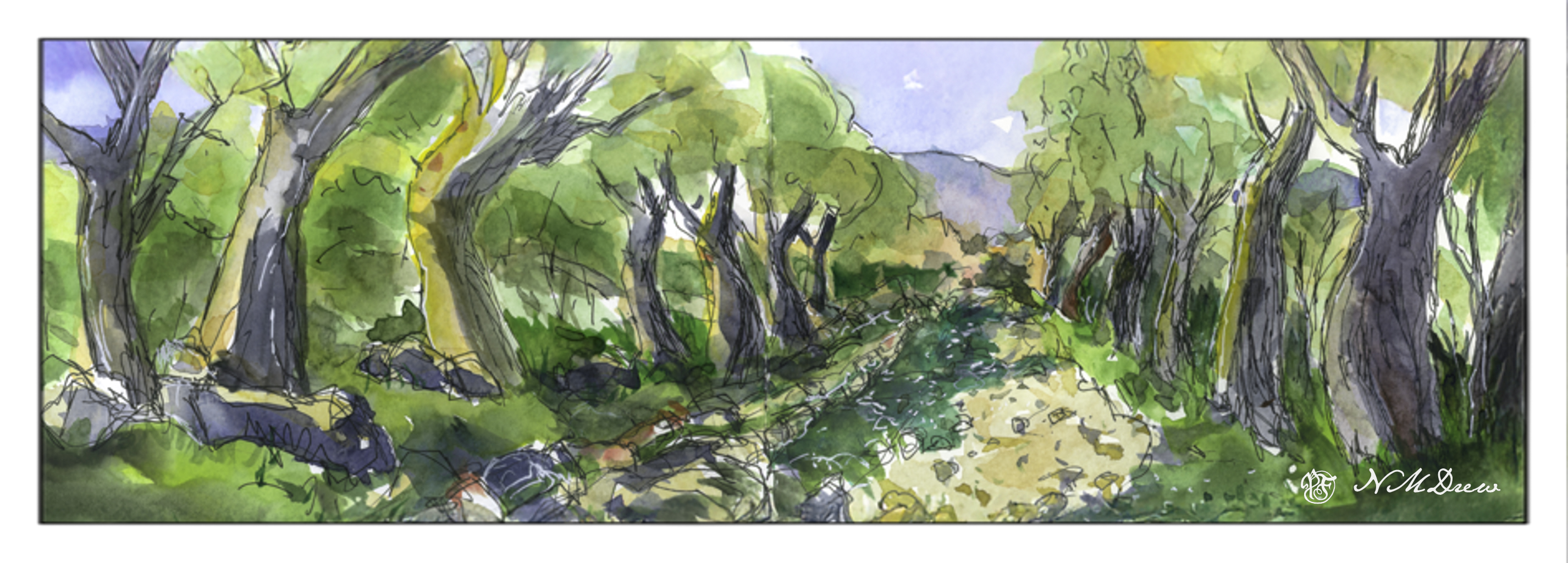
This is a very contrasty painting – and it doesn’t really play well with the eye. The shadow along the dirt road, on the left, is too green. The darks between the trees, from shadow and overgrowth, are not well done. I liked the ink drawing but think I could have made better color choices. Unfortunately, when you use a limited palette of only 10 basic colors, color mixing becomes a bit of a challenge. That is not to say these were not good quality paints – they are Schminke pan paints which are very intense – but I need to work more with moderating the colors.
Well, I didn’t paint anything yesterday, but I am beginning to work on cleaning up and getting rid of stuff. Yesterday I worked in the garden, straightening things up, getting rid of debris, and taking apart the drip system. With fewer plants it is unnecessary. This morning, sorting through clothes and mish mash in the in the garage.
However, painting continues!
Sketchbook across 2 pages, about 6×16 inches; ink and watercolor.
After working on pen and ink and watercolor wash from the short course I took, I decided to sit down, pull out some watercolor sketchbooks, and choose one for A Project. And that project will be to try to do a daily – or more than one daily – sketch following certain steps: pencil drawing, ink, erase pencil lines, watercolor, and then more ink. And maybe no ink. The idea, though, is to draw and paint the real world just to see where it goes.
Today it was pushing 80F, and after days of 60F or so, it has gone from cold and damp to warm and hot. Hard transition! So, I sat at the patio table and looked around me. Not excited by much of anything, but here we go!
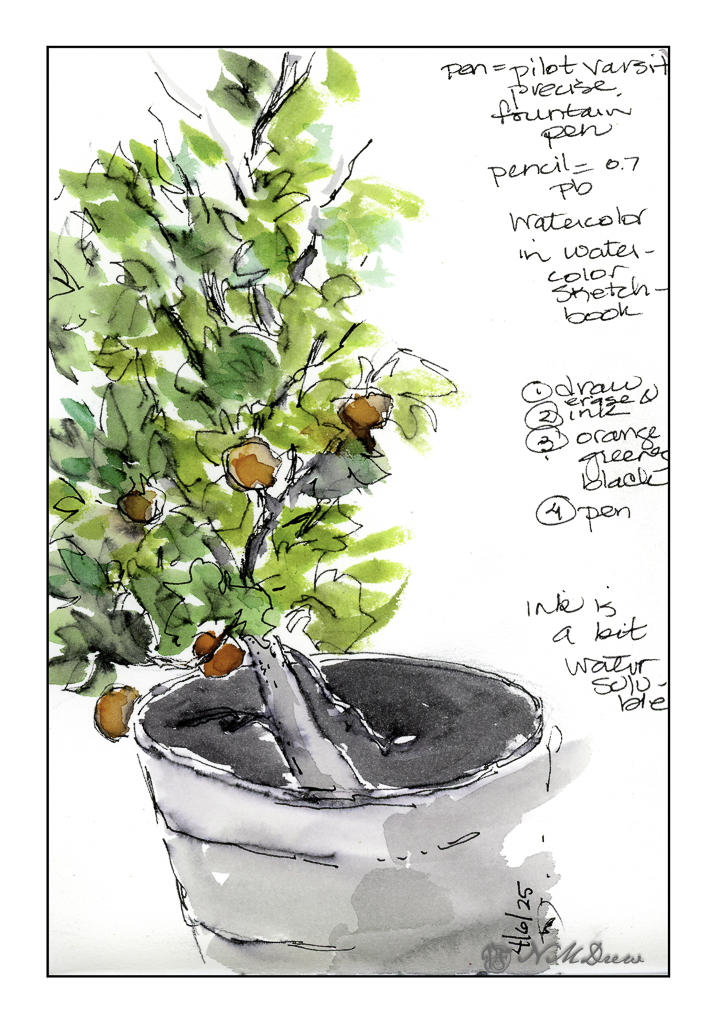
We have a small mandarin tree in a pot. This year, about 10 little delicious mandarins. Here I used a water soluble disposable fountain pen so there is some bleeding of ink and watercolor. This is the first one.
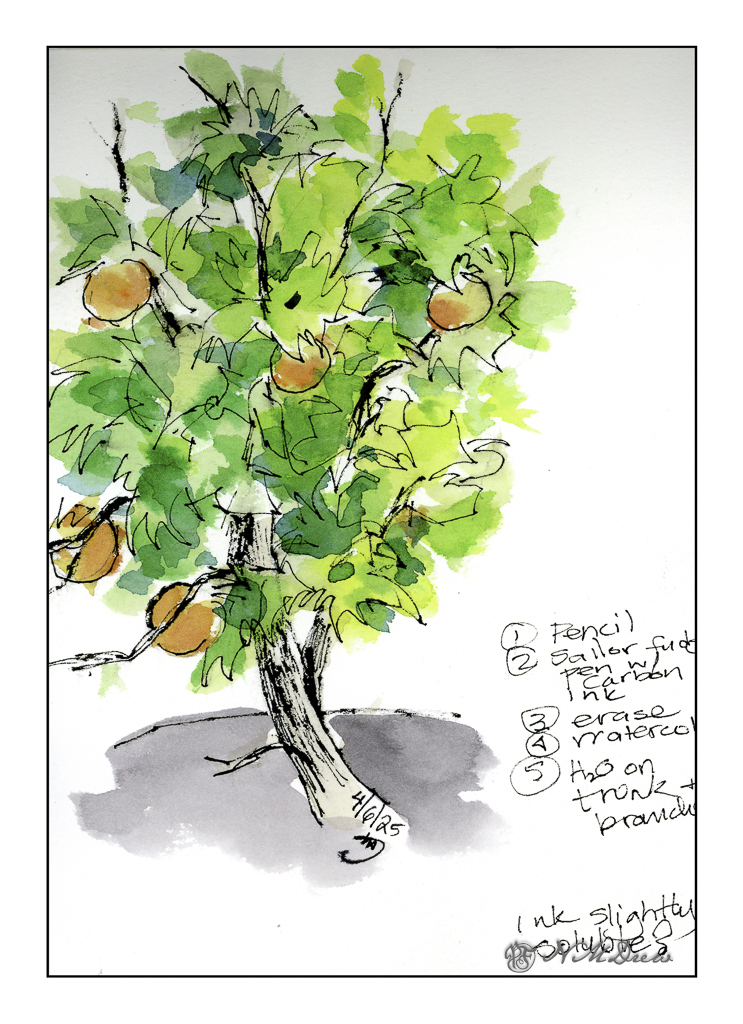
And here is the second rendition of the mandarin. I used Carbon Ink in a fude fountain pen. This ink is a bit more waterproof than the disposable fountain pen. The fude pen is by Sailor, and the pen nib is both wide and angled to about 90 degrees. Depending on how you hold the pen the lines will be fat or thin. The trunk is made up of the fat lines, and I think you can figure which ones are the thin lines!
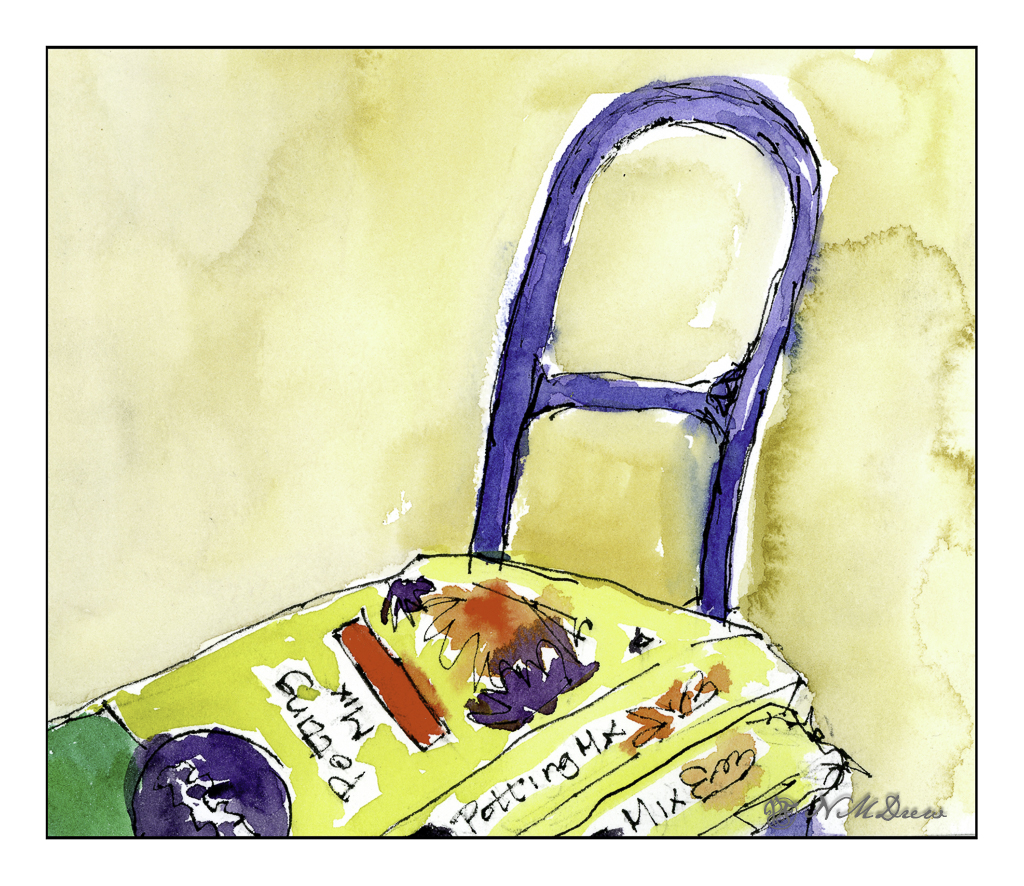
Not quite ready to retreat from my experiments, I used the fude and the disposable pen to create this portrait of Miracle Gro potting soil (my all-time fave). Ink applied, painted around, and more ink afterward. This was sitting just next to me, ready and waiting!
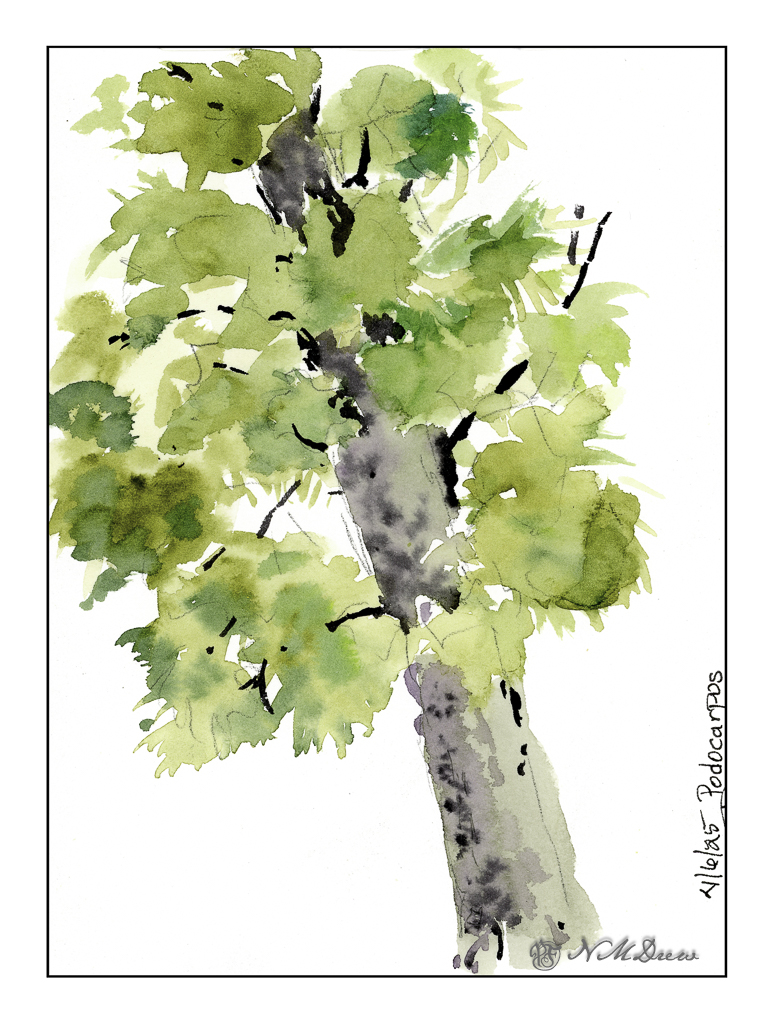
And finally, one of the many podocarpus trees along the back wall. Here, pencil outline, then plain watercolor. No ink. Not great but an exercise focused on areas of color – as in the mandarin tree drawings – to show warmth and depth – as well as simplification of groups of color.
There is a little thing in my brain right now that is sensing a change in how I see things I want to draw. It feels good. You probably know that feeling – something is changing with a more sophisticated or skillful – but new – approach. Let’s see where it leads.
140# CP watercolor sketchbook, about 5-8, Carbon Ink in Sailor Fude pen, Pilot Varsity disposable fountain pen, watercolors.
The very last lesson in this delightful class on ink and color sketching by Shari Blaukopf. As soon as I saw it I knew it was La Super-Rica Taqueria on Milpas Street in Santa Barbara, CA. Excellent food – it opened years ago and was a walking dinner destination when I lived in the area.
Anyway, this drawing is a culmination of drawing people and buildings, learning a bit about perspective and thoughts about how to do things. I enjoyed this one a lot even in my moments of frustration. Rather than using Bristol paper, I used 140# CP watercolor paper. The first frustration was the texture of the paper and my pencil – a lot of smudges. Still, I continued and laid down the ink lines after I had it limned out. Then, erasing all that smudging with the kneaded rubber eraser, and it cleaned up very well.
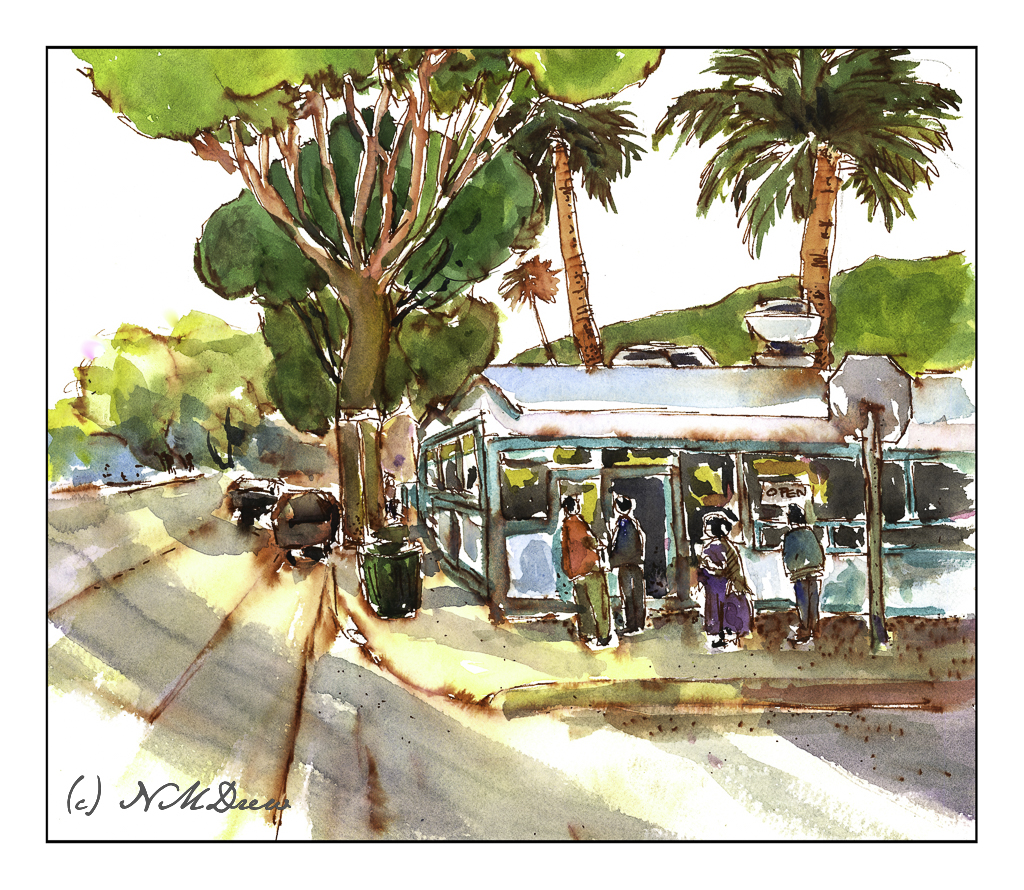
As you can tell by the shadows, this is either early morning or late afternoon – and it is late afternoon. The sun is to the left, which is in the west toward the Pacific. This is an older section of Santa Barbara, and because it is not filled with new and modern buildings, it is charming and pleasant, and certainly a break from modern suburban architecture.
When I started inking the outlines, I began with the stop sign on the right. Can you see how stupidly out of proportion it is? You could knock an elephant out with it! The people and the rest of the drawing are in decent relationships to each other. Unfortunately, I used colors which are rather saturated and did not pay attention to the fact that the ink bleeds a lot. When I painted the major tree to the left of the building, the trunk should have been very light. The same with the mountains above the taqueria itself. Despite that, I like the way it turned out overall. A word of caution – don’t drive the cars as they look quite unsafe.
Ancient Copper ink; fountain pen; 140# CP watercolor paper; brush and watercolors. About 11×13.
Another pleasant break to be had yesterday afternoon! Tasks and chores shucked and done; dinner to be prepared. In between, back to Shari Blaukopf’s short course on ink and pen and drawing.
I tackled the section on drawing people, and I think I accomplished my task quite well. As always, a few good tips really helped move my sketches into more successful areas – in particular the one about getting the shape of the shoulders correct and then moving up and down the body as needed.

The hands in the above drawing are not at all good, but such is life. The basic drawing was done in pencil, which I did not erase after applying the ink. The line drawing was done using Sailor’s black pigmented ink, and the washes were done with India ink, diluted to make the washes.
From there, we moved on to water soluble ink in color. The color Shari used, and which I bought, is called Ancient Copper. The pen I used is my trusty Spencerian nib in my vintage Edwardian pen hold made of silver (yeah, posh!). The Spencerian nib is great as it provides a very fine line, but with pressure yields a good thick line.
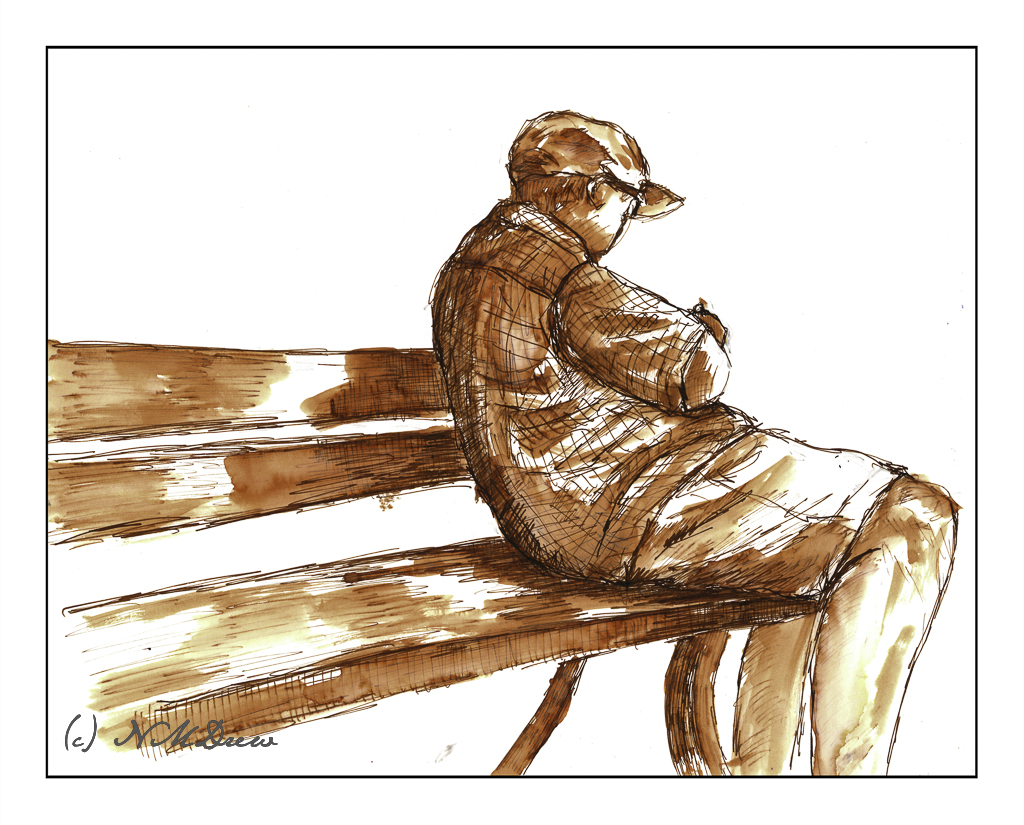
Looking at my signed and scanned image, it looks like there is black ink used here, but there is none. It just shows how scans can mutate color, but also just how variable the ink itself is – from on the nib, to dissolved with a brush dipped in water and applied across the lines.
First a pencil drawing, then outlines and cross-hatching with the pen. Darker areas have more hatching. Then, let the ink dry and erase the lines with a kneaded rubber eraser. From there, a brush dipped in water to create the lights and darks by applying it over the lines. Areas with more lines = darker areas. Then, while the paper was damp or dry, I used my dip pen to apply more ink. In particular, I used it to outline the man, his clothes, and the edges of the bench. This helped emphasize contrast and to help separate different areas of the drawing from other areas.
Bristol paper, 11×14, India ink, Sailor pigmented black ink, Ancient Copper ink, Spencerian dip pen, brush.
 Ink, Yarn & Beer