Nocturne Studies in Gouache

For some reason, gouache seems to be especially good for depicting strong colors and contrasts. In part I think it is simply because the colors can be so very saturated compared to watercolor. Their opacity also lends to this. Artist gouache is also water soluble, and you can re-wet what you have painted to modify it. You can hide mistakes, but you can also scumble and scratch and get some rather nice effects.
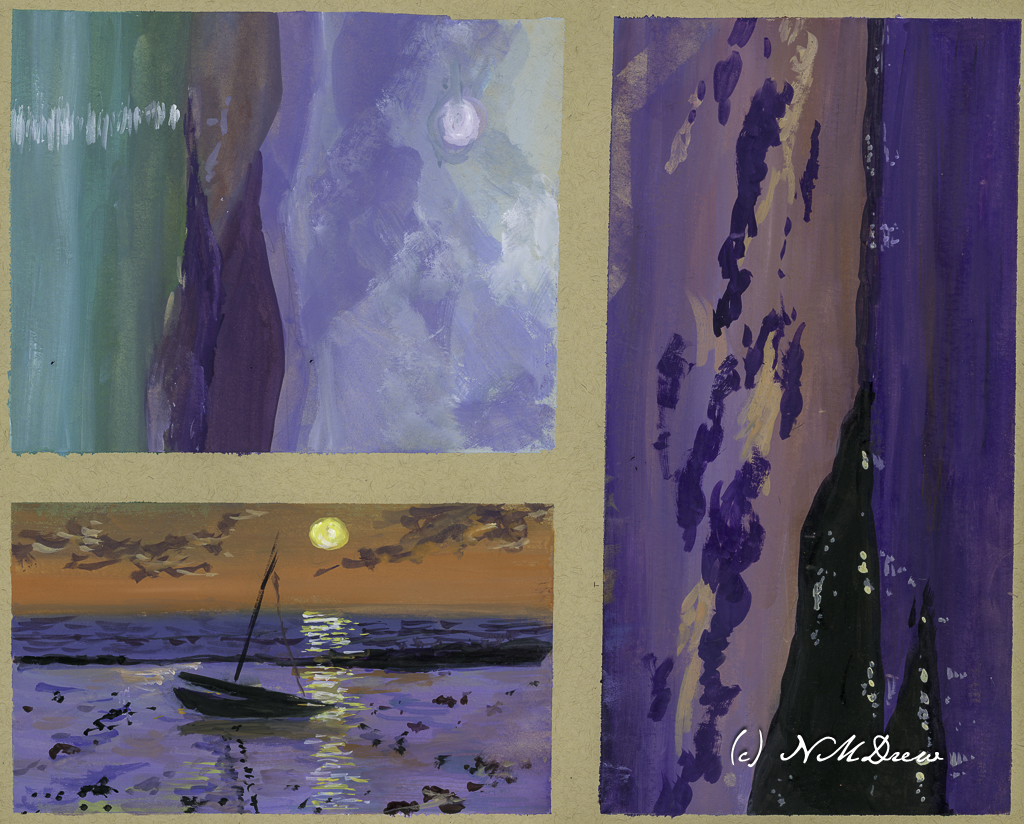
I divided up a sheet of tan paper which measures 11×14 inches. I used a lightly sticky artist’s tape to make up the different areas to paint. The first I painted is the large rectangular area on the right, and then on the left I did the next largest rectangle, and finally the one in the lower left corner. This image is directly from the scanner, so if you look carefully, you can see my mistakes which I corrected using Photoshop. The one in the lower left has 2 masts in the reflections – that is because I misplaced my mast and had to fix it for the final image.

Cheating? Well, if I were printing these critters, I would fix them, so for purposes here, I don’t think so. Also, these are all studies and the point is not accuracy so much as atmosphere – night, whether after sunset, before sunset, and on a full moon night.
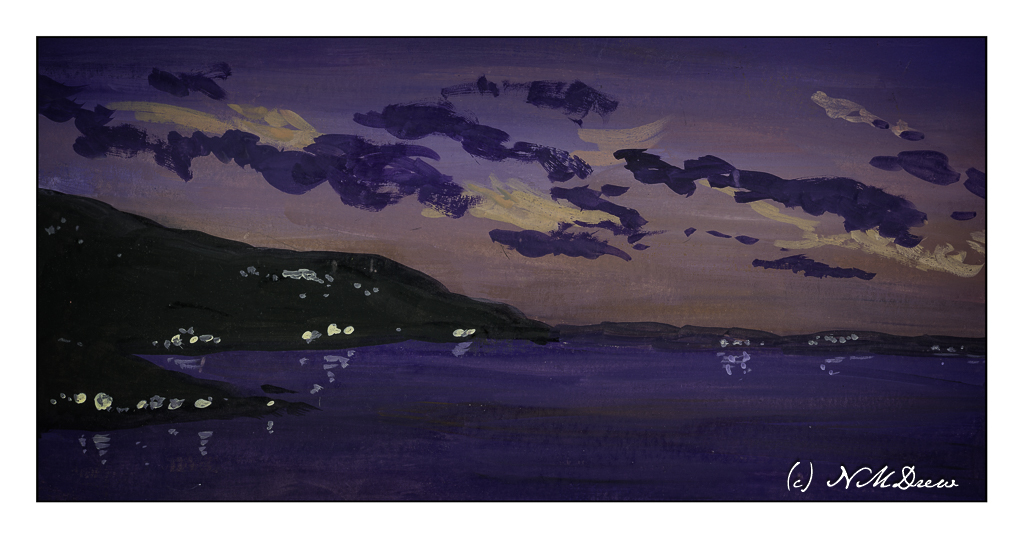
In the above painting I wanted here was a sense of dusk, when the sun is down and darkness is coming on. I worked with the sky, making it brighter than the water because with the earth’s curvature, the sky will still be bright. Lights coming on, too, add to the atmosphere, some warmer than others. And reflections, too, on the rather calm water.
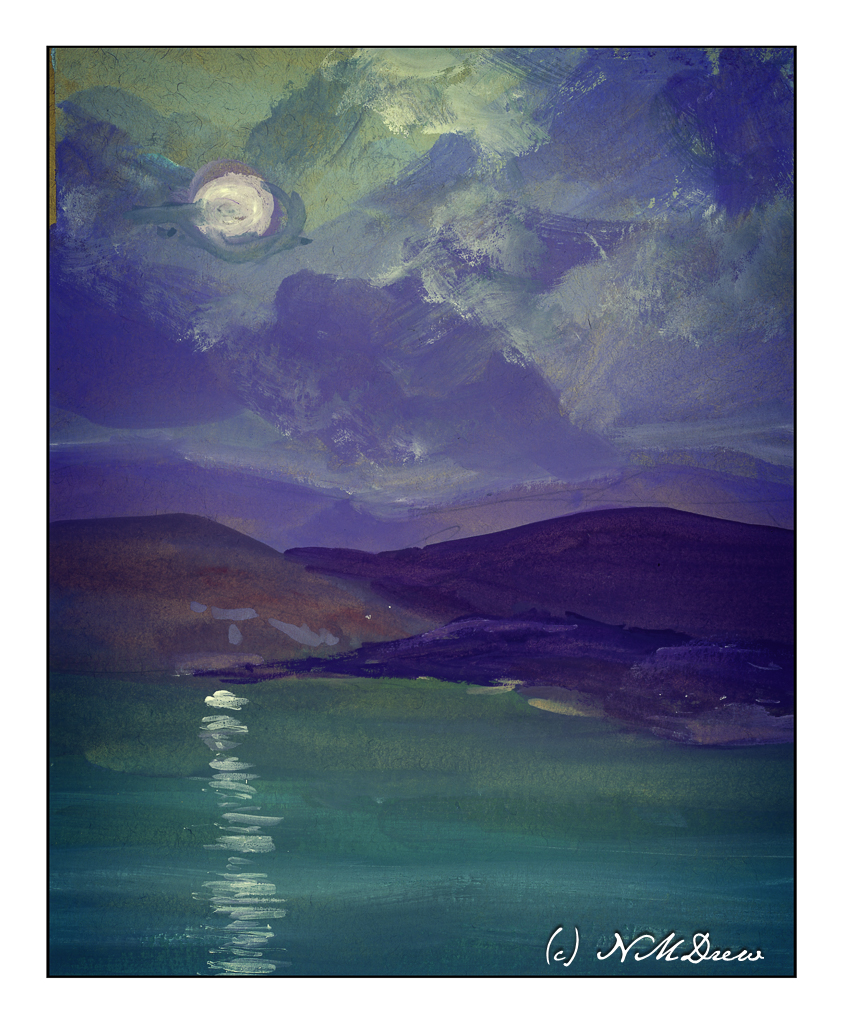
This one I played with in post because all of a sudden, in one foray of this or that setting, the light of the moon suddenly seemed to light up the surrounding clouds! I really liked it. Now, as far as the moon’s reflection on the sea – should it be more narrow closer to shore, and wider toward the bottom of the page, suggesting that is where the viewer is? The same applies to the painting below.
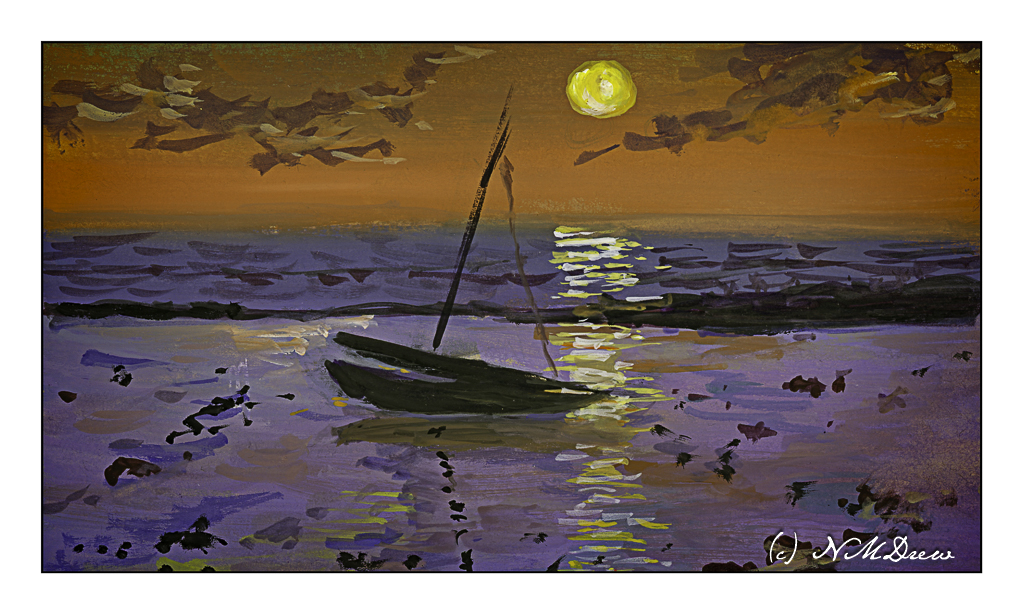
Once more, dusk. The sun is still out, but it is becoming increasingly dark. The sun’s reflection on the sea may need to be more narrow toward the horizon – again, something I need to check. What I wanted to do here was to get a sense of a boat resting on shallow water because the tide has gone out. The water is acting as a mirror and a bit of glass for the light above and the sand below.

Altogether, I had so much fun doing these studies! I want to carry them into watercolor, which I think could be extremely challenging, as well as into acrylic and oils. I also think that, much as I like the tan paper, it is very absorbent and perhaps I need to use a layer of acrylic paint or casein as a bottom layer for the paints. That is something to try later on.

As I post this, I have been awake about an hour. Rather funny to post a bunch of nocturnes as I watch the sunrise.

Now, back to my coffee!
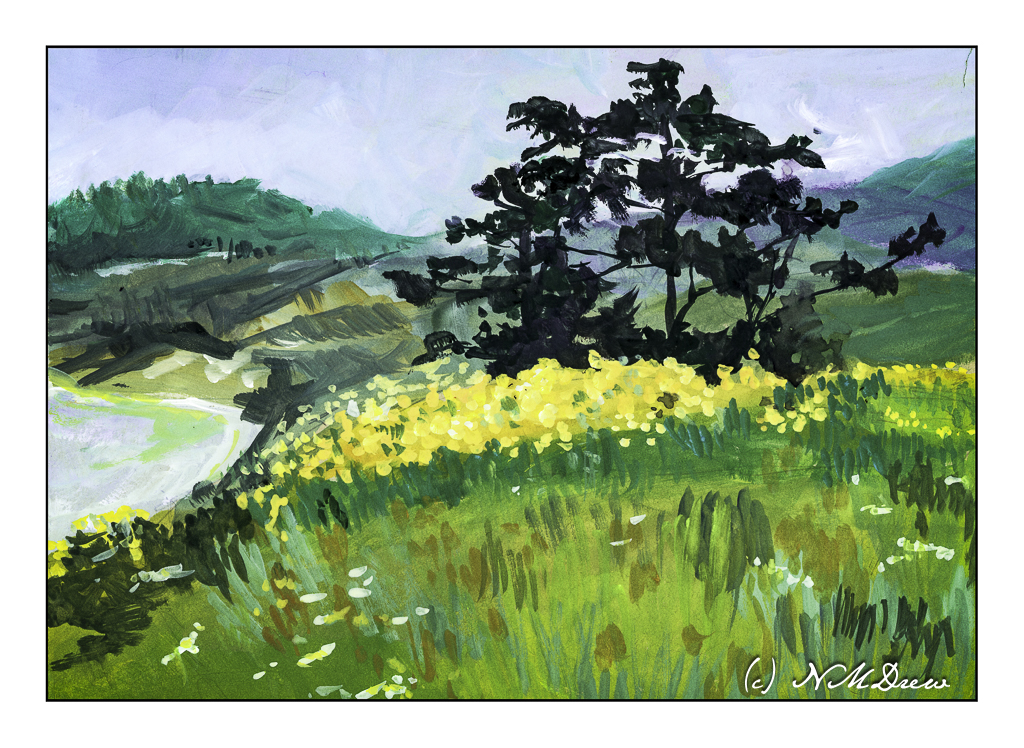
Toward Yaquina Head

Awhile ago I went to Newport, Oregon, with a friend. We spent a few days there and went to the various touristy areas around town as well as visited the Yaquina Head Lighthouse. It was a rather overcast day, quite chilly for the middle of summer. The hills were green and filled with wildflowers, the sea air fresh. Coming from a dry SoCal, it was a bit of paradise! I took a lot of photos, and this painting is based upon one of them.

The medium of choice was gouache with a tan heavy-weight paper as the surface. I usually paint on white, but as I have a big tablet of it, I decided to go ahead and try it out. I rather like the results, but truthfully have no idea if the tan paper makes a difference in the final appearance. The whites do seem brighter in this painting than they usually do, so perhaps there is merit in using toned paper. More paintings on the toned paper will be done as I like the surface for the painting.

Gouache, tan toned paper, 7×10.

Pigeon Point

California has a wonderful number of coastal state parks. Pigeon Point is one of them. This park features a lighthouse, coastal cliffs, hiking trails – all the usual attractions. It is located south of San Francisco and worth the time to visit.

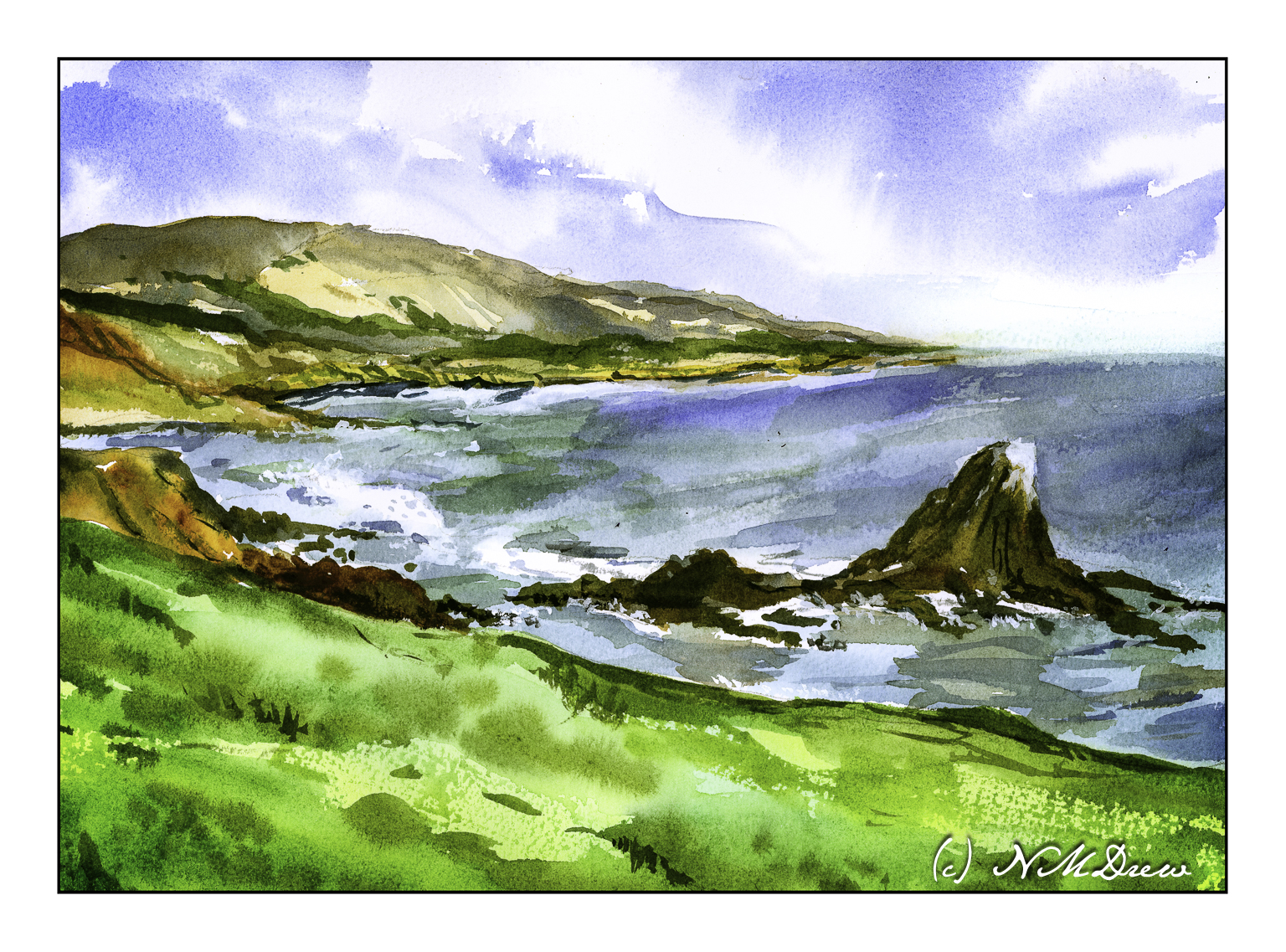
I tried to capture a bit of the wildness here with a sense of a windy day. Simplification of the foreground was a challenge. The first step was to lay down a very wet wash of yellow and green and letting them dry. From there, a bit of detail, using both dry brush and wet-into-rewetted paper.

The sky was laid in with clear water first, and from there the sky and clouds were given shape using mostly ultramarine blue in varying strengths. Once laid in, nothing was done.

The ocean was a bit tricky. There were multiple colors of blue and green and aqua. Sea foam and waves, too, added to the scene. The protruding rocks and boulders near and far add a bit of drama, and a bit of a problem! First I laid down a clear water puddle, avoiding the rocks in the foreground and the distant lands. From there, slow layering of colors, sometimes wet-in-wet, sometimes rewetting and adding color.

The distant coast was laid in with a number of simple washes, eventually building up contrast and shapes. The same was done with the rocks in the foreground, between the green slope and the horizon, but the washes were a bit darker. Once the foreground rocks were dry, increasingly less wet and more intense paints were done.

The final touches were to use titanium white gouache to get a sense of sea foam, hide a mistake or two, and complete details. I tried to work with a good sense of contrast that conveyed distance – in some ways it worked, and others it did not. This being watercolor, I think I finished in time!

Watercolors with some gouache, 11×14 Arches 140# rough paper.

At Ventura Harbor

A local group, Plein Air Ventura County, is having weekly meet-ups at the Buenaventura Art Association’s gallery during the month of August. Located in the local marina on the second floor, with galleries all around, there are views of the boats and the ocean and buildings. It’s a rather nice place to be and I have spent a lot of time there when I lived a few miles away. A friend and I packed up our supplies and trekked across the county. Traffic was a bit awful as everyone was leaving Los Angeles, but we drove on and arrived to a beautiful day at the beach.

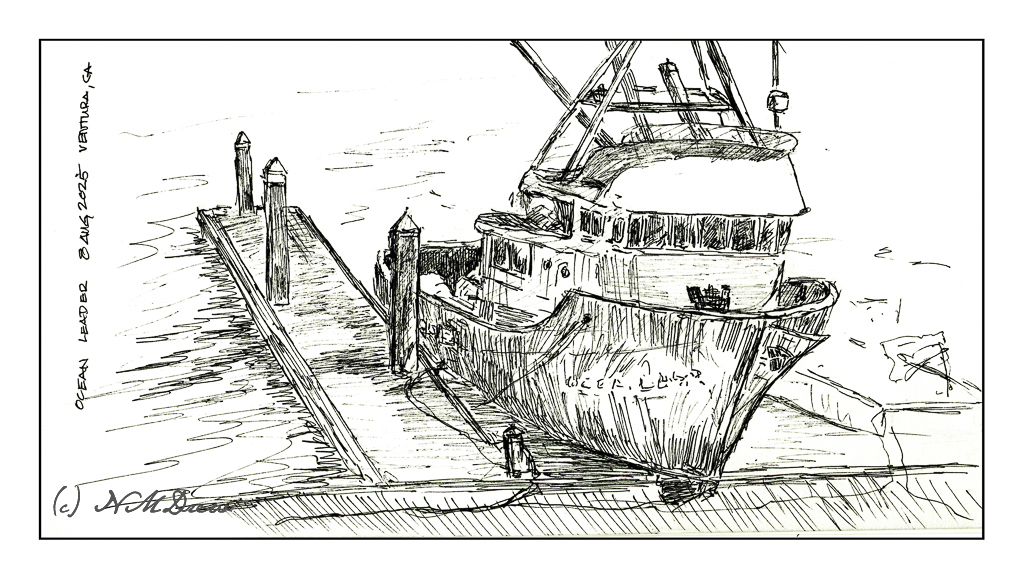
This was my first sketch and it took the longest. Normally with ink pen I like to just get to work without an underlying pencil drawing. Here, I decided to just go ahead and do a pencil sketch as I am no expert at boats or proportions. I am glad I did as I spent a lot of time erasing before I was happy with the results to begin the inking. I spent about 90 minutes on this.

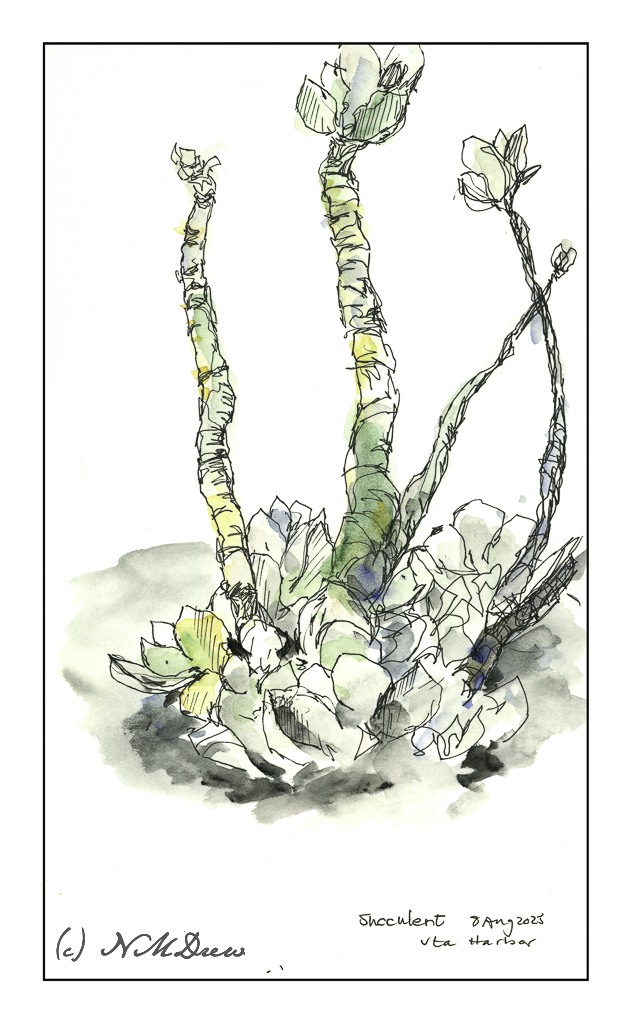
Next came this little weird succulent. It was on the gallery overlooking the marina, so I sat down and sketched it directly in ink. Plants don’t open you up to complaints about proportion (too often, anyway!), so off I went. I also wanted to see how the paper in this sketchbook would hold up to watercolor and I didn’t want to risk my boat to a poor water-paper combination. Luckily, it worked out quite well. I spent about 45 minutes on this drawing because I had to think about my colors and how thin I wanted the washes to be. In truth, this succulent was basically a silvery grey with a touch of subtle rust and green, but I needed to brighten it up.

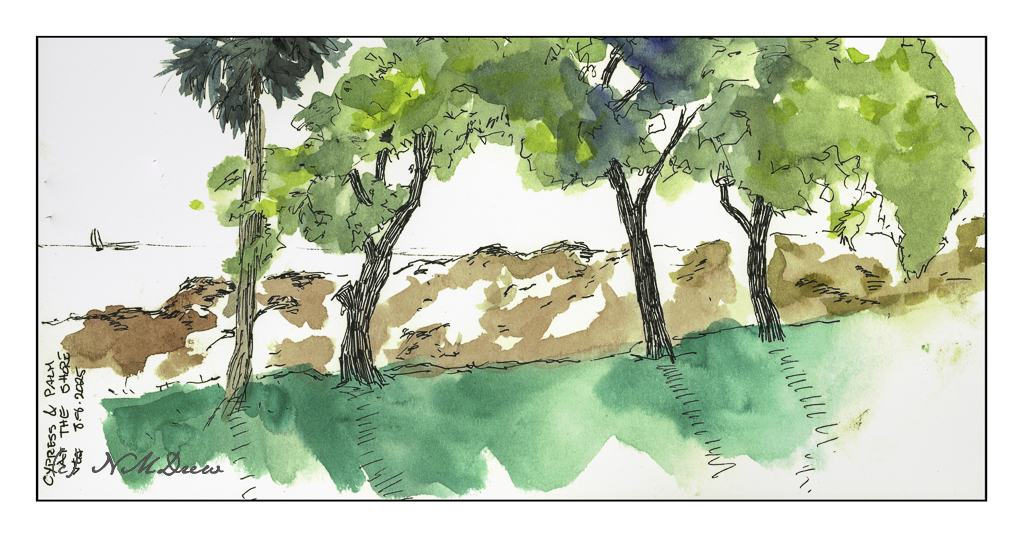
This was my final drawing, done in about 15 minutes. It was getting into the third hour and I was getting pretty tired. So was my friend. Here, I focused on the cypress trees and a single palm, the dunes beyond the road, and the Pacific beyond the dunes. The little sail boat really was there – it was the boat or flying pelicans, and the boat was the easier choice!

It was a cool, breezy, bright day at the beach. Salty wind. I got sunburned, something I didn’t think about as I don’t hang out in the sun like I used to! It was worth it, though, as I had a good time and came home pleased with my forays, especially into the boat drawing. The succulent was easy and fun – nothing I took too seriously. On the other hand, the cypress trees always throw me a bit because of the way the foliage seems to lie flat across a tree with a few branches – simply put, a complicated flat texture is the only way to describe it.

In between each sketch, a bit of wandering around and socializing before getting back into the sketching.

Ink, watercolor, Pentalic 6×12 sketchbook.

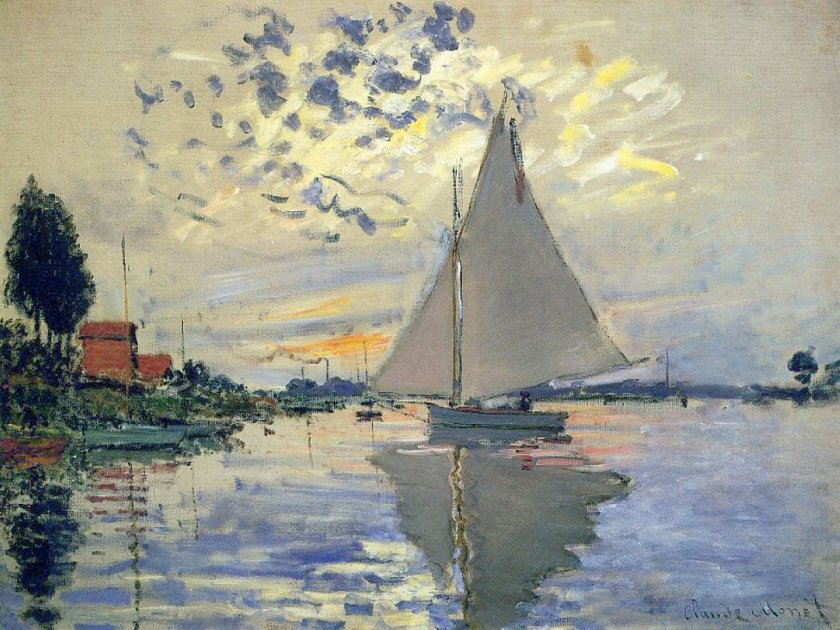
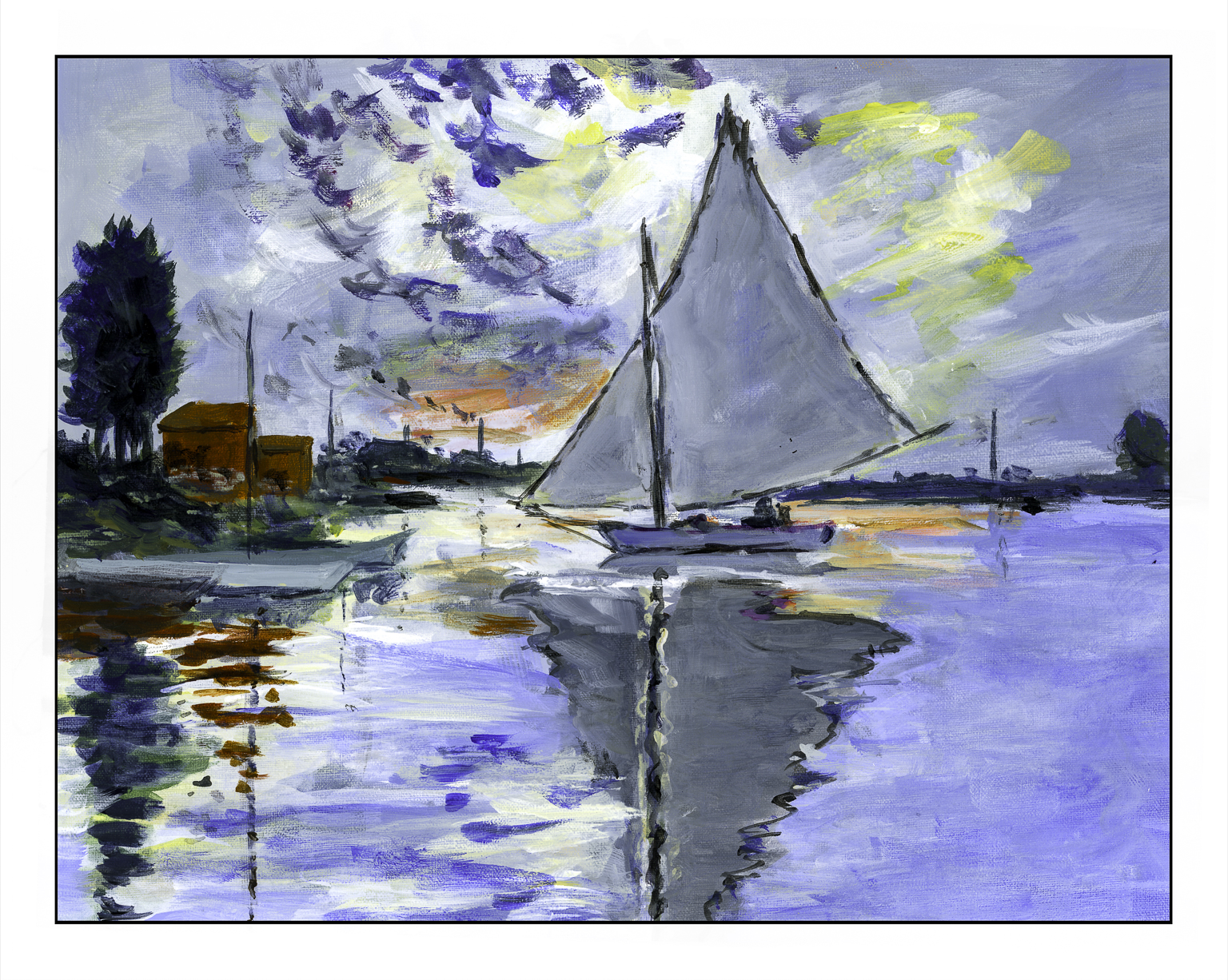
Master Study of Voilier au Petit-Gennevilliers by Claude Monet

The original painting by Claude Monet was painted in 1874 and measures approximately 22 x 29 inches. My painting measures 11 x 14 inches, so it is close to the same proportions. I left out a few things simply because I was not trying to replicate Monet’s painting but catch its sense of spontaneity. This spirit is what I found refreshing, and while Monet probably finished this painting alla prima, I spent about 6 hours in the studio. He used oils. I used fluid acrylics.

As I started to look more closely at Monet’s painting, I saw that his brushwork was very quick in many areas. The smudges of smoke in the left middle ground, the dark, wispy clouds used up a rather dry brush, one where paint was nearly gone. The white-blue swash across the sky seems like a quick thought. As well, it was interesting to see how the dark bits of clouds worked with the yellow and white areas to focus the viewer’s attention on the sailboat itself.

My own painting is more blue than Monet’s, but I saw a lot of blue in my reaction to his painting. Comparing the two is really interesting when I compare my scan to the Wikimedia online image presented here. It is hard work to get a good, warm grey and I did struggle with it. I also had to work on observing little things, such as the boats on the left middle edge – I couldn’t figure them out initially. The chimneys on the horizon also needed to be considered – what were they? The smoke on the left horizon gave it away. Once I had the boats on the left sorted, the vertical lines reflected in the water made a lot of sense.

What I really love about this painting is how it catches the light, which, of course, is the idea behind Impressionism. The moody sky with bits of cloud and fog and light as evening descends is what caught my attention. Even now, as I compare my master copy to Monet’s painting, I see even more subtleties which I could have caught. But, at some point, you just have to stop!

Fluid acrylics, Centurion OP DLX linen canvas pad, 11 x 14.