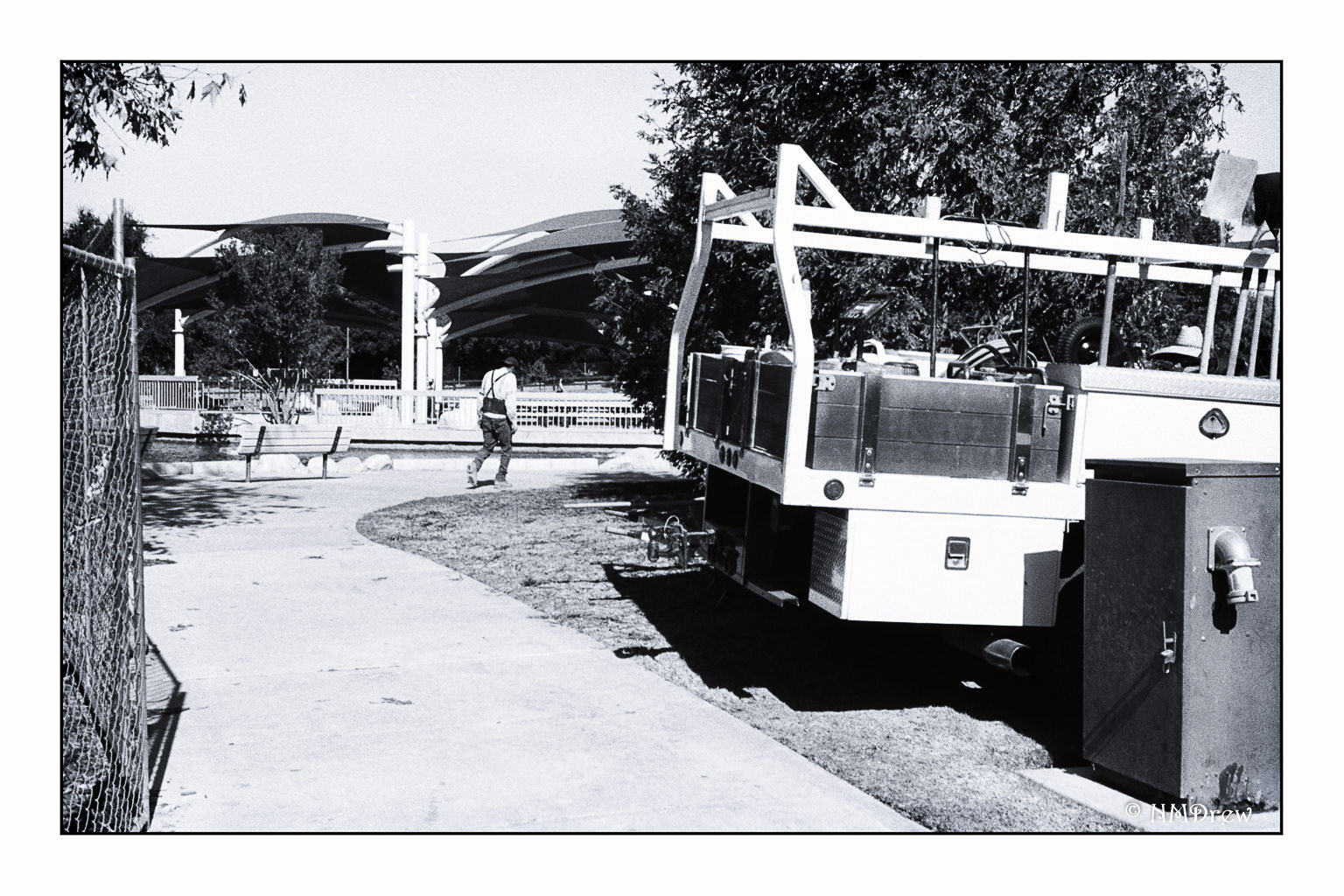
I love looking at construction sites! Always such interesting equipment and other things.

I love looking at construction sites! Always such interesting equipment and other things.
We take our everyday lives for granted, which is pretty much what we are used to on a daily basis.

Some people are always worried about where the next meal is going to come from – people who live in poverty or war-torn areas probably experience this far more than I can imagine. If I skip a meal, no biggie – lots of stuff in the fridge or down at the market. When a student tells you that in his former country, as a child, what he remembers most is always being hungry, it makes you think. To live like this is beyond my imagination.
And what about people who go from being very active, to suddenly being limited on a physical level? From walking to not walking? To using both hands to using one? The physicality of everyday life is not something most of us remark upon, unless it is suddenly gone! A stroke? A fall? Some crazy American with a gun? A nerve-wasting disease? How do we handle this?
If you think about, everyday life is normal as long as it doesn’t change. When it changes, how do we handle it? What do we do? Do we fall down and pity ourselves? Do we get up and move forward with whatever is in front of us? Certainly a level of self-pity and horror exist when something bad happens which changes our daily lives, but it also can lead to creativity and a philosophical or spiritual awakening. How we choose to adapt – and the key word is adapt – often determines our outcome. It may be minimal in the eyes of others, but it can be major within the person affected.
I really believe we need to look at our lives on a daily basis, to appreciate and be grateful for what we have, not focusing on what we don’t have. If our lives can be better, how? If we want to change things, what do we want to change? This is not an ever-moving forward process. Like the frog in the well, three feet forward, two feet back. The road is bumpy and challenging. At times the goal is obscured or lost, but movement continues. We choose in many ways how to adapt to our lives, however horrific we may find them.
Those who adapt, survive, even if the survival is not to their liking. Those who give up are also adapting, but probably not successfully. What we want, too, changes. We need to adapt to those changes. We need to think about them, to consider them on multiple levels.
When we stop making, stop doing, we stop being.
 . . . looks attractive, but work gives satisfaction.
Remember reading this?
It really is true. Finishing something, even minute, if viewed from the perspective this is what I am doing with my life – with !?!? or @$%*(&! added to the end – makes one reconsider the smallest activities.
Monday was a holiday, Martin Luther King Day specifically, and that day I sat down with my pile of UFOs from my husband’s office. I finished off the ends of two sweaters, two pair of socks. I finished a hat. I sewed on 10 buttons.
The result was quite satisfying, although one sweater is not really to my liking as much as I hoped. The other one I am pleased with and wore it yesterday. It’s construction is simple, knit in the round, raglan sleeves. The other has set in sleeves, something I really dislike, that I sewed in rather poorly and then felted. The fabric itself is nice, but the neckline is lower than I like as well as a bit puckery, but I believe I can fix both problems with a bit of thought. Then that sweater will be more satsifying.
Laziness? On that subject, when I am feeling lazy, I am either restless or bored, and cannot focus. When I am in a leisurely frame of mind, I am far from being aimless. Leisure is a luxury, and something I savor because it is a treat of an ethereal nature, and can be filled with a conscientious choice to do nothing, or filled with pleasures, such as knitting, reading, gardening, painting, or whatever appeals to me at the moment. It can be very unproductive when it comes to completing tasks, but very productive in restoring a sense of well being on all levels of existence – mental, physical, spiritual.
 Ink, Yarn & Beer