Pattern for Smartness

Here we go: a Simplicity advertising video from 1948! It’s even older than me, which is saying something. Definitely it shows its time, but in some ways it is rather fine vintage. The acting is corny, but despite that, there are some really good little sewing tidbits on using a pattern and constructing a garment.

The sewing machine is, I think, a Featherweight 221 in a card table. The telephone is an oldy, too; I have one very similar to it, adapted for the plug-ins, now useless in the age of VOIP. I miss having it around!  It always worked, especially when the electricity went out.

If you look, there is a wealth of knowledge here, as well as some pretty cool vintage things for us 72 years later.  Funny to think they were very modern then! Anyway, the importance and value of hand stitching and basting, how to sew darts (top to bottom) using tailor tack markings, and if you look closely, using a thimble when sewing by hand, give you an idea of the value of such knowledge. It reminded me of some sewing tricks I’ve forgotten from good ole Home Ec.

I have never learned to use a thimble comfortably – most of us these days are probably in the same position.  I do have a metal clamp-on thimble (not painful, just adjusts to your finger size) and a leather one.    I prefer these thimbles to the traditionally-shaped ones.

Now . . . . which machine?

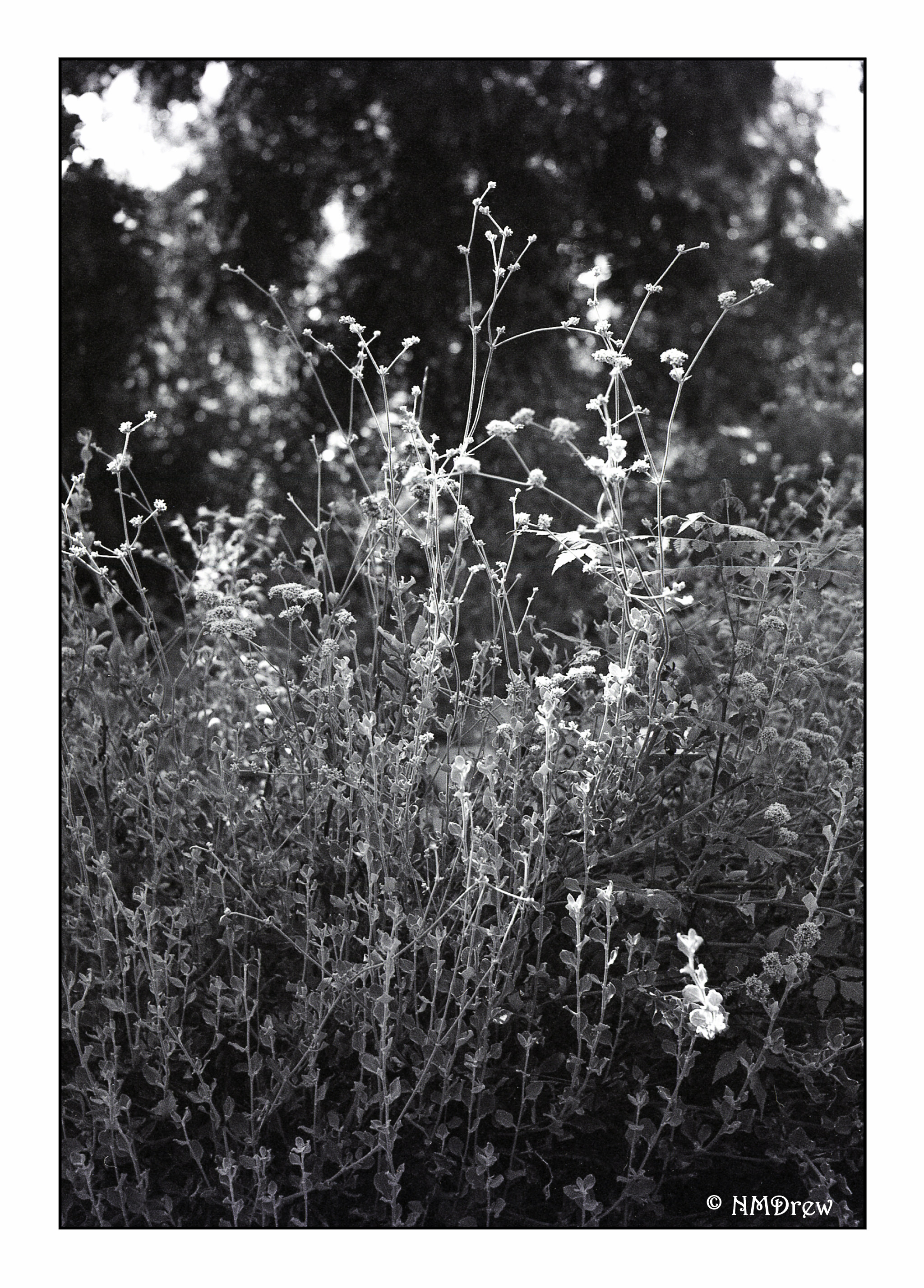
Sage

This time around I remembered I had the reduction mask in my 1937 Welta Weltur camera.  I also used a yellow(ish) filter I have that slides over the lens.  I have never used it before, but I am glad I did as it made the plants a bit more differentiated.  In theory, I get how filters work, but when I try to remember, it just disappears from my brain.  One day it would be really nice to get that clearly imprinted in my memory!

Okay, that aside, I so enjoy making pictures with these old cameras.  When they hit the sweet spot, there is something so beautiful in the final image.  This one I cleaned up – threads, spots – but didn’t do too much more to it other than upping the contrast a bit.  I wanted the white sage flowers to pop against the background.  The filter helped, but so did digital post production.

I know some people who claim that digital post is not the same as a real dark room.  No, it’s not, but it is a lot easier to do the same things – and then some! – you would do in a traditional dark room.

Anyway, more to come, but perhaps only a couple as a lot of the images are a bit dicey as far as putting out in the public’s eye.  I scanned these with the Epson V600 scanner and the film is Ilford Super XP 400, which is a black and white that can be developed in C-41, which is the chemistry for color negative film.

Flexilette


A couple of weeks ago, in the midst of all the destruction-construction going on in the house, a moment on eBay, and this little camera caught my attention:  a twin lens reflex 35mm camera.  It is an Agfa Flexilette, made only for one year (1960-61 I think).  It was a bit of a bidding war and I was really happy to get it.  Unfortunately, I haven’t had much time to play with it, but it is loaded up with Lomo 100 and I hope, as the domestic chaos winds down, I can get it out to see how it does photographically.  Mechanically, it’s smooth as silk, with large knobs and dials, which make it work very nicely.

Oh, BTW, I took this picture with my new tablet – an iPad 2018 (I had to replace my dying Samsung) on my new floors in my still-empty studio!