
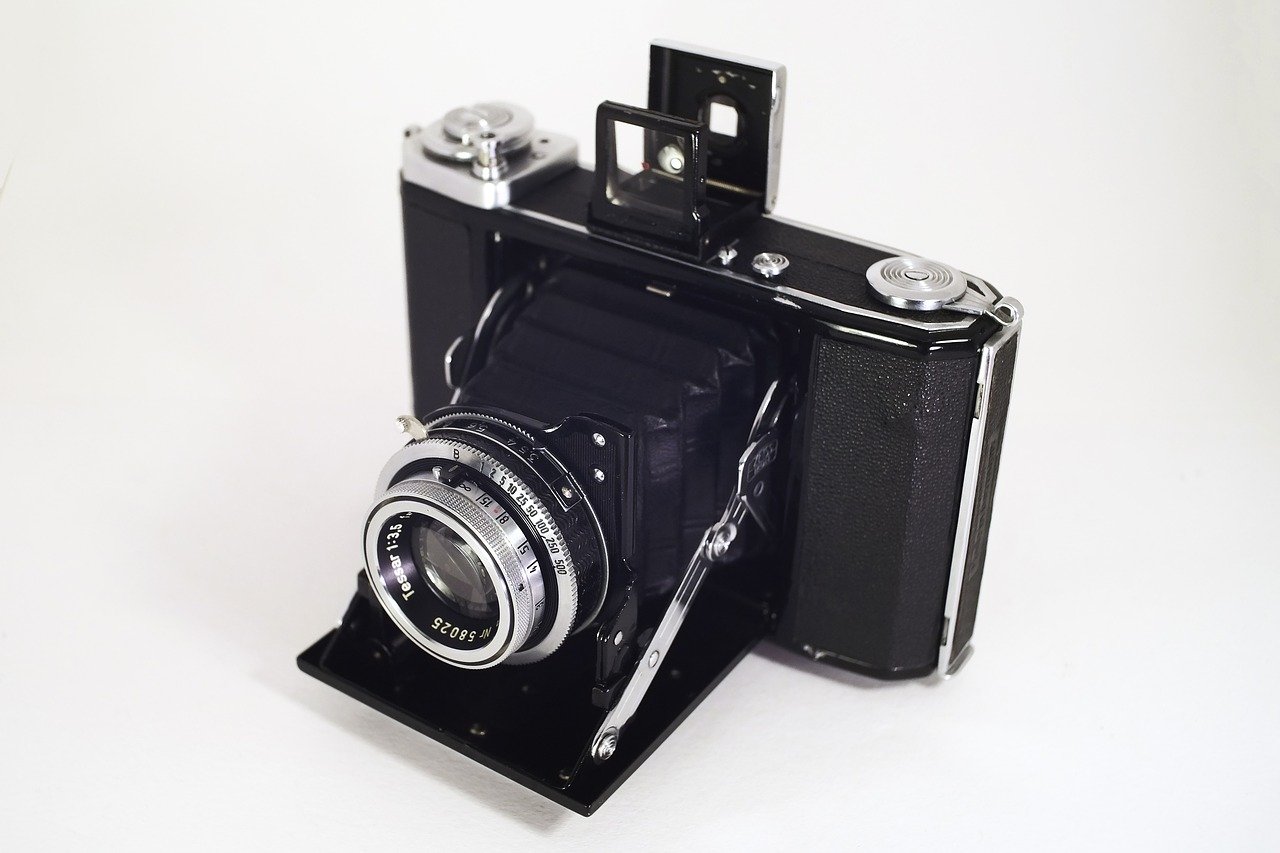
I have a number of medium format cameras, all but one being a German folder, and that one is the Yashica D TLR. What I like about the folders is their compact size when folded up, their vintage qualities (not so vintage in the 1930s through 1950s I expect), and in particular their beautiful lenses. The ones I have range in size from 6×4.5 with and without a mask, to 6×6, to 6×9. All take 120 film. The Yashica D takes 6×6 images and uses 120 film as well. However, the drawback to all of these cameras is the limitations of their lenses in length and focusing capabilities – fixed and immutable as they say. Yes, there are attachments, such as magnifying filters, but none of them can produce the variations available in a system allowing interchangeable lenses.
As a consequence, I have long been contemplating a modular medium format system, and ended up by chance or luck coming across a Mamiya 645 Pro TL with all the parts present in one package. Numerous YouTubers have really excellent videos, from short to long, from cursory to extensive detail. The video below shows the bits and pieces I have – it’s long, it’s detailed, but if you are really curious, follow along. I learned the most about this camera from it, and have watched a number of times.
Truthfully, I just dove into the purchase. I figured it would be best to get one all put together rather than trying to figure out what I needed. Searching around online, I found a Mamiya from a reputable dealer with all the parts that I knew a modular system needed for a reasonable price: A body, a lens, a film back, and a viewfinder. It has a grip, too, instead of a crank to advance the film. It’s big and heavy with everything attached – nearly 4 lbs to take a 6×4.5 image. Is it worth it? I’ll find out when my first roll of film comes back from the lab next week.
I spent about 3 days reading about each part and watching YouTube videos. I gathered PDF manuals from around the net. I fiddled and putzed. I got frustrated and annoyed, too, as well as learned so much . . .
The fact is, there are a lot of parts available for the Mamiya 645 Pro TL. It can be simple, it can be complex. It can be small, it can be big. Truthfully, I rather like small and light myself, and if I keep the critter (30 day return policy), I most likely will look for a waist-level finder and a crank to advance the film. I read about the body, the viewfinder with its auto-exposure, the film cartridge, the grip, the lenses. Everything has to be coordinated to work.
And when it doesn’t work? Pull out that dark slide!
When I take it out, I have to keep it safe in a camera bag as I have no camera strap is available that works with it with the grip in place. The Mamiya has proprietary lugs, and that is a nuisance. With a crank to advance the film, Op-Tech (my favorite camera strap) Style B attachments work, but when the grip is attached, they do not.
So, what do I think about it so far? I rather like it. The grip has that wonderful noise only a grip or automatic film advance in a camera can achieve – a click, a whir – just like an exhaust in a classic sports car! That aside, I really like medium format film photography the more I do it. Those negatives are beautiful. Scanning and editing them is not too big of a deal, and the addition of Negative Lab Pro makes them even better. I hope at some point to develop them using the Lab-Box, both black and white and color.
There are definite aesthetics in the images produced from this camera. You can find them on Flickr. You can also learn a bit about people’s reactions to the camera itself. I always like Max’s commentaries on various cameras found on his channel Analog Insights. He doesn’t go into how to use a camera, but the experience of using a camera. See what you think.
So there we are. Once I get the film back from the lab, I will have a better idea if the camera is worth keeping as I will know if the bits and pieces all work. It has automatic exposure with aperture priority using the viewfinder. I can switch to totally manual techniques. The film back advance works well from the sound of it. The lens is bright and clear, as is the viewfinder. The shutter curtain is not wrinkled. All seems fine mechanically and electronically – but the film will have the final say.
Yeah, another roll or two will be worth running through the Mamiya.
 Ink, Yarn & Beer