A Cool Tool to Use When Replacing a Treadle Sewing Machine’s Leather Belt

Whew! That was a mouthful, but I wanted to get in as much info as possible as a headline.

Let me explain.

Putting on a new leather drive belt on my ca. 1911 The Free No. 5 treadle sewing machine has been like having a tooth pulled without anaesthesia – a painful, dreaded experience.

The Free No. 5 is a clone of the classic vibrating shuttle machine, the Singer 27 /28 and 127 /128 machines. On the right side of the machine is the leather drive band which is used to drive the machine with the help of your own two feet.

To begin with, a leather drive band must be purchased, and they can be found online – Amazon, Ebay, a great online shop called “Sewing Parts Online” (which also has a great YouTube presence, and which you can watch further down the line).

The drive band is usually 3/8″ in diameter, 6 feet long, cylindrical in shape, and comes with a metal C-shaped wire inserted into a hole at one end – you have to make your own hole at the other end. You can also get a stretchy band, as used on many spinning wheels, and that is also great – and a nuisance to install, too. It is melted together instead of spliced together using a bit of metal wire.

So, back to the leather band.

Before you can get the band to work on the machine, you have to remove the old band and then measure the new band. My machine’s drive band is about 5’5″ long, but to get the correct measurement, I have to insert the new band and track it around the pulley on the sewing machine, into the back opening of the table and into the wheel by the treadle and keep it in the groove that the drive band rests in, and then up out of the sewing cabinet to the front of the machine. This involves crawling around on the floor, poking here and there, and cussing from time to time.

From there, even up the ends of the drive band and then cut. And cut off less than may be needed because you can shorten the drive band, but not lengthen it. While the band is about $10, unless you have an extra band, you could just regret that first cut. As they say, measure twice, cut once. Very true!

So, once the drive band is the right length, you have to make a hole on the cut end of the band to take the end of the C-shaped wire. How to do that?

First, punching a hole in a round piece of leather evenly on both sides is a pain. Doing it without removing the threaded drive band is also a pain. If you don’t remove it, how do you hold the leather still when it wants to roll all over the place? Josh made me a jig which sort of worked – a v-shaped thingy to let the leather band rest in. I would lay the band in the jig and take a hammer and fine nail to the leather to make the hole for the wire. Taping the band in place was useful to keep things from rolling around, but if my nail wasn’t perpendicular to the band, disaster often awaited. Even an awl was no guarantee of a good hole.

And this is when the cool tool shows up and saves the day! It is like a pair of pliers in size and weight, but consists of 3 parts – a part to pierce the leather band, a part to cut the band, and a part to crimp the C-wire into place. Below is the tool closed, with safety lock on.

And below is the tool opened up.

Using this tool and the preceding steps, I installed my new drive band in under 5 minutes, and that included cutting the belt twice. Now everything is working like a champ! I can sew on my machine, wind my cylindrical long bobbins, and enjoy it all. Here is the machine, up and running!

I bought my cool tool off a seller on eBay – I ordered it, saw it was packed and ready to ship in a couple of hours, and received it 2 days later via priority mail. The company is “Lovebug Sew N Go” – 100% rating with thousand of sales. Very impressed!

The video below, from Sewing Parts Online, shows the tool in action, as well as installing a new belt. You can purchase pliers from Sewing Parts Online, and a belt as well. The YouTube video includes direct links for each.

I cannot recommend this leather drive band tool enough. It is a bit pricey, but the lack of stress and decrease in time involved to get the belt installed is more than worth it. If you have never replaced your leather drive band, of course you will find some great videos on YouTube.

My own experience, besides using this tool, is to stretch the new belt a bit, and then work the belt into the machine by inserting into the pulley, work it into the back hole of the table, into the groove of the wheel and around to the front. Pull it up onto the surface of the table and then measure, mark it with a pen. Cut the belt. If the belt wants to flop around a bit, use some tape to keep it under control The belt is then measured in length, and cut; you want a small gap between the ends of the belt – no overlapping. Insert the C-pin and then crimp it together. Test it out and adjust as necessary.

Every sewing machine and cabinet is different – some seem poorly designed and the belt may catch on the entrance and exit holes of the table. If your table and belt are at war with each other, wrap some tape over where the ends of the belt join to make for a smoother transition.

But – look at some videos first!

The Leather Queen & No. 5

Where to begin? The best laid plans of mice and women can tumble away into oblivion. What once was planned is now unplanned. Chaos moves in and takes the reins. So be it.

Let us begin with yesterday. It started well enough. The Factory Dress is complete with only the need for a bit of top stitching along the front and a dab of fray check on a spot. That never happened because I set it aside for a quieter moment when I had the No. 5 open to sew a muslin (toile) for a shirt I am planning for Josh. I laid out the pattern and cut out the necessary pieces so the muslin could be basted together. But first, to be a good sewing machine owner, I determined I should oil my trusty and unrusty No. 5.

I popped open the machine to access the metal parts beneath the machine itself. And pop it did. The stretchy drive band I use on it snapped. Pure hell as these stretchy bands need to be melted together with a steady flame, a steady hand, and a lot of patience.

Let’s take a time out. I will not repeat what I said.

Okay. Moving on, the melting of and mending of the drive band for the No. 5 did not take place. Attempted and failed. Thus, I oiled the lovely girl and pondered my options whilst doing so. I finally decided to try, for the second or third time, to install the traditional leather drive band, of which I have several. Historically I have tried and failed each time. To succeed at last required thought. To YouTube for what to do in order for a successful installation. This was my fortunate and happy find – lengthy, wordy, informative.

From there, it was planning and thinking. I needed to cut the leather drive band to the correct length. I needed to make a hole it the other end. Should be easy enough, but past experience showed me that the leather is hard to cut with a pair of ordinary scissors. The hole is hell to make as the rounded band rolls to and fro, escaping as you make the hole. I don’t have a drill I can use without adult supervision. And, accessing the grooved wheel is a bitch to get to. I had to plot. The under carriage of the No. 5 is a tight fit, and I am no longer my svelte and agile younger self.

The under carriage of The Free No. 5 – here the leather drive band is installed. Behind it you can see the drawers that were in the way.

In the end, it was so simple to reach the wheel I was stunned. I pulled out all the drawers on the side of The Free No. 5 to access the drive wheel. Before doing that, I was reaching inside from the knee space. Moving the machine away from the wall helped a bit, but not a lot. Removing the drawers for easy access was amazing. Click on the pictures to read the little captions below each one.

Next, inserting the drive band to wind it around the wheel to get the correct length. There is a slot in the wheel to help you guide the band around, but I didn’t do that at first. I didn’t think about it, just thought, hmm, interesting. Of course, if the manual mentions it, I don’t know as I didn’t look. Moving on, the drive band got stuck quite tightly where it shouldn’t. I had to pull and tug on it while turning the wheel. In between, I cleaned up the dust behind the machine. At least I had stretched out the drive band as recommended in the above video.

Three choices of drive band – two stretchy ones of different diameters, and one traditional leather drive band, complete with staple for attaching to the other end.

Finally loose, stretched in the machine and across my shoulders as suggested in the video, I reinserted it for the 5th time, using that nifty little groove to guide it from top to bottom and back to the top. I measured, and cut. Then, make the hole needed to join one end of the drive band with the other. A jig of wood and tape to keep the band steady, a hammer, a fine nail. All ready to reinsert, top to bottom to top, and then splice.  Again, click on the pictures below to read the nifty little captions below each one.

My adventure was done. The belt was installed. My dirty floor was a bit cleaner. The splice was beautiful as I had a great pair of pliers to make a smooth cut as well as to press the wire flat into the drive band. All came together as if it were meant to be. It only took about three hours of my day, but I have emerged victorious and well educated on installing a leather drive band on a 110-year-old sewing machine.

Leather queen indeed.

An electric-powered sewing machine would have been easier, but not as much fun.

The Free No. 5 or the Singer 66-1? – Part I

Because The Factory Dress is based on 1920s dress designs, I plan to use either my treadle machine or my 1920 hand crank machine. Both would be appropriate for the time period. Even if electrified, they would be fine, unless you didn’t have electricity.  I’ll hand sew when necessary.

I think it would be fun to give some background on both machines. The Free No. 5 is not famous, but the Singer 66 is. If you go to eBay and search “The Free Sewing Machine” you will find a lot of them for sale. Anyway, a treadle machine allows you to use both hands as you sew. With a hand crank machine, the right hand provides the power, not your feet. Today, we will explore a bit about the The Free No. 5 treadle machine.

The Free No. 5 Treadle Sewing Machine

The Free No. 5 is a knock-off of a Singer 127 vibrating shuttle machine. It is a full-sized machine, having an 8″ harp and a vibrating shuttle mechanism. ISMACS has a number of brief articles about the No. 5 and other models made by Free.

This video shows you most of the basic functions of The Free No. 5, even though the blurb under the YouTube video says it is NOT a No. 5, for all intents and purposes, it is. The model “No. 5” is not painted on the head, but the decal pattern is the same ans the No. 5, the sewing cabinet is the same, and so on.  If you watch the video, listen to the sound of the machine as it sews – I love it!

I bought my No. 5 about 20 years ago from a gentleman in Billings, Montana.  He shipped it freight and it arrived on my doorstep in pristine condition.  It was beautiful, and still is.  Being new to vintage machines, I did not realize it had a long bobbin.  In fact, it was the only long bobbin machine I had ever seen.  I thought all sewing machine bobbins were round!!  Well, eventually they evolved into roundness, but here I was, perplexed and frustrated.  Thanks to the internet, and especially YouTube, I finally learned how to use the vibrating shuttle successfully.  Interestingly, one of my closest friends told me she had grown up sewing on this same machine, but the Singer 27 version!

The story behind my No. 5 is, to me, so interesting.   This man buys and sells  household goods as a living, and this household was a prize.  The story itself seems rather incredible.  He found a household for sale, upstairs, downstairs, and in the basement.  The house was ca. 1920 or earlier, but had been seriously remodeled to the point that new flooring was put in, a trap door about 3’x3′ constructed over the former opening to the basement, and forgotten.  Only a skinny person could manage the staircase.  In he went to find not  only my machine, vintage  and pristine and barely used, but also antique Stickley furniture in the same condition.  How do you get such items out of a 3’x3′ opening?  You take it apart and carry it up the stairs.  The story, he said, was this machine was bought for the former owner who hated sewing – into the basement it went.  And there it stayed until the 1990s.

My machine has proprietary attachments, but it does take a 15×1 sewing needle – at least there I didn’t get a lemon.   I have a bunch of attachments, too, and original long bobbins.  The original bobbins are longer than the new ones being made and are quite nice to use.  Despite the length differences, the new ones work fine with a few tricks.

To be continued . . . .

Cause & Effect

The quilt show is to blame for my current focus.  Looking at fabrics and looking at the wonderful handcrank machines got me to look at the machines I have strewn around the house.  There is a treadle machine in the family / kitchen area.  My mom’s old Viking (ca. 1965) – on which I learned to sew – is in the garage, along with a serger which terrifies me.  In the bedroom closet are a couple of handcrank machines, a Singer 222K, and a Janome 1000.

The treadle machine and the handcrank machines came to mind quite quickly – they really are fun to use, peaceful and soothing, and not needing to be plugged in.  The treadle was the first one to be pulled out.  Because of the help I got with the bobbin at the quilt show, it was really easy to set it up and get to sewing.

My treadle is called “The Free,” and it is in remarkably good shape.  I bought it on eBay several years ago; in fact, that is where I bought both my handcrank machines.

_DSC4605

_DSC4610_DSC4615_DSC4607

The treadle machine was rather dusty from a lack of use. I cleaned it up, dusted and oiled everything, popped in a bobbin, and threaded the machine. Off we went!

I have been using a stretchy spinning wheel band to drive it, but found that the band did not have enough width and / or torque to wind the bobbin, which is a long bobbin. I ordered a 3/16″ round band off eBay and installed it when it arrived.

_DSC4612

_DSC4614_DSC4613

Considering how old it is, this machine is still in beautiful shape. I’ve made clothes on it before, and now the urge to sew is hitting strong. The question is, which machine to use? Each has its advantages . . . but I’ll save that for another time.

At the Quilt Show

This past weekend was a two-day event, A Quilter’s Showcase, sponsored by the Conejo Valley Quilters, and held in the gym at California Lutheran University.  I went Saturday afternoon, to get out of the house, and to find some way to ignore my cold.  Of course, the main goal was to see the quilts!

Quilts are both works of art, and practical ways to use up small bits of material to make useful objects, such as bedclothes or pillow coverings.  Over the years – probably from the 80s on – wall hangings and other forms of quilting have evolved.  Not being a quilter does not mean I do not admire the skill, patience, and creativity involved in their making.  I don’t know if I have the patience for them in particular – I need to be moving, not glued to a sewing table or indoors.  Anyway, enough about me – let’s look at some of the offerings!

_DSC4599

First, the set up was really nice.  Along the periphery of the gym were the vendors, mostly quilt stores, some local, some from further away.  Everyone was really nice.  Locally, we have Cotton & Chocolate Quilt Company.  I liked their display, which was colorful – I especially liked the quilts hanging up.

Cotton & Chocolate

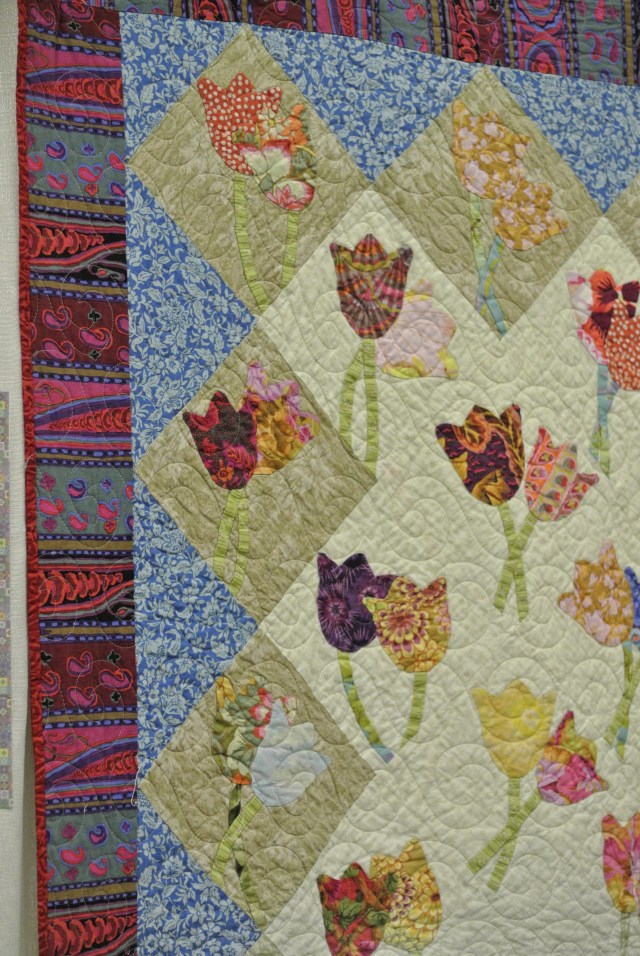
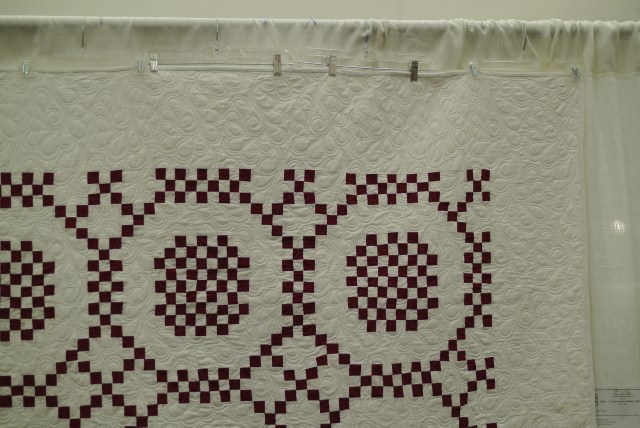
The inside portion of the gym was somewhat of a labyrinth. Individual quilts were hung up, like paintings on a wall. Clothespins attached to the side of the quilt allowed the viewer to peer at the reverse of the quilt by using it as a handle – a good idea to keep quilts clean, and to satisfy the curious. There were a variety of quilts, from pictorial to traditional, most new, but some from the 1800s and 1900s.

_DSC4591 _DSC4594 _DSC4600

_DSC4572

_DSC4588

_DSC4601

_DSC4567

_DSC4575

_DSC4577

_DSC4597

The vendors were mostly quilt stores, but you do need machines and thread and needles besides material to quilt. Businesses selling sewing machines were there – I didn’t see my favorite store, Art & Jenny’s from Ventura there – but there were plenty of other local businesses with great machines and friendly, knowledgable staff.  My favorite featured hand crank sewing machines, and quite a few of them.

_DSC4604This store is called Sew Cranky, and as you can see in the above picture, they had oodles.  If I didn’t have a couple of hand crank sewing machines of my own, I would have gotten one.  If you have never used a hand crank machine, it is very peaceful – no long electrical cords, slow motion, and you can take it outdoors, even if it does weigh a ton.  The decals are wonderful, and the click-click sound of the shuttle is soothing.  Treadle sewing machines are just as nice, but a bit less portable.  And, they do have attachments which compensate for the straight-stitch only of many older machines.

Communities, such as the Conejo Valley Quilters, connect people to arts and crafts, to resources, and open one up to the variety and talent found within one’s own neighborhood.  Their value may seem neglible, but in reality, our own lives become enriched from such venues, much more than we can appreciate in the moment.