 Setting Up
It is a bright, crisp spring morning, perfect weather for mordanting outdoors. The stainless steel dyeing pots have been pulled out, scales, yarn, alum and tartaric acid, buckets, goggles, gloves, basins, buckets, towels, thermometer, mixing bowls and spoons. First to be set up was a kettle of water to heat on the burner. Next, 100 g. of wool weighed out, and set to soak in hot water. On the smaller scale, a plastic bowl was set down, and then turned on to set the tare weight to zero. 5 g. tartaric acid weighed and emptied into a stainless steel bowl. 10 g. alum weighed out, and added to the bowl with the tartaric acid. Hot water added to this to dissolve the crystals. Meanwhile, I continued to organize a few things as the water heated.

Weighing
Having two different scales, one for large items and one for small, is great. These are the scales Josh uses in brewing, to weigh grain and hops. The large one does both pounds and kg and g, while the other one does tenths of a gram, along with other weighting systems.
Traditional natural dyes have an alum-to-wool weight ratio of 1:4. This means for every pound of wool, 1/4 lb. alum is to be used, or for every 100 g. of wool, 25 g. of alum is to be used. Most books warn you not to use too much alum as it makes the wool sticky. It does, and it is a really disgusting feeling. Nor can you fix the problem.
Trudy van Stralen, author of Indigo, Madder, and Marigold recommends using a 1:10 ratio of alum to wool, and a 1:20 ratio of tartaric acid to wool. Now, trying to figure this out in pounds is absurd, and this is where the beauty of the metric system really shines. It means for 100 g. of wool, the alum proportion is 10 g, and the tartaric acid is 5 g. If this is confusing, just think of it in terms of U.S. money – $1.00 = 100 g, a dime is 10 g., and of course a nickel is 5 g.
Van Stralen also recommends using the same water and the same solution for subsequent batches of wool, saving time in heating up water, and saving money by only adding 5% more alum and 2.5% tartaric acid back to the mordant bath. Appeals to me!

Mordants-to-Wool Ratio
My first batch of mordanting wool had plenty of room in the kettle, so for the second batch, I weighed out more wool. This time it was 260 g. Using the 10% rule would give me 26 g. of alum; the 5% rule of tartaric acid would be 13 g. Given the idea that there is essentially 5% and 2.5% of alum and tartaric acid respectively remaining in the mordanting kettle, I went with an approximation of 7.5% for the alum, which was 20 g, and 3.75% for the tartaric acid, which is 10 g. I added these to the mordant water to accommodate the larger amount of fiber. I still won’t have 25% alum to wool in weight, so there should be no stickiness problem. The rest of the wool will be weighed out in 260 g batches, so it should go more quickly. If I didn’t do this, I think I could easily spend the whole day mordanting; I’d rather do it in half the time!
For all of these, the water is not boiling, but holding steady at about 200 F. The wool skeins did not get agitated by roiling water. The commercial skeins have held their crisp twist, and the handspun ones did not exit the mordant bath any more felted than they were prior to entering it.
Premordanting for Indigo?
I don’t have any idea if indigo will be affected by an alum-tartaric acid premordant, but as I figure I will be overdyeing some of my future indigo wool with quercitron, for green, and cochineal for purples, premordanting the wool could only help. That is something to be seen in the future.

Comment
The last time I used natural dyes and mordants was ages ago. I used pounds and ounces, cups and teaspoons. The metric system is far easier than the English system! I am looking forward to the results as van Stralen uses a higher concentration of dyestuff to goods; this is my plan for this adventure.
I really like van Stralen’s book because of the clear and colorful illustrations. My own small dyeing library has old and new books in it. The different approaches to mordanting and to dyeing are interesting to read, as are the approaches to dyeing.
I’ve done the one-pot-dye-and-mordant approach, which is really time efficient, but perhaps not efficient in the use of chemicals and dye materials. There is also the added nuisance of having to pull twigs and flowers out of the wool. I am hoping to avoid this, and am trying to decide if I should get some mesh bags to contain the dye materials if I cannot grind them up finely enough.
A lot of the books from the 70s use the all-in-one method. Liles book is very specific. Others are vague. For Californians, Ida Grae’s Nature’s Colors is a must-have – too many books seem to think that the entire U.S. lives on the east coast!
This round of natural dyeing is a bit more systematic compared to my usual approach to dyeing. I’m interested in seeing the results of this. Because there is time involved here, it makes sense to heed what I am doing. And, as it is also an artistic experience, I find myself contemplating what I might do with this batch of yarn or that. For instance, the Shetland is being considered for – what else? – a Shetland sweater vest. This means I can use colors and more colors, but there will be (in theory) an underlying harmony from both the moorit fleece, and the natural dyes themselves.
Final Notes
Before you begin any dyeing – natural, unnatural – I cannot emphasize enough the importance of skeining your yarn properly. Even if it comes in a commercial skein with a few ties, it most likely will not be enough. I tied off a few extra figure-eight ties on the Sea Wool, but that was not sufficient. Some tangling resulted. For my handspun, I did my usual, and placed eight ties throughout the skein. My skeiner creates skeins which are 1 yard long, so I have six feet to play with. I find that I can have very minimal tangling if I adhere to eight ties, and 3 figure-eights per tie. A lot of work, but it is more work to untangle a skein. The alpaca and Blue Faced Leicester, being very fine yarns, probably should have had even more ties.
Below is a table of my weights of fiber and mordants. This could be a handy thing for me to refer to later on!
| Batch |
Wool Weight (g) |
Alum Weight (g) |
Tartaric Acid (g) |
Comments |
| 1 |
105 Sea Wool |
10 |
5 |
10% / 5% for initial pot. |
| 2 |
260 Sea Wool |
20 |
10 |
Did 7.5% / 3.75% as this was a larger amount than put in pot. 200oF. |
| 3 |
215 handspun, alpaca, Blue Face Leicester |
11 |
5.5 |
Pot boiled. Skeins got tangled. 5% / 2.5%. 200oF. |
| 4 |
220 handspun moorit Shetland |
11 |
5.5 |
Came out nice. 5% / 2.5%. 200oF. |
| 5 |
280 handspun moorit Shetland |
14 |
7 |
Water color rather lightly olive colored. 5% / 2.5%. 200oF. |



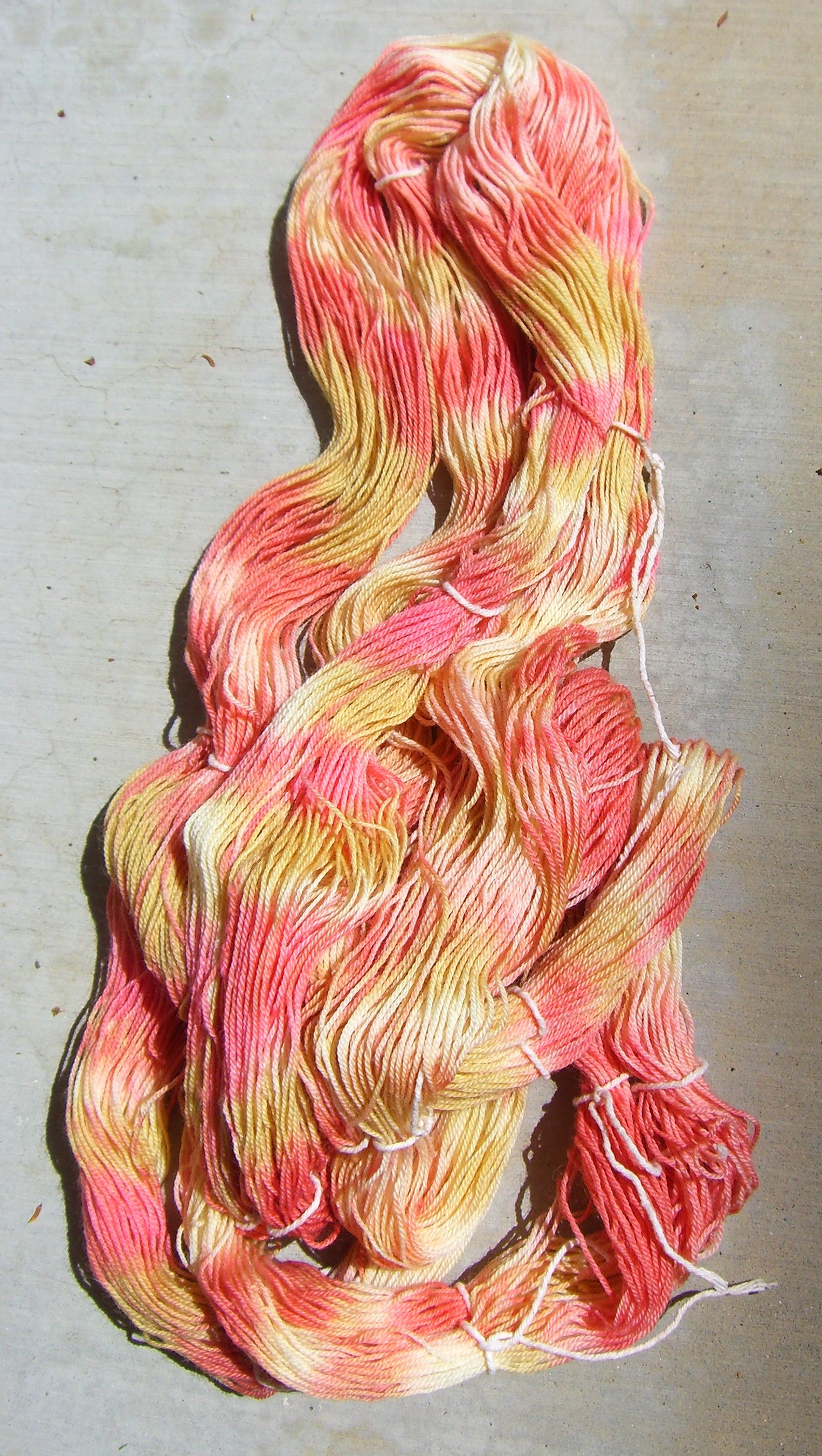
 In the pot is lace weight alpaca, and handspun white fleece. The final results are below.
 As you can see, the alpaca took up the color more deeply – perhaps it is the nature of the fiber.


 Ink, Yarn & Beer