
This past week I really have not done much of anything except munge around. The highlights of the week have been watching the very funny Betty la Fea – in English, and the American version – on DVDs from Netflix. What is there not to enjoy?
The second of the toe-up socks have been progressing over the past week. I’ve turned the heel using the Fleegle Heel, which is the reverse of a top-down sock gusset, but without the need to pick up stitches along the heel flap. The body of the sock measured 7 inches when I started the heel. Most toe-up recipes with gussets say to begin it 2 to 2.5 inches before the total length. I make my socks 9 inches long, so 6.5 to 7 inches would be fine – in theory!

Having turned the heel, before trying it on, just an eyeball of the sock told me that 7 inches was too long of a sock length. It should have begun at 6.5 inches, or maybe even 6. Another element of the heel was its angle, especially when compared to the short-row heel of the first sock. Additionally, I usually turn my sock heel on about a third of the total stitches, not the traditional one half. My gusset is a lot shorter as a result, and I am pleased with the way my top-down socks fit.


Still, the fit of this second sock, is not bad. The problem, in my opinion, is the tediousness of turning the heel. It was a lot easier to do, in some ways, than the short-row heel, but that is because the construction of the heel is one with which I am familiar. The heel flap construction of a top-down sock requires picking up stitches, but the Fleegle heel does not, so the overall product is a bit tidier, though longer in doing.
I may attempt to do this heel, if I do another toe-up pair of socks, on fewer stitches. It will be interesting to note at what point along the foot to begin a Fleegle heel with fewer stitches – I think the length of the sock may need to be a bit longer than when you use half of the total sock stitches. I also think I saw a reference to a Dutch heel for toe-up socks, which is not as fitted as this particular heel. Hmmm.
This second sock of this pair is made with only 54 stitches, not 60. The reason is that I don’t really think that 60 is good for the lace pattern here. The lace is stretchy, and doesn’t stretch out on my foot or leg. I’d make that for a large leg, and use 42-48 for a young girl or small woman.
Here, you can see the difference between the two socks, especially at the heel. The short-row heel sock is a bit too short, and the Fleegle heel sock is a bit too long. Still, I have no plans of ripping out either sock, and will wear them as a pair!

My inclination is to go with a Fleegle heel as preferred method, but use maybe a third of the stitches, instead of half. Also, fewer stitches for this lace pattern. The fact that knitting is stretchy allows for errors like this, and I can wear them before I decide I don’t like toe-up socks. Right now, I’m just now sure I like making them….

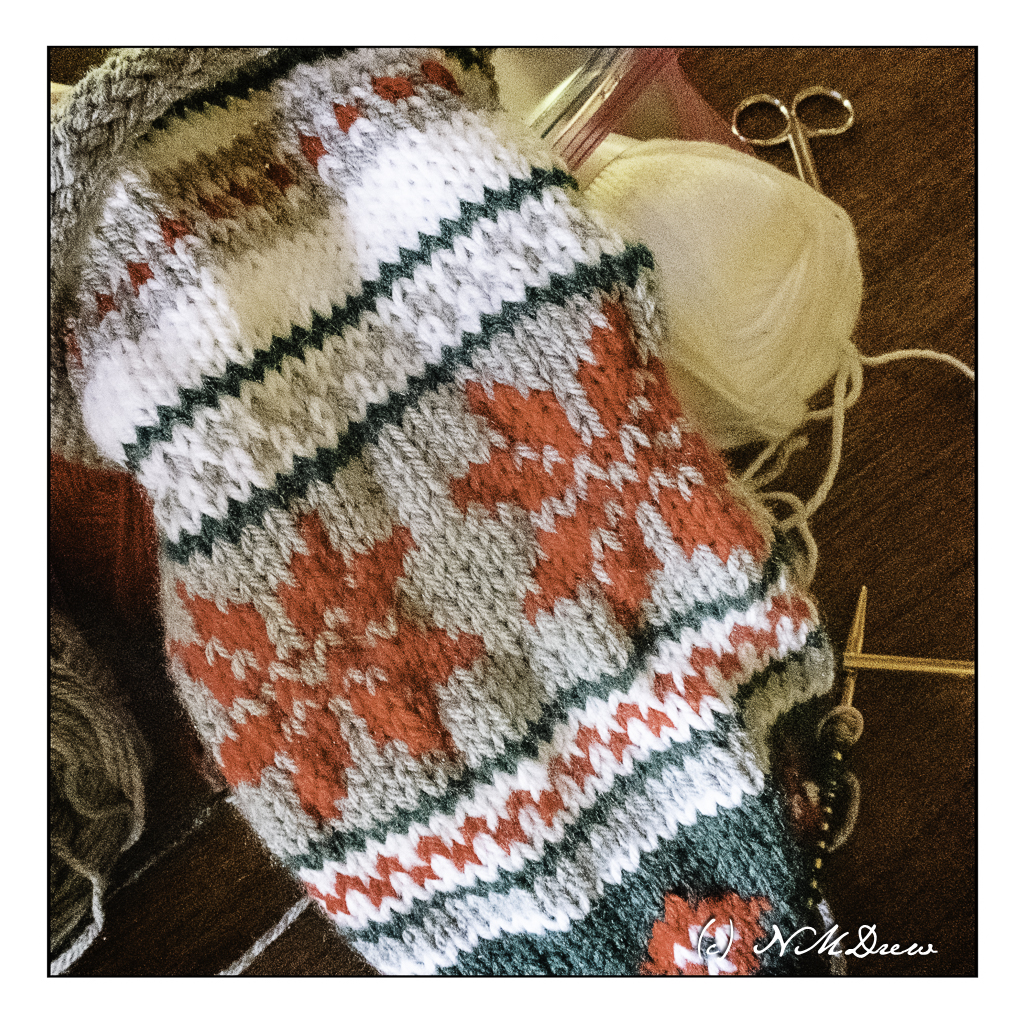
 I made these socks ages ago, using Noro Kureyon sock yarn. I, like many knitters, did not enjoy the knitting experience, but like the final product. These are warm and toasty and very comfortable to wear, far more so than the yarn implies while knitting.


 Ink, Yarn & Beer