Pattern for Smartness

Here we go: a Simplicity advertising video from 1948! It’s even older than me, which is saying something. Definitely it shows its time, but in some ways it is rather fine vintage. The acting is corny, but despite that, there are some really good little sewing tidbits on using a pattern and constructing a garment.

The sewing machine is, I think, a Featherweight 221 in a card table. The telephone is an oldy, too; I have one very similar to it, adapted for the plug-ins, now useless in the age of VOIP. I miss having it around!  It always worked, especially when the electricity went out.

If you look, there is a wealth of knowledge here, as well as some pretty cool vintage things for us 72 years later.  Funny to think they were very modern then! Anyway, the importance and value of hand stitching and basting, how to sew darts (top to bottom) using tailor tack markings, and if you look closely, using a thimble when sewing by hand, give you an idea of the value of such knowledge. It reminded me of some sewing tricks I’ve forgotten from good ole Home Ec.

I have never learned to use a thimble comfortably – most of us these days are probably in the same position.  I do have a metal clamp-on thimble (not painful, just adjusts to your finger size) and a leather one.    I prefer these thimbles to the traditionally-shaped ones.

Now . . . . which machine?

Hotter Than Hell, So I’m Gonna Sew!

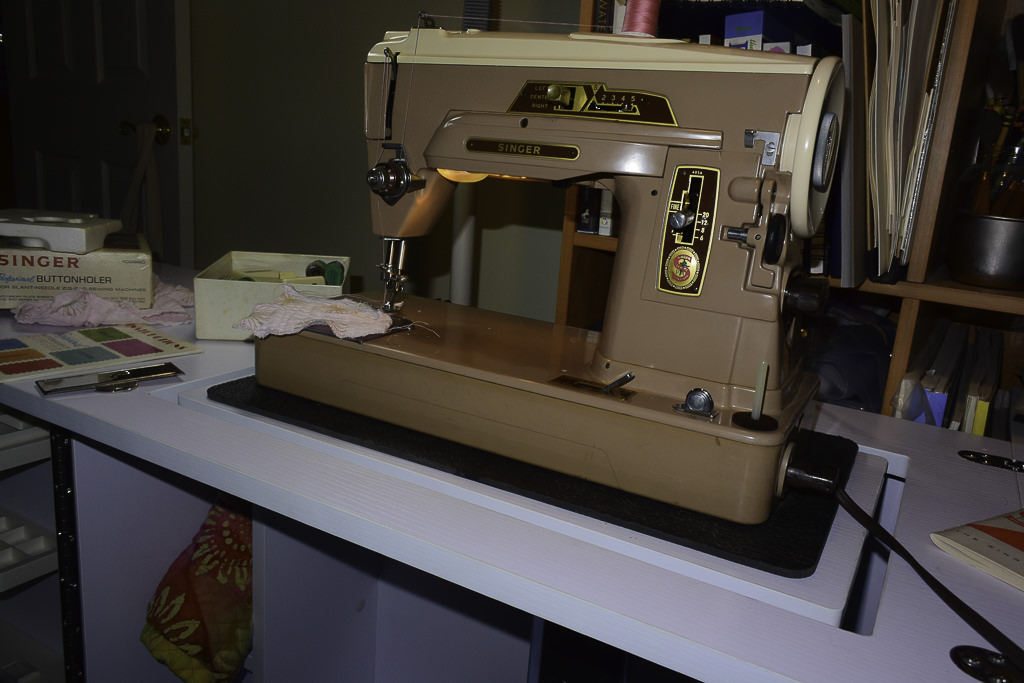
I think it must be about 100F (38C) where I live, so the air conditioning is on and not going out until it is dark.  My dogs aren’t mad, nor am I a Brit, so I am staying indoors, drinking water, and prepping the Maggie Shirt . . . and I am sewing it on my vintage Singer 403a,

I think these machines (the Singer 400 series) date from the mid to late 1950s and into the early 60s.  Mine is like it was never used.  When I bought her, she needed some TLC, heat and oiling, as well as a bit of gear grease, before she was off and sewing.  Unused machines freeze up, but once they have been given the right attention, I think they are the best!  I’ve had my 403a for awhile, and as I cycle through my machines, she hasn’t been out for a spin in quite some time.  Time to put her to work!

There is something to be said for the old Singer sewing machines.  They are well made and pretty straightforward.  The ingenious attachments are fun to play with and many collectors are nutso for them.  I have some, but usually rely on my more modern machines for things like fancy stitches and buttonholes.  Nonetheless, this machine is a blast.  It has cams for stitch patterns – the #0 cam is required to do a zig zag stitch – as well as straight stitch.

The 403a is a member of the “slant-o-matic” series of machines Singer made.  I like the slanted needle – it pushes the needle more into your line of sight.  Many newer computerized machines have the needle tucked back under rather fat upper portions, so they are harder to see.  Still, that doesn’t act as a deterrent.  For the 403a, as it is a slant needle machine, it is important to have the slant-o-matic attachments.  The one I have is the professional buttonholer, but I also have numerous feet that came when I got the machine.

Click on one of the images to open up the slide show . . .

The first two images are of the buttonholer – just a quick picture, really. The first shows you the box with directions, the second is the feed dog cover plate. The 403a has a rather interesting system to remove the throat plate – it is lifted up by a lever and slid out. The buttonholer cover slides in to its place – kind of complicated until you get the feel for it. The last picture shows you the box of feet and cams that came with the machine. The manual shows you just how unused the whole machine was when I got it.

When I buy an old machine, I want one that I know will work.  I like them to look good and to run well.  Some people get off on restoring machines, and while I can work on most of my machines for general maintenance, I really don’t find it a lot of fun to try to fix an ugly, rusted, beat up machine that is covered with rust and has electricals of suspect quality.  Prima donna, yes!

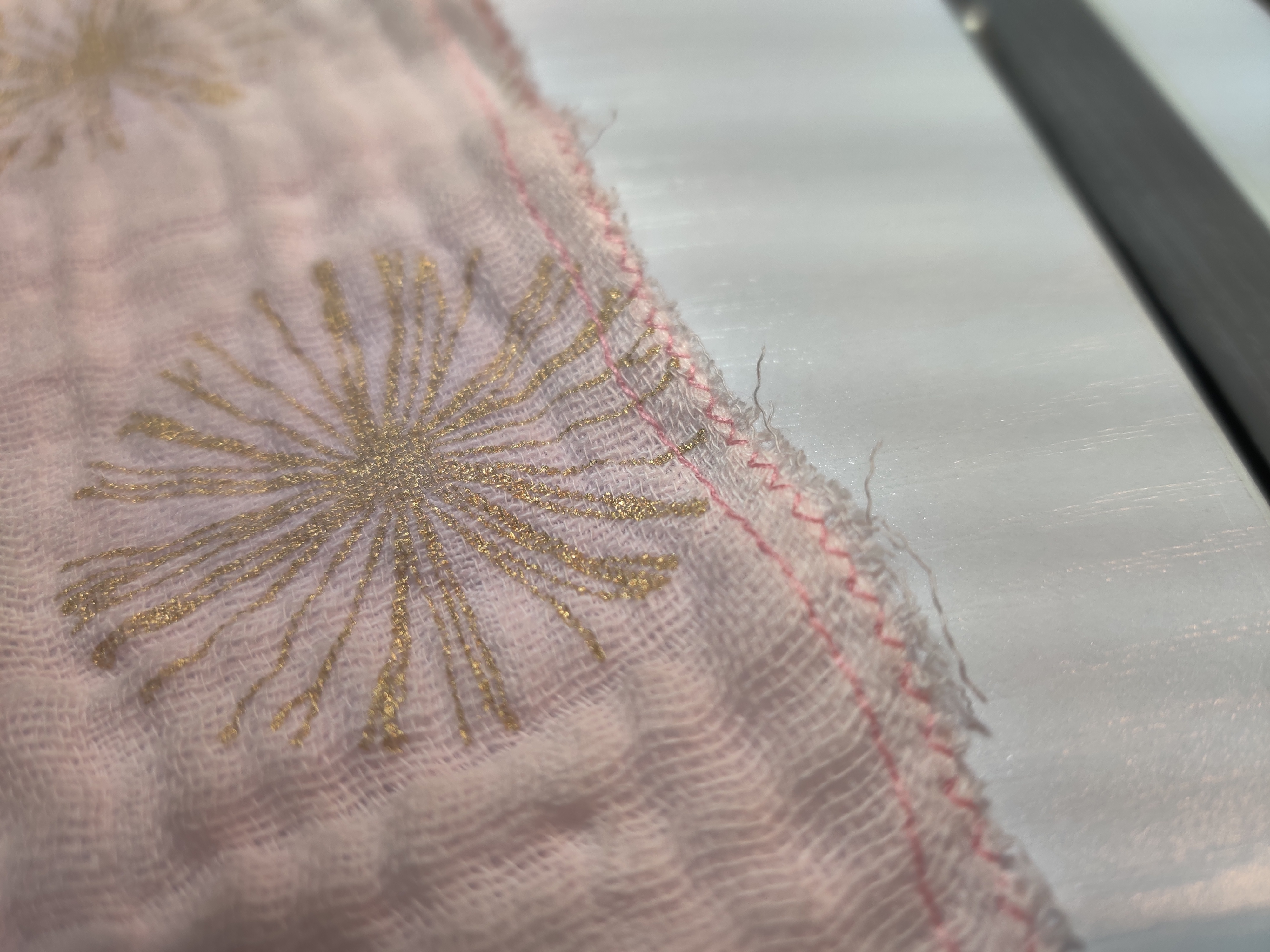
Finally, here is how I spent a few hours this afternoon.  The gauze for the Maggie Shirt is soft and stretchy, as is the characteristic of the critter.  It is also very ravelly.  Perhaps it is a bit of overkill, but I decided to stay stitch (the straight stitch) all around each piece, and zigzag to finish the edges.  I may need to cut out another collar stand as it seems to have gotten a bit warped by all this attention, but I have an extra yard.  Never having sewn with gauze, I bought a bit more to play with and to be sure that I didn’t lose so much to shrinkage that I would not be happy.

To be continued!

In Search of the “Perfect” Buttonhole, Part I

I don’t know about you, but sewing a good-looking buttonhole, without a mistake, seems to be a nearly impossible task.  There are attachments for machines.  Some machines have 4-to-6 step built-in buttonholes.  Sew a buttonhole by hand?  Hmmm.  I’ve been tempted and then reconsider:  it’s not worth the stress (even though there are some great YouTube tutorials I have watched!).

In each of these, something can go wrong.  A perfect buttonhole can be destroyed with a slip of the seam ripper when making the final slash.  Birds nests of thread can collect under what looks like a beauty of a buttonhole.  Stitches can be skipped.

I have a small (compared to some people) collection of sewing machines, ranging from a treadle with a long bobbin (The Free #5), two old Singer handcranks (a back-clamping Lotus 66 and a 99), a Featherweight 222K, a Necchi hiding out in the garage in a horrid French Provincial table), some Kenmores (158.1030, 158.1400, 158 904, 158.19802), a Bernina or two (801S and 930), a Janome 6500, and a Pfaff Passport 3.0 (which I may trade in as it seems to have a few too many quirks).  I also have a Viking 19e, fixed at long last, which was my mother’s machine, and the one I used throughout my school years.  I also have attachments for the treadle, Singers, Kenmores, Berninas, and Janome – anything to make life easier.  Or purportedly easier.  Buttonhole attachments are included in the mix.  And as adjuncts, a coverstitch machine and a serger.

Not all attachments fit all machines.  Most are proprietary.  For instance, did you know that Singers of yore come with rounded corners and Kenmores are squared?  Round pegs – or rounded corners – do not fit in square holes – or squared holes.  And in reverse.  Thus, Singer attachments are not likely to work on a Kenmore, and Kenmores might not work on a Singer or a Bernina – but they might.

For awhile, Singer made slant-needle machines, and must have slant-needle attachments.  Kenmore machines range from low-shank, to high-shank, to super-high-shank.  These might require specific buttonhole attachments or shank adapters.

Let’s not talk about Kenmore buttonholers of some variety – many are proprietary to given machine models, and are not clearly identified.  Did you ever look at all the models than Kenmore made?  Maybe even more models than Singer.

I have 4 Singer buttonholers (gotten cheap off eBay – some for a couple of bucks) and a generic, low-shank one I bought 20 years ago at a local sewing machine store.  That last buttonholer is the easiest to use of all of them, but the old Singers are a lot of fun and do a pretty good job.

A good or great buttonhole attachment or machine function is a gift from the gods.  Imagine making clothes at home on a straight-stitch machine in a few hours – or several – and then spending the same amount of time (I would think) sewing in 12 buttonholes on a shirt or a blouse or a dress. Even if funky and weird, a buttonholer is up there with a washing machine and a paperclip and a safety pin as far as being this side of miraculous.

Whoever invented the automated buttonholer, thank you, thank you, thank you!

Stay tuned for Part II!

Retro with Flamingos

Like I said, I have gotten the sewing bug.  And a taste for a bit of nostalgia.

Yesterday, I went to a local Joann’s and came home with a couple of really fun prints to make up some shirts / blouses.  The fact is, today it is almost impossible to find any 100% cotton blouses or short-sleeved shirts for women.  Almost everything is either a knit, a slimy synthetic, or a cotton blended with 3-4% spandex.  The latter is really uncomfortable as far as I am concerned because that little bit of spandex takes away all the breathability of pure cotton.
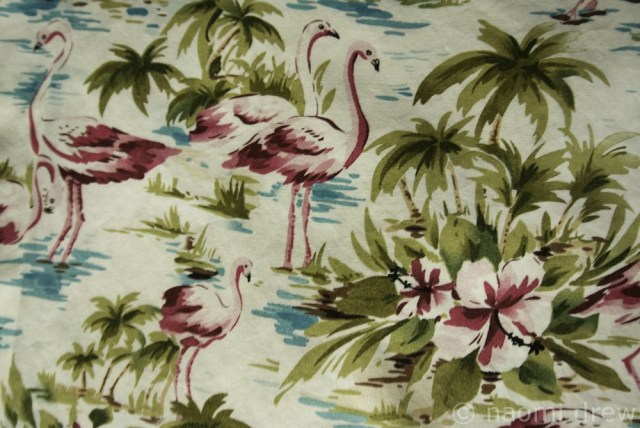
Flamingo Material

This flamingo pattern caught my eye.  I am a sucker for wild Hawaiian prints, and really, the worse they are, the more fun.  Here in California, prints like this are totally okay, but probably not for NYC in the dead of winter.  There was only 1 yard and 19 inches left on the bolt, but I took it, and got a 50% discount as it was the end of the line.  From my earlier days, I used to make shirts with only 1.5 yards, so I figured I could do it.  And I did, but I have put on a few pounds since my youth, and really needed a bit more for an easy layout, and while I did get it, but the neck facing was scrimped a bit.

Flamingo Shirt Pattern

I rummaged through my patterns, and luckily, I found this one.  Short sleeves, sorta Peter Pan collar, and five easy pieces.
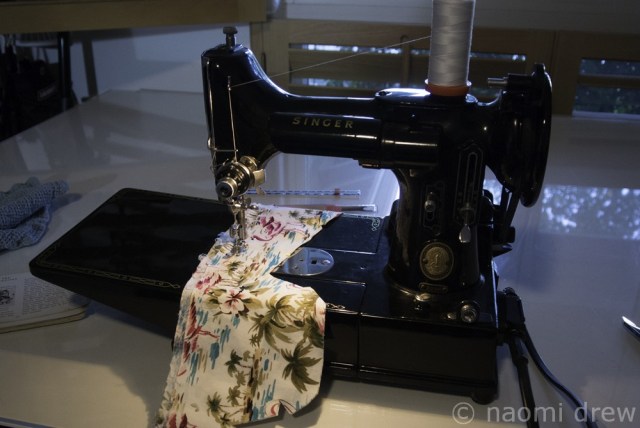
Featherweight 222K and Flamingo Friend

In keeping with nostalgia, I decided to dig out the Singer Featherweight, a 222K with the open arm, reverse stitch, and droppable feed dogs.  All straight stitch otherwise.  I also decided to sew this without the use of attachments, except for the buttonholer (which is later, and with trepidation), and use techniques required of a straight-stitch machine.
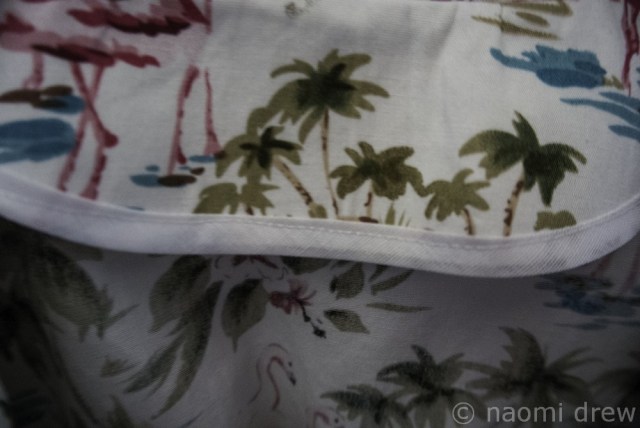
Bias Tape on Facing

In some ways, I think this was actually a good choice.  I always zigzag every piece before I sew it because I hate raw edges, but I could not do that with this project on this machine.  In reality, I think it may be okay because the material is not constricted by the zigzagging.  I did all my staystitching and edge stitching, and I clipped and layered the collar seams.  In other words – I took my time!
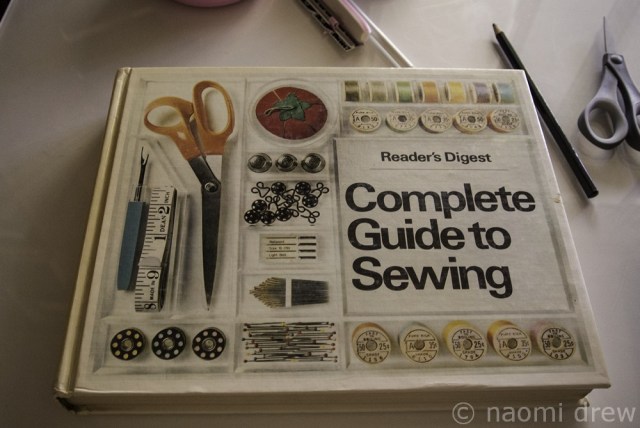
Still a Great Book!

I also refreshed my sewing skills by pulling out The Reader’s Digest Complete Book of Sewing, a present from my father back in the 60s or so.  Compared to more recent books on sewing, this is a real encyclopedia of information and technique; when I was younger, it was too tedious for my helter-skelter approach to sewing, but today, I really appreciated it.  I read about facings and collars and edge stitching and stay stitching.  I also read about using bias tape to finish edges, which I had thought about prior to the project, but learned that into a curve you do one thing, and out of a curve, you do another.

Pointing Collar Corner

One thing I didn’t learn in my sewing classes in school was that there is a technique to put a nice point on collar – take some thread on a needle, double knot, and once you have pulled most of the collar out, run the needle into the corner on the inside, and push it through the corner on the outside, tug, and cut.  A very nice point is the result!  Like I said, the Reader’s Digest book is full of good information!

Sleeves

The blouse is far from finished, but I am fairly satisfied with my progress.  It was interesting to use a straight stitch machine that is belt driven.  A couple of times, the machine didn’t like the thickness of the blouse, but with some encouragement, we got through it.

What remains to be sewn are the sleeves, side seams, hem, and making the buttonholes.  I am not too sure how long that will take – it may not get looked at until next Friday, because some of my days are pretty long.  In the meantime, I will re-read about setting in sleeves and other good things.  Nothing like a sense of accomplishment – until I destroy it with badly done buttonholes.  Buttonholes are my nemesis, and I need to practice them all the time.