At the Quilt Show

This past weekend was a two-day event, A Quilter’s Showcase, sponsored by the Conejo Valley Quilters, and held in the gym at California Lutheran University.  I went Saturday afternoon, to get out of the house, and to find some way to ignore my cold.  Of course, the main goal was to see the quilts!

Quilts are both works of art, and practical ways to use up small bits of material to make useful objects, such as bedclothes or pillow coverings.  Over the years – probably from the 80s on – wall hangings and other forms of quilting have evolved.  Not being a quilter does not mean I do not admire the skill, patience, and creativity involved in their making.  I don’t know if I have the patience for them in particular – I need to be moving, not glued to a sewing table or indoors.  Anyway, enough about me – let’s look at some of the offerings!

_DSC4599

First, the set up was really nice.  Along the periphery of the gym were the vendors, mostly quilt stores, some local, some from further away.  Everyone was really nice.  Locally, we have Cotton & Chocolate Quilt Company.  I liked their display, which was colorful – I especially liked the quilts hanging up.

Cotton & Chocolate

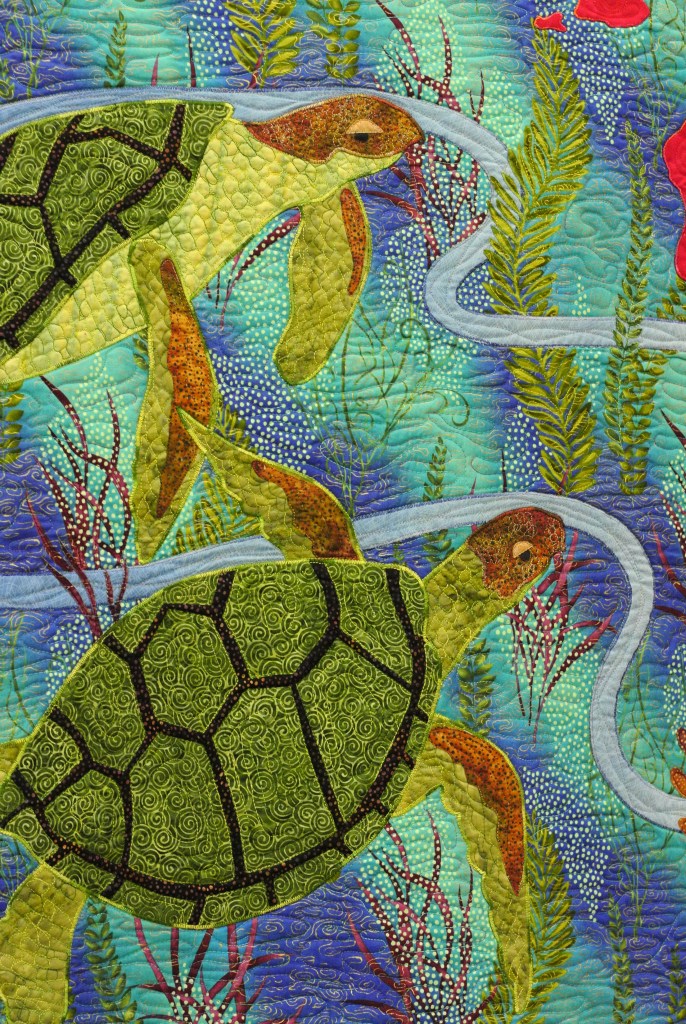
The inside portion of the gym was somewhat of a labyrinth. Individual quilts were hung up, like paintings on a wall. Clothespins attached to the side of the quilt allowed the viewer to peer at the reverse of the quilt by using it as a handle – a good idea to keep quilts clean, and to satisfy the curious. There were a variety of quilts, from pictorial to traditional, most new, but some from the 1800s and 1900s.

_DSC4591 _DSC4594 _DSC4600

_DSC4572

_DSC4588

_DSC4601

_DSC4567

_DSC4575

_DSC4577

_DSC4597

The vendors were mostly quilt stores, but you do need machines and thread and needles besides material to quilt. Businesses selling sewing machines were there – I didn’t see my favorite store, Art & Jenny’s from Ventura there – but there were plenty of other local businesses with great machines and friendly, knowledgable staff.  My favorite featured hand crank sewing machines, and quite a few of them.
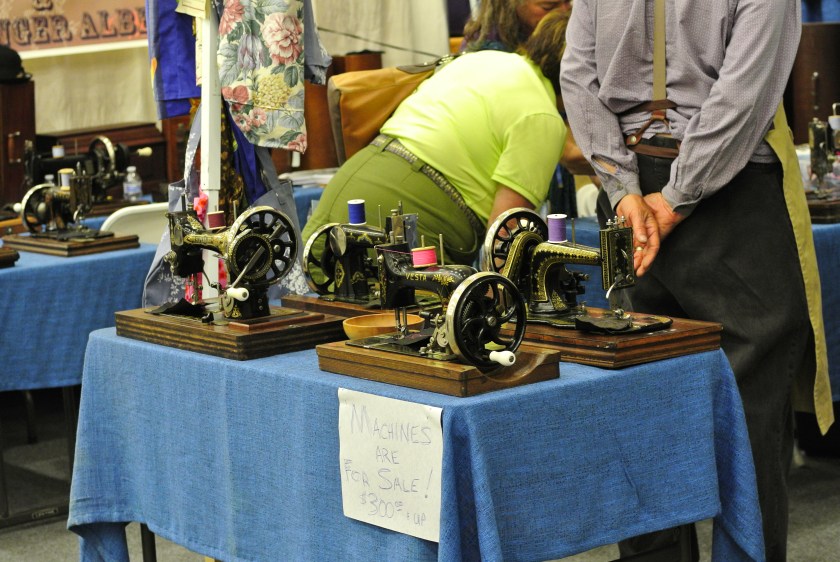
_DSC4604This store is called Sew Cranky, and as you can see in the above picture, they had oodles.  If I didn’t have a couple of hand crank sewing machines of my own, I would have gotten one.  If you have never used a hand crank machine, it is very peaceful – no long electrical cords, slow motion, and you can take it outdoors, even if it does weigh a ton.  The decals are wonderful, and the click-click sound of the shuttle is soothing.  Treadle sewing machines are just as nice, but a bit less portable.  And, they do have attachments which compensate for the straight-stitch only of many older machines.

Communities, such as the Conejo Valley Quilters, connect people to arts and crafts, to resources, and open one up to the variety and talent found within one’s own neighborhood.  Their value may seem neglible, but in reality, our own lives become enriched from such venues, much more than we can appreciate in the moment.

Handsewn Hippari Top

Awhile ago I wrote a bit about John Marshall, a fabric artist and clothing designer who is very influenced by traditional Japanese clothing and dyeing.  He is the author of an excellent book on traditional Japanese clothing construction, Make Your Own Japanese Clothes. In his own work, John moves beyond the ordinary into the extraordinary, with an excellent eye for detail and color.   As an instructor, he is well-organized and clear, and very knowledgeable.  As an artist, there are few to compare.  His book is just like him – full of information that is detailed (but not annoyingly so) – and moves a traditional clothing into a modern vein.

Traditional Japanese clothing is made from fabric measuring about 13-14 inches wide.  As a result, buying fabric requires buying yards of it!  It comes in varying lengths on bolts, depending on what the final product is to be.  There are traditional lengths for haori, for kimono, and so on.  Modern Japanese stores carry modern fabrics, but probably have access to traditional fabrics.  In the U.S., patterns for making traditional Japanese and Asian clothing may be found at Folkwear, a company with patterns for traditional clothing from around the world.  These patterns allow you to use modern fabrics in modern widths, such as 45″ wide.  The beauty of John’s book is that if you have Japanese fabric in traditional widths, you can use the patterns he provides without too much work.  The selvages of the material are incorporated into the clothing construction, and sewing is minimal.  Seams do not need to be finished to prevent raveling.  The range of clothing is narrow, but the variety comes in the patterns of the fabrics themselves.

The hippari is a wraparound top, essentially unisex according to Marshall, but generally worn by women.  The male version of the hippari is the jimbei, another wraparound top but with side vents for coolness.  The illustration on the above left is from page 83 of John’s book.  He writes:

Of construction similar to the jimbei, except for tapered sleeves that stay out of the way and sewn (closed) side seams, the hippari is an infinitely practical as well as attractive top.

The hippari I made is an amalgamation of the two styles.  I created vented sleeves for coolness, as I use it as a sort of smock over my regular clothes.  The sleeves are gathered to keep them up and out of the way.  The fabric is a modern kasuri fabric woven in the traditional width.  The bolt measured about 10 yards in length, and using the layout in Make Your Own Japanese Clothes, I created a custom-fitted top.

I decided to sew my entire hippari by hand.  I used 100% cotton thread and tested out some of the techniques illustrated in John’s book, as well as techniques I improvised and use in my own home-made clothing.

The idea of sewing clothing by hand probably seems daunting.  I know for a fact my own handsewing is not what it could be with hours and hours of practice.  I can do tidy little stitches, but sewing a backstitch for yards is not easy to do.  The material needs to be stretched taut for the stitching to be easily accomplished.  I stretched mine out on a large embroidery hoop at times, and at other times I just held it, stitched, and hoped for the best.

Sewing birds and clamps have been used for centuries to make this job easier, and traditional Japanese sewing boxes come equipped with just such items.  If you wanted, you could use a C-clamp to hold your material in place.  The nice thing, though, about sewing the hippari was the crispness of the fabric – it really allowed me to sew much more easily than a soft, drapey fabric.  Washing has softened the material, and, yes, it did shrink, but not too much.

This photo shows the open armhole, which actually is very nice if you are planning to wear the hippari over other clothes. It gives a little more room for movement, as well as helps keep you cooler. As I tend to get warm easily, I decided to do the vented sleeves found in the jimbei. If you do this, be sure to reinforce the vent, otherwise you may need to re-stitch your seam.

A running stitch or back stitch may be used for the majority of the seams. The same can be used to hold the seams in place, such as under the arm. The straight edges of the selvages mean no finishing of cut edges, as you can see from the final photos below.  Below, the running stitch is shown for the back center seam of the hippari in the left hand photo, and to the right is illustration of the selvage edge.  The selvages are also seen in the photo above.

For greater detail of the hippari, click the next photo.

Altogether, this is an easy project if you want something different to do.

John Marshall: Works in Fabric, ii

My first contact with John Marshall came about when I discovered his book Make Your Own Japanese Clothes.

For anyone interested in traditional Japanese fabrics and clothing, this book is an incredible resource of information.  You learn how to construct Japanese clothing using traditional fabrics (which measure 13-14 inches wide), and how to sew them using traditional hand-sewing techniques.  Of course, you can also sew them by machine, but that just isn’t the same!

Garment construction is given for kimono, haori, hanten, various tops, vests, pants, obi, and tabi.  Not only do you learn how to make these, you also learn about the construction of sleeves, hems, collars, and the use of lining and padding.  All of these, combined with illustrations and photographs, give window to both traditional clothing, and a window into creating your own clothing with a modern cast.

I made the hanten, hand-stitched using traditional kasuri, and totally enjoyed the process.


Knitting Offenses

The other day, I was over at the local bookstore, and decided to grab a few knitting magazines to peruse with my coffee.   I saw some great designs in texture combined with lousy garment construction and finishing techniques.  The biggest offenders are the shoulders, sleeves, bodies, and necklines.

Garment Design. As an example, not too long ago, I bought a pattern booklet from a famous yarn maker.  The cover hat and glove set caught my  eye.  I bought it, without reading it.  When I read it, I was stunned.  The hat pattern – the same as for the back of the glove – was   knitted back and forth on two needles, and then seamed!  The gloves were knitted on four needles, in the round.

Huh??  Am I missing something here?

Necklines. I always look at the construction of the neckline, and I read the pattern.  Is there sewing to be done?  Is it knitted and attached as you go along, or done separately and then sewn on?  Is the neckline shaping capable of supporting the rest of the sweater body?   How does that V-neck or scoop neck look?  Too low?  Too high?  Do the edges of the neckline have a finished look, or do they look sloppy and stretched out?  Is it flattering?  Does it make the sweater fall off the shoulder?

Badly Designed Sleeves. Under this heading, you can find poorly sewn sleeves, at the shoulder and into the armpit, and along the length of the arm.  First question:  Who did the finishing?  Next question:  Why would you design a sweater with sleeve seams?

In one of the magazines I looked at, it was pretty obvious that the person who pieced together the sweater could not do the job.  The sleeve seam was messy and ragged.  The knitted pattern did not add to the offense; some stitches make it difficult to knit a “sewable” edge, but the designer can eliminate this problem if they must have sleeve seams.

Another picture in the same magazine showed inset sleeves with the same crappy finishing.  Puckers, uneven sewing.  This destroyed the sweater.  Here, the knitting designer was at fault to a degree because the pattern stitches used did not make the sewing-up easy.

Finally, photography.   A lot of magazines show evidence of pinning and pulling to make an item “fit” the model.   Here is when design flaws can really show up, as well as poor finishing techniques.  Thank the photographer for this!  It may make you re-think doing that pattern.

Body. This has been written up by some rather famous people.  Elizabeth Zimmermann said it all.  She documented this issue quite well when she sold her seamless Fair Isle sweater pattern to a famous magazine.  Said magazine rewrote the pattern to have side seams, shoulder seams, and sewn-in sleeves, even though it was pretty obvious in the picture that there were no seams at all – or that the seamstress was superb!

Poorly designed sweaters can result in sweaters which can never be sewn together well, no matter the talent.  I have some ski sweater designs from the 40s and 50s.  The raglan sleeves are sewn in, and the patterns – snowflakes, elk, stars – are placed in the middle of the raglan seam.  Not nicely sewn in the photos, and not worth doing, unless it is in the round.

What to do? Well…what can you do?  If you really like something, is it something you can do?  Do you have the skill, creativity, know-how to fix problems?  Do you want to take the time to do it?  Do you want to learn to do it?

If you answer yes, then have at it.  If you answer no, then look for another pattern!  You know your own personality, so why make yourself crazy and frustrated to the point of misery?

IMHO. I am a frump and a snob.  I don’t wear trendy clothing, and I don’t make fashionable designs.  I like well-tailored, comfortable clothing.  I like good shoes.  I like good materials and craftsmanship.

When it comes to knitting anything, I really appreciate good construction design, good finishing, and elegance.   Most of this can be done with a minimal of sewing.