A Bag for the Lady

Machine Inside!

I got a new-to-me sewing machine the other day, a Kenmore 158.19802, but that is a story for another day.  However, it needed to be used, and I needed something fun to do that wouldn’t make me nuts.  My sewing student likes to make stuff, like pillow cases and stuffed felt tomatoes, and me, I have never done anything with my sewing except make clothes.  Because her thinking patterns aren’t mine, I decided to think outside of my box, and looked for something free, and useful.  Voila!  The Pleated Tote by Artsy Crafty Babe.

Pleated Tote Pattern

This is a free pattern, and it is really well-designed.  It looks good, has great directions, and with sale material, didn’t cost me more than $10.00 and some time.  And, I got to see how the new-to-me-machine works (very nicely!).  The pattern is all in the PDF file, ready to be cut out!

Pattern Piece

What I did differently from the original pattern is to double the length of the straps – I like long ones, so I can wear the bag diagonally if necessary, or knot up the straps if I want shorter handles.

Interfaced Lining and Body

A few other things I did was to interface the material and the lining with fusible lightweight pellon, clip the corners and curves, and made sure the darts of the lining and the outside of the bag were sewn to lay in opposite directions to keep the thickness of the material as minimal as possible.  Nice details, such as inside pockets, a button loop, and gentle curves, make this bag a winner.

Pocketses

Construction directions were clear – and if I had not read them I would not have done it right.  You sew the lining and body together, right sides together, and get this.

Inside Out

Through an opening left in the lining, you pull the bag right side out!

Right Side Out

The material itself is a bit heavier than calico-weight cotton, sort of a lightweight upholstery, but not a duck.  It is 100% cotton, and although dry cleaning is recommended, I washed the material in hot water and dried it on hot – I like to shrink anything I know is going to go into the washing machine.  (I don’t know anyone who would dry clean a purse!)  I needed about 2 yards of material, and the stuff I used was 60 inches wide.  The body of the purse and the lining match, as do the pockets.   Because I wanted a bit of body to the overall purse, I decided on the interfacing for the lining and external part of the purse, and am glad I did – lightweight, but not shapeless.

Long StrapsDetails

At the Quilt Show

This past weekend was a two-day event, A Quilter’s Showcase, sponsored by the Conejo Valley Quilters, and held in the gym at California Lutheran University.  I went Saturday afternoon, to get out of the house, and to find some way to ignore my cold.  Of course, the main goal was to see the quilts!

Quilts are both works of art, and practical ways to use up small bits of material to make useful objects, such as bedclothes or pillow coverings.  Over the years – probably from the 80s on – wall hangings and other forms of quilting have evolved.  Not being a quilter does not mean I do not admire the skill, patience, and creativity involved in their making.  I don’t know if I have the patience for them in particular – I need to be moving, not glued to a sewing table or indoors.  Anyway, enough about me – let’s look at some of the offerings!

_DSC4599

First, the set up was really nice.  Along the periphery of the gym were the vendors, mostly quilt stores, some local, some from further away.  Everyone was really nice.  Locally, we have Cotton & Chocolate Quilt Company.  I liked their display, which was colorful – I especially liked the quilts hanging up.

Cotton & Chocolate

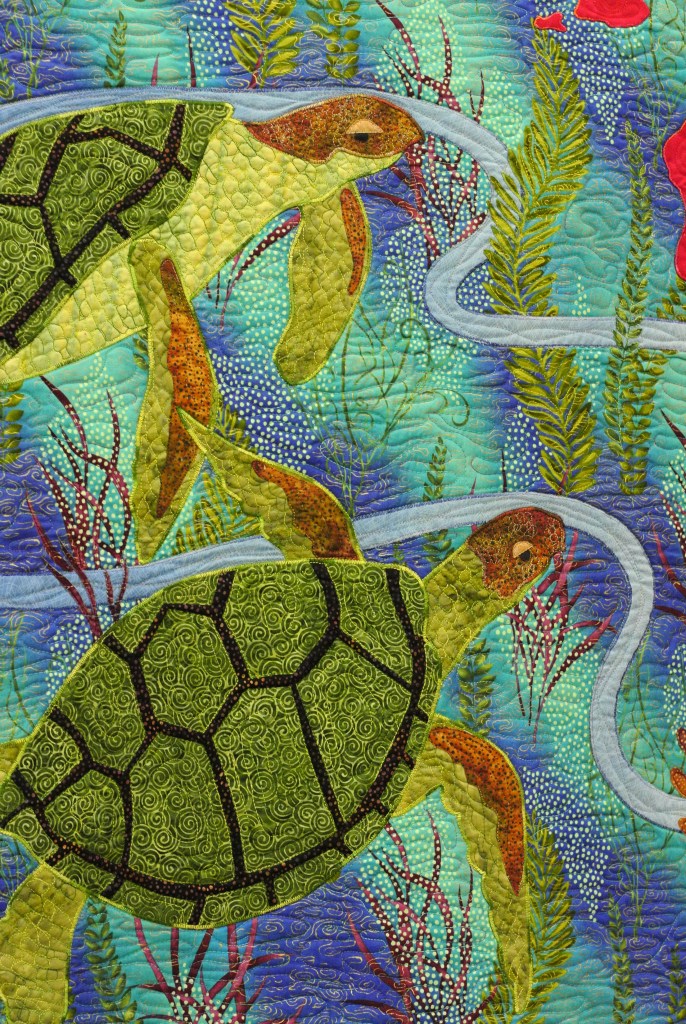
The inside portion of the gym was somewhat of a labyrinth. Individual quilts were hung up, like paintings on a wall. Clothespins attached to the side of the quilt allowed the viewer to peer at the reverse of the quilt by using it as a handle – a good idea to keep quilts clean, and to satisfy the curious. There were a variety of quilts, from pictorial to traditional, most new, but some from the 1800s and 1900s.

_DSC4591 _DSC4594 _DSC4600

_DSC4572

_DSC4588

_DSC4601

_DSC4567

_DSC4575

_DSC4577

_DSC4597

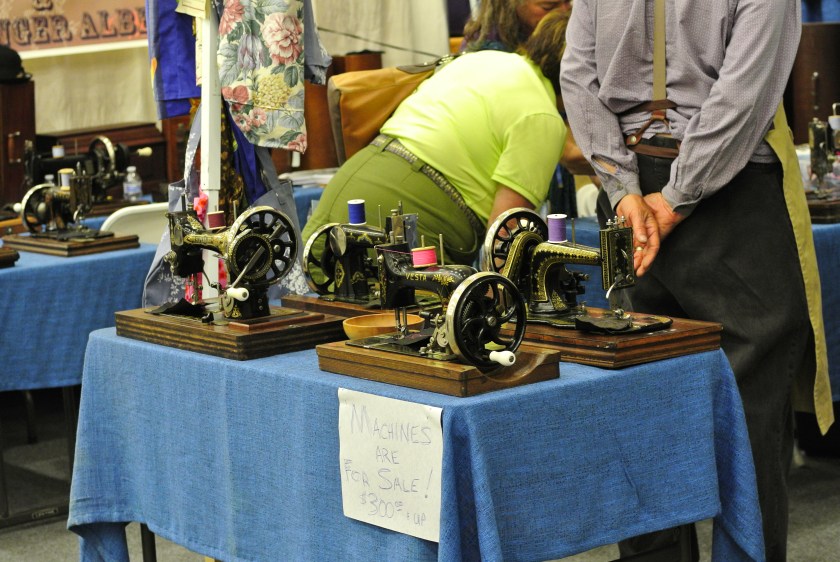
The vendors were mostly quilt stores, but you do need machines and thread and needles besides material to quilt. Businesses selling sewing machines were there – I didn’t see my favorite store, Art & Jenny’s from Ventura there – but there were plenty of other local businesses with great machines and friendly, knowledgable staff.  My favorite featured hand crank sewing machines, and quite a few of them.

_DSC4604This store is called Sew Cranky, and as you can see in the above picture, they had oodles.  If I didn’t have a couple of hand crank sewing machines of my own, I would have gotten one.  If you have never used a hand crank machine, it is very peaceful – no long electrical cords, slow motion, and you can take it outdoors, even if it does weigh a ton.  The decals are wonderful, and the click-click sound of the shuttle is soothing.  Treadle sewing machines are just as nice, but a bit less portable.  And, they do have attachments which compensate for the straight-stitch only of many older machines.

Communities, such as the Conejo Valley Quilters, connect people to arts and crafts, to resources, and open one up to the variety and talent found within one’s own neighborhood.  Their value may seem neglible, but in reality, our own lives become enriched from such venues, much more than we can appreciate in the moment.