A Cool Tool to Use When Replacing a Treadle Sewing Machine’s Leather Belt

Whew! That was a mouthful, but I wanted to get in as much info as possible as a headline.

Let me explain.

Putting on a new leather drive belt on my ca. 1911 The Free No. 5 treadle sewing machine has been like having a tooth pulled without anaesthesia – a painful, dreaded experience.

The Free No. 5 is a clone of the classic vibrating shuttle machine, the Singer 27 /28 and 127 /128 machines. On the right side of the machine is the leather drive band which is used to drive the machine with the help of your own two feet.

To begin with, a leather drive band must be purchased, and they can be found online – Amazon, Ebay, a great online shop called “Sewing Parts Online” (which also has a great YouTube presence, and which you can watch further down the line).

The drive band is usually 3/8″ in diameter, 6 feet long, cylindrical in shape, and comes with a metal C-shaped wire inserted into a hole at one end – you have to make your own hole at the other end. You can also get a stretchy band, as used on many spinning wheels, and that is also great – and a nuisance to install, too. It is melted together instead of spliced together using a bit of metal wire.

So, back to the leather band.

Before you can get the band to work on the machine, you have to remove the old band and then measure the new band. My machine’s drive band is about 5’5″ long, but to get the correct measurement, I have to insert the new band and track it around the pulley on the sewing machine, into the back opening of the table and into the wheel by the treadle and keep it in the groove that the drive band rests in, and then up out of the sewing cabinet to the front of the machine. This involves crawling around on the floor, poking here and there, and cussing from time to time.

From there, even up the ends of the drive band and then cut. And cut off less than may be needed because you can shorten the drive band, but not lengthen it. While the band is about $10, unless you have an extra band, you could just regret that first cut. As they say, measure twice, cut once. Very true!

So, once the drive band is the right length, you have to make a hole on the cut end of the band to take the end of the C-shaped wire. How to do that?

First, punching a hole in a round piece of leather evenly on both sides is a pain. Doing it without removing the threaded drive band is also a pain. If you don’t remove it, how do you hold the leather still when it wants to roll all over the place? Josh made me a jig which sort of worked – a v-shaped thingy to let the leather band rest in. I would lay the band in the jig and take a hammer and fine nail to the leather to make the hole for the wire. Taping the band in place was useful to keep things from rolling around, but if my nail wasn’t perpendicular to the band, disaster often awaited. Even an awl was no guarantee of a good hole.

And this is when the cool tool shows up and saves the day! It is like a pair of pliers in size and weight, but consists of 3 parts – a part to pierce the leather band, a part to cut the band, and a part to crimp the C-wire into place. Below is the tool closed, with safety lock on.

And below is the tool opened up.

Using this tool and the preceding steps, I installed my new drive band in under 5 minutes, and that included cutting the belt twice. Now everything is working like a champ! I can sew on my machine, wind my cylindrical long bobbins, and enjoy it all. Here is the machine, up and running!

I bought my cool tool off a seller on eBay – I ordered it, saw it was packed and ready to ship in a couple of hours, and received it 2 days later via priority mail. The company is “Lovebug Sew N Go” – 100% rating with thousand of sales. Very impressed!

The video below, from Sewing Parts Online, shows the tool in action, as well as installing a new belt. You can purchase pliers from Sewing Parts Online, and a belt as well. The YouTube video includes direct links for each.

I cannot recommend this leather drive band tool enough. It is a bit pricey, but the lack of stress and decrease in time involved to get the belt installed is more than worth it. If you have never replaced your leather drive band, of course you will find some great videos on YouTube.

My own experience, besides using this tool, is to stretch the new belt a bit, and then work the belt into the machine by inserting into the pulley, work it into the back hole of the table, into the groove of the wheel and around to the front. Pull it up onto the surface of the table and then measure, mark it with a pen. Cut the belt. If the belt wants to flop around a bit, use some tape to keep it under control The belt is then measured in length, and cut; you want a small gap between the ends of the belt – no overlapping. Insert the C-pin and then crimp it together. Test it out and adjust as necessary.

Every sewing machine and cabinet is different – some seem poorly designed and the belt may catch on the entrance and exit holes of the table. If your table and belt are at war with each other, wrap some tape over where the ends of the belt join to make for a smoother transition.

But – look at some videos first!

Precious Pocketses

Clothing without pockets is ridiculous.

I carry a lot of things in my pockets.  I put my phone in, my keys, money, a small wallet with ID.  At times my pockets carry lens caps, tissue, paper towels, pens or pencils or markers.  If I can stash things in pockets, I would rather do that than go out with a purse slung on a shoulder.

Defined by Wikipedia as

pocket is a bag– or envelope-like receptacle either fastened to or inserted in an article of clothing to hold small items. Pockets are also attached to luggagebackpacks, and similar items. In older usage, a pocket was a separate small bag or pouch.

That works for me.  Pockets have been found as bags to carry items, such as with Otzi the Iceman, bags worn under clothing with slits to access them, and so on.  It’s good to have them to carry things, leaving hands free.  Backpacks and other types of bags (fanny packs, butt bags, whatever, be you English or American 😉 ) are all useful ways to tote.

And then there is a “poke” – a dialectical word for a pocket, used in mountain areas to this day in the US.  “A pig in a poke” leaves a lot to the imagination.

So, why pockets?

Sewing.  I love sewing, and have decided to work on expanding my skills as well as knowledge.  Hand sewing is an art I have long enjoyed, and have set myself the task of improving those skills, such as hand sewing a 17th century shift in linen.  (Nearly done!)  I have also collected some books on medieval clothing, Tudor, and Regency era clothing.  Hand sewing was done in all those eras.  But, as I also like modern clothing, I have decided to improve my machine skills, such as with my serger / overlocker and coverstitch machines.  All this in addition to my first love, painting.

Back to pockets.

Burnley  & Trowbridge have a whole YouTube series on sewing pockets that tie around your waist, accessible through your clothing.  Very simple and elegant.  Here is the first video in the process:

And there is a book that I just bought, by Barbara Burman and Ariane Fennetaux:

Definitely a great read so far – scholarly, thought-provoking, and a great look at the humble pocket.

However, is it just utilitarian? Nope! Pockets can also be works of art, with fine embroidery, as seen on the cover of the book above. They are also included in the wardrobes of dolls form long ago. You can read about pockets at England’s great Victoria & Albert Museum.

Besides the V&A,  VADS has a whole series of pictures and information about pockets – 373 to be exact – of accounts of material bought for pockets, paintings with pockets, dolls clothed with pockets, children and adult clothing with pockets.  Scroll through it – it is a stunning resource for pockets and all kinds of other things.  Words cannot describe the visual richness and historical treasures found at these sites.  Here is an image of a doll, skirts flying, and pocket showing:

And so, I will leave you with thoughts of the humble pocket.  I have plenty on me today – two in my fleece vest, two big ones in my pants.  I am a very happy girl, I assure you.  If it ’twere true I had on socks, I could also use those for pockets.  (We won’t discuss my underwear.)

Pocketses are truly precious.  Gollum knows.  So do I.  So do you.


Fixing Things

I like the idea of being independent of experts as much as possible. Maybe being as self-sufficient as possible is a better way of expressing it  This way I don’t have to wait for someone to do something for me which I can do on my own. A lot of things are best left to the experts, but a lot of daily stuff doesn’t have to be that way.

The experts I absolutely insist upon are accountants for taxes (I used to get the 1040-EZ back with corrections as the English is nonsensical as far as I am concerned), auto mechanics, and doctors. Appliance repairmen are often overpriced and not as good (and inexpensive) as my husband.  He is good at figuring things out and fixing them. He can research things on the internet and then buy parts.  I am no good at fixing those kinds of things.

However, I do think about the things I can fix or figure out how to fix on my own.  I can deal with computers pretty well, software and hardware.  I can adjust small mechanical things.  I can sew clothes, cook, preserve food, garden, and jerry-rig a lot of stuff.  I can knit and weave and spin (oh, what a domestic I am!).  If I had hand-powered tools I could do a lot of carpentry, but I don’t like high speed electrical tools, except maybe drills. And handheld sanders.  Things that go too fast annoy me.

And, I do like sewing machines.  In the past few months I have bought two to work on.  One I got working, and then something went wacko, so I am going to have to get in touch with my mentor and have him help me out.  Another one had a stuck feed dog area, but that I figured out and with oil and heat got it working again.  Computerized sewing machines are not for me to fix, but the ones I have run beautifully, so I am not worried about those.  However, cam stacks and upper thread tensioners are things I might want to take a try at one day.

When I think of it, though, I don’t want to fix sewing machines a lot, like in doing it on a regular basis.  Instead. I want to know enough to make the little fixes they might need, and know enough about them to troubleshoot and fix issues.  I had to find this out by actually working on some machines.   That knowledge and experience is definitely a worthwhile skill to have.

I come from and married into a family where doing and making things is part of daily life.  My father could build a house, plumb and wire it, as well as sew and farm and build things out of metal and wood.  He was an engineer who designed air planes and fighter jets.  My mother could do a lot of things, too, more on the domestic front, but she studied engineering and was a television cameraman in the 1940s.  My married-into-family sew, knit, bead, build harpsichords and furniture from scratch, and bake and cook, manage TV news stations, do music and video editing, and build airplanes and cars from scratch.  These are all skills, old and new, that make for creativity and self-sufficiency.

Self-sufficiency and self-efficacy are intertwined and make for a happier life than relying on someone else to fix or prepare or supervise one’s life.  It doesn’t mean you are separate from everyone.  It means you are able to rely on yourself, rely on others, and others can rely on you.  Skills bring people together, and this, in turn, community and connection and interdependence.


It Had to Go! (Bye-Bye Passport, Hello Presto!)

Yesterday, in a moment of pique, I packed up the Pfaff Passport 3.0 sewing machine and took it back to the dealer.  Time to trade it in for something better, even if a bit heavier for taking to classes.  I’ve tried to like the damned thing, but too many little frustrations mounted up.  After only two months, it was time for it to get lost.  I felt no love for it, only a liking for the fancy, decorative stitches.  I had a problem with too-flexible plastic presser feet and a bobbin cover that was capricious, sometimes jumping out of its holder in the middle of a seam.  As well, the reverse button would work sometimes – and other times it would not.  Why bother?  I hate to say it, I gave it a two-star review somewhere on the net . . .

Enter the Baby Lock Presto II.  My dealer gave me full credit on the Passport, and I walked out with a brand new machine, marked down incredibly to be a very good deal.  To me, that is great business.  And, I really am liking the Presto II.  It’s not full of decorative stitches, which I admit I do like and imagine using them to create some interesting things in the future, but the practical side of me finds that a machine that works, has solid feet, a good stitch, and a good reputation is more important than fancy stitches.  (Oh, the Puritan speaks!)  It also has damnably good buttonholes!

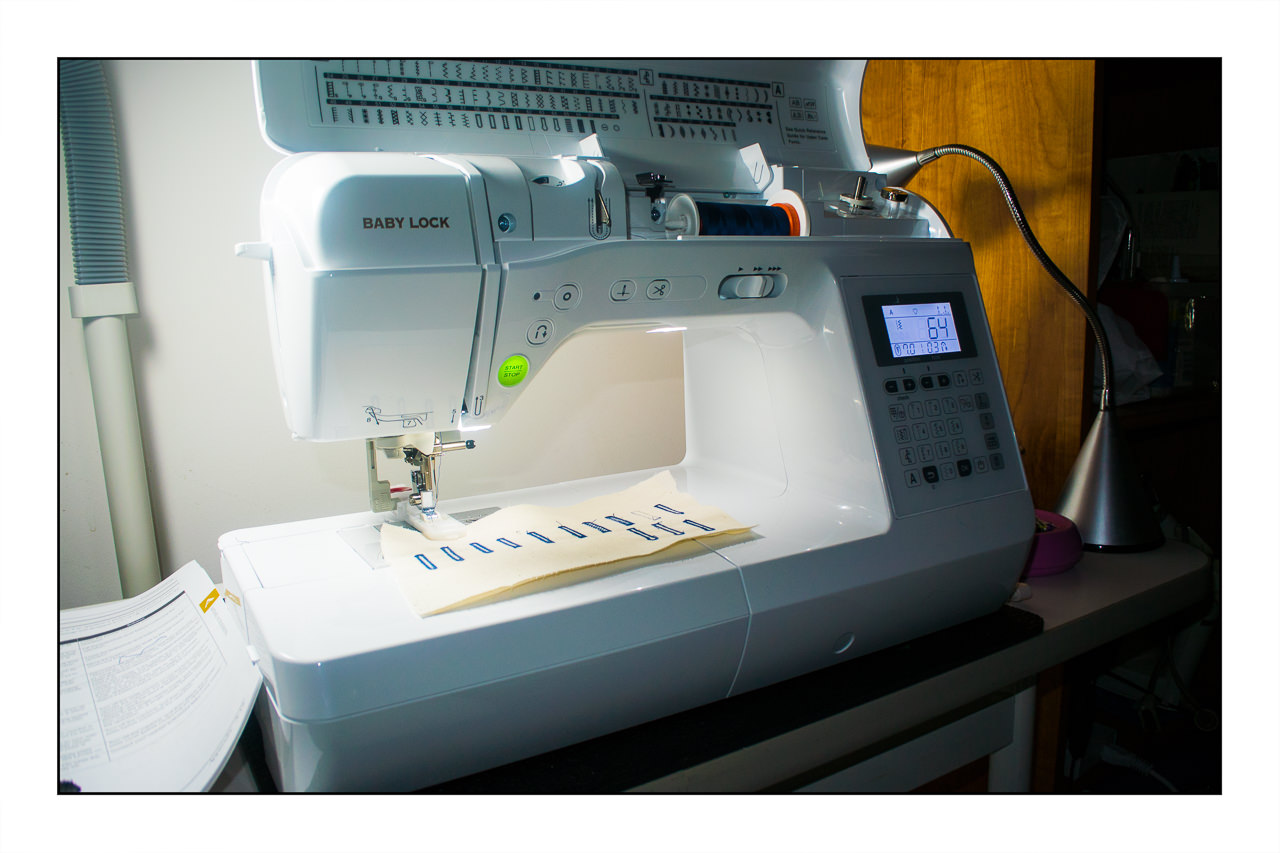
There are 7 buttonholes on this machine, some of which I did multiple times to check out their quality. The default ones are very good as they are, but I prefer the ones where I lowered the pressure on the presser foot from 4 to 3 and shortened the distance between the stitches, for example from 0.5 to 0.3.  My trimming is not spectacular as I just cranked them out after putting some medium weight Pellon between two layers of a fine, soft natural muslin.  The buttonholes are actually quite nice . . . I wonder if computerized sewing machines produce some of the best ones?  I know that my Berninas do a really fine job and they are mechanical machines.

Anyway, this machine is probably 5 lbs. heavier than the Passport and does not have a case.  I have a turquoise Tutto trolley (say that 3 times real fast!) to transport the Presto II.  The machine also has a handy dandy handle on top to make carrying it easier.  Classes will not be a problem as far as weight.

Below is a frontal view of the Presto II, a promo image from Baby Lock.  There is a Presto (I) prior to this one – the II has the addition of a thread cutter.

Image result for presto ii babylock promo image

The promo picture below gives you an idea of the location of various buttons for your sewing convenience.  On the right is the digital display, which is very easy to use.  A few things aren’t intuitive, but you can read, right?  Easy peasy afterward.

Beneath the index finger is the thread cutting button, to the left of that is the needle-up / needle-down, then a button to push to terminate a pattern when it is complete, and the reverse stitch.  One thing the Presto II has that the Passport does not is a sensor which won’t let you sew if the presser foot is up.  What is not shown is the fact it has an absolutely fantastic automatic needle threader!  Oh, how my old eyes like that!  To the right of the index finger is the speed control – slow to fast, up to 850 stitches per minute (faster than I need!).

Image result for presto ii babylock promo image

Finally, in the Baby Lock promo picture below, you see under the top of the Presto II.  The top of the machine flips up.  In the picture I took above, you can see the 100 stitches printed on the lid.  The spool holder and bobbin winding mechanism are also under the lid, and the bobbin winder sports its own thread cutter.  Under the lid and along the thread paths are clear markers on how to set up the upper thread (solid line) and how to set up the thread to wind the bobbin (broken line).  The bobbin case itself has a picture showing how to place the bobbin it it.

Image result for presto ii babylock promo image

I’ve never sewn or used a Baby Lock prior to yesterday.  I know their sergers are supposed to be phenomenal, so why not their sewing machines?  There are a lot of thoughtful little conveniences – small touches – which make this an outstanding machine, more so considering that this is not one of their fancy embroidery machines or even top of the line sewing machine.

After having the Presto II in my possession for a little over 24 hours, I can honestly say that I have “bonded” with it – I like it a lot! – and do not regret getting rid of the Passport 3.0.  It’s sad that I feel that way as there is a lot of potential in the Passport, but the poor quality of its plastic feet and the bobbin cover coupled with the reverse button’s finicky quality were not worth working with.  Sewing should be a pleasant experience, not a wrestling match with faulty equipment and shoddy materials.

In Search of the “Perfect” Buttonhole, Part I

I don’t know about you, but sewing a good-looking buttonhole, without a mistake, seems to be a nearly impossible task.  There are attachments for machines.  Some machines have 4-to-6 step built-in buttonholes.  Sew a buttonhole by hand?  Hmmm.  I’ve been tempted and then reconsider:  it’s not worth the stress (even though there are some great YouTube tutorials I have watched!).

In each of these, something can go wrong.  A perfect buttonhole can be destroyed with a slip of the seam ripper when making the final slash.  Birds nests of thread can collect under what looks like a beauty of a buttonhole.  Stitches can be skipped.

I have a small (compared to some people) collection of sewing machines, ranging from a treadle with a long bobbin (The Free #5), two old Singer handcranks (a back-clamping Lotus 66 and a 99), a Featherweight 222K, a Necchi hiding out in the garage in a horrid French Provincial table), some Kenmores (158.1030, 158.1400, 158 904, 158.19802), a Bernina or two (801S and 930), a Janome 6500, and a Pfaff Passport 3.0 (which I may trade in as it seems to have a few too many quirks).  I also have a Viking 19e, fixed at long last, which was my mother’s machine, and the one I used throughout my school years.  I also have attachments for the treadle, Singers, Kenmores, Berninas, and Janome – anything to make life easier.  Or purportedly easier.  Buttonhole attachments are included in the mix.  And as adjuncts, a coverstitch machine and a serger.

Not all attachments fit all machines.  Most are proprietary.  For instance, did you know that Singers of yore come with rounded corners and Kenmores are squared?  Round pegs – or rounded corners – do not fit in square holes – or squared holes.  And in reverse.  Thus, Singer attachments are not likely to work on a Kenmore, and Kenmores might not work on a Singer or a Bernina – but they might.

For awhile, Singer made slant-needle machines, and must have slant-needle attachments.  Kenmore machines range from low-shank, to high-shank, to super-high-shank.  These might require specific buttonhole attachments or shank adapters.

Let’s not talk about Kenmore buttonholers of some variety – many are proprietary to given machine models, and are not clearly identified.  Did you ever look at all the models than Kenmore made?  Maybe even more models than Singer.

I have 4 Singer buttonholers (gotten cheap off eBay – some for a couple of bucks) and a generic, low-shank one I bought 20 years ago at a local sewing machine store.  That last buttonholer is the easiest to use of all of them, but the old Singers are a lot of fun and do a pretty good job.

A good or great buttonhole attachment or machine function is a gift from the gods.  Imagine making clothes at home on a straight-stitch machine in a few hours – or several – and then spending the same amount of time (I would think) sewing in 12 buttonholes on a shirt or a blouse or a dress. Even if funky and weird, a buttonholer is up there with a washing machine and a paperclip and a safety pin as far as being this side of miraculous.

Whoever invented the automated buttonholer, thank you, thank you, thank you!

Stay tuned for Part II!