Lemon Verbena Cake

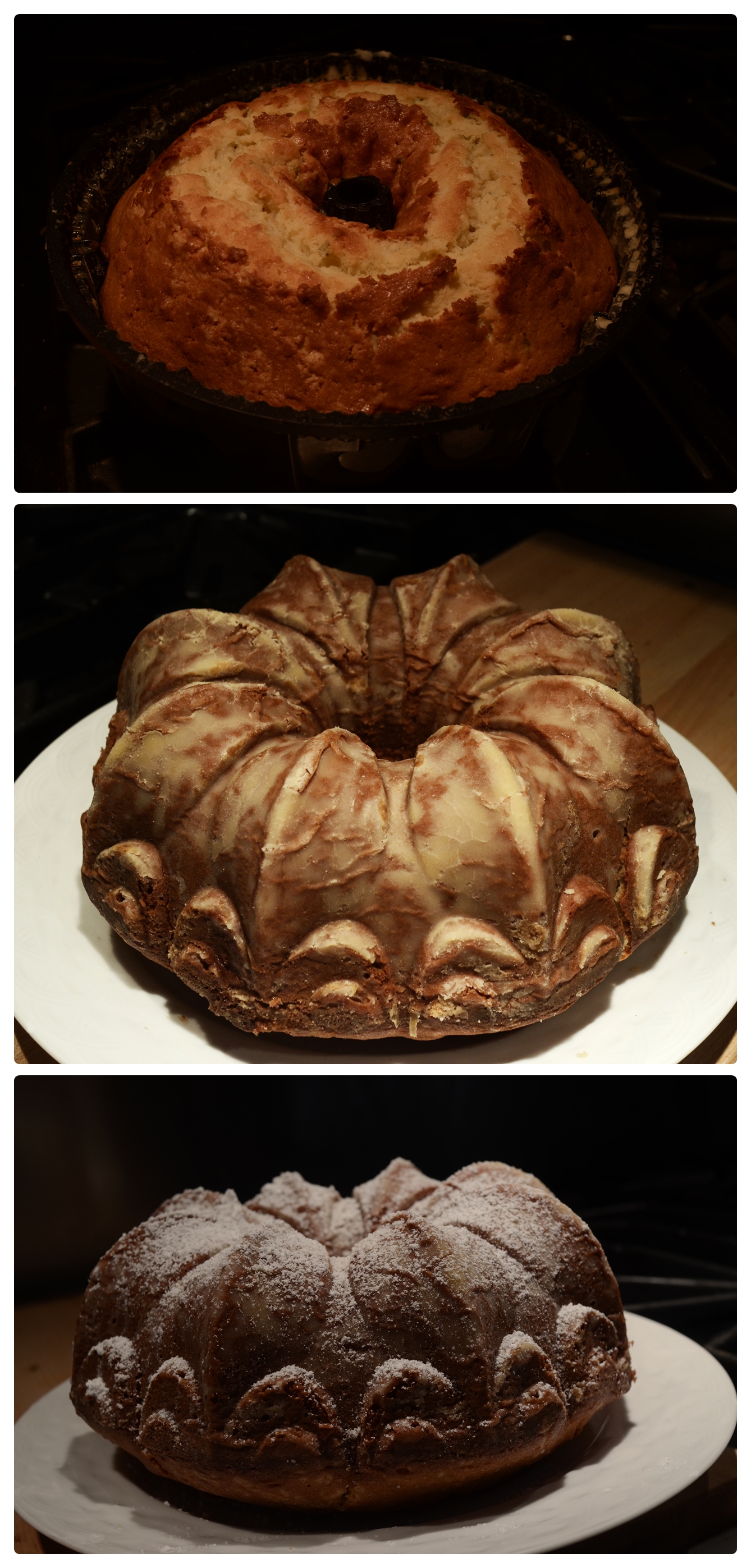
I have a beautiful lemon verbena bush in a pot on the patio, and each time it blooms I think I need to do something with it.  For some reason, lemon verbena pound cake struck a cord, and over the past several days I have been looking for something that sounds good.  Nothing really did, so with a few web recipes, and some cook books, I made up a recipe.  I dragged out the big grey monster (a.k.a. the Kitchenaid Mixer), bowls, pans, and assembled myself a cake with fresh lemons from the neighbor’s tree, lemon verbena from my bush, and a bit of elbow grease.

Lemon Verbena Cake

2 sticks (l c.) sweet butter
2 c. white sugar
4 eggs
2-4 T. fresh lemon verbena leaves, rinsed and chopped fine
Lemon zest from 1 or 2 lemons
Juice of 1-2 lemons, placed in measuring cup
Half-and-half to make one cup, added to measuring cup with lemon juice
1/2 t. salt
1 t. baking powder
1 t. baking soda
3 c. King Arthur’s unbleached white flour

Method

Preheat oven to 325 F for convection oven, or 350 F for regular oven.  Place rack in middle of oven.

With about a tablespoon of soft butter and some waxed paper, thoroughly grease a 10-inch bundt pan.  Make sure to get every crevasse and nook filled up.  Dust with a generous amount of flour, and tap out remainder.  Set aside.  (I took my butter and pan outdoors to hasten the process – hot sun, melty butter!)

In mixing bowl, beat together butter and sugar until light and creamy.  Add eggs, one at a time, beating in thoroughly.  Add chopped lemon verbena leaves and lemon zest, beat some more.

In another mixing bowl, sift together flour, salt, powder, and soda.  Alternately add the half-and-half with lemon juice (it will be curdled by now) and a third of the flour.  Liquid-flour-liquid-flour-liquid-flour.  Beat very thoroughly after each addition, scraping down the sides as necessary.  Be sure to really beat the batter a lot – the more the beating, the finer the crumb.

Bake for 60 to 75 minutes (1 hour to 1 1/4 hours).  Test by inserting toothpick into cake – if it comes out dry, cake is done.  Also, check to make sure that the cake is pulling away from the pan edge a bit.

Pray to the cake-baking gods!

Cool cake on rack 5 – 10 minutes.  With small knife, gently pry away cake edges from pan; tap on pan multiple times to loosen.    I banged on the bundt pan with a wooden spoon after I took the cake out from the oven, and used a filet knife around the center tube and around the edges of the cake.  After this, I placed a plate under the cake, tapped some more, and it came out very nicely.

My cake took about 1 1/4 hrs. to bake; I let it cool 15 minutes before inverting it onto a plate.  While the cake was still warm, and I wanted to flatten the bottom a bit, I pushed on the cake with a towel until I was happy.  Also, I think my generous buttering of the pan, along with a proper cake-god dance, did the trick.  I finally just dusted the cake with a bit of powdered sugar, through a sieve, because I do not care much for glazes.

Altogether, I am rather pleased with myself!

Pork & Chiles

We have an ongoing love affair with pork, and with chiles.  Hot chiles, sweet chiles.  With little left in the freezer, although it is a bit warm outside, today just seemed to be a perfect day to make an oven-braised pork stew.  This really is a mish-mash, and despite its color, it has dried red chiles in it, and hot fresh green serranos and jalapenos.  Braised in an oven-proof kettle at 275-300 F, this is a dish which needs a bit of attention, can be as dry or wet as you want, and makes a delicious meal for summer or winter, depending on your mood.

Pork & Chile Stew

Pork & Chiles Stew
2 lbs. pork loin, cubed
2 large onions, coarsely chopped
3 serranos and 3 jalapenos, seeded and finely chopped
5-8 dried red chiles, sweet variety, such as ancho
8-10 cloves of garlic, chopped and smashed
1 T. ground cumin
2 T. coriander seeds, ground
2 T. fresh oregano
1 c. chopped parsley (I would use tomatillos, but don’t have any right now, and don’t feel like going to the market)
2-4 c. dark beer
2-4 c. chicken broth

Preheat oven to 275 – 300 F. Use a lower temperature for a longer, slower cook. Allow yourself about 6-8 hours of cooking and prep time before serving.

In an oven-proof kettle with an oven-proof lid, heat some cooking oil, brown cubed meat. Add onions, stir until soft. Add all herbs and seasonings as you chop – just add them and continue to stir and add until all is cut up and sauteed together in the kettle.

Seed the jalapenos and serranos under running water, being sure to wear nitrile gloves. Chop fine, then thoroughly clean up cutting block, discard pepper seeds and bits. Then take off the gloves, discard them, and wash your hands. Add to the stew.

Pour in beer and some chicken broth, to cover the meat. Bring to simmer.

Place in 300 F oven on middle rack, cover with lid. Plan to let it bake / braise at least 4-5 hours, or longer if you use 275 F. Add extra liquid if stew appears dry – you need to check it!

After about 2-3 hours of cooking, take the dried sweet red chiles out of their package. (I like Mojave brand, or just the ones in bins at local markets.) Break them up, remove stems, and sautee in some oil over low heat. Make sure they become rather soft. Then pour a couple of cups of boiling water over them in the pan (watch out for splatters!) and let soak for about 20-30 minutes. When this is done, transfer chiles and some soaking liquid to a blender, and puree the mess until all the peppers are broken up. Add this liquid to the stew, stir it in.

Continue to cook the stew for a few more hours, checking liquid levels. About an hour before you think you want to eat the stew, you can add some drained, rinsed canned hominy, or, like I did, some baby potatoes.

Serve with tortillas, shredded cheese, sour cream. Garnish with cilantro or something pretty, like more parsley or whatever you want.

P.S. The picture is not any indicator about the tastiness of this dish! I took it last night under fluorescent lighting and forgot to adjust it – and at 1600 iso. Not the best shot. However, the pan really is green – its a “lemon grass” Le Creuset Dutch oven – love it!

In Which a Duck Meets Its Doom

Roast duck is something to be savored, and unfortunately most ducks bought in your average grocery store are not worth eating.  The last one I bought was years ago, and I was shoved somewhat unceremoniously aside when I was not going to follow the directions on the bird’s wrapper.  Some little pop-up thingy was supposed to erupt miraculously when the bird was done.  Needless to say – so why am I saying it? – the result was a gastronomic catastrophe.

Most people fail to understand the chemistry involved with cooking meat, or any protein for that matter.  Simply put, a high heat will change the molecular structure of protein, and not always for the best.  Eggs are a very good example of this:  scrambled over high heat, they become tough.  Poor cuts of meat benefit from slow cooking, using a low temperature, which is why pulled pork takes all day long on a smoker, and is worth the patience of waiting for it.  I think duck is the same way if you plan on roasting it.

Since that last disaster, I think I have had duck twice, both times served in a restaurant, and only the breast.  One had cherries, and was quite good – the big problem was not enough of it!  When I was a kid, duck was a staple in the family, so for me, it is like an old friend, but a special one.

As I have not roasted a duck unsupervised for awhile, I feel like a prisoner set free!  I perused my usual recipe haunts, and decided to do a slow roast at 275 F, and to make an orange glaze, which sounded pretty good.  The links I used are this one for the glaze, and this one for the general directions, complete with pictures.

I bought the duck this morning at Whole Foods, and while I did not keep it in the refrigerator in a pan, naked and exposed to the air (why would I want to do this?  According to my research, this helps make for the crispy skin!) for 24 hours as is recommended, I did rinse it off and stuff it with a bunch of orange peel and a sliced Spanish onion.  There were a few pin feathers to pull out, but this duck was remarkably clean.  The giblets were set aside for stock, which will be made when the duck is done and eaten; the fat will also be saved for later use, being poured off before the glaze begins.

The Glaze Most Delicious

Put together in a small sauce pan the following ingredients, bring to a simmer, remove from heat and set aside for later.

  • 1/4 c. fresh orange juice
  • 3 T. honey
  • 3 T. blackstrap molasses
  • 1/4 c. balsamic vinegar
  • 4 minced, grated garlic cloves
  • 1/2 tsp. each ground pepper and freshly ground coriander seed

Do this after you put the duck in the oven.  Go sit down someplace where you can hear the timer ding one hour so you can flip the bird.  Me, I went and listened to Mr. Reacher’s adventure in Mississippi and made some phone calls and knit on the Cloisonne mittens.  I also enjoyed the wafting fragrance of the duck as it roasted its way to nirvana.

The Duck So Nutritious

One five-pound duck.  If you want, after you wash and pat it dry, let it sit for 24 hours in your refrigerator, unstuffed and uncovered, to make the skin especially crispy.  If you don’t want to, then don’t.

Once you are ready to cook your duck, score the duck skin and fat, and prick the duck in several places.  This will allow the fat to escape and drip into the pan.  Take your giblets, and any other parts, and set aside for stock.  Squeeze a juice orange, and save the juice for the glaze.  Slice up the orange rind, along with a Spanish or some other onion, and stuff it into your duck.  The more the merrier – the onions are great to eat after the duck is cooked, and the peel adds to the final flavor of the meat.

Heat the oven to 275-300 F.  Put the duck in a pan, on a rack, and make sure your pan is deep.  Not being sure how much fat I would get, I used my largest pan.  I could have gone smaller, but better safe than sorry!  I could probably have used this pan and rack for two ducks, if I had been greedy, extravagant, or having company.

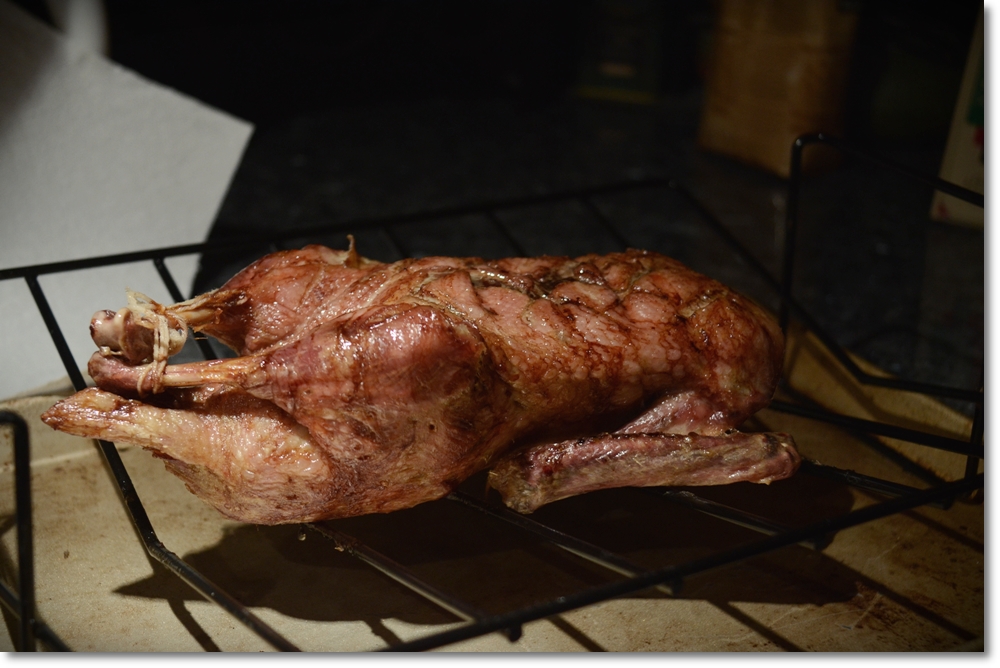
Place the duck breast side up, tying the legs together with twine after you have filled it full of oranges and onions.  Cook it for 1 hour, remove from the oven.  Prick the duck, and flip it over.  Cook another hour.  Repeat so that at hour three the duck is now breast-side down.  The recipe calls for cooking about 4 hours; I pulled the duck out after 3 3/4 hours, and then began the final phase.  I set my timer for 60 minutes, just to remind me.

Push the temperature up to 400 F.  Once that is reached, pop the duck back into the oven, breast side up.  While you are waiting for the oven to heat up, you can pull the rack out of the pan and drain off the fat – I did this to use for other purposes.  I also scraped the cracklings out of the pan and set them aside for flavoring biscuits and for gravy, and to pop a few into my mouth.
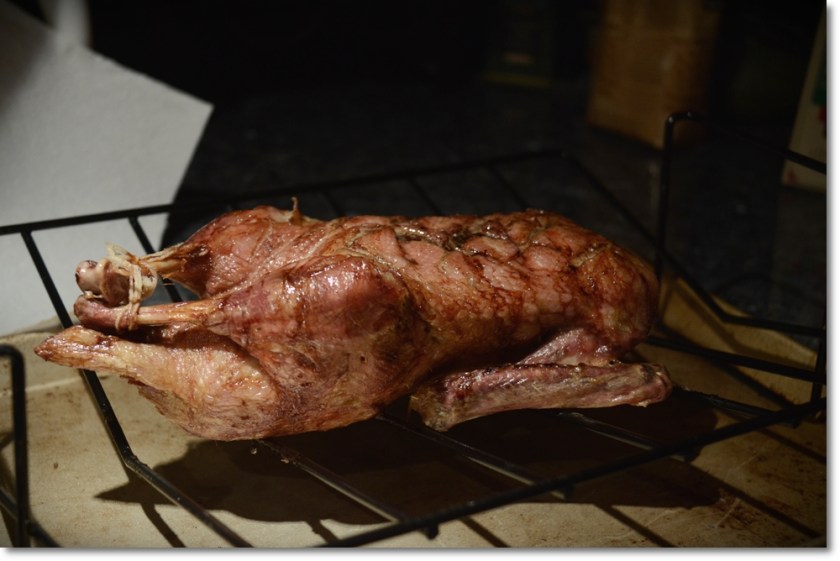
Once you have the oven at 400 F, return the duck to the oven, breast-side up.  Set the timer for about 10 minutes – this way you can watch the skin.  The linked recipe said do it for 30 minutes, but reviewers said not to do this.  I didn’t do it for 30 minutes – ten were fine.  Then, remove from the oven.  Let it stand, and as you let it stand, mop it with the glaze, letting it soak in between moppings.

Carve Thy Bird!

Anyone can do it better than me!  I have not had to carve anything for so long, I’ve forgotten where what is and how it is connected.  Still, food is food, and as long as it is not on the floor, who cares?  Unless you are trying to win a prize for prettiness, don’t sweat it.

Results

Damned fantastic!  You gotta have that skin – crispy, orangey, sweet with a bit of tang.  The meat was tender, not dry, and not greasy, either.  I served it on a bed of mixed salad greens and arugula, using an orange champagne vinegar as dressing.  I was really pleased with the results.  Yes, a lot of time, but really not a lot of work.

A Word of Caution

Finally, for those of you who have never tried to roast a duck, I would like to give you some advice.  First, make sure you have a duck.  A real duck.  Get one that is free-range, organic, whatever.  Make sure there are no pop-up thingies.  Try Whole Foods or a butcher you know.  Don’t steal one from the neighborhood pond.  And, if you cannot identify a duck, here is a clue from the esteemed Mr. Nash:

Behold the duck:  It does not cluck.
A cluck it lacks. It quacks.

Sandwich Rolls

I am not a fan of boughten bread, especially rolls that pass as “bread.”  More specifically “buns” – that ubiquitous, cottony fluff that seems to haunt the American hamburger.  Specialty bakeries can produce very good products, but they are not that easy to find for a reasonable cost.  Of course, cost is always relative – is it worth my time?  If yes, the cost is worth it.  But if my time is not available, boughten might be acceptable.

This past week I have not been interested in sitting inside.  Rather, the weather and light have been pulling me outdoors.  The air is bright and wintery (as wintery as it gets where I live!), clouds, new green on branches, willow buds and toadstools.  The squirrels are quite plump – “in someone’s corn” – and busy eating everything.  I’ve also been inclined to knitting and reading and fidgeting and cooking and, today, baking some rolls for tonight’s dinner.  In a week, all this will be set aside as I return to work.

So, the recipe, and the rolls.

Sandwich Rolls
1 pkg. dry yeast
1 c. hot water
1 tsp sugar
pinch sea salt
2-4 T. olive oil (I glopped it in)
3-4 c. King Arthur unbleached white flour
cornmeal

Mix together hot water (not boiling) with yeast, sugar, oil, and a cup of the flour. Stir to make a slurry. Beat awhile to mix it smooth.

Begin adding the remainder of the flour, about a cup at a time. At about 3 cups total, add it in 1/4 c. increments.

When batter is a bit stiff, turn out onto floured board and knead about 10 minutes, working in flour. Keep dough a bit soft.

When done kneading, form into ball, and then place in oiled bowl. Turn bread dough around in bowl to make sure all surfaces are covered with oil. Cover with damp cloth and set aside to rise in warm area for an hour, or until double in volume. Punch down dough, turn out onto lightly floured board, and knead for about a minute. Return to bowl to rise another hour.

Remove from bowl, cut into 6 slices, and then shape into balls and flatten. Roll in cornmeal, and place on 11×16 cookie sheet lined with parchment paper. Cover with damp towel and let rest for 15 minutes. Warm the oven to 375 F, with rack in center of oven.

Remove cloth from top of rolls, brush with olive oil. Bake for 30 minutes; cool on wire rack. If rolls are not brown enough to your liking, broil lightly to brown tops.

Sandwich Anyone?

We have leftover pork tenderloin which we roasted after marinating it in olive oil, rosemary, garlic and pepper.  This will be thinly sliced and made into sandwiches with caramelized onion, mustard (optional), tomato and something green and leafy, like cilantro or arugula.  We also have some aioli, which might also be a good addition to a sandwich.

Now, out for the evening walk, to enjoy the sky filled with pink clouds!

A Crostata of a Different Flavor

Sunset Magazine is filled with interesting things. Recipes of all sorts may be found, and the holiday issues are some of my favorites. The Thanksgiving edition had a particularly intriguing recipe, which I made for yesterday’s family get-together. You may find the original recipe here; what makes it particularly interesting is the fact it is made with an artisan flour derived from a different wheat than is in your average flour.  It is made with

Emmer farro flour, made from whole-grain emmer wheat, gives the crostata a rustic texture and great flavor. Because it’s low in gluten, it needs to be mixed with all-purpose flour to hold the crust together

The flour is from Bluebird Grain Farms whose specialty is heirloom organic grains.  While I did not use their flour, I think I am quite likely to try it in the near future.  I’ve added a link to their site under the Farmers to Admire category.

Below is how I made the crostata.  I think that you can use this recipe as a basis for any fresh, seasonal fruit – the frangipane is a wonderful flavor!

PASTRY

  • 1 1/2 c. whole wheat white flour
  • pinch salt
  • 1/2 cup plus 2 tbsp. cold unsalted butter, cut into cubes (1 stick of butter, and 2 T more)

Use a food processor, as in the original recipe:  pulse flours and salt to mix. Add butter and whirl 3 seconds. Drizzle in 1/3 cup ice water, pulsing until mixture comes together in a shaggy ball but still has bits of butter showing. Form into a disk, wrap airtight, and chill at least 2 hours or overnight.

FRANGIPANE

  • 1/4 cup unsalted butter, at room temperature
  • 6 t. white sugar
  • 1/3 cup blanched almonds, finely ground
  • 1 large egg
  • 1 T flour
  • 1/4 to 1/2 tsp. almond extract
  • 1/4 teaspoon vanilla extract

Beat together 6 T. of sugar with butter until light and fluffy.  Mix in almonds (I used ground almond meal from Trader Joe’s), egg, flour, extracts, until smoothly blended.  Set aside.

CRANBERRIES

  • 3 cups fresh or frozen cranberries (1 12-oz. package)
  • 1/4 c. white sugar
  • 1 T. water

Mix together cranberries, sugar and water.  Set aside.

ASSEMBLING CROSTATA

Roll out dough on floured surface into a 14-inch circle.  Rotate and flip pastry as you roll it out.  Trim edges, and transfer to a round pizza pan or rectangular cookie sheet.  Line either with a sheet of parchment paper.   (I used a cookie sheet, only to find it was to big for my refrigerator, so I tilted it to fit, and had no problems with any berries escaping!)

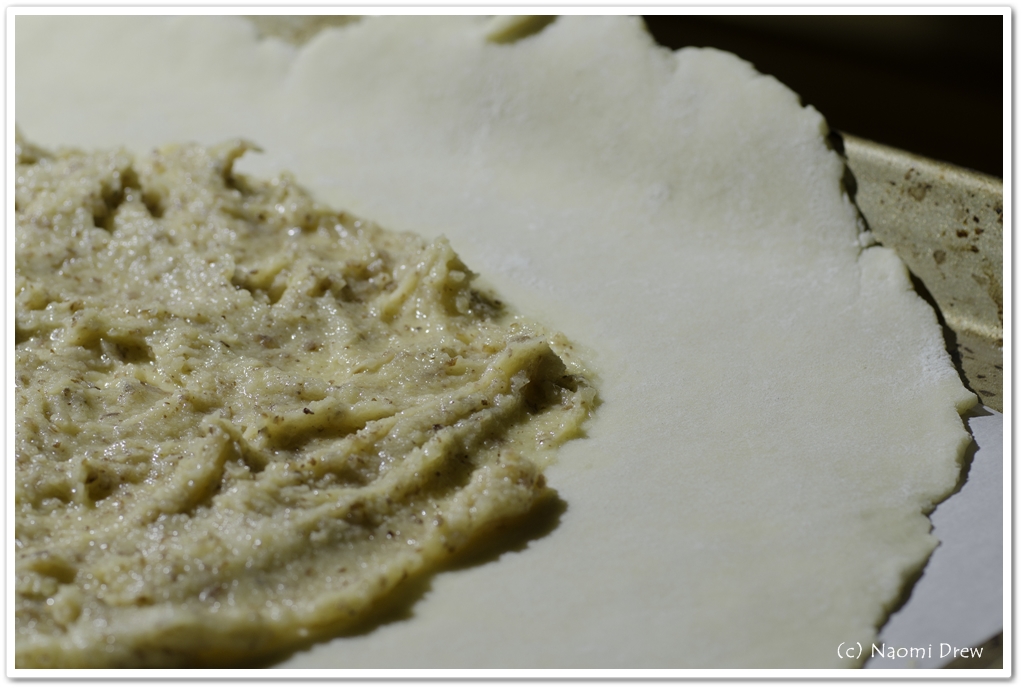
Spread frangipane over inside of dough, leaving about a 3-inch border outside your circle of frangipane.

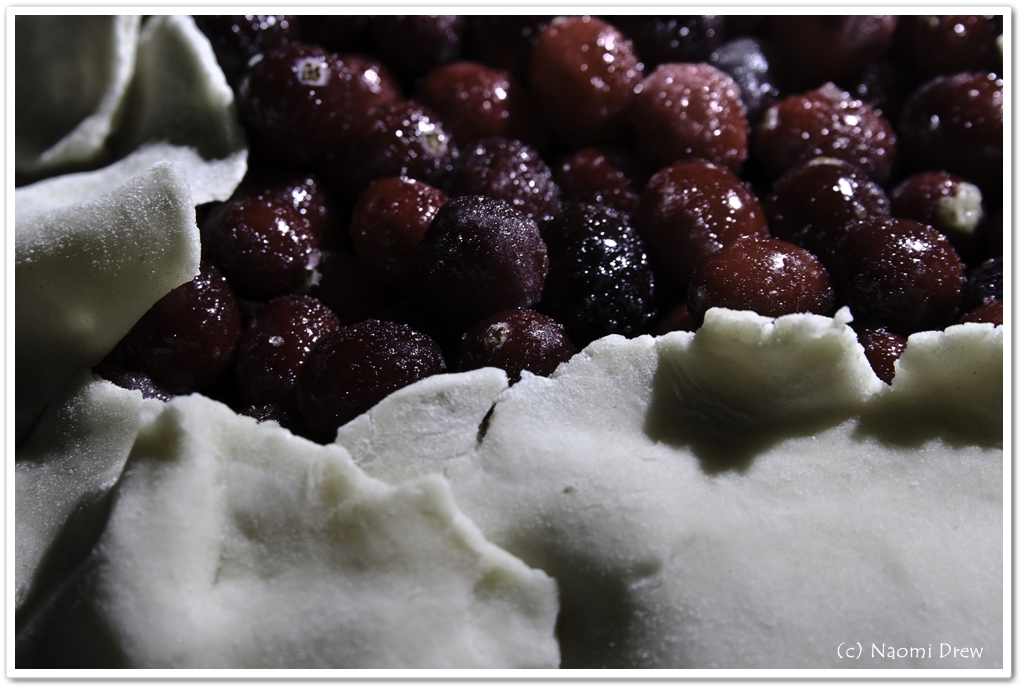
Place sugared cranberries over the frangipane mixture, pressing them in a bit to help keep the cranberries in place.

Fold the edges of the dough up and over the cranberries – do this gently! – and create pleats or folds as you go.  Once you do this, pinch the pleats in place a bit to seal the dough.  This will prevent leakage during baking.

Place crostata in refrigerator for about 30 minutes before baking.  While you do this, preheat the oven to 375 F with the cooking rack in the middle.  I used my oven on convection, but changed nothing as far as temperature or time.

Bake crostata for 45 minutes.  I checked mine at 35 minutes, and then continued.

Cool on parchment paper and cookie sheet, then transfer crostata and parchment paper to cookie rack to finish cooling.

Serve at room temperature, or warmed in the oven.  Great with vanilla ice cream!