I Like Pie!

Apple Pie! (1 of 2)

With both of our having the entire week off for the Thanksgiving holiday, there is good reason to celebrate! And, with a bunch of apples hanging around, pie is the perfect answer.

Apple pie is a very subjective thing. Undoubtedly a favorite – but favorites come in many varieties, just like apples. Time and energy play into it as well – homemade crust? peeled apples? bottom crust? crisp topping?

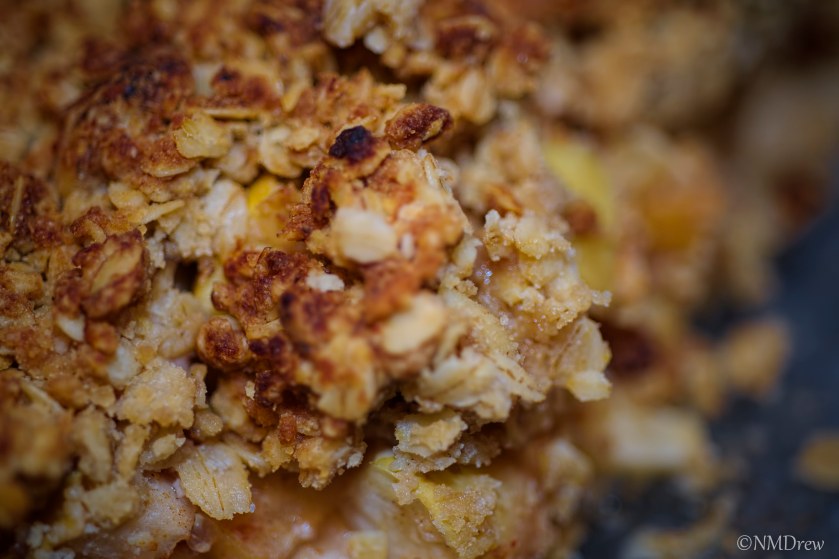
I am very partial to crisp toppings. In fact, I usually just make apple crisp as it requires no crust. I don’t peel the apples, either; the skins add something to the entire melange which I find quite good. Apple choice is important in many instances, but a variety of apples often makes for the best pies for flavor.

Spices are also critical to flavor. Your favorite may not be mine. I like my pie with lots of spice – not hot, though adding pepper when there is a lack of ginger gives a pie a bit of zip.

Here, then, is my recipe for this particular pie. Next one may vary. Enjoy – and happy holidays!
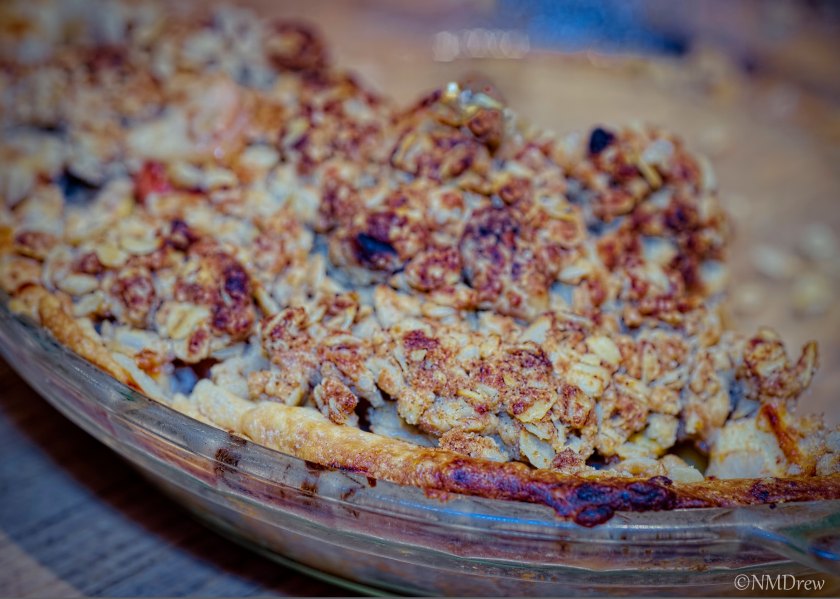
Apple Pie! (2 of 2)

Apple Pie & Crisp

6-8 apples, sliced, peeled if you want, and cut into bite size pieces
Zest of lemon – all of it if you want from the lemon you juice
1 lemon, squeezed
1/2 c. white sugar
2-3 T. tapioca
Fresh ginger, finely grated – 2-3 T.
Mace – 2-3 tsp.
Nutmeg – 1/2 grated (about 1 tsp.)
Cinnamon – 2-3 T. – the hotter the cinnamon, the less you should use
2-4 T. water

If making a pie, preheat oven to 425 F.  Mix all the stuff together and let sit while you create the pie crust and/or topping. Stir it now and then so it can juice up.

Pie Crust – one or two, pre-made or homemade.

Crisp Topping

Up front, I don’t measure anything. It is thrown together. Too wet, add more dry ingredients of your choice; too dry, add more melted butter.

1 stick butter, melted
1 c. oatmeal (more or less)
3/4 – 1 c. flour
1/4-1/2 c. brown sugar
Nuts (I used walnut halves)
Spices as used in the pie, and a bit of salt

Mix dry ingredients together. Pour in melted butter. Mix until rather crumbly but holds together if squeezed in your hand. Pat topping onto pie or crisp (or both – which is what I ended up making because I had oodles of apples).

Let’s Bake It!

For the pie, place pie in 425 F oven for 10 minutes. After 10 minutes, turn to 350 F. Bake another 40-50 minutes. Baking the pie at a very high heat helps prevent the bottom crust from being soggy. Failure to turn down the oven after 10 minutes can be disastrous. Set that timer!

If you are making a crisp along with the pie, do not put the crisp in the oven until you turn down the temperature. If you are only making a crisp, bake it at 350 F for about 40-50 minutes.

Serve warm, cold, with ice cream. A good cup of coffee and pie is a great afternoon treat.

Enjoy! And happy holidays to everyone.

Shortbread with a Story

Shortbread Cookies

Driving home from work the other night, NPR was on the car radio. The story? A Tale of Two Shortbreads.  Take the time to listen to the story – it is so much better than reading it!  And then make some for yourself – it really is a great shortbread recipe.  So, thanks to the Brass sisters for this!

The Brass Sisters’ Favorite Holiday Shortbread

Makes 32 1-inch by 2-inch pieces

1 cup butter (2 sticks)

1/2 cup sugar

1/8 teaspoon salt

2 cups flour

Grated zest of 1 orange

1 teaspoon orange extract or 1/2 teaspoon orange oil

Set oven rack in the middle position. Preheat the oven to 350 F. Line the bottom and sides of a 9-inch by 9-inch by 2-inch pan with foil. Grease the foil with butter or coat with vegetable spray.

Add flour and salt to a mixing bowl, whisk to combine, and set aside.

Cream butter and sugar in the bowl of a standing mixer fitted with the paddle attachment. Add orange zest. Add orange extract or orange oil and combine. Add dry ingredients, 1/2 cup at a time, beating until completely absorbed and dough comes together. Do not overbeat or shortbread will be tough.

Gently pat dough into prepared pan. (Press down the edges with tines of fork.) Prick top of dough evenly about 20 to 25 times.

Bake shortbread 35 minutes. Cool on rack for about 20-25 minutes, or until slightly warm. Score shortbread with a knife into 1-inch by 2-inch pieces, but do not cut through entirely. When completely cool, cut into pieces along scored lines. The texture should be sandy and crumbly. Store orange shortbread in a covered tin between sheets of wax paper, at room temperature.

Shortbread will firm up as it cools. Placing shortbread in the refrigerator will help it firm up. If the shortbread is pale, continue baking another 5 minutes, watching carefully to be sure it is not browning too quickly.

Well, mine were done a bit differently.  I’ve got a cold, and my stuffed up nose seems to be limiting the oxygen my old brain is getting.  I dumped all the ingredients in a mixing bowl, and went to town until all was crumbly, but I only used the grated orange rind, and added a teaspoon of mace.  I lined a 9×9 pan with parchment paper.  Everything got patted nicely into the pan and put into the oven.  Oxygen deprivation stepped in again, and the shortbread wasn’t pricked, which is usually recommended to keep the cookies from bowing in the baking pan.  Still, they came out okay, without any bowing.  And the results are still delicious and wonderfully crumbly – but best of all, not overly sweet.

Mole for Thanksgiving

No, we did not dine on that furry little critter that lives underground.  The picture above is not a burnt mole, but sautéed dried peppers.

I made mole from scratch, using a recipe for mole poblano from Pati’s Mexican Table as the basis.  I was able to find all the ingredients in a local store which caters to the Middle Eastern, Asian, and Mexican populations, so there are far more exotic ingredients available than in the local chain grocery stores.

This is what I used:

Dried chilis:  ancho, pasilla, mulatos, chipotles – about 20-25 in different amounts.  I cut off their stems, and poured the seeds into a custard cup, to be added later on.  In a large Dutch Oven, I sauteed the chilis in oil, removing them from the pan, and draining them on towels; I did this is in small batches.

Once the chilis were done I added more oil to the pan and sautéed up a chopped white onion and an handful of chopped garlic.  Then I added about a quarter cup each of raw almonds, peanuts, raisins, sesame seeds, and pumpkin seeds.  At one point, I added all the saved seeds from the dried chilis.  Next came about a teaspoon each of whole cloves, anise seeds, and coriander seeds.  A stick of whole cinnamon followed along with a pinch of allspice, thyme, and marjoram.  These I sautéed and then added some tomatoes and tomatillos I had roasted over an open flame on a grill – two or three tomatoes and about eight large tomatillos.  The blackened skins of these were removed.  As a thickener, I tore up thin corn tortillas – about six.  Once all this was put together, it continued to simmer a bit on the stove, with a bit of stirring.

Once I was happy with the melange – it smelled wonderful! – I added about six cups of homemade chicken broth, the sautéed chilis, and 7 ozs. of 85% dark chocolate, specifically Valrhona.  From there, I let it simmer another 15-20 minutes, and let it cool.  The final step was to run it through the blender until smooth.

This makes very thick paste.  I ended up with more than a quart, which can keep for several weeks in the refrigerator, or frozen in small batches, to be used later on.

Making the mole was really easy – it only took a couple of hours as I did all the prep work as I moved along.  If I had been more organized, I doubt it would have taken even that long.

Anyway, mole sauce can be used with chicken or turkey (or moles?).  We had chicken.  I browned the chicken on all sides, and then took about 2 c. of the mole paste, and another quart of chicken stock, and put them in a slow oven – 300 degrees – for about 3 hours.  The result was heaven, and went well with saffron rice, cranberry sauce, salad, and tirimisu.

I hope your Thanksgiving feast was as tasty as ours!

Summer Baking

Plums

Summer fruit, summer dessert.  Berries, nectarines, plums, grapes.  Shortcake, pie, upside down cake, jam and jelly.

Fruit cannot be compromised by ingredients in any way, but flavors must be enhanced.

The focal point is fruit.  Spices, juices, textures, subtle flavors all add to the experience.  Ultimately, simplicity seems to be the best.

The problem is, most desserts are laden with fats, such as butter, and too much sugar.  Where to compromise?  What to make?

Upside down cake!  Simple and easy, and with the right ingredients, neither too sweet, nor loaded with the “wrong” fats.  Solution, then?  An olive oil cake.

Summer Fruit Upside Down Cake

Preheat oven to 350 F. Grease and flour 9 inch circular cake pan.  Fresh seasonal fruit – your choice!  I used red plums, some ripe, some toward the green side – great sweet and sour combination.  You could also do berries, strawberry-rhubarb combo, peaches, nectarines.  In winter, go for apples and pears.  Maybe add some chopped nuts or raisins in winter.

2-3 c. fresh fruit
2 T. white sugar
1 tsp. orange extract (I used Penzey’s)

Mix all of the above together, set aside. Stir occasionally, while creating the cake batter, if you think about it.

1.5 c. white or whole wheat flour
1/3 c. corn meal (yellow or white)
2 T baking powder
1/2 t salt

Mix together in a bowl. Set aside.

2/3 c. extra virgin olive oil
1 tsp. vanilla extract
1 tsp. orange extract
3 large eggs
3/4 c. light brown sugar

Whisk all liquid, eggs, and sugar together till thoroughly blended.

Add 1/3 flour to oil-egg mixture, mixing thoroughly, but do not over mix. Continue adding 1/3 flour to mixture until all flour mixed in.

Spread fruit over bottom of pan. Spread cake batter over fruit. Bake in oven 20 minutes, check, turn pan if necessary. Bake another 20 – 30 minutes until toothpick inserted in cake comes out clean.

Remove baked cake from oven. Run knife around edge of cake in pan. Jiggle pan to loosen fruit at bottom. Place large plate over top of pan and invert. Knock on bottom of cake pan to loosen cake –  I used a wooden spoon.  Remove the pan and scoop anything sticking to the pan back onto the cake – don’t be shy, make sure to taste it, too!

Cool. Serve with whipped cream, creme fraiche, or yogurt.

Upside Down Cake

Karelian Pies

Karelian Pie

Years ago I met a young Finnish woman named Sirkku, and she made what she called Karelian Pies.  I’ve never forgotten them, but never really knew how to make them.  What I do recall is that the filling was a buttery, creamy rice – unlike anything I had ever tasted before – in a rye dough square that had finger prints on the edges, and was turned over, corner to corner, to contain the rice.  I thought they were absolutely delicious.

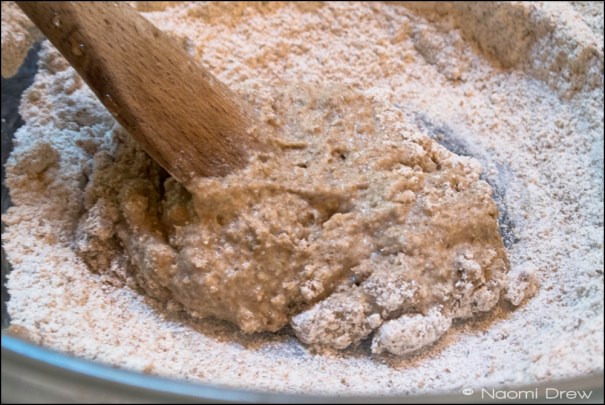
Mixing Flours and Water

Move ahead to the days of the internet and instant gratification.  I decided to look them up, and came across this recipe for the pies at Tofu for Tea:

Karelian pies (makes 12-14 small pies)
120 g rye flour
30 g plain flour
1/8 tsp salt
120 ml water
190 g white rice (she used sushi rice, I used Arborio)
500 ml milk
1/2 tsp freshly grated nutmeg (optional)

If you don’t have a scale, try to keep the portions similar for wet / dry ingredients.  Luckily, I do have a scale, and it worked out nicely.  Use Google to get equivalent non-metric measurements.
Choose a good dark rye flour.  Bob’s Red Mill is one I use for all sorts of baking, and it is always really tasty.  Other brands exist – see what is out there.

Rye Flour
Sift together the rye flour, plain flour and salt in a bowl, or use a whisk to blend the flours and salt.  Add the water to the flour by making a small well in the middle, and stir with a spoon as you pour the water into the well.  Dough will be soft and moist (and I think would be great for crackers!).
Mixing Flours and Water
When all is combined, mush the dough together into a ball and transfer to a board dusted with flour.  Roll the dough into a tube, cut in half, and roll out until long and thin.  My final dough looked like two long tubes, each about 14 inches in length, and about an inch in diameter.  Divide into 12-14 pieces.
Tubular!
Sliced and Ready to Roll Out
Making sure you have plenty of flour on your hands and the board, roll the sliced tubes into balls.  As with pie dough, it is really important to work with a lot of flour, and dry hands.  Flatten each ball slightly, and with a floured rolling pin, very gently flatten the balls into oval shapes.  Flip the dough over after 3 or 4 rolls with the pin, and never put more pressure on the edge of the dough with the pin – you want a light touch.  Spread the dough out from the center to the edges until it is about 1/8 inch thick.  Transfer to cookie sheet lined with parchment paper.  If the dough gets smooshed into the board, or sticks to the rolling pin, scrape it off, and roll it into a ball.  Before reworking it into a flattened shape, remove the sticky dough left on the board or the pin, and redust everything with flour.
Rye Dough Balls
Rolled Out Dough
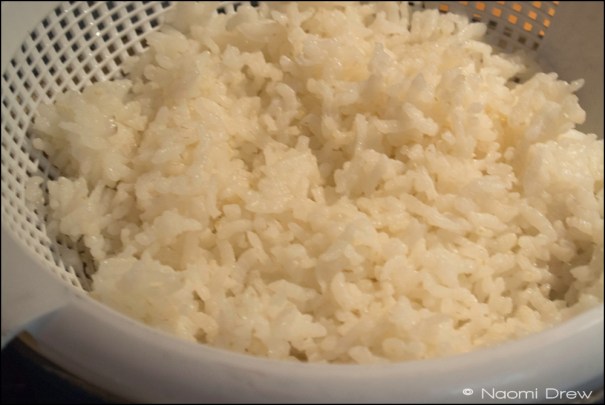
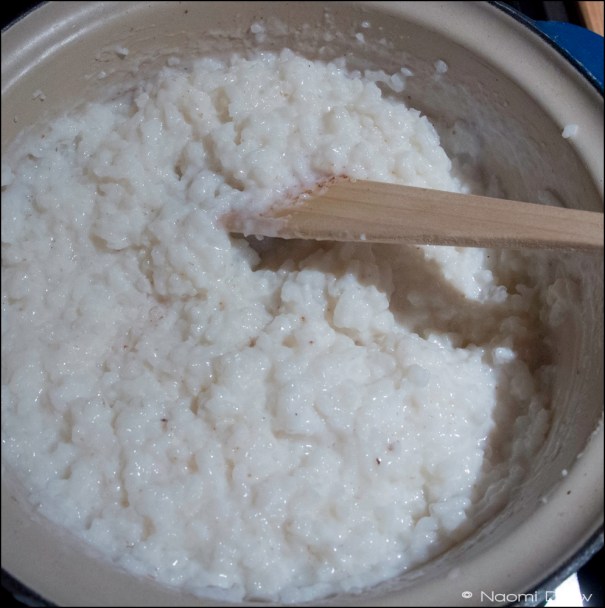
The rice totals about 2 c. dry.  Put into a pan, rinse until clear, and then drain.  Add 1 qt. water (or 1 liter), bring to boil, then drop to low, cover, and cook about 15 minutes.  You will now have a rather watery mix of rice and liquid.  Drain rice and water in a sieve for about 20 minutes.  Return to pan, add milk (about 2 c.) and bring to light boil, drop temperature, cover, and maintain a simmer.
Cooked Rice - First Cooking
Draining Rice
Creamy Rice - Second Cooking with Milk
Check your pot and stove top as milk boils over very easily!  As an aside, this is also an excellent base for stove-top rice pudding, but the crock pot works better because it doesn’t boil over.
Boiled Over!
Boiled-Over Milk
The flattened rye dough doesn’t need to be covered with a damp cloth while the rice cooks.  You might consider cooking the rice and making the rye dough while the rice cooks
Pies Ready to Bake
Once the rice is cooked, stir it up with the grated nutmeg.  You might consider a little butter as well, if you like that richness.  The nutmeg adds a really nice touch to the pies – no idea if it is traditional – and I imagine that, instead of nutmeg, some good, fresh herbs would be nice, such as fresh chervil or savory.  Fill the pies with a nice mound of rice.  You can fill each flattened rye ball, and then do curl the edges of the dough up and around the rice, or do it individually.  Keep your hands dry, so I suggest just dusting them with white flour.  Pinch the dough together around the rice.  When you have made all the pies, left over rice can be added carefully to the pies.

Melt a couple of tablespoons of butter in a dish and stir in a bit of milk.  Brush this over the rice and on the rye dough.

Preheat the oven to 210 C / 400 F.  Bake for about 20 minutes.  I had two racks, so I switched the racks half way between, at the 10 minute mark.  Cool on the pans, or move to wire racks.  When completely cooled, store in a container in the refrigerator.
Cooling Pies on Rack
Notes
It took about 1.5 to 2 hours to make these.  They are rather tasty, and certainly not something most of us eat every day.  I imagine they would be very nice as a side dish, say with fish or a good green salad.  By themselves, they can be a bit bland, but with a good pairing with other foods, would work out very nicely.  Personally, I really like them, and when I want something to do, they could be just the perfect thing to keep my hands out of the devil’s work.