The Koala at Rest, the Koala in Use

Josh got home and helped me with a few things. First, we installed the pegs that allow the left hand tray / fabric support to rest securely on the left-hand doors. Next, we installed the longer footers on the foot rest.

Side and Notion Trays, with Chair, i

This is how we plan to store the cabinet overnight. Will we be running into in the dark? I also have my drafting table chair pushed in because that is an important element. I need to measure how high it is, seat to ground, in case we decide (I decide!) if having to move a chair room to room is a major inconvenience. If so, I will need to know how far up or down a chair can go when and if I buy another one.

If you look into the foot space of the cabinet, you can see that my machine is lowered and the plug / machine cover is in place.

Side and Notion Trays, with Chair, ii

This is a view from the other side of the table which gives a better view of the plug on the top of the machine.

The Next Day . . .

Okay, overnight I stored it like this, both shelves on, folded in, and chair in place. No one got nailed in the middle of the night!

Now, in use . . .

Sewing Cabinet in Use!

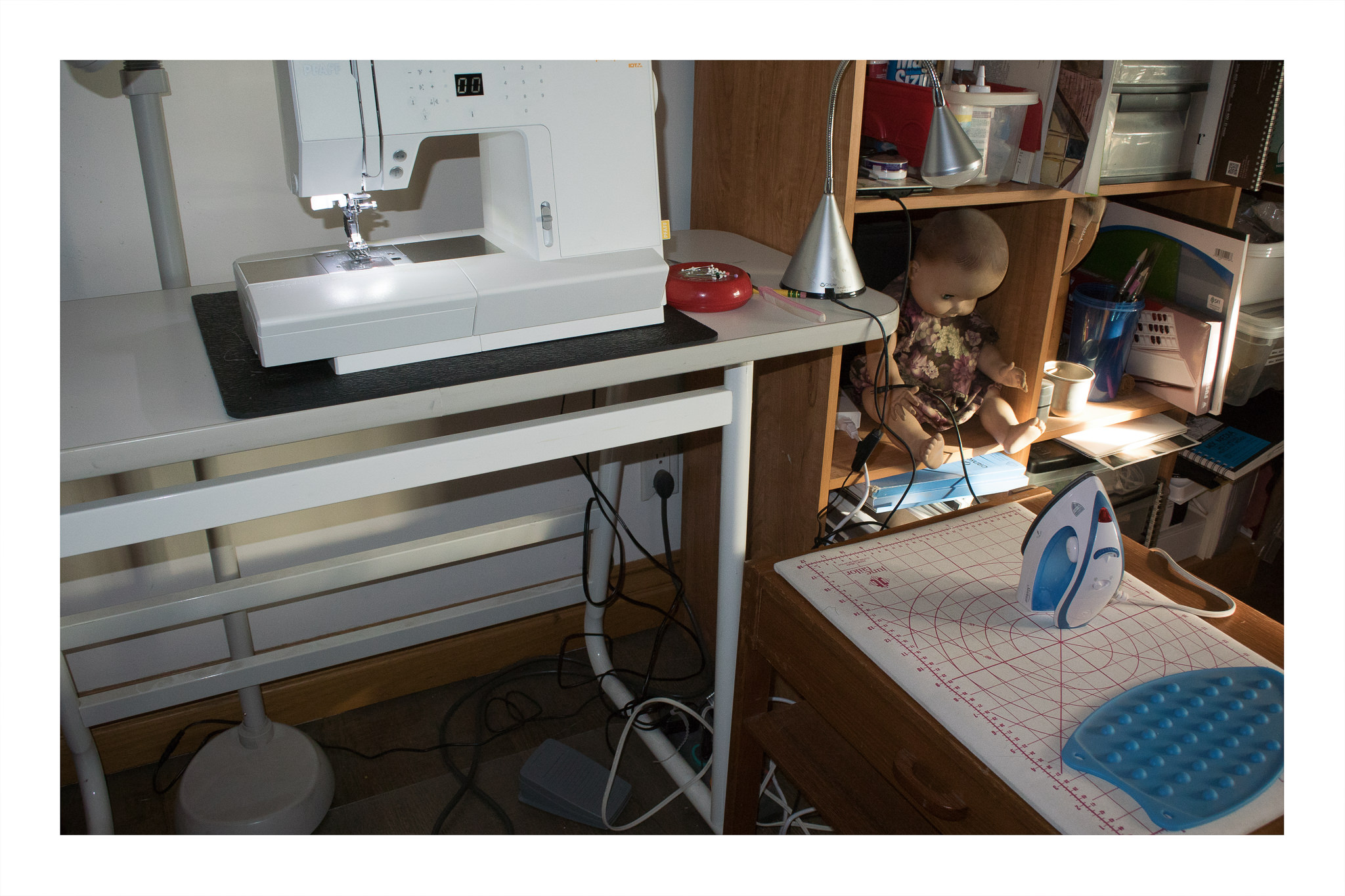
I have set up the cabinet as I want to use it today. The extension table is out to support the rotary cutting mat. The left side has had its tray removed and stowed in a storage area in the footwell of the cabinet. The left side drawers are folded back so that the cabinet can be rolled in closer to the wall. My old typing table from the last century (I think even 1970s) is supporting a portable tabletop ironing board. The iron itself rests on a silicon mat so it won’t burn the ironing board cover. Time to iron and then sew another quilt square – and there are 4 in this pattern, so off I go!

Finished the Quilt Top and Killed My Iron

This is the quilt top, all put together as of noon today!  This is just the top – next Sunday is the border, and then wait until the second class begins sometime next year.  That is when we will add the batting and the back side of the quilt.  And do the binding.  And, I assume, the quilting.  It feels pretty good to be at this point in the quilt, let me tell you!

And, in the middle of all this excitement, my foot wrapped around the cord to my iron – one I have had for 20 years at least and really like – pulled the iron off the counter, and it shattered into a billion pieces of plastic.  “It’s dead, Jim,” to quote someone.  Luckily, I had another iron, older than that one, as back up.

Sacrifices must be made, I guess.  The sewing gods are jealous gods . . .

Quilting Project, i

For the past month, every Sunday, I have been taking a beginning quilting class from 1 to 4 pm. It’s like boot camp! The teacher is detail oriented, explains the whys and wherefores, and is perfect. At this point, we beginners are “piecers” and not quilters. No quilting in this session – to be continued in 2019.

I have been sewing forever, since about 10 or 11, and now that I am closing in on retirement, you can guess that I have been doing it for awhile.  However, quilting is different in some ways.  No backstitching.  Precision seaming.  Scant 1/4 inch seams.  How do my points look?  (Those are where the points of square or triangle meet another piece – are they pointed, blunted, exposed?)  Every time you make a seam, you iron – press the piece flat, open the seam.  Then move on.

In the picture above, you can see that I have set up a small pressing station next to me. This keeps me from getting up and down with each seam. Many people do this. The little iron is really nice – and really inexpensive, too! It’s a “Hot to Trot” mini iron by Sunbeam, with a mini price of $12.99 at Target or on Amazon. It heats up quickly, has steam, has steam bursts, and is comfortable in the hand. The ironing pad is also a cutting board on the other side, but I find it easier to walk over to the drafting table if I need to cut anything (first picture).

The pattern itself is filled with lessons. To read a quilt pattern requires a bit of work, and a poorly written pattern will kill your enthusiasm very quickly. This one was written by the teacher, Becky, and she’s done a really good job. Her being the teacher, she knows this pattern. Last week, I had sewn a couple of pieces wrong – in just a glance, she said, “You need to fix that!” I think I am so – sew? – lucky to have an exacting and knowledgeable instructor. This is really important as I have been to a few other quilting classes and they have all left me very disappointed. While I don’t see myself becoming an obsessive quilter like some people, I know that I am going to walk away with an appreciation of quilting and a new sewing skillset.

Finally, as a birthday present, I was given a lightweight, take-to-class sewing machine by the best guy in the world, mi esposo Josh. I’ve had a bit of a love-hate relationship with the machine, partly because of problems with a foot being made of a flexing, flimsy plastic (which the dealer replaced with a metal foot – much nicer – love goes up, hate goes down), but also because I am learning a new skill with a new machine. This is a Pfaff Passport 3.0, weighing in at less than 15 lbs. Considering one of my machines is a 50 pounder, a portable, class machine is necessary. This machine was made for portability, and in that arena I really like it. In the big picture, I think this machine is a keeper. If I need to have more harp space – the area between the needle and the right hand part of the machine – I can always use a bigger machine. For the quilting, I may bring in my Janome 6500 as it is more powerful, has a quilting table, and more harp space.

Finally, the quilt itself. In class I completed the center square, and then one of the 3 different squares which will surround the center. I need to complete all 12 squares – 3 different patterns – by next Sunday. That is when we start working on the borders, which consist of strips and squares. I think we will also begin on “squaring the quilt” – when you make your quilt an even shape. Or, that may be the final class. The center square is fairly large, and the other squares will surround it. The center square is below. It is a graphical representation of a flower basket.

The surrounding squares are all variants of flower baskets. Below is “square 1” of the three. Each square requires 4 renditions of the same square; yesterday I completed all of this square – all 4 of them. It took a bit of time.

Over the next few days, today included, I will complete the remaining 8 squares. The dog ears will be trimmed. Fortunately, I have cut out all the pieces for the entire quilt – except the border – and placed each one in a baggy, each piece labeled in size and for which square. These are the details Becky has been so good with! It would be all to easy to get lost in colors, shapes, sizes, and so on.

Okay, time for breakfast, and then on to sewing! To be continued . . .

Another Bag – The Rockport Tote

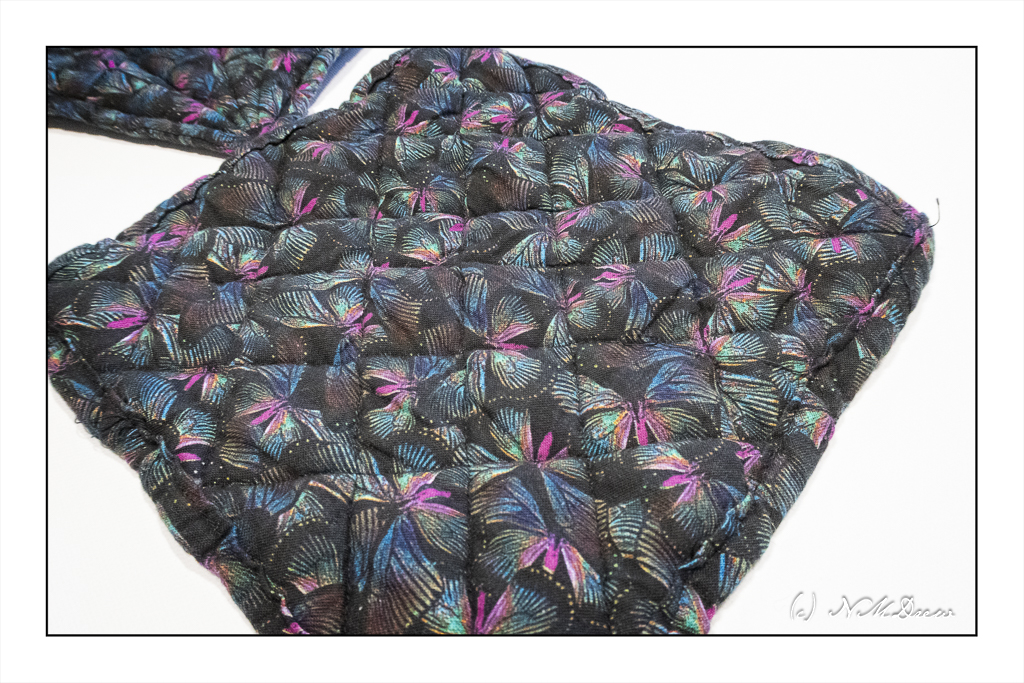
Between Inktober 2018, watercolors, tasks and errands, I have been working on another bag.  This one is in need of massive trimming of threads – so is the Boxy Tote – before it is done.  Then, it will be shipped off to a friend of 45 years “just because”!  It’s not perfect, but then nothing I ever do is, so that’s life, eh?

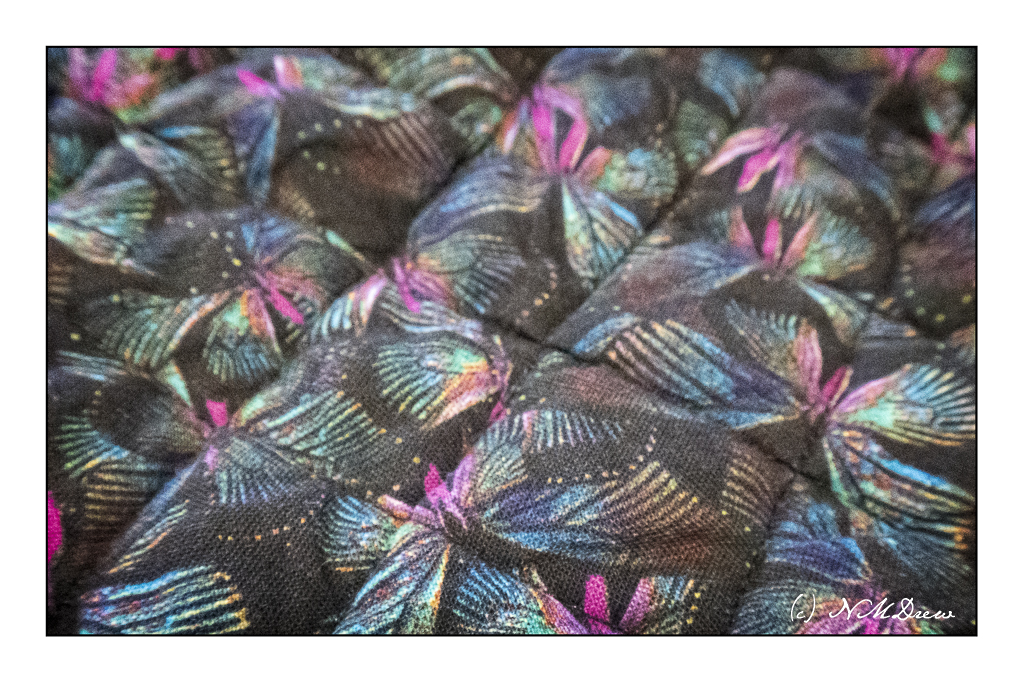
This bag is done with one piece of material and quilted every half inch on the body.  It’s called the “Rockport Tote” from Aunties Two.  The pattern is clearly written, and even better, there are videos to accompany it.  If you are interested, follow the preceding links and you will find them.  This project took me awhile to do – it spanned about 3 weeks, and in between a lot of stuff, I was champing at the bit to finish it.  I’m going to start another one next week – bags are in the works for Christmas presents.

The bag comes in three sizes – small, medium, large.  The small is tiny, perfect for little gifts and using up scraps of fabric.  I made the medium size.  The large is a bit bigger, but this one is a nice size to carry around.  Also, I was really happy to find this ceramic Celtic knot work button in my button box – it seems perfect for the bag.


One thing I am enjoying with my time off is the actual ability to have time.  If I was still working, I would be rushing and feeling pressed to finish this bag, and I think the whole project would have become a point of aggravation.  Slowing down requires having time, and in the time I have, I am finding I am enjoying working on things that would otherwise become frustrations.  My sewing skill is far from good, and my own rather casual approach to things doesn’t help.  Still, I do have time to do handwork (hand sewing) and picking apart seams or other bits that might not please me.  I have time to think about what I want to do, and time to set aside a project with the time to return to it.  All of a sudden the rush-rush-rush of my former daily life is gone.

And thus, another project completed.  I start a 5-week introduction to quilting class at Quilty Pleasures and another 2-day class to make another Rockport Tote.  Yes, you read that last right – I figure I would make one Rockport, and then make another, learning from my own experience, as well as that from Betsy, who taught the Boxy Tote class I took last month.  And, though I profess to dislike quilting, my thought is that learning how to cut and sew precisely, as needed for a good quilt, won’t hurt me or my sewing skills.  I can only improve.  And I know I will have a lot of fun in the process (and probably some frustrations, too.)