
The Shul on the Beach

For the past three weeks I have had a cold, which continues with abandon. Sore throat, stuffy nose. Allergies, too. Add to this, the SD slot in my camera no longer holds the card, so it is in the shop awaiting parts and repair – probably won’t get it back till mid-July. Hopefully under warranty, and won’t cost me a couple of C notes.
As a result of this thrilling life, nothing much interests me other than just getting by and getting well. In my hours of tedium, I’ve been playing with some software, and really pushing pictures to the edge. Sometimes bad or dull pictures can be made more interesting, but I can tell you right now, some only become far worse. Here is my example, for your amusement.
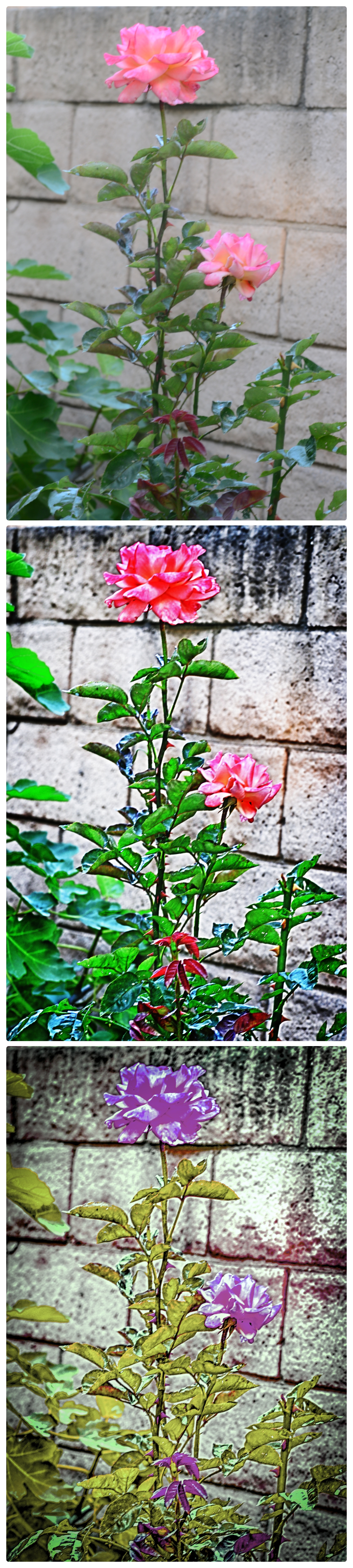
Hardly attractive, perhaps interesting. It opens some creative thought processes as well as makes me wonder if people who are into photography and post-processing images are logical and sequential in knowing what they want for results, or just play around. I expect those who do specialize in post-processing are very well versed in problems and correcting them – me, I am not, and so just wander around. I need to sit and focus on such things. But, I would rather be outdoors . . .
Last Wednesday, our little photo group met up to shoot a sunset. The initial place we met was rather uninteresting, so we drove up the hill in search of a different spot. A good decision.
We were up above the Simi Valley, and had expansive views in all directions. To the north, the mountains and plains caught the rays from the setting sun. To the south, the busy 101 provided light trails to contrast the twinkling of the city lights. To the east, Santa Susana Pass gave light trails if the exposure was long enough. To the west, the sun was setting, and spread out over the land, sculpting hills and fields, casting long shadows on rocks. Where we were also had some trails, old oak trees, rocks, and fences – what this area must have looked like before the building booms of the 60s began.
I packed the Tamron 17-50mm lens, which is great for general and landscape photography, the Tamron 70-300mm, and the Kiron 30-80mm varifocal. The final and only lens used was the Kiron lens, which is a manual focus lens from the 1980s. All my exposures were manual, from f/stop to aperture to focus. What I should have brought along was my flash – I had misplaced my remote for it, so the flash stayed at home. I could have used it for lighting the foreground in some shots.
Doing a total shoot without depending on any technology except my eye and what the camera says is a good exposure is stepping back in time. I really enjoyed the slowness, and the fact I needed to consider so many elements. In the forefront of my mind were a few major elements: composition and placement of focal points and areas of interest. In each frame, I tried to look at everything in the lens, moving from corner to corner, observing shadows, light spots, lines in the landscape, perspective. It is not really hard to do, per se, but it is hard to do it quickly. Becoming conscious of these bits and pieces eventually develops habits and trains the eye and mind; in turn, this will work in my favor as I continue this practice. I can imagine this will work in quick-changing situations – having an eye to anticipate and prepare.

Above you can see the evolution of the final picture. The very top one is a jpg, straight out of the camera. The middle one is with some push of the color. The sky was really quite lovely, and in retrospect, maybe I will go in and re-do the picture to keep that cerulean, rather than the ultramarine sky of the bottom picture.
Anyway, I couldn’t figure out why the middle picture kept bugging me, and then I looked again, and saw that the bright yellow spot in the middle tilted down, toward the right – it just wasn’t level. In Lightroom, I rotated the picture ever so slightly, and was much happier. In the bottom, final image, I pushed the yellows and the greens and used the gradated filter in LR, as well as used Viveza 2 to create a bit more zing in different areas. I eliminated the spots (on the lens or the sensor – need to check) in the sky using Photoshop, and then Faststone and Photoscape for resizing, framing, and signature.
Compositionally, the lines and the light is what caught my eye. The warmth of the sun on the slopes, along with their curvy lines was a nice contrast to the diagonals of the fore and middle ground. The verticals of the weeds in the very front of the picture played nicely against curves and diagonals. I think this is why the downward angle of the middle picture bugged me – the horizontal wasn’t there, and it is in the final image. Instead, it is also a diagonal, and was one diagonal too many.
I am not displeased with this picture. In post-processing the goal was to re-create the golden cast of the sunset on everything – that evanescent glow never stops fascinating me. My hope is that the image does not look fake – but it could, depending on the monitor.

The above image is the middle one in the grouping above, straightened, and post-processed pushing the warmth of greens, yellows, and oranges. Once more, sky spots removed. Then framing and signature added.
And, I just realized now why having an electronic photo frame is not a bad idea! Just a photo album in a different format. Maybe I’ll go buy one . . .
A new adventure into photography – focus stacking. The purpose of stacking photos is to create one very sharp and detailed image from many. There is a lot of software out there, free and pay-for. I am playing with CS5 and Helicon Focus.
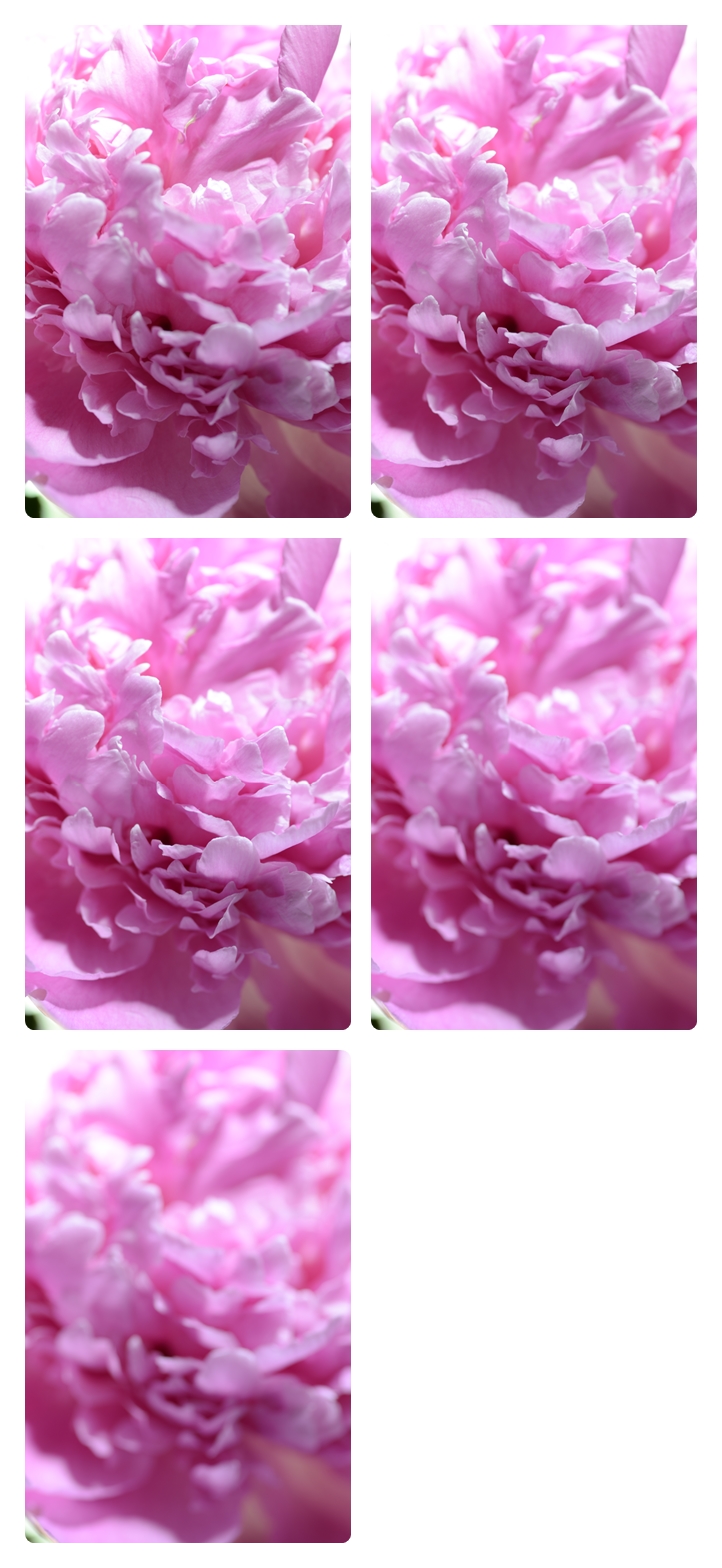
To do stacking, you need a tripod, and a steady object. I am using a peony in a vase. Then what is done is to take multiple images, and focus on different parts of the object, taking multiple images. This means that the focus moves through the object at different points, so what is now in focus becomes out of focus, until you have moved from front-to-back or back-to-front. From all the images a final one will be produced.
This first attempt is with just 5 images, which you can see in the combination picture below:
These images were both merged into a single file, as you can see below. The one on the left is using CS5, and the one on the right is using Helicon Focus.

The next one I did shooting 16 different pictures, close in, and using the macro capabilities of the Tokina 100mm macro lens (which I used for the above images, as well). You can see the different pictures below:

I focused from front to back. In CS5, the software got itself into a tizzy when I did all 16 – which are 16 MB jpgs, so they are pretty big. So, I used only 10 or 11 of them, and got this result:

The ragged edge in the above picture shows you how CS5 works by aligning sharp edges with one another. Below is the image generated by Helicon, using all 16 images:

Below you can see the result of only using 10 images with CS5 on the left below, and all 16 images with Helicon on the right:

The result is rather interesting – using only a few of the pictures for the CS5 stack, there is a nice sense of depth because the upper part of the picture is out of focus. The Helicon picture ustilises all 16 images, but because the upper image is not blurred, the sense of depth is lacking – or else it shows that there are even more petals in the flower as we move along.
As this is my first attempt to do this, I don’t have much of an opinion about the final product. I own CS5, but have a 30 day trial running with the Helicon. The CS5 will require cropping, which is not a big deal, but the Helicon produces a very clean, elegant product. And, the Helicon is very easy to use as it is a software specific for stacking.
Personally, I find too many group activities overwhelming. Too many people. Too much stimulus. Too much to distract from the focus of the group. Certainly, lots can be learned from seeing what others do, but too much can also be lost in the mix. I am a definite introvert, and while I like people, I prefer them in small doses . . . unless its a despotic situation, and I am the despot!
Anyway, one thing rather nice about the internet is the fact you can belong to some kind of group activity, but not be overwhelmed with others. I like a number of flickr groups for this reason – photographers with similar interests, occasional comments, groups with a focal theme and good postings. These are groups I can check in with, and check out of, and no one gets hurt feelings.

One I am finding particularly enjoyable is “Our Daily Challenge, 2” – the second group formed as an offshoot of the first. Highly original and creative photos emerge from a daily challenge. Themes for the day have included Distorted, Runs or Running, Hidden, and so on. What the photographer does can be staged, spontaneous, an impetus and go out and shoot something familiar but with a different skew. This puts a creative push behind photography.
Today’s theme is Distorted. I could putz with software and create special effects, I could destroy something and have a distorted item to snap. Instead, I have a zoom lens that creeps. It moves along and can be rather frustrating. But this is what made my theme for Distorted – the blur from the creep. So I simply moved the lens in-and-out, using a small f/stop to have a longer exposure. I was very, very pleased with the results. (No, I am not the first person in the world to do this.) The pleasure lies in the pattern repetition, somewhat recognizable in some of the pictures, and hinted at in others: Fugue.
 Ink, Yarn & Beer