
Here, the repeated patterns of leaves provide the texture, from large to small, old to new.

Here, the repeated patterns of leaves provide the texture, from large to small, old to new.

I got a new-to-me sewing machine the other day, a Kenmore 158.19802, but that is a story for another day. However, it needed to be used, and I needed something fun to do that wouldn’t make me nuts. My sewing student likes to make stuff, like pillow cases and stuffed felt tomatoes, and me, I have never done anything with my sewing except make clothes. Because her thinking patterns aren’t mine, I decided to think outside of my box, and looked for something free, and useful. Voila! The Pleated Tote by Artsy Crafty Babe.

This is a free pattern, and it is really well-designed. It looks good, has great directions, and with sale material, didn’t cost me more than $10.00 and some time. And, I got to see how the new-to-me-machine works (very nicely!). The pattern is all in the PDF file, ready to be cut out!

What I did differently from the original pattern is to double the length of the straps – I like long ones, so I can wear the bag diagonally if necessary, or knot up the straps if I want shorter handles.

A few other things I did was to interface the material and the lining with fusible lightweight pellon, clip the corners and curves, and made sure the darts of the lining and the outside of the bag were sewn to lay in opposite directions to keep the thickness of the material as minimal as possible. Nice details, such as inside pockets, a button loop, and gentle curves, make this bag a winner.

Construction directions were clear – and if I had not read them I would not have done it right. You sew the lining and body together, right sides together, and get this.

Through an opening left in the lining, you pull the bag right side out!

The material itself is a bit heavier than calico-weight cotton, sort of a lightweight upholstery, but not a duck. It is 100% cotton, and although dry cleaning is recommended, I washed the material in hot water and dried it on hot – I like to shrink anything I know is going to go into the washing machine. (I don’t know anyone who would dry clean a purse!) I needed about 2 yards of material, and the stuff I used was 60 inches wide. The body of the purse and the lining match, as do the pockets. Because I wanted a bit of body to the overall purse, I decided on the interfacing for the lining and external part of the purse, and am glad I did – lightweight, but not shapeless.


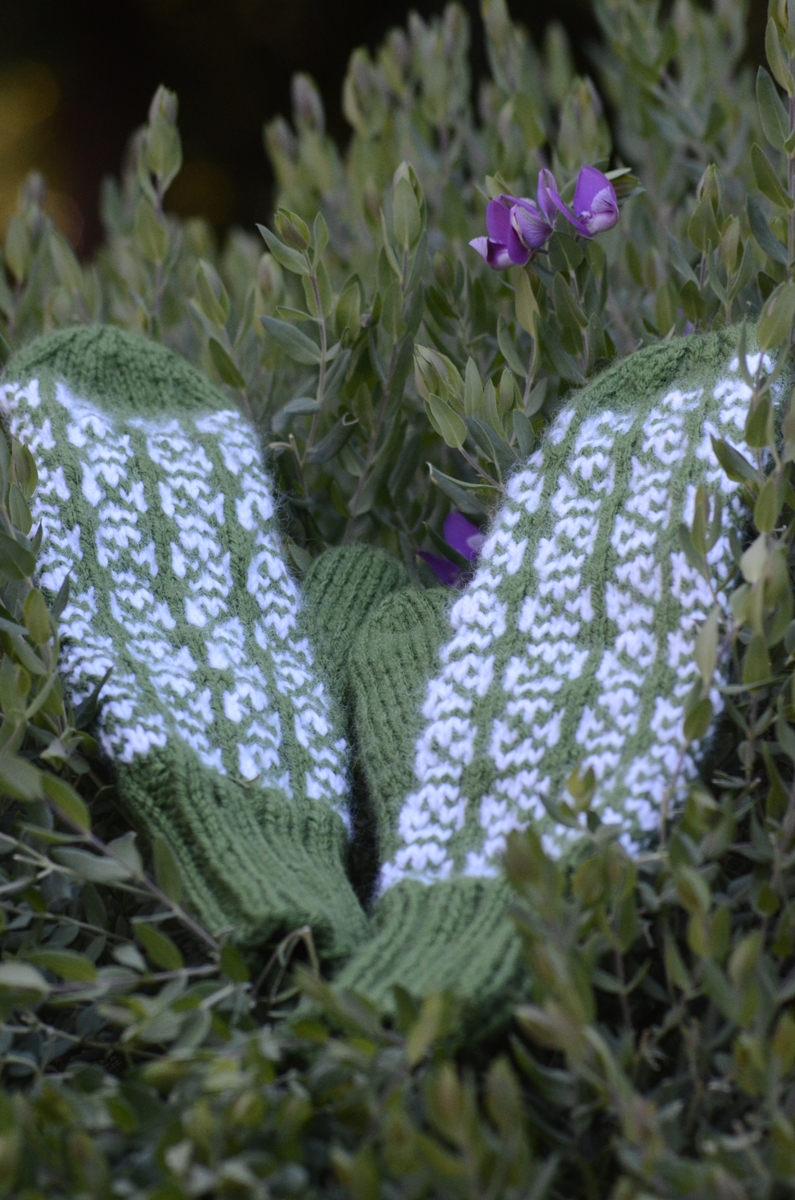
I designed these mittens last winter, in February. I finally completed the pattern – it’s nice to have some time off to finish things! Also, I admit, sitting in front of the computer to learn photography software is quite a drag, and very frustrating . . . so I pulled out the needles, and have begun to knit again.

I wanted to have solid-colored thumbs on these mittens, and practice carrying long floats at the same time. It took a bit, and I learned, too, the need to randomize the stranding on the thumbs. When I didn’t, the yarn got stacked up in rows, and affected the final design. If you look closely at the picture, I did a boo-boo when I took the picture – you can see the thumb is rather puckered. The second mitten is much nicer.

The pattern is not too hard to follow, and but for beginners, the stranding may be a bit of a challenge. The carried yarn makes for warm mittens, and if you start now, you could have a pair for yourself – or a loved one! – in time for the December holidays. (Shameless plug, huh . . . )
If you are interested in buying the pattern, you can find them under “My Patterns” page, or find them here on Ravelry. Cost is $4.00.
Nothing like cold weather to make you want to be warm, but nothing beats that first hint of spring in the air. The wind changes, the buds swell, leaves from crocus, tulip, and hyacinth emerge through the crusty snow. In a drab winter world, that brilliant green is a visual excitement.
Soon, a new pattern will emerge here. It is being written up over the next few days.

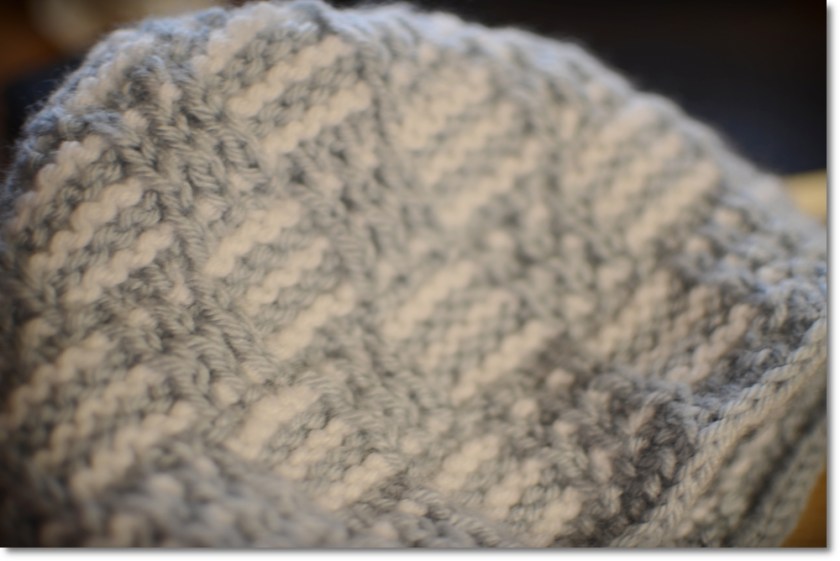
This hat is a simple mosaic stitch pattern, with texture created using purl stitches along with knit and slipped stitches. Although mosaic knitting looks complicated, it really is not. The fact is, each knitted round (or round with purl stitches) is done in only one color. The slipped stitches pull the contrasting color up from the row below. The biggest challenge in writing up this pattern was actually in translating the written pattern into a charted design.
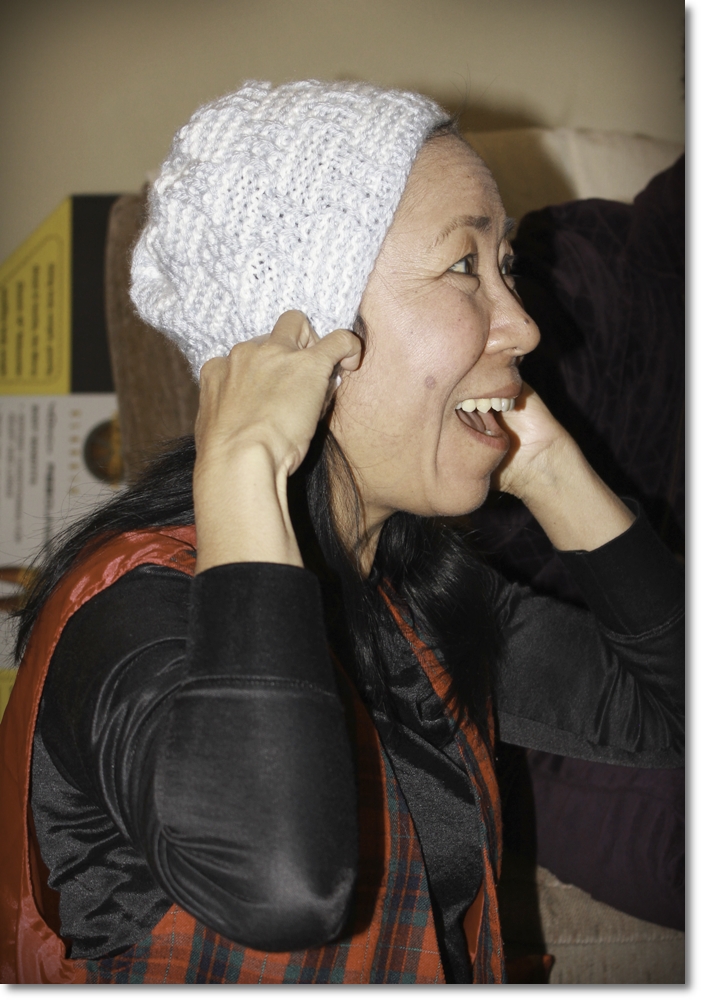
Besides the mosaic pattern, the foundation round of the hat is done in i-cord, invented or unvented by Elizabeth Zimmermann. This creates an edge that is tidy, but a bit stretchy. The result is a hat with a snug edge which helps the hat hold its shape. From the initial i-cord cast on, the first round increases the stitch count, and thence the pattern commences. You can purchase pattern on Ravelry – follow the link here, or else click on the pattern listing under my “page” column.

Although I did not make the pattern available in different sizes, it would be easy to modify the pattern for a very large head or a child, simply by adding or subtracting repeats.
What is a “Skep”?
A skep is an old word for a beehive, made of coiled straw or grass, and shaped into a conical formation. In the New World, there were no honey bees, and so when the Europeans settled, they brought their bees with them. The shape and texture of this hat made me think of a skep – thus its name!
Unfortunately, our honey bee population is being challenged by viruses or some other horrible illness, and their number is dwindling. Add to this, they are mating with African bees, which are known to be very aggressive. Neither is a good thing.

A Bee Artist
I would like to refer you to a site I really enjoy, Pencil and Leaf, which is the blog of an artist who does wonderful drawings and painting of bees and flowers. Buzz over to see her fine work.
 Ink, Yarn & Beer