
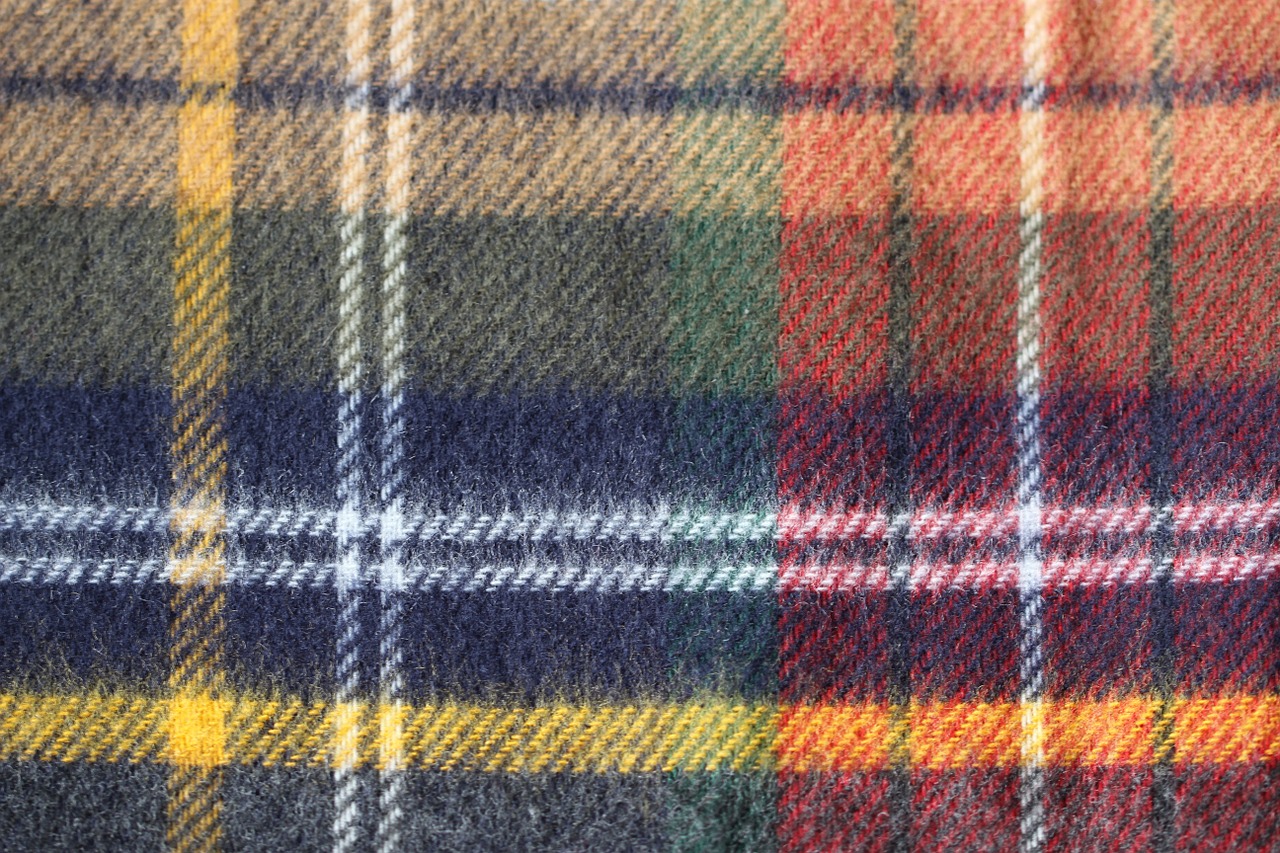
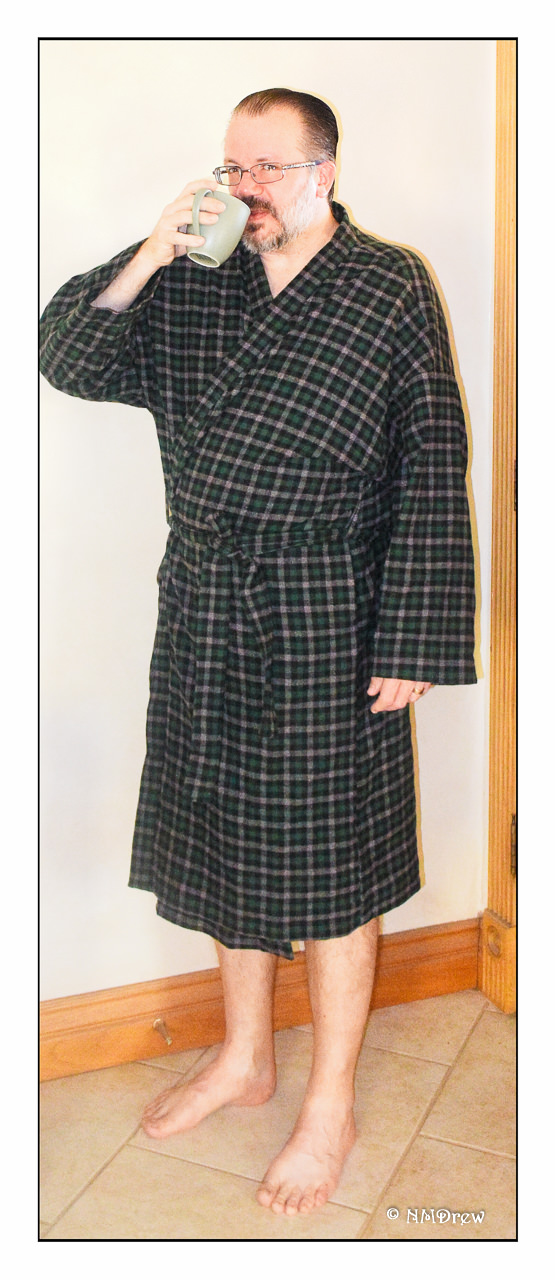
Last Christmas I made my husband a flannel robe. I had never sewn with flannel before, and having found a really soft, lofty, excellent flannel at the local fabric store, on sale no less for 50% off, I had to try it. His current robe was a flimsy one made of cheap flannel, too short, and not very warm. So, off to work I went, and you can read more about it here. As with all washable fabrics, I washed it on the hottest setting and dried it on the hottest setting – cotton shrinks, flannel is linty, and the sizing and such makes a fabric deceptive.
 I figured I knew enough about sewing and fabric that I didn’t need much more than my accumulated knowledge. However, as I proceeded to cut out the robe, I became aware of just how much flannel stretches! The robe was really lopsided, even though I cut out each piece separately to match the plaid weave. I was soooooo careful! I attributed the mismatched plaid to my own casual approach to sewing – I do it for fun, enjoyment, and not to make myself nutso with idealized perfection – but soon realized the fabric itself had its own personality.
Fast forward to the past week. I made myself a robe out of the same pattern for the same reasons I made my husband a new robe. My summer robe was too short, had crappy flannel, the waist set too high. I bought a lighter weight flannel than the plaid for my husband, figuring it would be more tightly woven and thus have fewer problems. As usual, I pre-washed the flannel in super hot water and dried it on super hot. Since this flannel is printed, I didn’t worry about it too much after that . . . but I still found that, even though was picky about my cutting, when I went to sew it, some pieces were warped, even with stay stitching.
Hmmmm. What is going on here?
Research revealed some things I didn’t know, but had learned by experience. Viewing YouTube videos on sewing with flannel came up with some suggestions, paralleling many of my own ideas after sewing two robes and having more flannel projects in the sewing wings. Let’s begin . . .
Before Sewing
- Determine the yardage for your garment based on the nap layout. Flannel is a napster!
- Buy 20% more fabric than you need as flannel shrinks a lot!
- Buy at least 1 yard more if you need to match plaids, or even more if the plaid is a large one.
- Pre-wash in super hot water and dry. Repeat if necessary.
- Use a starch or sizing spray on the reverse side of your fabric when you iron it prior to cutting out your pattern
- Iron by the press-and-lift method – don’t iron back and forth or in a circular manner as this will cause the fabric to warp
Cutting Out Your Pattern
- Flannel has nap. Determine the direction in which you wish to lay out your pattern.
- Lay out all pieces in one direction because of the nap.
- Cut out pieces individually if you have a plaid so that you can match up the weave if you wish.
- Mark all notches and dots – this will help keep your pattern in line when you sew – remember it is gonna stretch!
Getting Ready to Sew
- Stay stitch where directed by your pattern.
- I plan to stay stitch around each piece before sewing – this might help with stretching issues, it may not, even though I zigzag all my pieces prior to sewing.
- Finish all the edges of a piece before you sew – this will cut down on fraying (and flannel wants to fray) as you sew, even if you have to trim seams later on.
- Use a walking foot / quilting foot if you have one. The differential feed helps reduce the stretching of the flannel as you sew. If you don’t have a walking foot or differential feed on your machine, roll the fabric up and support it so that the upper layer especially is not weighted down. This helps a bit.
- Use a new needle. For heavier flannels, use a 16/90 sharp or universal; lighter weights use a 14/80.
- Increase your stitch length. Most modern machines default to 2.5mm – try 3.0 to 3.5 depending on the fabric.
- Use polyester thread as it is a bit stretchy and can work with the natural tendency of the flannel to stretch. Cotton thread is always my thread of choice, but it doesn’t stretch.
- Decrease your upper thread tension if you can. Less pressure on the fabric means less stretching as you sew.
- Pin, pin, and pin some more! This helps keep the fabric from slithering around as you sew. Or, if you like, hand baste each piece. This might actually help when matching up plaids more so than pins.
- For my next robe, for my husband’s brother, which is made out of the same fabric as his, this is what I plan to do.
Sewing the Garment
- Take your time. I slow down my sewing considerably when I sew flannel. This helps me keep the fabric under more control than if I am zipping along at maximum speed.
- Remove pins just before they slide under the presser foot. If you snap a pin, you might find it is difficult to locate later on.
- Think about how you want to prevent the fraying so inherent in flannel. How are you going to control it? Consider
- serging the seams
- overcast stitching the seams if your machine has such
- zigzagging the seams
- flat felled seams
- French seams
After the Garment is Sewn
- Hang the item up for a couple of days if it has a hem to be put in. The fabric will stretch out and relax a bit. This will allow for a better hemming experience I think (just what I think).
- Hand sew hems and facings into place. As flannel is stretchy, you can then slightly gather in excess fabric as you stitch. The nap in the flannel allows for slightly larger stitches – more than one thread of the warp or weft can be picked up. The stitch will be buried in the nap.
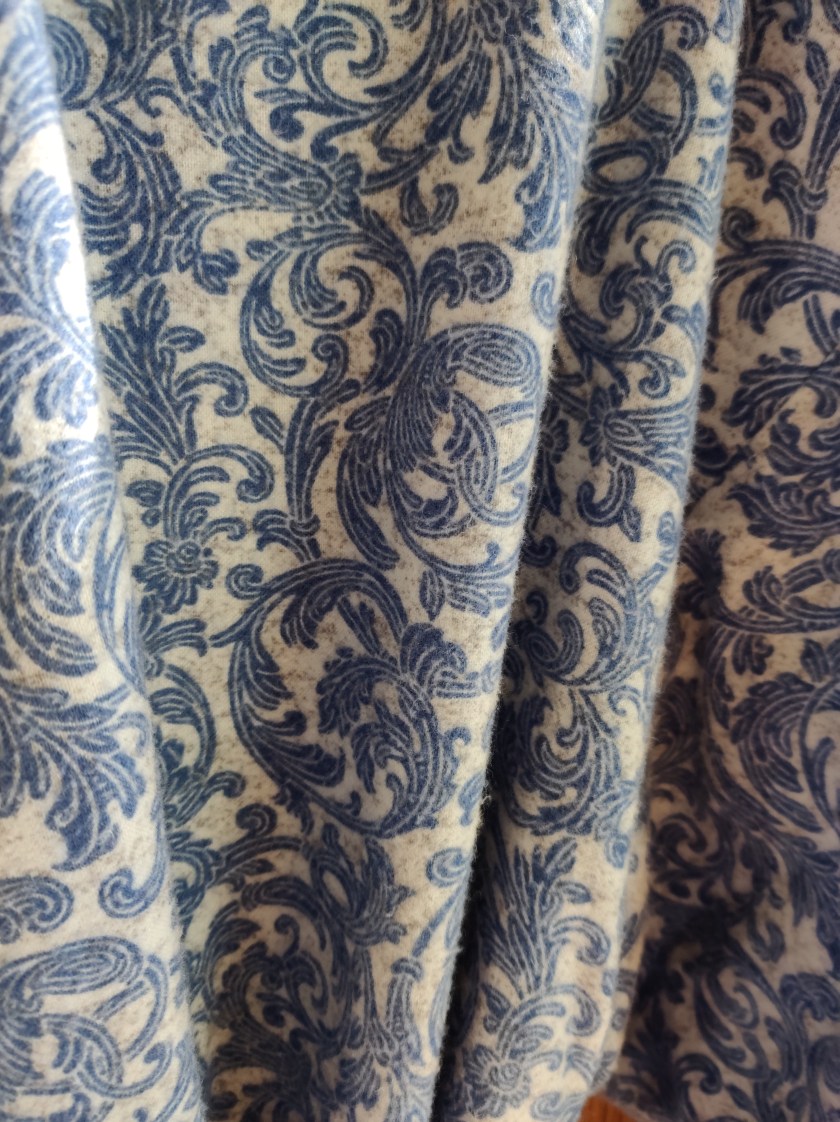
As you can see, this flannel is considerably less heavy than the one in Josh’s robe. It is very soft and fuzzy, which makes for a comfortable robe. Over time, we will see how good the quality of the fabric is through washing it. Now that it is shrunk, there is no need to wash it on super hot nor dry it the same way.

As you can see, this robe is baggy and loose. Wearing it is very comfortable. The off-the-shoulder sleeves, while perhaps not the most flattering, certainly are roomy. I made the small robe for myself and the large for Josh. The front overlap is good, covering more than enough in both sizes.
I had a few issues with the sewing sequence. I didn’t like the fact that the sleeves were sewn on and then the front bands. I personally would do front, back, front bands. From there I would add the pockets and loops to hold the belt. Afterward, shoulder seams. I also think that perhaps sewing the side seams and easing the top of the sleeve might make for a better match of the hems at the bottom of the sleeve. I also cut two belt loop pieces instead of one, using the other for a loop at the inner neckline to hang on the hook behind the bathroom door.
I didn’t spend 2 hours sewing this robe either! My time was about 10-12 hours. I really took my time, and spent a couple of hours for about a week sewing, ironing, finishing seams, hand sewing hems and front bands. The final product is pretty nice and looks professionally made. I am not sure if the fabric caused some of the pieces to stretch in weird ways, but it was not something that caused issues in the end. On the front of the robe, even though I matched notches and dots, one band was shorter than the robe front and the other was a bit longer. Hemming took care of such discrepancies.
In the end, I like this robe pattern, but for a woman, perhaps one sized for a female build would be a better choice. Unisex patterns are, in my experience, sized for men. Big shoulders, narrower hips. I look a bit different than that!





 Ink, Yarn & Beer