Waiting for Lovers . . . and some notes on On1 Photo Raw

waiting-for-lovers
Waiting for Lovers

Today is the very, very first day that On1 Photo Raw is available for usage.  I think the original idea was to have a product ready to roll in October 2016, but rather than have a “finished” product full of bugs, they realized they had more on their plate, and held off until today, November 23.  I’m glad they did – and I am glad, too, that they realize that this really is a “work in progress” as it stands.

Personally, I love On1, and have been using them since version 8, which was a while back.  I use it with Lightroom.  What makes On1 great as a company is their support, ongoing consistent development, tutorials, and so on.  On1 products are sophisticated, and while they do not rival Adobe Photoshop for complexity, On1 products are far easier to use.  I prefer their brushes, spot and blemish removal tools, as well as the fact I can create presets which I can store.  At this point, the presets from On1 Photo Suite 10 cannot be used in On1 Photo Raw, but I expect they will have the ability to port them later on.  The one-up that Photoshop has is its “content-aware” fill.

The image above, Waiting for Lovers, was edited using On1 Photo Raw.  It is a film image using Kodak Ektar 100 in a 1930s Welta Weltur rangefinder.  The lens is an uncoated Xenar – probably about 75mm – which has an ethereal quality to it that I really love.  Scanning the image with my rather dirty Epson V600 (I have since cleaned it), I ended up with a blue streak across the entire image.  On1 took it out quite nicely.  Spots and threads were also easy to remove.  I think On1 did something to their processing algorithm (or whatever), as the spot removal works very quickly.
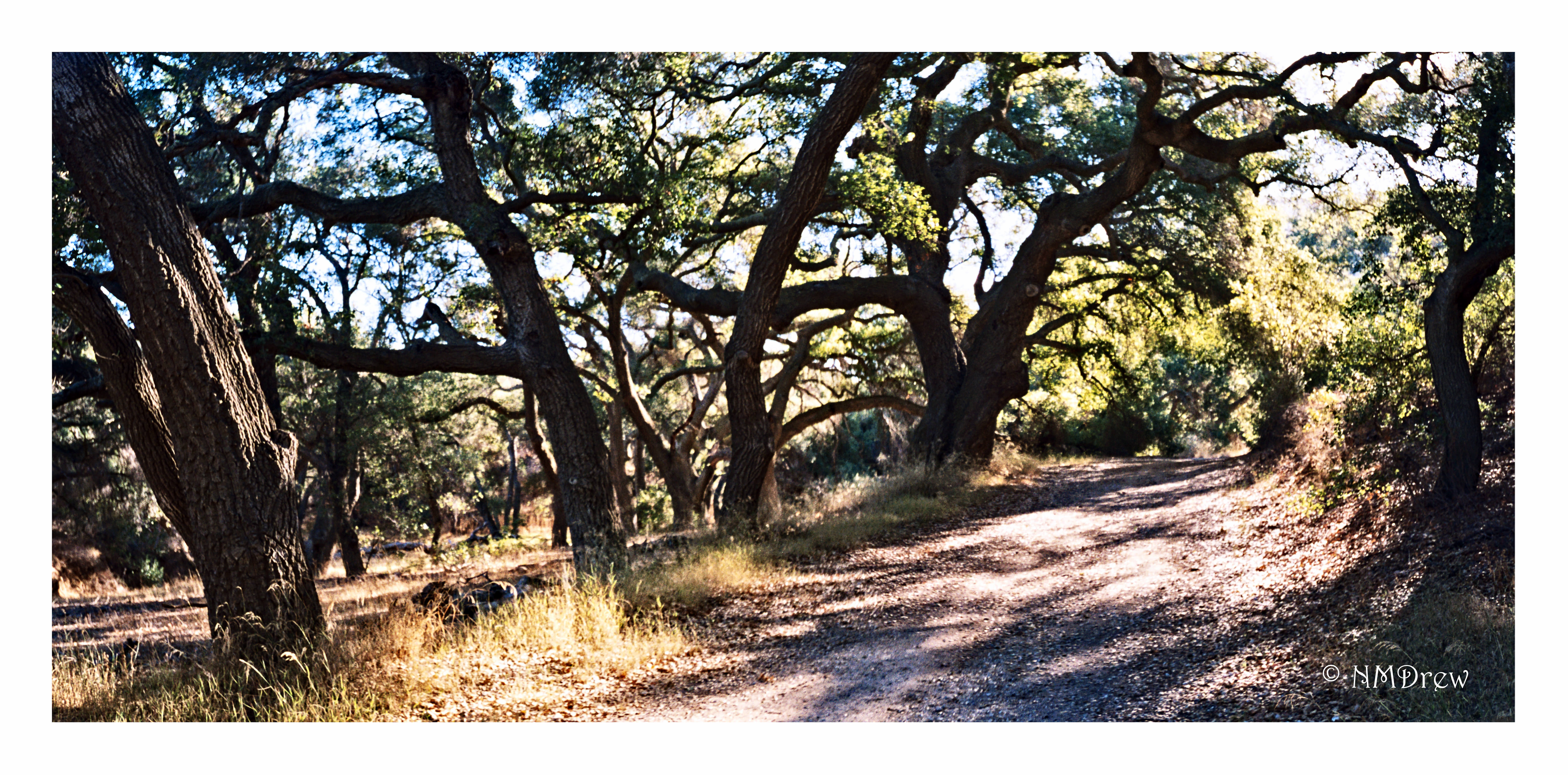
chumash-trail-1

This image is a pano stitched together in LR, and consists of two images taken with the Olympus XA4 and Lomography 100 film.  The only thing I did was perk it up a bit with some detail, in LR and in Photo Raw.  It is nearly identical to the SOOC image.
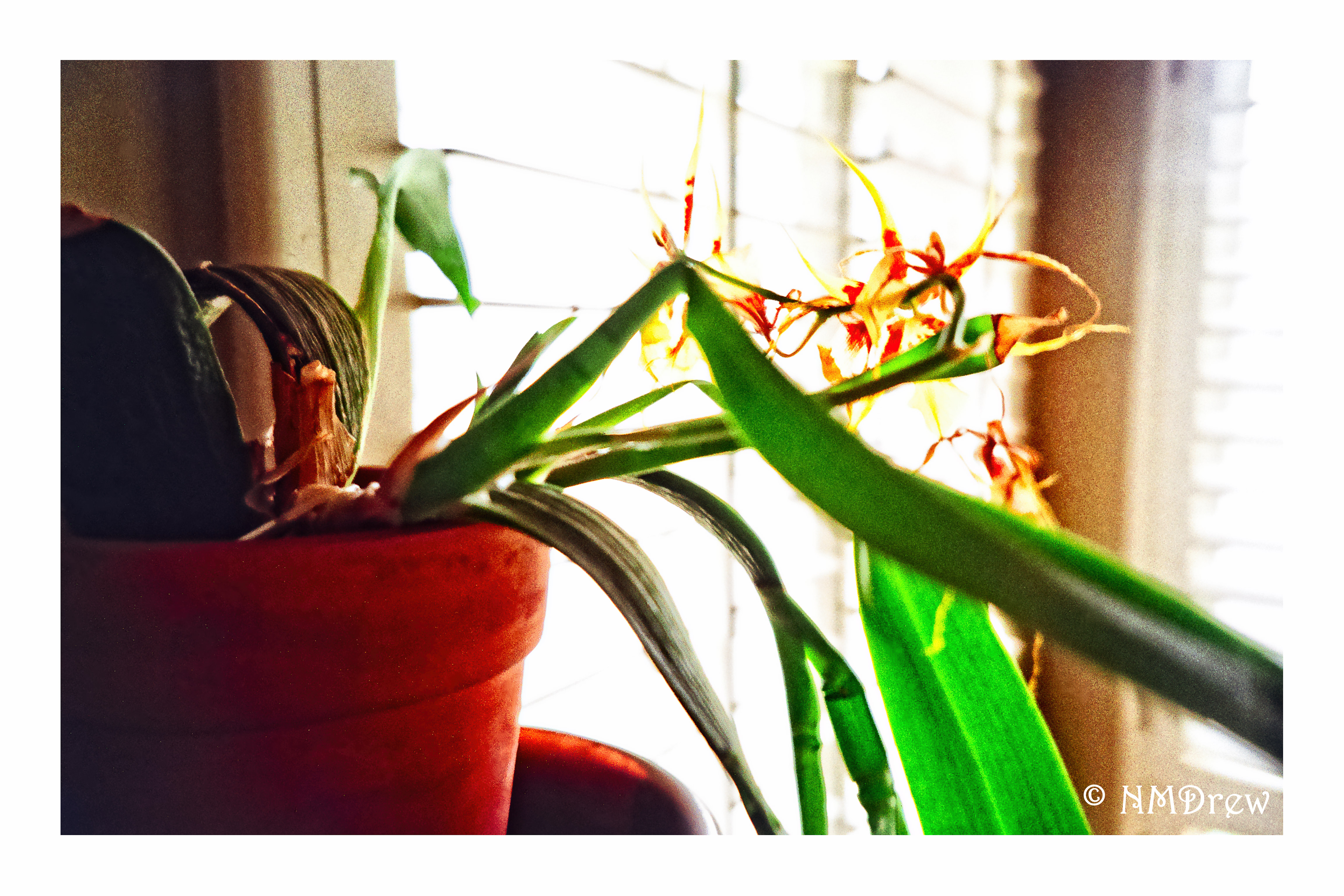
orchid-in-the-window

Finally, the above image was really pushed in On1 Photo Raw.  Spot removal, brush usage, presets, whatever.  This was an overall high-key, pale image, but I set it up to be contrasty and bright – possibly too much so – but wanted see what I could do.  This was also taken with the XA4 and Lomo 100 film.  Both of these two images were scanned using a Pakon 135 scanner.

There is so much software out there for photographers, that competitors to Photoshop seem to come and go.  My favorite and most consistent programs are Lightroom and On1.  I also use DxO v. 11, and while it is good for some things, it lacks the diversity of On1.  Capture One is good, too, but it makes me crazy as it does not make sense to me at times . . . but I admit, I have not put in time to using it as it has a higher learning curve, and is not, for me, very intuitive.  So, two thumbs up to On1 for its Photo Raw software – I think it will prove to be a real winner as they continue to develop it.

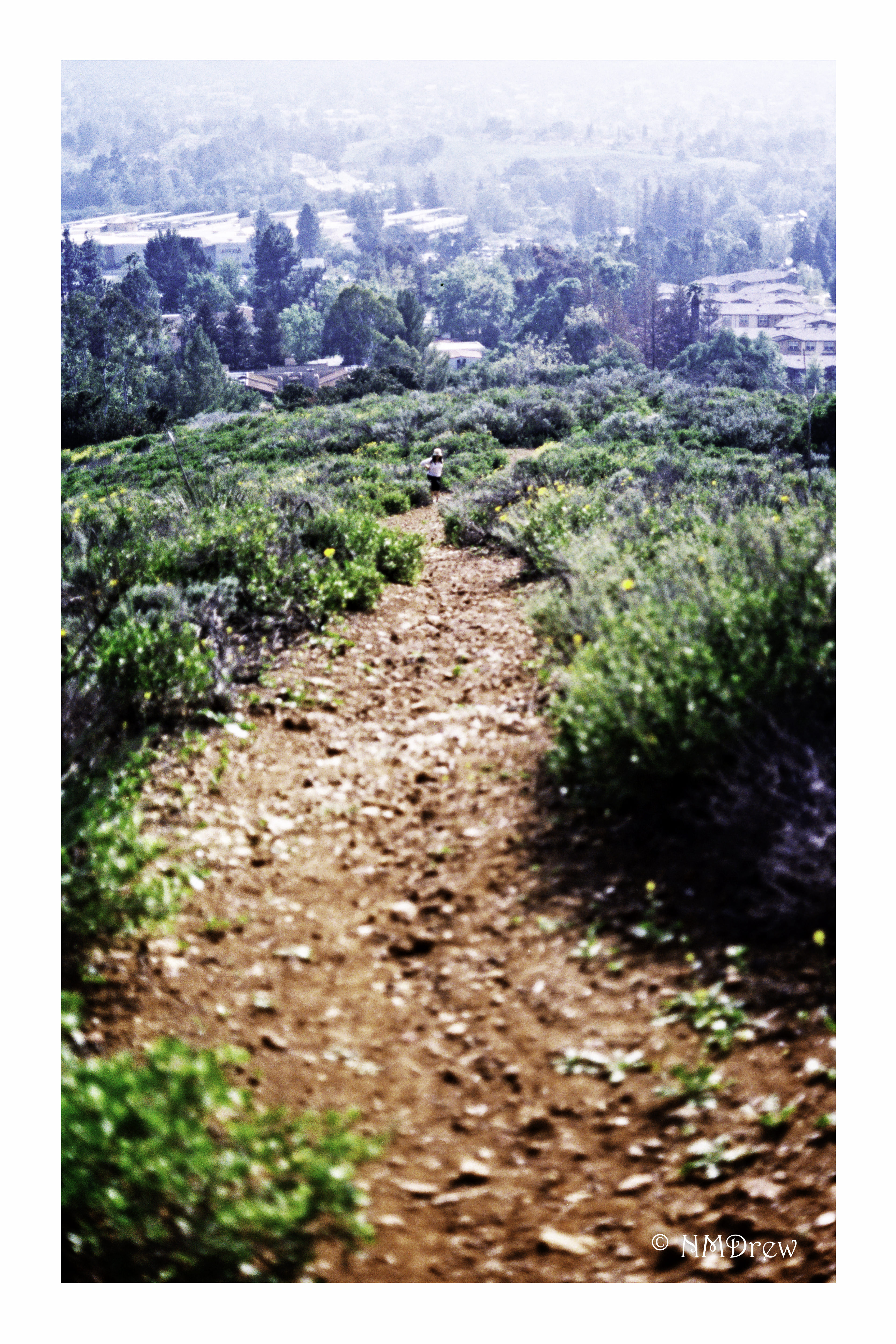
Sycamore

sycamore

Another image from the Moonrise Trail.  Because it varies from sunny to shady, it’s a great place to play with exposure and other photo-y things, like compensation, speed, and aperture.

This was taken using the Canonet GIII QL17, Agfa Vista 200, and scanned at home using the Pakon NonPlus.  Some tweaks in LR and On1.

A Photographer’s Friend: Epson V600 Scanner

For 35mm film, you cannot go wrong with a Pakon scanner – it comes in a lot of flavors and price ranges.  The problem is that it is no longer being manufactured.  Models vary in price and availability, usually on eBay.  On the other hand, the Epson V600 scanner is still being produced, and is about $200 US, depending on where you shop.  It is a great way to scan your own medium format film.

As we all know, YouTube is an endless resource for information, opinions, silliness, and instruction.  One photographer whose videos I enjoy, and learn a great deal from, is Matt Day.  In particular, his video on using the Epson V600 is invaluable.  The video below is for scanning black and white film.

Scanning black and white film is easy, but one of the issues you might find is that the Digital Ice is not useable with b&w.  Digital Ice is the software which reduces scratches and dust on negatives as they are being scanned.  It works great with color film – scan the same color negative twice, and you will see the differences.  The reasons why are found on the web, but essentially it is because the chemical content of color and b&w film are different.  Therefore, having a very clean negative for b&w scans is necessary, although you can remove dust manually through software, such as Photoshop or On1 Perfect Photo Suite / Photo 10.  NB:  Digital Ice will work with b&w C-41 processed film (color film is C-41).

The Epson Scan software is quite robust.  It does a great job, and has a lot of tools to help the end user modify individual images prior to the final scan – yeah, use the preview for sure!  Below is an image of what my settings are in b&w.

Epson Scan B&W Settings

The best way to use the software is to just explore it. Check or uncheck boxes as you desire. Take the time to play with it, to get used to what the software does. Matt’s out-of-the-video settings are very good. I checked the “dust removal” box for a particularly nasty set of negatives – don’t know if I saw much difference, but I didn’t look too closely.

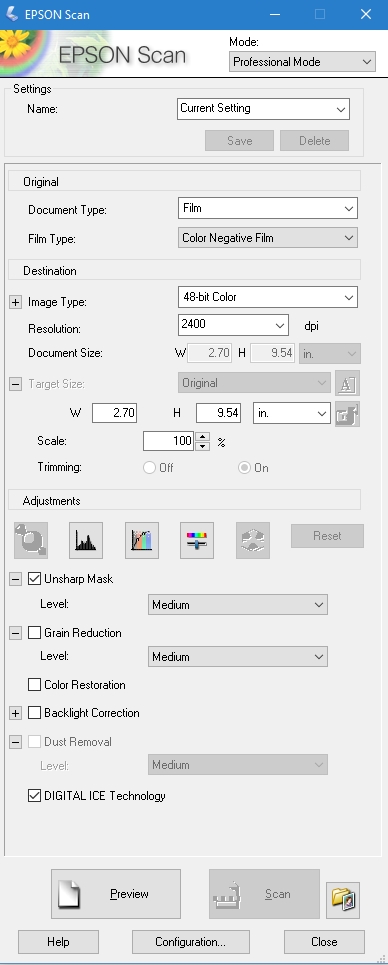
Color negatives have different configurations – as you can see in the image below.

Epson Scan Color Film Settings

These are what I use, and am fine with them. In the middle of the screen are adjustment buttons – check them out to see what they do (try reading the manual, or googling them, if you need help!). The two items checked are the ones I use – unsharp mask, per Matt’s recommendation, and the Digital Ice, per my recommendation.

Also, do not be lured into much more resolution than 3200, as the files can become very big, and perhaps not worth the size for post-production work.  Some people have noted that beyond 3200, quality begins to degrade.

Directly below are three items which are important to look at. The “Preview” button lets you see what you are going to end up scanning. If you watch Matt’s video, you will see how he uses the previewed images to make adjustments. The button labeled “Scan” will be activated once you are ready to roll, but BEFORE YOU SCAN, go to the button directly to the right of the “Scan” button. You must use this to give the final info to the scanner – where to send your scans.

Epson Scan File Save Settings

I always save my images to specific file directories, where I keep all my photos that I later import into Lightroom. I save as Tiff, and try to renumber to 001, but if I rescan, I change the file number to 100, and so on. I like having the image folder opening after I scan because then I can double-check my foggy brain and make sure I have done this job! I don’t want my Ektar in my Portra scan folder.

Also, while I think the Epson Scan software automatically detects the film size(s), if you notice anything weird, go to the “Configuration” button on the bottom of the page.  Here you will find info for Preview, Color, Film Size, and Other.

Altogether, I like my Epson V600. The price is right for me, and because I am just getting into film in a bigger way, I don’t want to spend too much money – film costs add up quite quickly! Other software helps develop an image to your final liking – as you can see below. The first picture is directly from the scanner, and the second one has been manipulated to the nth degree because it was so crappy (an image from my previous post, Catastrophe in the Darkroom.

img014

Stripes

Click on the images above to see the crap in the first, and the final clean up in the second.

To clean up the final image above I did the following:

  • exported image from LR6 to On1 Photo 10 Enhance and used the spot removal tool (this is better than the one in LR as it does not search for an area similar to the one being fixed, and as a result, does a better job).  More post, if desired, in On1 Photo 10 Effects, or whatever else I want to do.
  • Return to LR6, and exported to Photoshop, using the Noise / Scratches and Dust filter (or whatever it is called).  To use this, find a video – there are good ones for us unsophisticated Photoshop users.
  • Return to LR, and do final export with signature.

And there you are – a brief review and some post-processing steps.