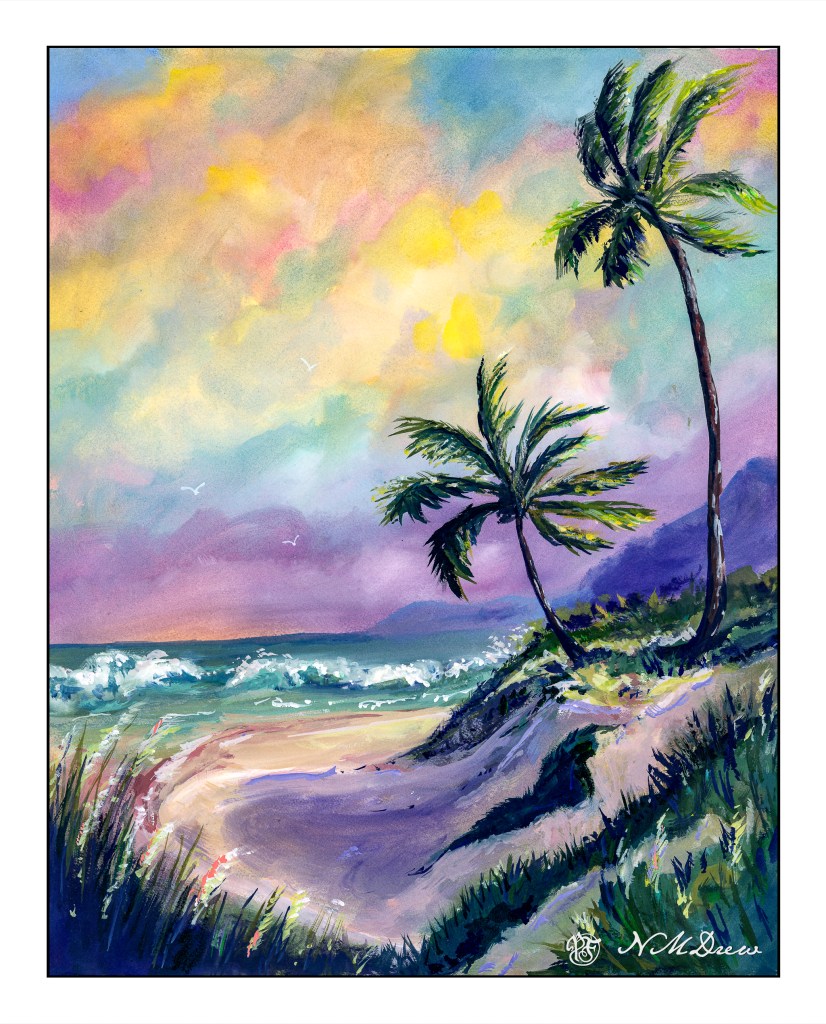
A Slice of Paradise

This is a tribute to the African-American painters of Florida known as The Highwaymen. Some of their numbers include Sam Newton, Alfred Hair, and so many others that I cannot name them all. In a time of racial unrest in the U.S., these painters somehow managed to thrive despite the Jim Crow laws of the South, and unfortunately, their work was not appreciated as it should be. However, today we know more about them, and can enjoy their work – the internet is so helpful in that regard.

I love bright colors and cheerful landscapes, and the tropics beckon. Palm trees are alluring and the brilliant light of these areas make colors more alive and intense. The Caribbean is filled with islands and azure seas, trade winds, towering clouds. States such as Florida, on both the Atlantic and Gulf sides, throughout the Gulf of Mexico and down along the coasts of Central and South America have such beauty in common.

The Highwaymen were not untalented amateurs. Some were self-taught, others learned from A.E. Backus. Each painter in this group sought an income otherwise denied them, as well as perhaps a way in which to express the beauty around them. Read up on them – they are a fascinating slice of art history.

As with the painting I last did, “Swamp,” this one is done with watercolors mixed with gouache on 16×20 inch 140# CP Arches paper. I used more gouache this time than I did with the last painting, and it was quite a challenge. I started out with bright colors and a totally different idea of a painting, but as I started blending the gouache with the watercolor, the gouache became a driving force. However, all color represented is simply toned with white or black gouache.

These artists worked in oil on masonite. Oils lend to blending colors more so than does acrylic paint, and I found that the gouache and watercolor worked similarly. I may try to do something similar in acrylic, and expect it will be a serious challenge as acrylics dry so quickly. Often The Highwaymen sold paintings still wet!

This is perhaps the most fun I ever had with a painting. I referred to paintings by some of the artists to see how they used color, photos from the internet of palm trees and Floridian sunsets. The composition is similar to a number of seaside ones, and I attempted to emulate the colors used by the painters for sand, sea, sky, and palms. I hope I caught some of the liveliness and spirit of The Highwaymen. I know I will be back to visit them, and Florida, again soon.
Storm Across the Water

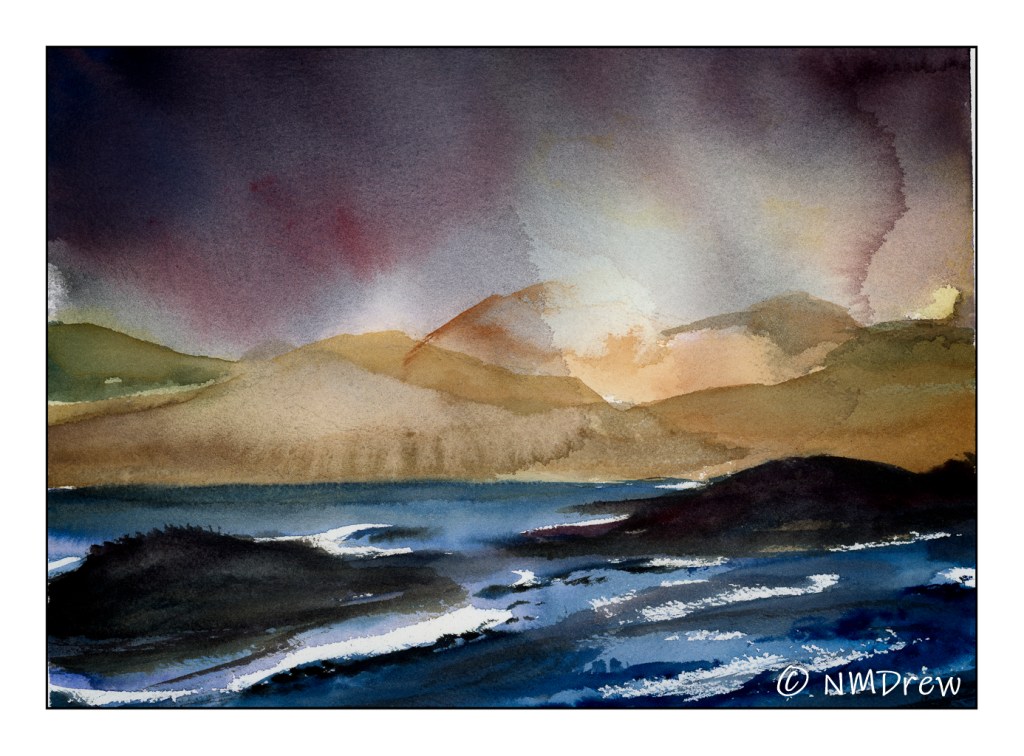
I painted this shortly after doing the “Quiet River” watercolor yesterday. Still in a patient mood, which was good, as this painting, though small, needed a bit of thought and a bit of patience to complete. The effect of rain meant laying in heavy washes on damp paper and letting them run. In other areas, damp color had to dry only so far before a dryer brush could apply color. As you can see, I rather messed up with a second round of wet paint because of the bloom (aka cauliflower) in the middle right. Still, it works, catching the breakthrough of the sun and the scudding quality of a storm on a windy day.

This one pleases me quite a bit!

Rain at Cattle Point

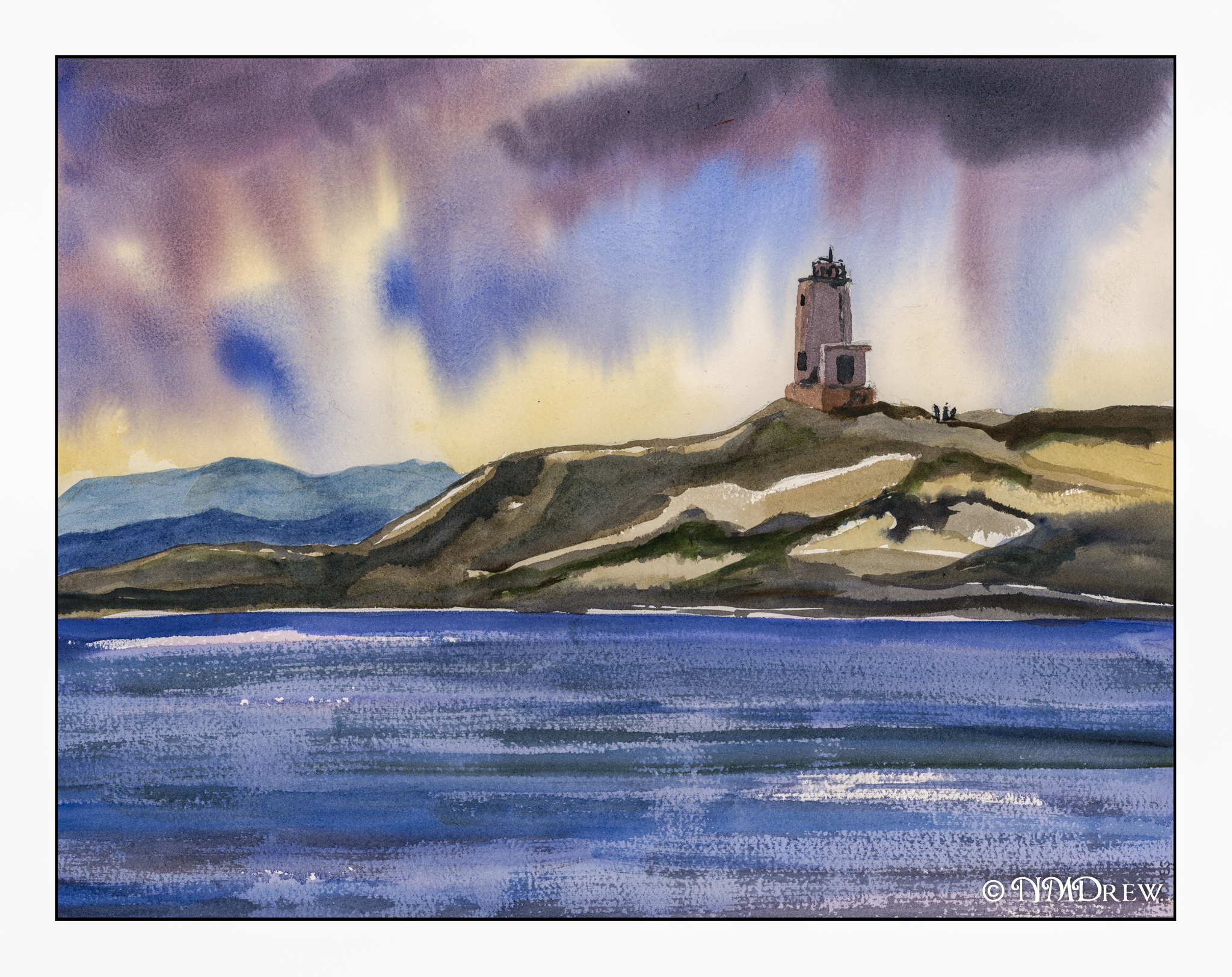
Hopefully this conveys a fickle weather day late in the year!

I think the dot-dot-dot and color isolation with Pointillism helped with this watercolor.  I was very aware of color placement and capable of containing colors to certain areas.  I managed, too, to have patience and let areas dry before going back in, or let them get slightly damp for dryer painting onto a damper area, preventing blooms.   Proportions are off – sigh.

As well, a limited palette of primarily blue (ultramarine and cobalt) with burnt umber and burnt sienna, yellow ochre, and a spot of orange and Hooker’s green.  140# CP Arches, 16×20.

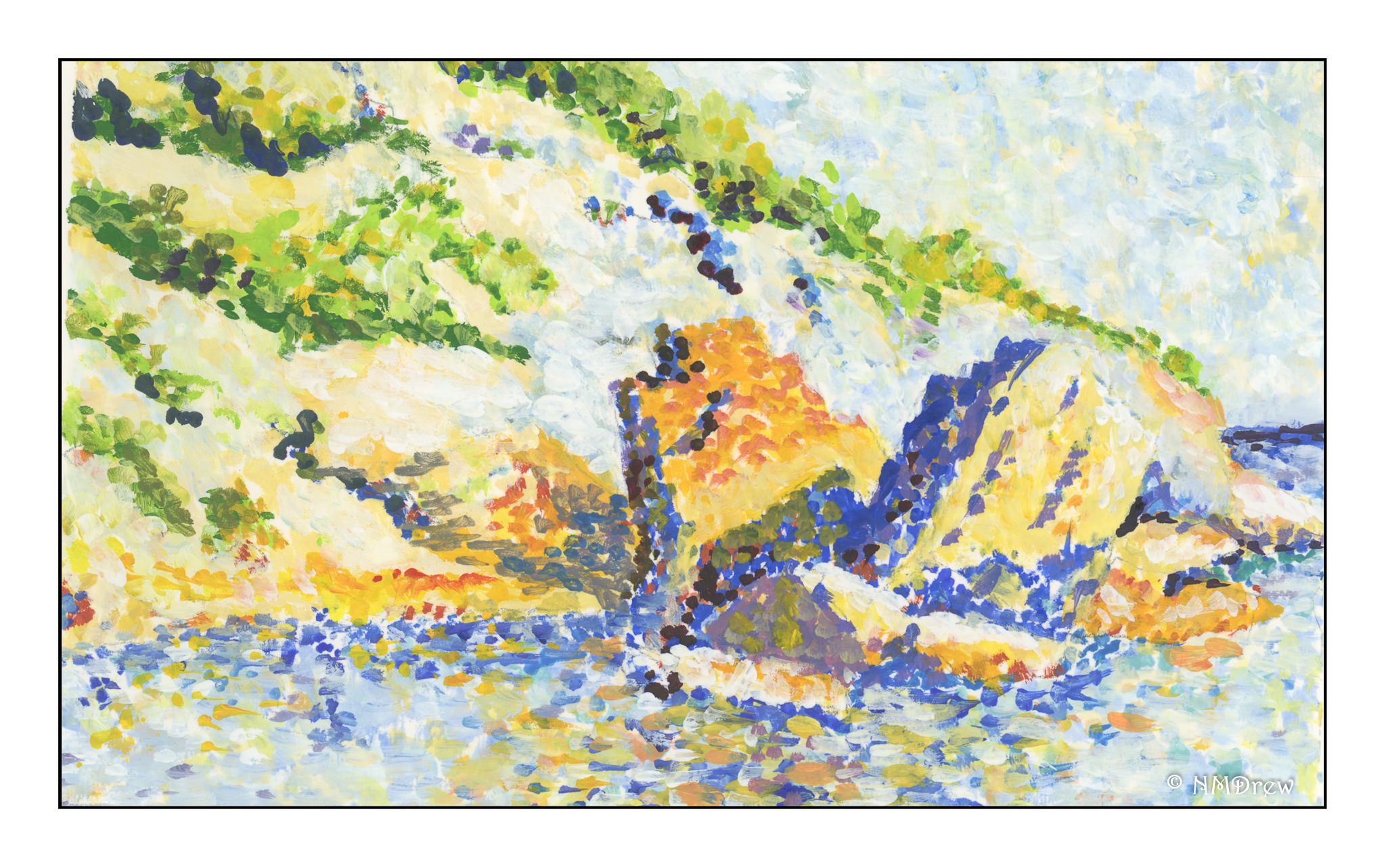
Cassis, Cap Lombard – Detail Study from a Painting by Paul Signac

After putzing around with attempts to emulate some of Monet’s Impressionistic paintings of Etretat, I muddled around and found the works of Paul Signac, a Neo-Impressionist and Pointillist. These two schools espoused dabbing, using complimentary colors and such to create a sense of light and movement. They are rather delightful to my eye – I am a magpie at heart – and the vibrant colors and energy of these painters fascinates me.

Here, I decided to see what I could do with a detail of Paul Signac’s painting, which you can see below. His rocks, or whatever they are, and their reflections in the sea caught my attention. My reflections are not very good. As a first attempt to try pointillism, I just started with making dots on the unpainted paper. In reality, the best way to start would have been to laid down solid areas of underlying color, and then build upon that with the dots.

If you look at Signac’s painting, you will see the use of orange and blue in the shadows – reflected light in the shadows. What I also found fascinating is his use of different shades of blue – ultramarine, cobalt, and cerulean in particular. Together with varying shades of orange, yellow, and ochre, he created the stone reflections. I found this very hard to do, but think I get the idea!

More to come. The purpose of copying or interpreting Signac’s work (and Monet’s) is to get a better sense of color. With pointillism, the colors are applied individually. Doing this myself, I begin to appreciate the purity of color when juxtaposed with another.

Sea Stacks

Along the coasts of many countries, the upper northwest of the US, there are sea stacks. Some are barren rock, some are topped by trees. Wide beaches at low tide make these places a bit of wonder, and those further out to sea make you want to sail out, climb, explore. I always have a fantasy of a house built into one, hidden away from the rest of the world. I could make a trip to just find sea stacks.