Cochineal, ii

White and Moorit Wool

I have spent the last few weekends dyeing with quercitron and cochineal.  I did not devote just one day to each color, but did both each day.  The quercitron adventures yielded golden yarns and flammegarn, as well as exhaust baths I used with the exhaust baths of the cochineal.  For both, I premordanted the yarn with alum and tartaric acid as I wanted to move toward reds and pinks, rather than the red violet or burgundy colors derived from unmordanted wool.  I used handspun moorit shetland and commercially spun yarn for the cochineal.

First Dye Day

A couple of weeks ago, when I did the flammegarn, I did my first-ever dyeing with cochineal.  Using the recommendations from Trudy van Stralen’s Indigo, Madder & Marigold, I set up my dye bath the day before I planned to dye.  

Tin Dissolved in Water
I ground up 5 g of cochineal, combining it with 2.5 g of tartaric acid, mixed them together, and let them soak overnight.  The next day, as with the quercitron, I filtered out the bugs before starting the dye pot. Into this dye bath I put in 1 skein of commercially spun wool, weighing in at 50 g, and the handspun moorit, weighing in at 75 g.  This was certainly more wool than the 10% cochineal / 5% tartaric acid weight van Stralen uses, but I wasn’t too worried.  I wanted to see the results more than anything!

The wools were in the dye bath for 35 minutes (per van Stralen’s recipe). In the early minutes of immersion, the moorit and white took on orangish casts. These colors deepened the longer the yarn remained in the bath, moving closer toward red for the moorit, and pink for the white.

Moorit and White Wool - Before Tin Added to Bath

After 35 minutes, the yarn was removed, and 0.25% of yarn weight of tin added. Thus, 125 x 0.25% = .3125 g. I put in .3 according to my scale. Before adding the tin, the yarn was removed from the bath. The tin was weighed out in a bowl, water added, and then stirred into the dye pot. Tin is added to “bloom” colors toward the red side. Once done, the wools were returned to stew another five minutes, and removed. The moorit became a rather dull wine-red, and the white became a lovely pink color.

Moorit and White Wool - After Tin Added

Pulling the wools out of the dye bath was a pleasant surprise. Each color was harmonious with the other, intense without being displeasing.

Moorit and White Wool Just Out of the Dye Bath

The next step was to immerse the skeins in ammoniated water, to further push the colors toward magenta. The pictures show fairly well the before and after colorations.

Moorit and White Wool After Dipping in Ammoniated Water

The wool pulled up most of the color in the dye bath, but left behind was a pale orange. Another skein of white wool was placed in the exhaust, heated for 45 minutes, and then removed. It had a pale orangish color, but when placed into the ammoniated water, it turned a lovely sea shell pink.

Exhausted Cochineal Bath
Wool Dyed in Exhaust Bath - Not Yet Dipped in Ammoniated Water

And you would think after all tihs activity I would be done, right? Nope! I had saved my filtered bugs and quercitron dregs, the quercitron dye bath, and the remainder of the exhausted cochineal. All these were warmed up together and yet another
white skein immersed . . . but you will have to wait to see all the final colors in another installment.

Quercitron, ii

Today’s adventure is simply about dyeing with the quercitron and the colors I got.

Dr. Edward Bancroft is credited with utilization of the Eastern Black Oak for yellow dyes.  In his book, Experimental Researches Concerning the Philosophy of Permanent Colours; and the Best Means of Producing Them, by Dyeing, Calico Printing, &c, he devotes an entire chapter to Of the Properties and Uses of Quercitron Bark. If you wish to read about the history of quercitron, the above links are worth pursuing.

You can also read what I’ve written about it as well.

And if you have read a bit of what I have written about using quercitron for the flammegarn, you will recall that I set it up the night before.  For today’s dye bath, I used 15 g of the powdered bark, soaked in warm water.  This morning, I strained it out, and set aside the coffee filter to reuse later.  I soaked the yarn to be dyed while the dye pot was heating up.  The yarn was premordanted with alum and tartaric acid a week or so ago.

Filtering out the dye matter is important.  The quercitron is finely ground, and if left loose in the dye pot with the yarn, it would easily get entangled in the yarn or fleece, and require a lot of time to remove it.  Trust me, it’s not worth skipping this step!  Coffee filters are ideal, and then the sludge may be set aside to dry out for reuse.  I do this with some other dyes, such as cochineal and brazil wood, even though subsequent uses will be weaker.

I used my largest dye pot, even though I was dyeing a small amount of yarn.  The reason for this is that the temperature of the dye bath is more easily controlled.  This is critical to keep the dye toward the yellow, rather than brownish, side.

When I made the flammegarn last weekend, I kept the yarn in the dye pot only about 20 minutes.   Today, the yarn continued in the pot on the heat for an hour, and then was given time to rest in the cooling liquor.  After that, it was dipped in a vinegar bath, which, as Bancroft notes, causes the dye to move toward yellow rather than toward a brownish or greenish color.  While I have not tried it, Bancroft states that “tin, mixed with a decoction of the bark, produces and exceedingly beautiful lively yellow.”  Perhaps an afterbath of tin would be worth trying.

In the pot is lace weight alpaca, and handspun white fleece.  The final results are below.

As you can see, the alpaca took up the color more deeply – perhaps it is the nature of the fiber.

Quercitron, i

Eastern Black Oak

The Eastern Black Oak (quercus velutina) is a common, medium-sized to large oak of the eastern and midwestern United States, with a range that runs essentially east of the Mississippi. Other names for this tree are yellow oak, quercitron, yellow bark oak, or smooth bark oak. It grows best on moist, rich, well-drained soils, but can also grow in less optimal conditions. Its acorns take two years to mature, unlike those of other oaks, and are rather squat and round.  It belongs to the family of red oaks.

Black oaks are medium to large trees, growing to a height of 80-100 feet, with trunks about 3 feet in diameter. The leaves have 7-9 lobes, and vary in length, from 4 to 10 inches. During the summer, the leaves are a crisp green color with paler shading underneath. In autumn, the leaves turn to red. The bark of young black oaks is smooth with light grey coloring, but with age, deep furrows develop and the bark becomes thicker and darker. The inner bark is an orangish-yellow color, and it is from this that the dye quercitron is derived.

According to Wikipedia,

Quercitron is a yellow dye obtained from the bark of the Eastern Black Oak (Quercus velutina), a fine forest tree indigenous in North America. The name is a shortened form of quercicitron, from Latin quercus, oak, and citron, lemon, and was invented by Dr. Edward Bancroft (1744-1821), who by act of parliament in 1785 was granted special privileges in regard to the importation and use of the substance. The dyestuff is prepared by grinding the bark in mills after it has been freed from its black epidermal layer, and sifting the product to separate the fibrous matter, the fine yellow powder which remains forming the quercitron of commerce. The ruddy-orange decoction of quercitron contains quercitannic acid, whence its use in tanning, and an active dyeing principle, quercitrin, C21H20O12.

Edward Bancroft was an interesting character, born in the mid-eighteenth century in pre-revolutionary America.  During his lifetime he was – according to varying sources – apprenticed to a physician, a scientist, a writer, as well as a spy and double agent during the American Revolutionary War.  He was a secretary to American Commission in Paris, working for Benjamin Franklin, as well as spying on the British, and for the British.  (Whew!  That must have been complicated!)  After his life as a spy, his scientific side is credited with having discovered that the inner bark of the Eastern Black Oak, a tree found throughout the midwest and east coast, produced a colorfast and lightfast yellow dye which matched, and possibly surpassed, the common European yellow dyes of the time, such as weld and fustic.  Bancroft received English and French patents giving him the right to import the bark, and this made him a rich man in the latter years of his life.  Before his death in 1821, Bancroft had published a number of books on natural science, and on dyeing; it is on this latter subject he wrote two volumes, published in 1814:  Experimental Researches Concerning the Philosophy of Permanent Colours.

The inner bark of quercus velutina is finely ground before being used as a dye.  It is my hope that the harvesting of this bark is done sustainably, without damaging or killing the tree, unless it is harvested for its wood.

Flammegarn

Early this morning, I got up to meet a cool, breezy morning with a clear sky and the promise of perfect weather. What more could be asked for on a day when the morning is to be spent outdoors dyeing yarn? Everything from the last pre-dyeing days was gathered together – the pans, the spoons, scales, and so on, including the skeins of pre-mordanted yarn. Today, a number of things were planned, and happened: dyeing both commercial and handspun yarn with cochineal and black oak bark, also known as quercitron.

What is flammegarn?

Today’s entry is about flammegarn, which is an old Scandinavian method of making yarn with variegated colors. A skein (or two, or three) is tied off with cord, immersed into a dyepot, and colored. The result is a “flame yarn” – so named because this was traditionally done in red over white yarn – with splotches of red and white coloring which knit up into a space-dyed yarn. Modern dyers do this – just google “flammegarn” and you will find a number of examples. Earlier this year I wrote about making flammegarn with commercial dyes, which you can read about here. Judy’s knitted up some socks out of her flammegarn – I need to get a picture of them to post.

Set up the dye materials the night before.

Last night I prepared the dye materials. Specifically, I ground up 5 g of cochineal bugs, and mixed them with an equal part of tartaric acid. Then I added hot tap water, stirred them together, and let them sit overnight. I weighed out 10 g of black oak bark, and did the same, but without the tartaric acid. I did about five dye baths this morning; out of these, two were used for the flammegarn, which is fingering weight, commercially spun blue-faced leicester in two 200-yard hanks.

Filter out the particulate matter.

The dye pot was set up by filtering out the particulate matter from the water into which I put it last night. I used an old coffee filter and a paper filter; the filter was set aside and the clear liquid placed into a large dye kettle.

Cooler dye bath temperatures are better for yellows.

Even though I was using only about 135 g. of wool (100 BFL, 35 moorit shetland), I wanted a large kettle. A larger kettle is easier to control as far as not allowing the temperature to rise very high. This is especially important with yellow as the hotter the temperature, the more the yellow can drift toward brown or greenish hues. I kept my pot around 140-150 F. The weight of dye matter to fiber (the BFL specifically) was 1:10 – 10 g. oak bark to 100 g. of BFL, which had been premordanted with alum and tartaric acid.

According to J.N. Liles, most of the black oak bark color will be taken up in the first 20 minutes of immersion. This proved to be the case. I pulled both the BFL and moorit out periodically to check the color, and once I liked it, I put in a piece of copper pipe – about a thumb’s length – and a pinch of gypsum (the chalk my husband used in beer making to change the pH of his brew, as well as increase the availability of calcium and sulfur ions). Liles recommends adding “1/2 tsp. of chalk” but doesn’t state whether it is calcium carbonate or sulfate, so I used the gypsum. The color in the pot became a tad bit brighter – a rather mellow, pale gold.

Prepare the flammegarn by tying off sections of the skeins.

While the dye bath was heating up, I took my two BFL skeins and tied string around them. The string acts as a resist, keeping the white (or lighter colored yarn) from getting dyed. After this, they were set into hot water prior to immersion into the dye bath.

This yarn was removed from the pot and set in a basin to cool enough so it could be handled for untying and re-tying to create the flammegarn yarn. While the fibers cooled, I took the remaining particulate matter of both the quercitron and the cochineal and remixed them with water, and then filtered them again. The result was a orangish coral color. This was added to the remaining dye in the pot that had been only the black oak bark. This was slowly heated while the flammegarn was prepared with more ties. This new dye bath now contained the exhaust of the cochineal and quercitron, the tin added in the last five minutes of the original cochineal dye bath, and the gypsum and piece of copper pipe. Once this bath reached about 180 F, the flammegarn was immersed into the bath. Here it remained about 10 minutes, was removed, and then dipped into ammoniated water (about 1 part ammonia to 24 parts water – 1/2 c. to 3 qts. of water). After the dip, I rinsed the yarn in clear water and spun it out in the washer before hanging the hanks up to air dry outdoors.

It’s in the water.

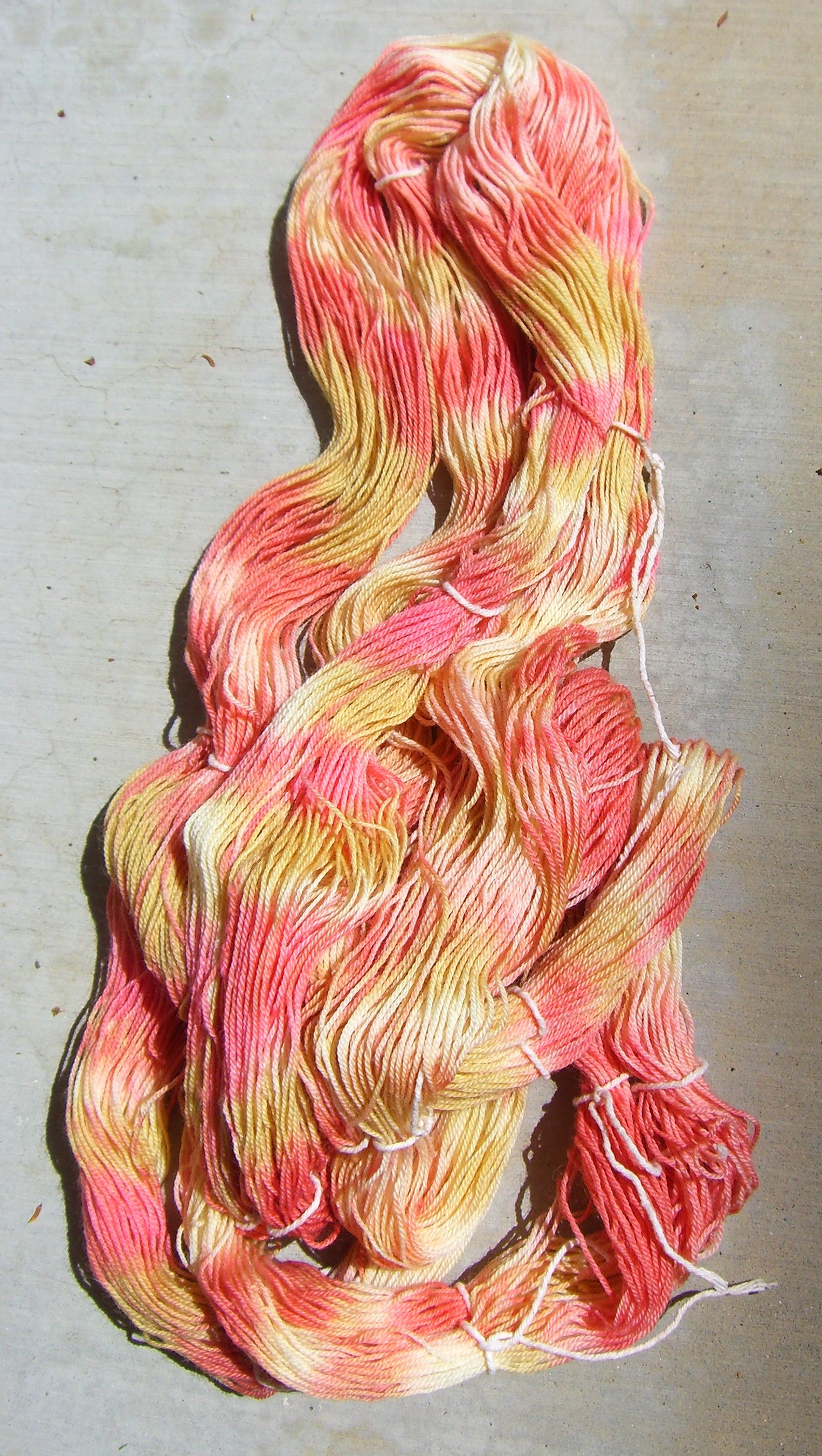
The water here in Thousand Oaks has a pH of 8. This means it has a slightly alkaline quality. The use of gypsum is to move the water closer toward pH 7, which is neutral. Ammonia is alkaline, and pushes cochineal toward the purples, and the tin in the dye bath helps to promote the red qualities of the cochineal. With the golden underdye of the quercitron, the overdye of the two exhaust baths created a color similar in tone to the gold. The result is a color variation in the yarn ranging from pale gold, to darker gold, corals and pinks.

Voila!

The final results are below. The colors are a bit lighter, but the photograph does a good job of showing the true colors. My camera pushes yellows and oranges toward the reds, and makes them far too intense at times. If you click on the photo, you should be able to see the skeins in a larger photograph, which will help you get an idea about how they look in real life. Bigger is better, here! These skeins most likely will become my own pair of flammegarn socks, either with a 2×2 rib for the ankle, or plain knitting, unless I create a little scarf with some plain knitting combined with lace.


Thockies, ii

Having another week off before returning to school is soooooo nice! I’ve been able to sort out yarn, focus on designing a few things, and soon enough, get some sumi-e done as well.

I was pretty sure I would make socks out of the Riihivilla yarn – and decided that is exactly what I would do. My final choice of contrasting yarn was a warm, naturally creamy white. The warmth of this white is far nicer with the colors than the stark, wintery white I first considered, and does a lot to bring out the warm reds of the cochineal and purple of the variegated yarn.

You can see from the pictures that the color differences, while subtle, are readily apparent. The hand of the wool is very pleasant and has a nice bounce to it.  I’m looking forward to wearing these socks!

When you dye with natural dyes, it is very easy to make a yarn become harsh and unpleasant, partly from the handling of the wool – such as extreme temperatures – or the chemicals involved. These yarns are mordanted with alum, and obviously handled properly. Having dyed with plants myself, I know only how easy it is to mess up and ruin an otherwise nice yarn. Leena Riihelä, the owner of Riihivilla in Finland, has done a great job!