Chemistry Magick & A Quill Scraper

Early this morning, Josh and I went to the hardware store.  We bought supplies for Thursday’s indigo dyeing adventure and a piece of steel wire to make a quill scraper, a tool used to scrape out the membranes inside the feather’s quill, which is where it attaches to the bird.  Once home, Josh headed out to the garage, and within about 45 minutes produced a scraper, similar to the one found in yesterday’s quill cutting video with Mr. Ruud.  All told, it measures about 8″ in length and is a dandy little item.
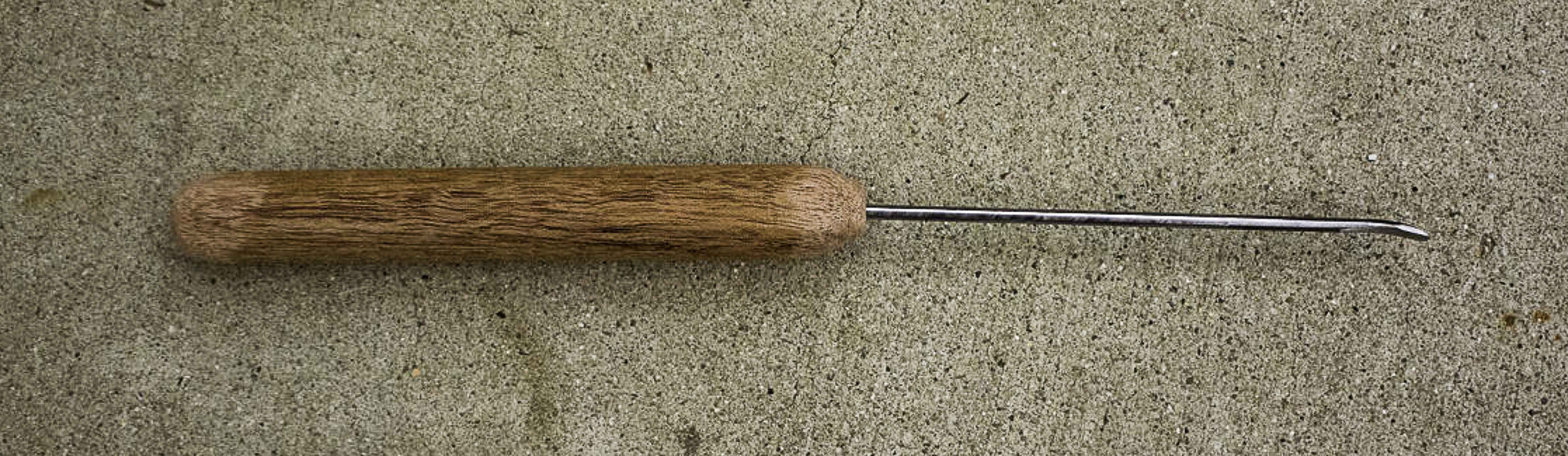
Quill scraper made with a piece of steel wire, inserted into a wooden handle. End shaped and bent. Total length is about 8 inches / 40 cm. Works very well!

And then, a bit of housework – dusting! It’s gotta be done – a bit of lunch, a nap, and onto the magic of adding Ferrous Sulfate Heptahydrate to my slightly fermented jar of oak galls.

Ferrous Sulfate Heptahydrate was not hard to find.  I bought it from Amazon and had it within a day or so.  The jar is about 113 g. – I need 50 g. for the ink.  Thus, I weighed it out.

From here, it was time to add it to the oak gall mix, which has been out in the sometimes-sun since Saturday. I shook is multiple times everyday.

And now – oh, this was so exciting and beautiful! – the addition of the Ferrous Sulfate Heptahydrate to the oak gall mixture!

Ferrous Sulfate Heptahydrate as it settled into the oak gall and water mixture. So lovely!

And now, shaken up, the dark ink of the Iron Gall Ink!
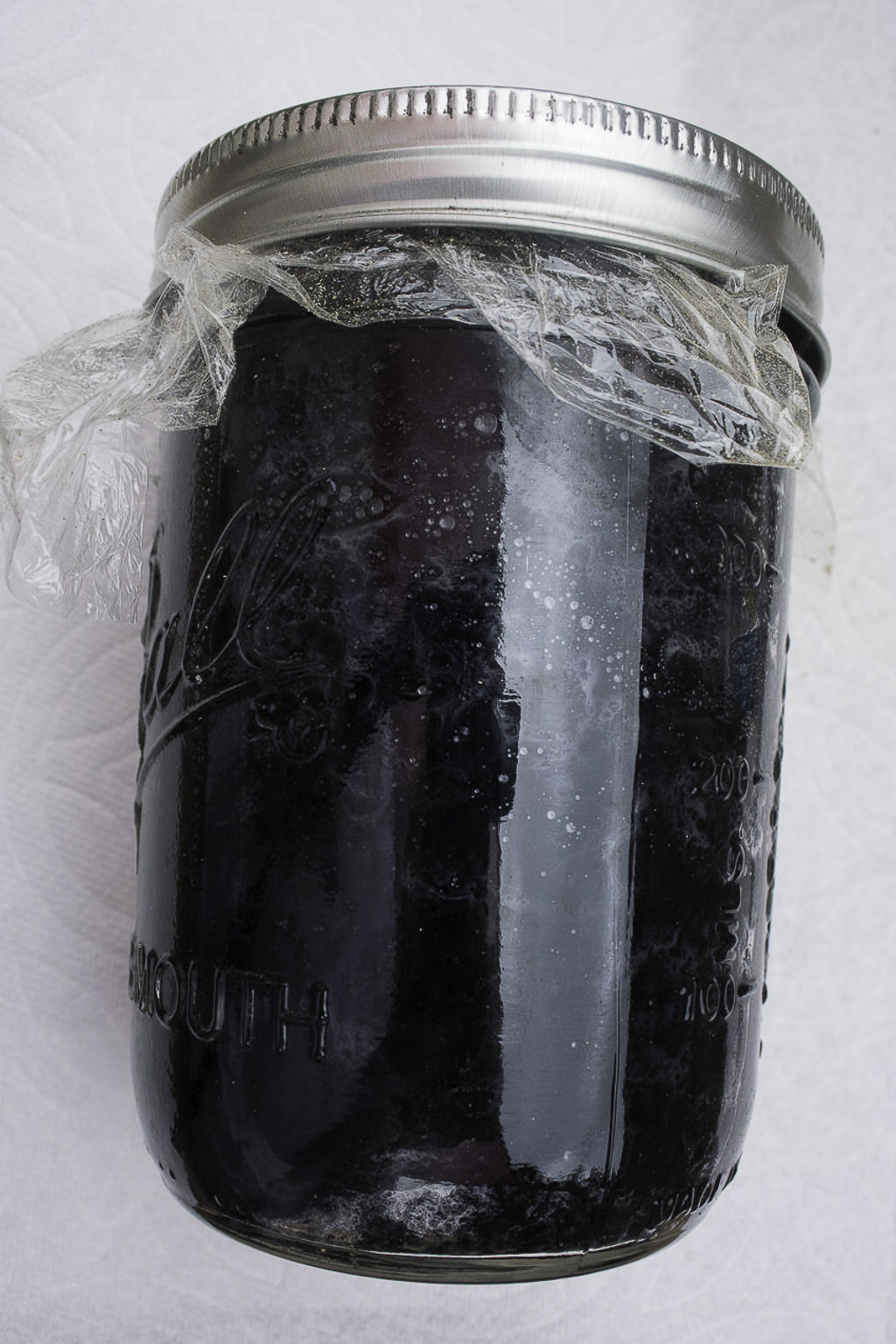
Shaken mixture of Ferrous Sulfate Heptahydrate and Oak Galls!

And now, another 24 hours out in the sometimes-sun. Stay tuned for the addition of Gum Arabic (25 g) tomorrow!

Summer’s Days

Today is the last day of my vacation.  Different activities have wandered in and out of my weeks off.  Mundane things, such as car repairs, have taken up time.  Spinning and reading and knitting and playing games and socializing and calligraphy and photography and painting and studying are amongst the other activities.  Probably the most amusing, though, has been reading a popular book about a certain witch and vampire . . .  if you are into the subject matter,  you know of whom I write.

Elizabethan Script from a Devotional in the Beinecke Library

It has been a fun journey into Elizabethan (Tudor) England, and its historical figures.  I have read about Sir Walter Raleigh and his unhappy end; about Nicholas Hilliard, the limner and miniaturist (his work is quite admirable); Edmund Spenser; Thomas Harriot, who was an Einstein of his time; Henry Percy, Earl of Northumberland; Mad Kit Marlowe (I read his plays in college); Matthew Roydon.  I’ve also looked up articles on quill cutting for writing purposes – I used to cut my own quills years ago – and the different hands used in Elizabethan England.  Ink recipes, too.

Self Portrait by Nicholas Hilliard

I dug out my own dip pens, and steel nibs (19th and 20th century items) to practice handwriting with such.  Poor paper, which is porous and pulls the ink out of the nib in blurry blobs, yields frustrating results.  Bond paper, such as 24 lb. copier paper, is far better, but not ideal.  Wider nibs, made by Speedball, require deep wells to hold the ink.  While practicing such, I decided that I would look up a poem apropos to the era, and found one by Roydon:  An Elegy; or, Friend’s Passion for his Astrophel.

From there, on to different poetry archives, with poems by Sir Raleigh, Edmund Spenser, Shakespeare and others.  However, for some reason, this one popped up without any planned search, just by clicking on the name of the author, Royall Snow:

Watteau Panels

i.  A Melody with Sombre Chords

Pierrot draws aside the willows
As a curtain,
And naïve Columbine steps through.
In the moonlight–
Like the twinkling of silver minnows
The gurgling brook winks at Pierrot.
He had come there before.

ii.  Danse Macabre
From a hidden orchestra
Drifts in blurred melody the valse hesitation
A dancer presses his partner’s hand
Commandingly.

iii. Acquiescence
“No,” whispers the woman
And turns her head
So that the moonlight falls on her bare throat.

Given the subject matter of my reading, one cannot help but wonder why this one poem appeared.