


Early this morning, I got up to meet a cool, breezy morning with a clear sky and the promise of perfect weather. What more could be asked for on a day when the morning is to be spent outdoors dyeing yarn? Everything from the last pre-dyeing days was gathered together – the pans, the spoons, scales, and so on, including the skeins of pre-mordanted yarn. Today, a number of things were planned, and happened: dyeing both commercial and handspun yarn with cochineal and black oak bark, also known as quercitron.
What is flammegarn?
Today’s entry is about flammegarn, which is an old Scandinavian method of making yarn with variegated colors. A skein (or two, or three) is tied off with cord, immersed into a dyepot, and colored. The result is a “flame yarn” – so named because this was traditionally done in red over white yarn – with splotches of red and white coloring which knit up into a space-dyed yarn. Modern dyers do this – just google “flammegarn” and you will find a number of examples. Earlier this year I wrote about making flammegarn with commercial dyes, which you can read about here. Judy’s knitted up some socks out of her flammegarn – I need to get a picture of them to post.
Set up the dye materials the night before.
Last night I prepared the dye materials. Specifically, I ground up 5 g of cochineal bugs, and mixed them with an equal part of tartaric acid. Then I added hot tap water, stirred them together, and let them sit overnight. I weighed out 10 g of black oak bark, and did the same, but without the tartaric acid. I did about five dye baths this morning; out of these, two were used for the flammegarn, which is fingering weight, commercially spun blue-faced leicester in two 200-yard hanks.
Filter out the particulate matter.
The dye pot was set up by filtering out the particulate matter from the water into which I put it last night. I used an old coffee filter and a paper filter; the filter was set aside and the clear liquid placed into a large dye kettle.
Cooler dye bath temperatures are better for yellows.
Even though I was using only about 135 g. of wool (100 BFL, 35 moorit shetland), I wanted a large kettle. A larger kettle is easier to control as far as not allowing the temperature to rise very high. This is especially important with yellow as the hotter the temperature, the more the yellow can drift toward brown or greenish hues. I kept my pot around 140-150 F. The weight of dye matter to fiber (the BFL specifically) was 1:10 – 10 g. oak bark to 100 g. of BFL, which had been premordanted with alum and tartaric acid.
According to J.N. Liles, most of the black oak bark color will be taken up in the first 20 minutes of immersion. This proved to be the case. I pulled both the BFL and moorit out periodically to check the color, and once I liked it, I put in a piece of copper pipe – about a thumb’s length – and a pinch of gypsum (the chalk my husband used in beer making to change the pH of his brew, as well as increase the availability of calcium and sulfur ions). Liles recommends adding “1/2 tsp. of chalk” but doesn’t state whether it is calcium carbonate or sulfate, so I used the gypsum. The color in the pot became a tad bit brighter – a rather mellow, pale gold.
Prepare the flammegarn by tying off sections of the skeins.
While the dye bath was heating up, I took my two BFL skeins and tied string around them. The string acts as a resist, keeping the white (or lighter colored yarn) from getting dyed. After this, they were set into hot water prior to immersion into the dye bath.
This yarn was removed from the pot and set in a basin to cool enough so it could be handled for untying and re-tying to create the flammegarn yarn. While the fibers cooled, I took the remaining particulate matter of both the quercitron and the cochineal and remixed them with water, and then filtered them again. The result was a orangish coral color. This was added to the remaining dye in the pot that had been only the black oak bark. This was slowly heated while the flammegarn was prepared with more ties. This new dye bath now contained the exhaust of the cochineal and quercitron, the tin added in the last five minutes of the original cochineal dye bath, and the gypsum and piece of copper pipe. Once this bath reached about 180 F, the flammegarn was immersed into the bath. Here it remained about 10 minutes, was removed, and then dipped into ammoniated water (about 1 part ammonia to 24 parts water – 1/2 c. to 3 qts. of water). After the dip, I rinsed the yarn in clear water and spun it out in the washer before hanging the hanks up to air dry outdoors.
It’s in the water.
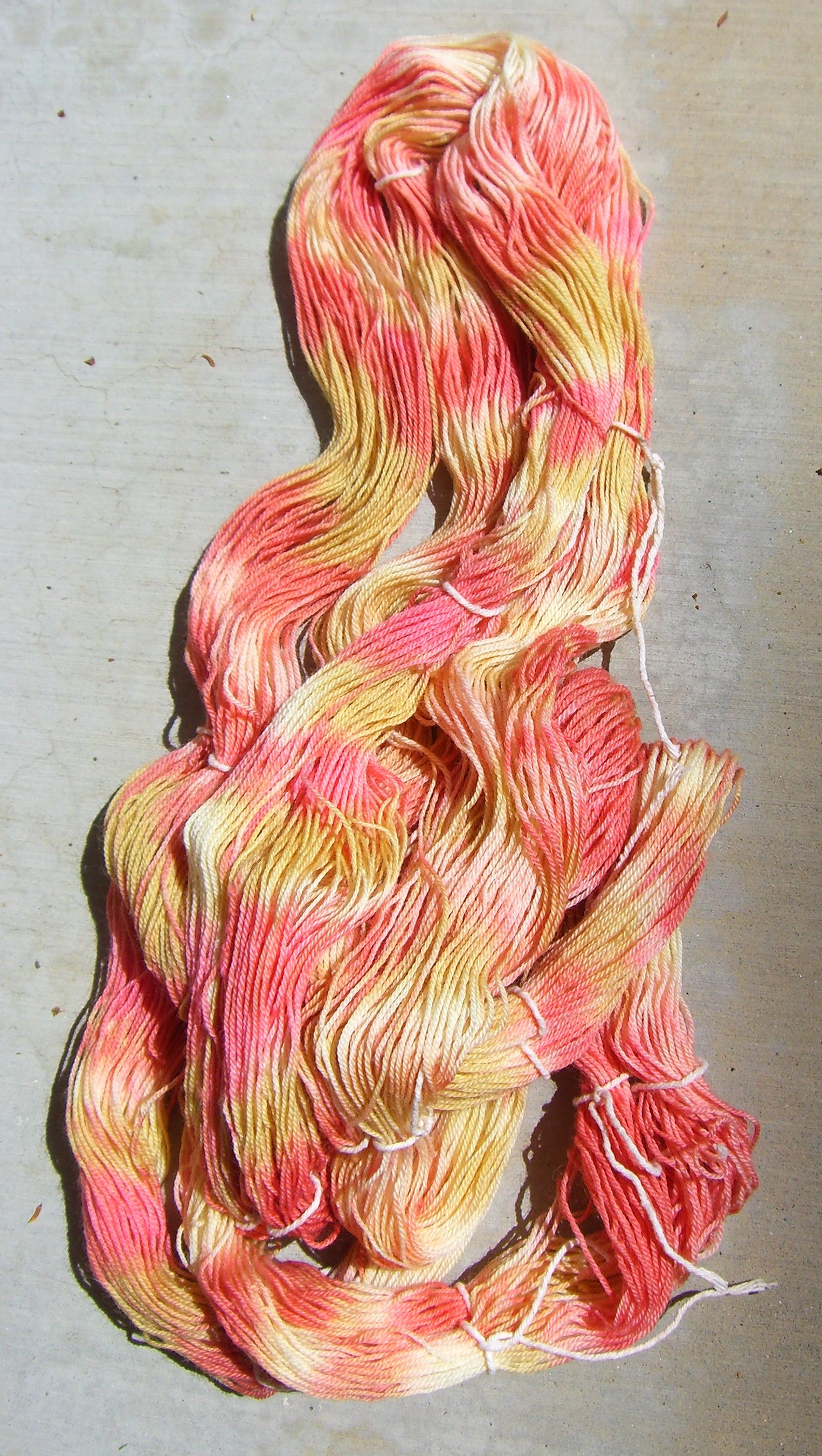
The water here in Thousand Oaks has a pH of 8. This means it has a slightly alkaline quality. The use of gypsum is to move the water closer toward pH 7, which is neutral. Ammonia is alkaline, and pushes cochineal toward the purples, and the tin in the dye bath helps to promote the red qualities of the cochineal. With the golden underdye of the quercitron, the overdye of the two exhaust baths created a color similar in tone to the gold. The result is a color variation in the yarn ranging from pale gold, to darker gold, corals and pinks.
Voila!
The final results are below. The colors are a bit lighter, but the photograph does a good job of showing the true colors. My camera pushes yellows and oranges toward the reds, and makes them far too intense at times. If you click on the photo, you should be able to see the skeins in a larger photograph, which will help you get an idea about how they look in real life. Bigger is better, here! These skeins most likely will become my own pair of flammegarn socks, either with a 2×2 rib for the ankle, or plain knitting, unless I create a little scarf with some plain knitting combined with lace.



 Even though I have been writing about scones and ink, as well as rambling, I have been knitting. I finished a project that sort of took shape one day when I was putzing around. Unbelievably, I did another pair of toe-up socks, and was very pleased with the results. They were very easy to do, to design, and fairly quick knitting up, even though I was using US 1.5 needles (though you could use a US 1 or 2 – 2.25 to 2.75 mm) and knitting at 8 stitches per inch.
 Another UFO finished! You can find the pattern on the




 Ink, Yarn & Beer