In Which I Have a Cold and Knit a Sweater

Sweater Sleeve

This past week has seen me seriously down with a cold – out of a 5 day work week, only 2 days had me visible at all!  I started getting it a week ago today, and knowing how awful the cold could be – the other half came down with it the week before – I decided I had better figure out something to do with myself.  I decided to make myself a sweater.  And I am glad I did make that decision early on in the game because, had I not, I would have just watched TV all day long and felt horribly unproductive.  Even sick, I just don’t like blobbing around.  So, in between aspirin and decongestants, sleeping and sneezing and shivering, I knit up a sweater and watched Engregages, but with English subtitles.  Interestingly, I could understand a lot of the French by the time I watched all the episodes available on Netflix.

Sweater

One of the things that has been haunting me in the world of knitting is my abundance of half-finished projects, meaning things that need a bit of thought.  Being sick, thinking is one of the last things I wanted to do.  The project needed to be interesting, fast, and simple.  The solution was an Icelandic-style sweater.  I dug out my Lopi pattern books, and looked at  Ravelry, and finally decided on a pattern – which I modified to a degree – and colors.  White, light grey, dark grey, black.  Contrast.

Sweater Neckline

The yarn is a fuzzy acrylic because I had it on hand.  Using US 8 and 10.5 needles, the sweater had a gauge of 3.5 sts / inch.  Once that was established, the rest was easy.  And, in exactly 7 days, my sweater is completed, finished, ends woven in, washed, and ready to wear.  It fits pretty nicely, too, but my grafting skills are not what they used to be . . . so I won’t show you the underarm seams.

Sweater with Pattern Book

If you have the book shown, Volume 17, the pattern is based upon sweaters 19 and 20, with some modifications to the last 2 pattern rounds.

To say the least, I’m feeling pretty smug!

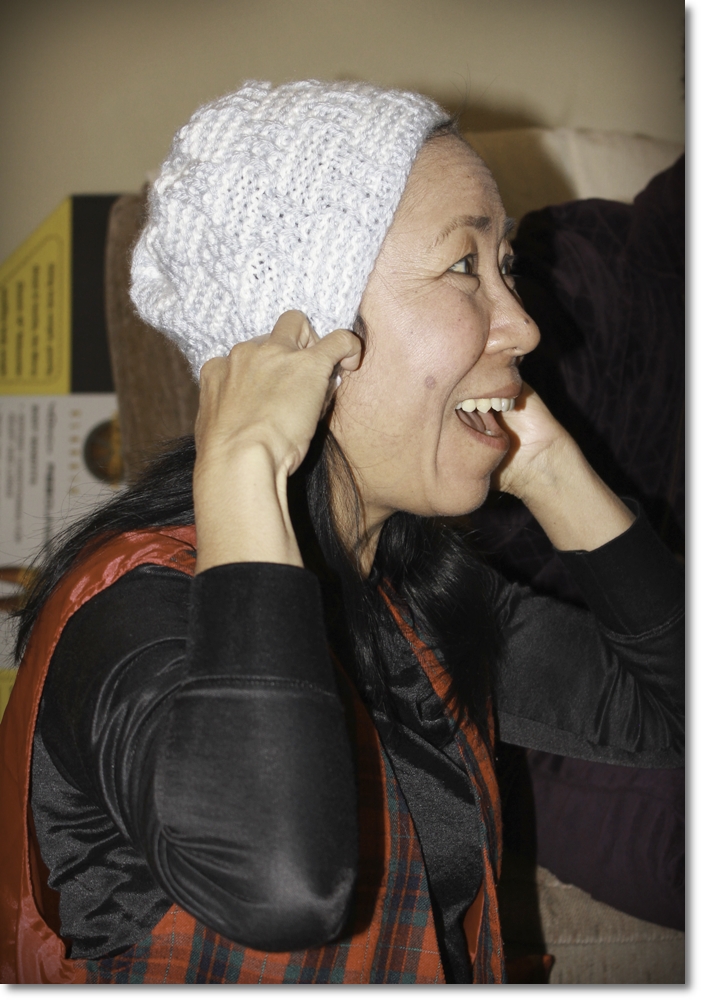
Skep – A New Hat!

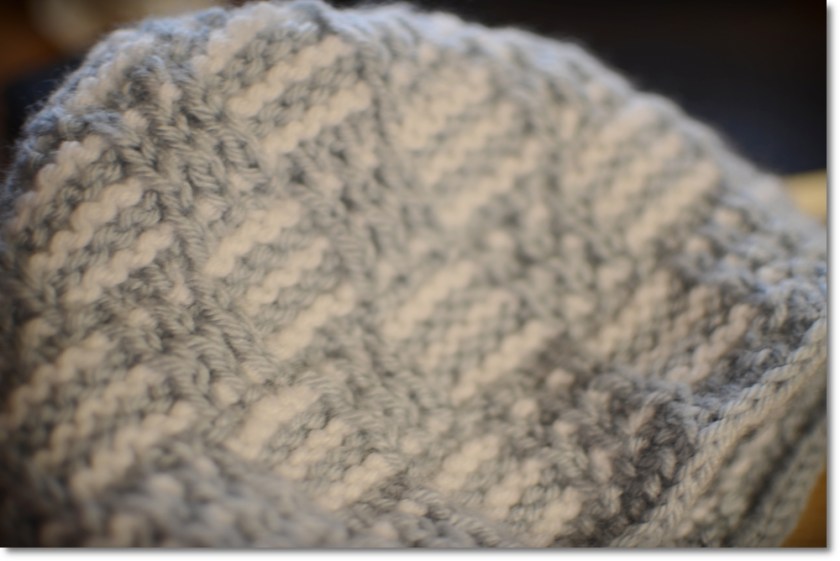
This hat is a simple mosaic stitch pattern, with texture created using purl stitches along with knit and slipped stitches.  Although mosaic knitting looks complicated, it really is not.  The fact is, each knitted round (or round with purl stitches) is done in only one color.  The slipped stitches pull the contrasting color up from the row below.  The biggest challenge in writing up this pattern was actually in translating the written pattern into a charted design.

Besides the mosaic pattern, the foundation round of the hat is done in i-cord, invented or unvented by Elizabeth Zimmermann.  This creates an edge that is tidy, but a bit stretchy.  The result is a hat with a snug edge which helps the hat hold its shape.  From the initial i-cord cast on, the first round increases the stitch count, and thence the pattern commences.  You can purchase pattern on Ravelry – follow the link here, or else click on the pattern listing under my “page” column.

Although I did not make the pattern available in different sizes, it would be easy to modify the pattern for a very large head or a child, simply by adding or subtracting repeats.

What is a “Skep”?

A skep is an old word for a beehive, made of coiled straw or grass, and shaped into a conical formation.  In the New World, there were no honey bees, and so when the Europeans settled, they brought their bees with them.  The shape and texture of this hat made me think of a skep – thus its name!

Unfortunately, our honey bee population is being challenged by viruses or some other horrible illness, and their number is dwindling.  Add to this, they are mating with African bees, which are known to be very aggressive.  Neither is a good thing.

A Bee Artist

I would like to refer you to a site I really enjoy, Pencil and Leaf, which is the blog of an artist who does wonderful drawings and painting of bees and flowers.  Buzz over to see her fine work.

Lampshades and Buttonholes

What do these have in common?  Both are useful, both are usually ugly.

Given this, these past few days I have been on the quest for a good buttonhole.  I’ve found that the classic eyelet buttonhole is by far the easiest, and attractive.  Unfortunately it is not going to gracefully accommodate a large button if you are using fine yarn.

I have tried a number of them, and none have pleased me, though some have intrigued me.  The best one, beyond the eyelet, is the “Two Lip” or “Tulip” buttonhole by TechKnitter, a genius in the ranks of the knitting world.  It is a bit of work, but I think I can get it.  It was featured in the Summer 2010 issue of Interweave Knits, and it is presented here by Eunny Jang.

In trying out a number of buttonholes, it becomes pretty obvious what their major failing is:  to complete the buttonhole, you turn your work, creating one extra row of new stitches, over which you then work another row.  The result is lumps and holes, and uneven stitches.  Very, very ugly.

This does not occur with the eyelet, nor the Tulips buttonhole.  The eyelet is straightforward – k2tog, yo – and continue on your merry way.  The Tulips buttonhole requires some wraps, unwraps, fiddling with a crochet hook and a double-pointed needle, but it works.  The upper part of the buttonhole is continued in the same direction as you are originally knitting, adding the stitches by doing a yarn over and making a loop with the crochet hook.  Kind of messy to do initially, but it will get graceful later on.

In sewing, I hated buttonholes so much I would make loops for everything.  I have only made eyelets for sweaters because everything else was so dreadful.  As I am designing a sweater for Josh, an eyelet buttonhole will not accommodate a button an inch in diameter.  Necessity forced me into the search – I’ve ripped the sweater out twice now! – and I hope that I will get it down.  Meanwhile, I plan to practice, practice, practice!

Lucette

. . . has arrived!

This is a hat I named after the lucet, which is a tool used to make cords, as well as after one of my favorite designers, Lucy of A Black Pepper (click the link at the right to go visit her), who does beautiful designs with cables and bobbles.

This hat is begun with the Estonian cast on, which is really easy to do, but nearly impossible to describe in words.   You can find Nancy Bush’s video of it on YouTube, or on the August 8, 2010, entry here.  This cast on is incredibly stretchy, as well as neat and tidy.  If you look at the bottom two pictures, you can see how much the hat will stretch out to accommodate a head!