Buying Toys, i

For anyone who loves fiber arts, places such as Convergence or Spin-Off Autumn Retreat are a bit of hog heaven.  Vendors from all over the country come to sell their wares.  Workshops and classes abound.

According to many vendors, the turn-out for this Convergence was disappointing.  No major crowds on any day, just a slow stream of buyers.  In some ways, this was great, because as a buyer who has been to really crowded venues, I could take my time and wander here and there – and then return yet again, not feeling rushed to get something for fear it would disappear five minutes later!  However, this is not good for the sellers who have spent money to be part of the market place, who have traveled many miles to get to Long Beach, and who have also spent money on food and lodging.

I did my bit, and met some absolutely wonderful people, and caught up with a couple of my favorite people, John Novak of Village Spinning and Weaving in Solvang, CA, and John Marshall, the master of katazome dyeing from Covelo, CA.

I bought items for spinning, weaving, knitting, and sewing.  For spinning and knitting I bought . . .

. . . the world’s best ball winder from Nancy’s Knit Knacks.  Suzi Liles of the Eugene Textile  Center.  I also bought a cone of Harrisville Designs Shetland in Emerald Green from her, which I have already swatched on US 4 needles and washed.

Suzi was wonderful to talk with, and everyone who was at her booth was helpful and knowledgeable.  Had I a few thousand dollars, I would have come away with another spinning wheel, and a pile of yarn.

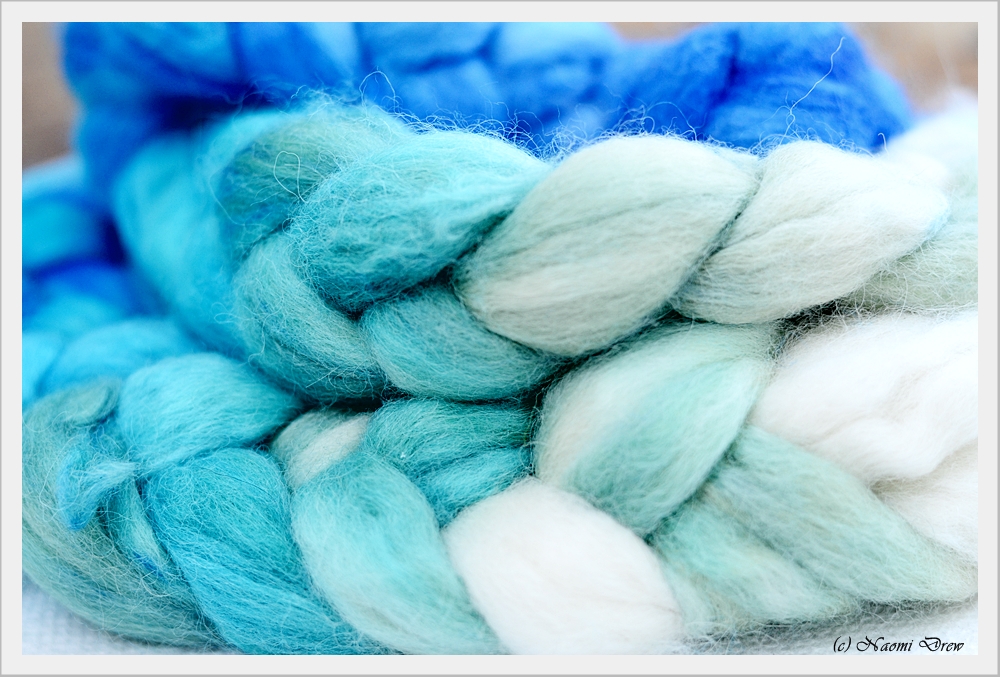
For spinning I got some to-dye-for (bad pun!) baby alpaca from Christine at Grasshopper Springs Ranch.

You cannot even begin to imagine what a lovely touch this has  . . .

And, oh, yes, I bought more things, too . . . but you will have to wait for the next installment to see!

Handsewn Hippari Top

Awhile ago I wrote a bit about John Marshall, a fabric artist and clothing designer who is very influenced by traditional Japanese clothing and dyeing.  He is the author of an excellent book on traditional Japanese clothing construction, Make Your Own Japanese Clothes. In his own work, John moves beyond the ordinary into the extraordinary, with an excellent eye for detail and color.   As an instructor, he is well-organized and clear, and very knowledgeable.  As an artist, there are few to compare.  His book is just like him – full of information that is detailed (but not annoyingly so) – and moves a traditional clothing into a modern vein.

Traditional Japanese clothing is made from fabric measuring about 13-14 inches wide.  As a result, buying fabric requires buying yards of it!  It comes in varying lengths on bolts, depending on what the final product is to be.  There are traditional lengths for haori, for kimono, and so on.  Modern Japanese stores carry modern fabrics, but probably have access to traditional fabrics.  In the U.S., patterns for making traditional Japanese and Asian clothing may be found at Folkwear, a company with patterns for traditional clothing from around the world.  These patterns allow you to use modern fabrics in modern widths, such as 45″ wide.  The beauty of John’s book is that if you have Japanese fabric in traditional widths, you can use the patterns he provides without too much work.  The selvages of the material are incorporated into the clothing construction, and sewing is minimal.  Seams do not need to be finished to prevent raveling.  The range of clothing is narrow, but the variety comes in the patterns of the fabrics themselves.

The hippari is a wraparound top, essentially unisex according to Marshall, but generally worn by women.  The male version of the hippari is the jimbei, another wraparound top but with side vents for coolness.  The illustration on the above left is from page 83 of John’s book.  He writes:

Of construction similar to the jimbei, except for tapered sleeves that stay out of the way and sewn (closed) side seams, the hippari is an infinitely practical as well as attractive top.

The hippari I made is an amalgamation of the two styles.  I created vented sleeves for coolness, as I use it as a sort of smock over my regular clothes.  The sleeves are gathered to keep them up and out of the way.  The fabric is a modern kasuri fabric woven in the traditional width.  The bolt measured about 10 yards in length, and using the layout in Make Your Own Japanese Clothes, I created a custom-fitted top.

I decided to sew my entire hippari by hand.  I used 100% cotton thread and tested out some of the techniques illustrated in John’s book, as well as techniques I improvised and use in my own home-made clothing.

The idea of sewing clothing by hand probably seems daunting.  I know for a fact my own handsewing is not what it could be with hours and hours of practice.  I can do tidy little stitches, but sewing a backstitch for yards is not easy to do.  The material needs to be stretched taut for the stitching to be easily accomplished.  I stretched mine out on a large embroidery hoop at times, and at other times I just held it, stitched, and hoped for the best.

Sewing birds and clamps have been used for centuries to make this job easier, and traditional Japanese sewing boxes come equipped with just such items.  If you wanted, you could use a C-clamp to hold your material in place.  The nice thing, though, about sewing the hippari was the crispness of the fabric – it really allowed me to sew much more easily than a soft, drapey fabric.  Washing has softened the material, and, yes, it did shrink, but not too much.

This photo shows the open armhole, which actually is very nice if you are planning to wear the hippari over other clothes. It gives a little more room for movement, as well as helps keep you cooler. As I tend to get warm easily, I decided to do the vented sleeves found in the jimbei. If you do this, be sure to reinforce the vent, otherwise you may need to re-stitch your seam.

A running stitch or back stitch may be used for the majority of the seams. The same can be used to hold the seams in place, such as under the arm. The straight edges of the selvages mean no finishing of cut edges, as you can see from the final photos below.  Below, the running stitch is shown for the back center seam of the hippari in the left hand photo, and to the right is illustration of the selvage edge.  The selvages are also seen in the photo above.

For greater detail of the hippari, click the next photo.

Altogether, this is an easy project if you want something different to do.

John Marshall: Works in Fabric, ii

My first contact with John Marshall came about when I discovered his book Make Your Own Japanese Clothes.

For anyone interested in traditional Japanese fabrics and clothing, this book is an incredible resource of information.  You learn how to construct Japanese clothing using traditional fabrics (which measure 13-14 inches wide), and how to sew them using traditional hand-sewing techniques.  Of course, you can also sew them by machine, but that just isn’t the same!

Garment construction is given for kimono, haori, hanten, various tops, vests, pants, obi, and tabi.  Not only do you learn how to make these, you also learn about the construction of sleeves, hems, collars, and the use of lining and padding.  All of these, combined with illustrations and photographs, give window to both traditional clothing, and a window into creating your own clothing with a modern cast.

I made the hanten, hand-stitched using traditional kasuri, and totally enjoyed the process.


John Marshall: Works in Fabric, i

John Marshall, of Covelo, California, is an incredible fabric artist who designs clothing using the traditional Japanese katazome and tsutsugaki techniques to color the fabrics he uses in clothing he designs and sews himself.

A bit about John, from his website:

John Marshall is an internationally known textile artist working with techniques of paste resist dyeing. He produces a wide range of sophisticated and colorful designs, many of which show the influence of his years of study in the Orient.

John grew up in the small town of Florin, just outside of Sacramento, California. Before wartime evacuations, Florin had been one of the largest Japanese-American communities in the United States; after the war many returned to reclaim lost years and property. These are the friends and neighbors John and his five brothers and sisters grew up among.

John’s Godmother, the late Mary Tsukamoto, was a great influence in his life: teaching him to read and write the Japanese language and sharing with him her great love of her cultural heritage.

At the age of seventeen, having worked and saved toward his goal for many years, John was off on his own to discover Japan. His eagerness to learn secured him private instruction under a variety of specialists in doll making, centered around the Yamato style. John was intent on studying the many facets of these shell-faced dolls, such as carving, weaving, dyeing, and sewing, to name just a few. His knowledge of the Japanese language proved to be of great benefit in understanding the subtleties of the culture.

The internationally published paper artist, Kunio Ekiguchi, took John under his wing and saw to it that he received the proper introductions so necessary in Japan. Mr. Ekiguchi arranged an apprenticeship for John with the late Matsuyo Hayashi, a master dyer in the bingata style of paste resist. Through her insight and careful instruction, John became truly fascinated with this ancient art form. Mme. Hayashi had long dreamed of sowing the seeds of her art abroad. Upon her death, John discovered she had willed much of her lifetime collection of work, supplies and equipment to him. John was determined to fulfill her wishes by bringing her techniques to the West.

Continuing his research into ancient cultures and dye techniques, John aims to interpret the sensibilities and aesthetics of the ancient and ethnic world through the Japanese paste resist process, using the actual plants and insects employed in making the original dyes. John’s research so far has taken him to Japan, Thailand, Italy, Indonesia, and the Yucatan. Through the generosity of collectors, he has had the opportunity to view first hand a wide range of ancient and ethnic textiles and artifacts which have served to influence his fabric designs.

Today John is in the midst of renovating an old flour mill in the Old West town of Covelo, nestled in the remote mountains of Mendocino County of Northern California. A generous 12,000 square feet, the new studio is used to display the full range of his work intermixed with art pieces collected at home and abroad. Situated on an acre of land complimented with over 300 wisteria vines gracefully covering a redwood arbor, this sun-filled space is also used to host lectures and as a classroom for teaching a wide range of Japanese crafts: dyeing, bookbinding, doll making, paper crafts, sewing, color theory and production, and textile history.

John has also taught programs for the past twenty five years for a wide range of institutions including a number of years at the Pacific Basin School of Textile Arts in Berkeley, and through UC Berkeley Extension Services, as well as lecturing extensively to large groups through museums, guilds, embassies, and universities internationally. He is currently working on a project to teach his design concepts to Japanese students of kimono design in Tokyo.

Specializing in one-of-a-kind works of art, John takes on commissions and new challenges. He produces primarily large interior hangings and luxurious clothing. All of John’s work is designed, dyed, and constructed for actual use. All hues are colorfast to repeated washings and to light. Personally executing all stages going into the creation of each piece is one of his great joys.

John Marshall’s work is collected internationally. He has done commission work with traditional kimono in Japan and also produces pieces for stockbrokers, professors, art collectors, and many international figures including European royalty. He travels regularly, showing to his private clients throughout North America and Asia. His work was also carried by leading galleries throughout North America.

John is writing a series of instructional books. The first was published by Kodansha International, 1988, on the subject of Japanese sewing techniques and design concepts for use in the western world. The title is Make Your Own Japanese Clothes: Patterns and Ideas for Modern Wear. This will be followed by a number of other books, including one on his unique dye techniques. His video, Japanese Textile Dyeing: Introduction to Paste-Resist Techniques, released through A/zo Productions, covers the basics of using natural dyes with Japanese Paste resist methods.

John is eager to share information and ideas, with the hope of helping the seedlings of Japanese dyeing and crafts to grow and enrich all our lives.

I have had the privilege to take dyeing and katazome classes from John, and appreciate his warm, friendly personality and the structure and organization of his workshops and classes.  I hope to continue learning from John in the future.