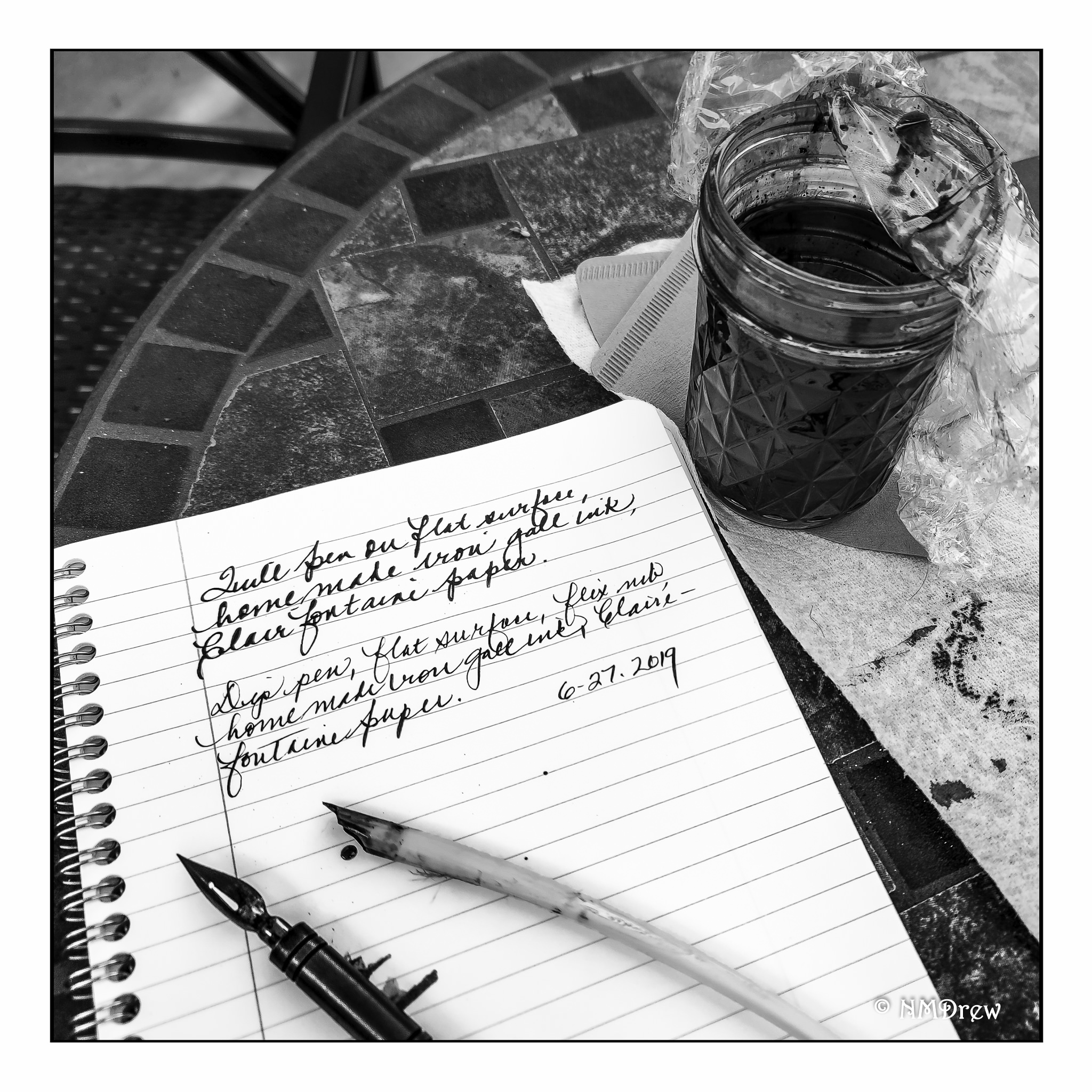
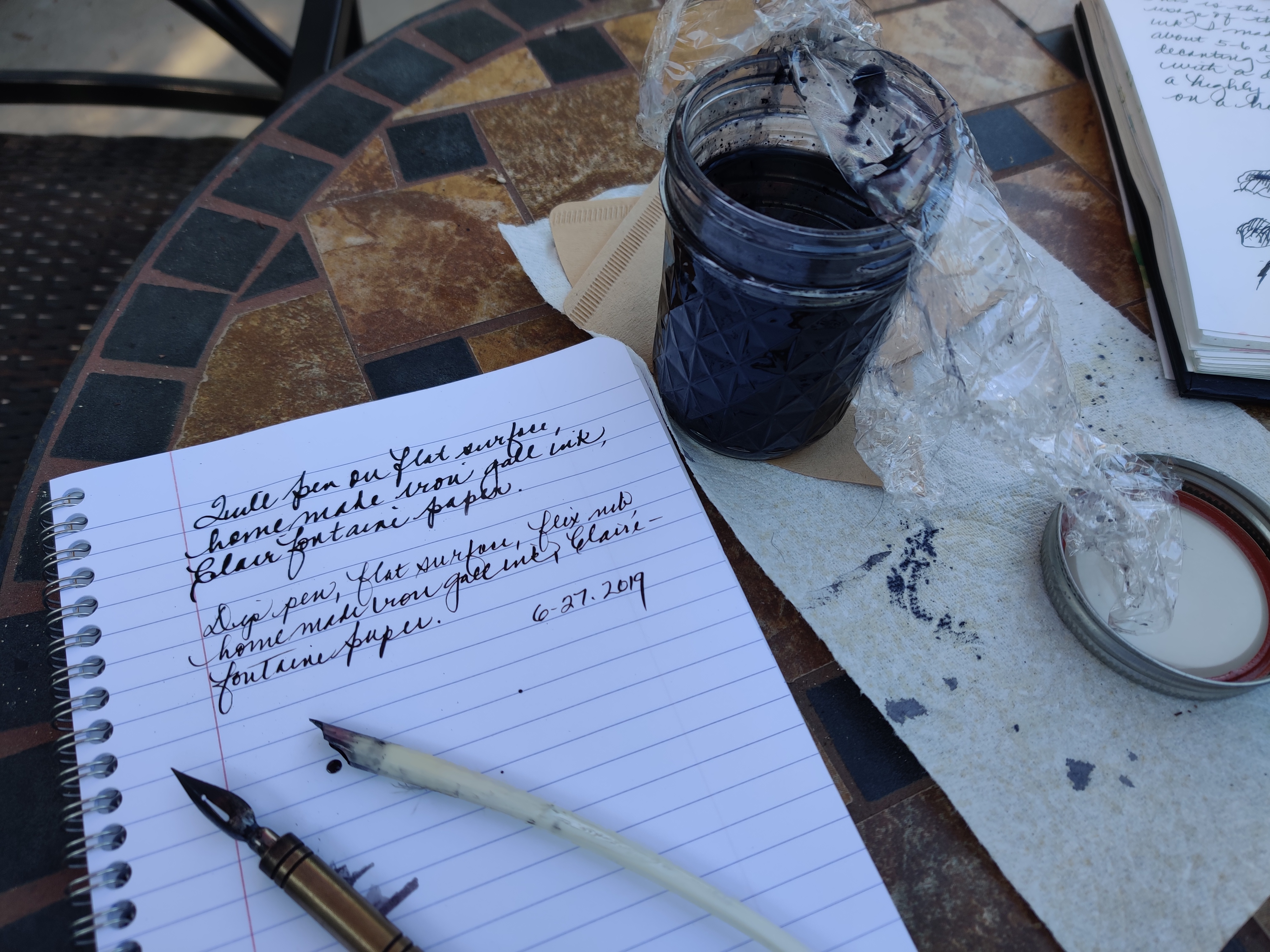
Over the past week, I have been fermenting iron gall ink. Today I decanted the mixture, and here is my first attempt using it. I used a quill pen I cut from a turkey feather, and a dip pen using a flex nib. The paper is a Clairefontaine notebook with very smooth paper.
I am documenting this historical moment with some documentation . . .
I spent most of the day dyeing with indigo on yarn . . . and some silk. A long day! But, on the list of things to do was to decant the iron gall ink I have been making over the past week.
Success! It is a really beautiful ink! It flows well off the flex dip pen nib as well as the quill I cut a few days ago. I’ll blog a bit more about it later, as at the end of a long day, I’m really tired, but really content with both the dyeing and the ink.
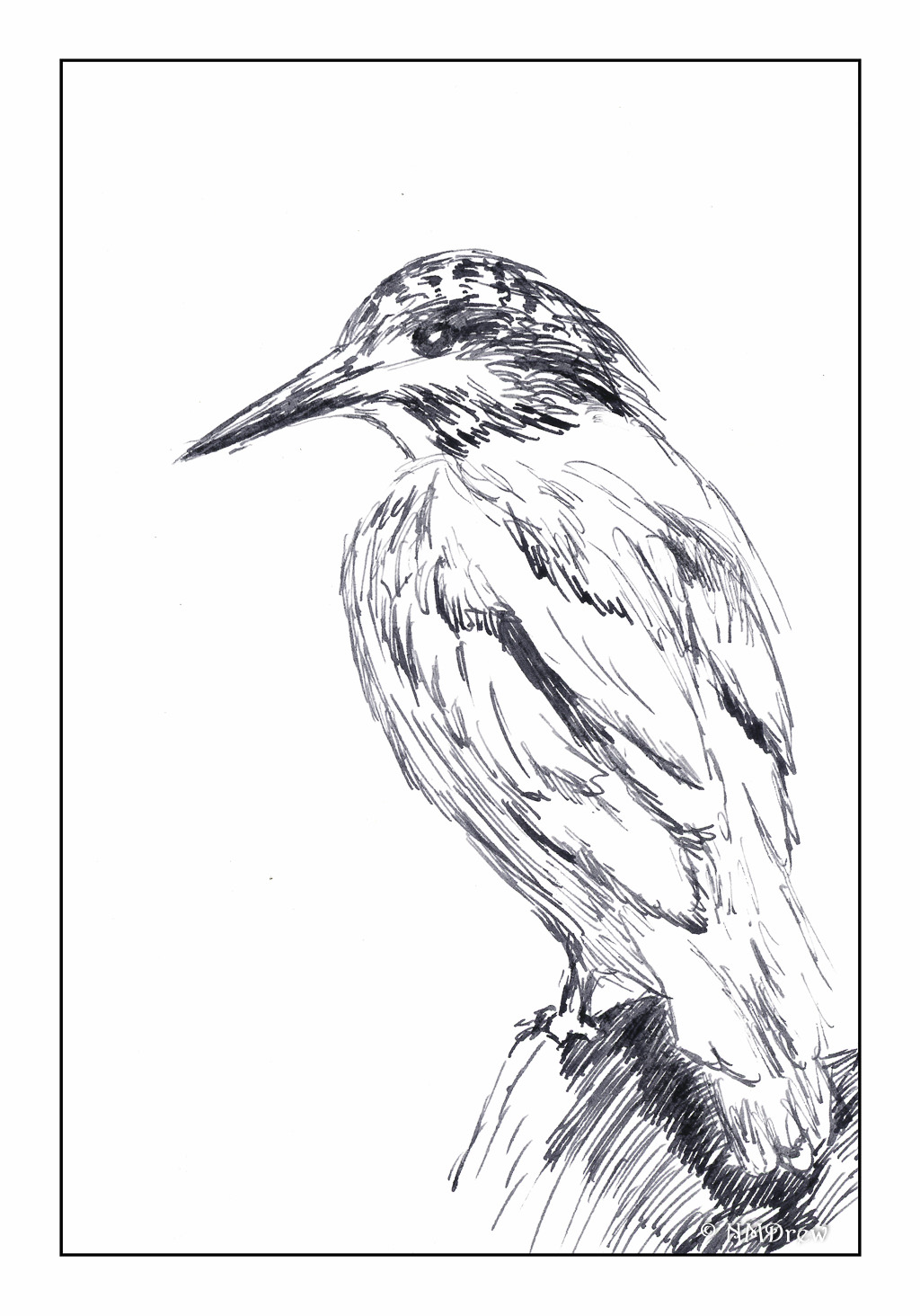
This morning I did a quick sketch of a kingfisher using iron gall ink using a dip pen. As you can see, there is a bit better variability in lines than when drawing is done with a quill pen (see yesterday’s post). Both have qualities I really like – expressiveness, boldness, delicacy. As I am used to using fountain pens, a dip pen is no problem once I learned how to control the amount of ink on nib. What must be remembered is how to load the nib, and as nibs are all different, a bit of testing on scratch paper helps.
At present, I am deciding if I want to colorize this drawing – which is why for now, it is not! If I do, I want to use very dilute but vibrant colors. It is my hope that the ink will shine through the paint without my having to re-ink parts of it.
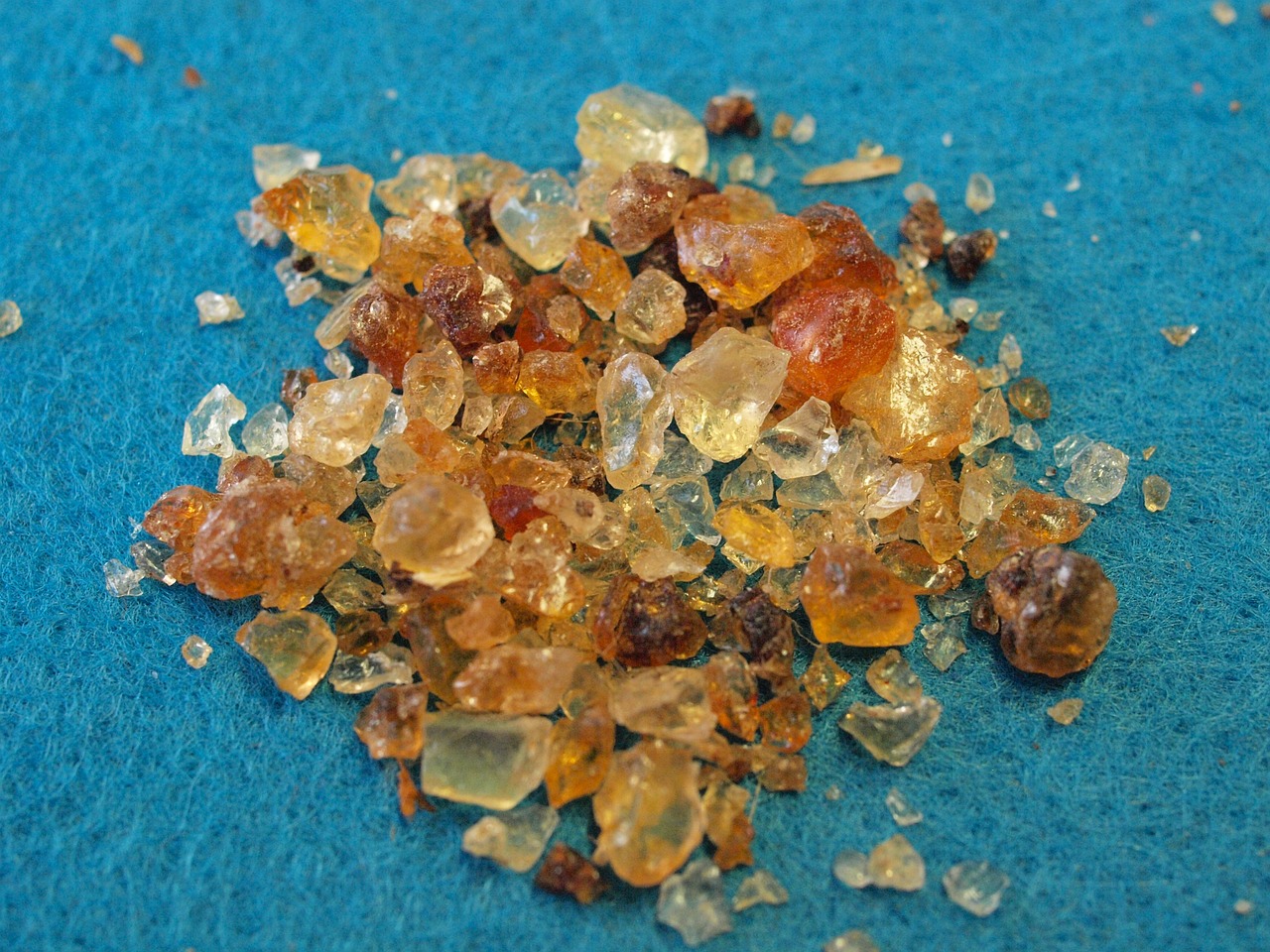
Today is the final day for adding ingredients to the iron gall ink. I added 25g. of gum arabic to the ferrous gallate (new name for the oak gall / ferrous sulfate heptahydrate solution) to create the final product of ink. Until the gum arabic is added, the solution is really just a solution or a liquid. My gum arabic was in a powdered form, so I simply placed it on top of the liquid in the jar, and shook it a lot. Since adding it, I am continuing to shake it. The gum arabic to the left is in its most common form – hardened sap. It has a jewel-like quality, I think – a lot like amber – and besides using it in ink, it is edible and has many uses in the food industry.
Gum arabic, the hardened sap of the acacia tree, is used a binder in ink, controlling the ink’s viscosity – how the ink flows. It adds more control into the ink’s behavior, such as eliminating or lessening feathering, bleeding or cracking when use on paper or parchment. An element of luminosity or shine is another characteristic it imparts to ink.
In addition to controlling viscosity, gum arabic helps the ink to adhere to the paper. The water in the ink evaporates, and left behind is the colored portion of the ink; it is the gum arabic which acts as a glue to stick the ink’s pigment to the paper.
An ink – or watercolor paint or gouache – needs the gum arabic to give it the right consistency or body to flow easily, but not messily, from the pen or brush. Other pigmented inks may also crack, and the addition of the gum arabic helps prevent this; I don’t believe that iron gall inks suffer from cracking.
Soon enough, the ink and quill will be put to the test of actually using it! Stay tuned . . .
Long before we had metal dip pens, artists drew with reed pens and with quills cut from the pinion feathers of a swan, turkey, or goose. If you look at the ink sketches of artists such as Rembrandt or DaVinci, you will see some very common characteristics. The ink lines vary in width – narrow, wide. Often the ink is brown, and so those not in the know think that brown ink was a thing way back when. In reality, it is the degradation of iron gall ink (aka oak gall ink) through time. When initially laid down, it was black. With time, it turns brown, and with a lot of time and depending on its degree of acidity, the iron gall ink can destroy the paper and drawing.
Over the past week, I have been playing with iron gall ink and a quill pen I cut from a turkey feather. I have some homemade iron gall ink nearly done – come Thursday, it will be ostensibly ready to use. Today, because I am finally at a point where I have time to play, I drew with iron gall ink and my quill, and then applied watercolors. The ink took its sweet time drying, and I didn’t blow dry it, but let it air dry or blotted it to see what would happen. As it is a damp day, it took awhile. Anyway, the following three pictures were first done with the ink, dried, and then painted in with watercolor. If you look at the pen strokes, you will see variations. I’ve never drawn with a quill before, so it was a new experience, one quite different than with a dip pen or fountain pen.
Kumquats – InkKumquats – Ink and Watercolor
The kumquats were the very first drawings I did with the quill and ink. I had to really think about textures. You see, when you use iron gall ink, it begins as a light grey, but as it is exposed to the air, it becomes darker and darker until it is black. This made values a challenge!
Bamboo Forest – InkBamboo Forest – Ink and Watercolor
Here, the ink in the picture was not quite dry, and some bled into the watercolors as I lay them down.
Market Melons – InkMarket Melons – Ink and Watercolor
For the melons, the ink was taking forever to dry! I decided to see what would happen if I blotted the ink. The result was smudges, which you can see throughout the picture.
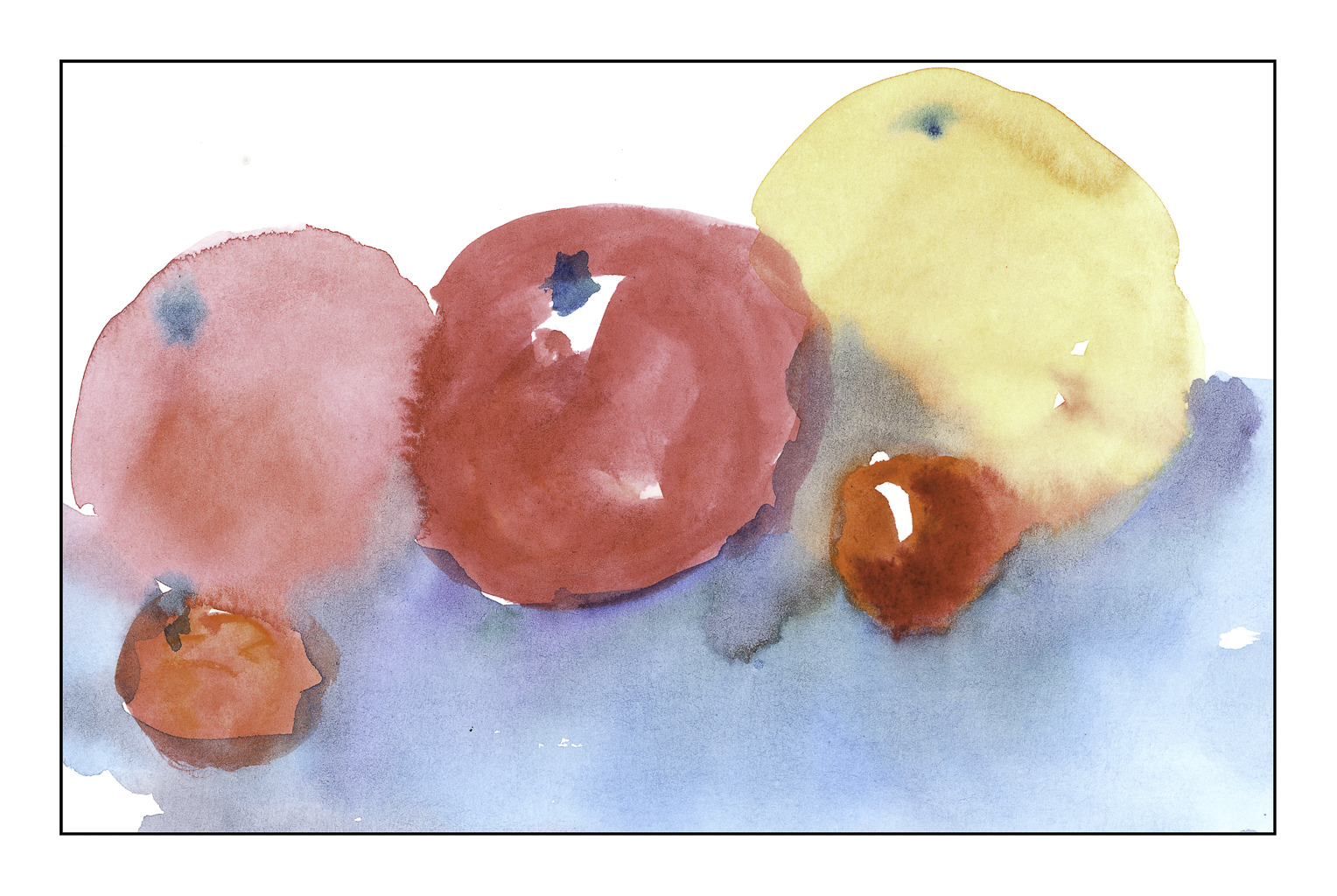
Fruit – WatercolorFruit – Watercolor and Ink
This final set was done with a sketchy watercolor. No thought was really given to composition or to color as I wanted to use the ink to express outlines, shapes, and shadows.
Altogether, this was a lot of fun, and for me there is a potential I hadn’t really thought about in getting a sense of history by using historical tools – quills, iron gall ink – that were once the best technology had to offer. I wonder what Rembrandt and DaVinci would think about paints in a tube, rather than the task of purchasing, grinding, and creating their own paints . . . perhaps they made their own quills and inks, too.




 Ink, Yarn & Beer