
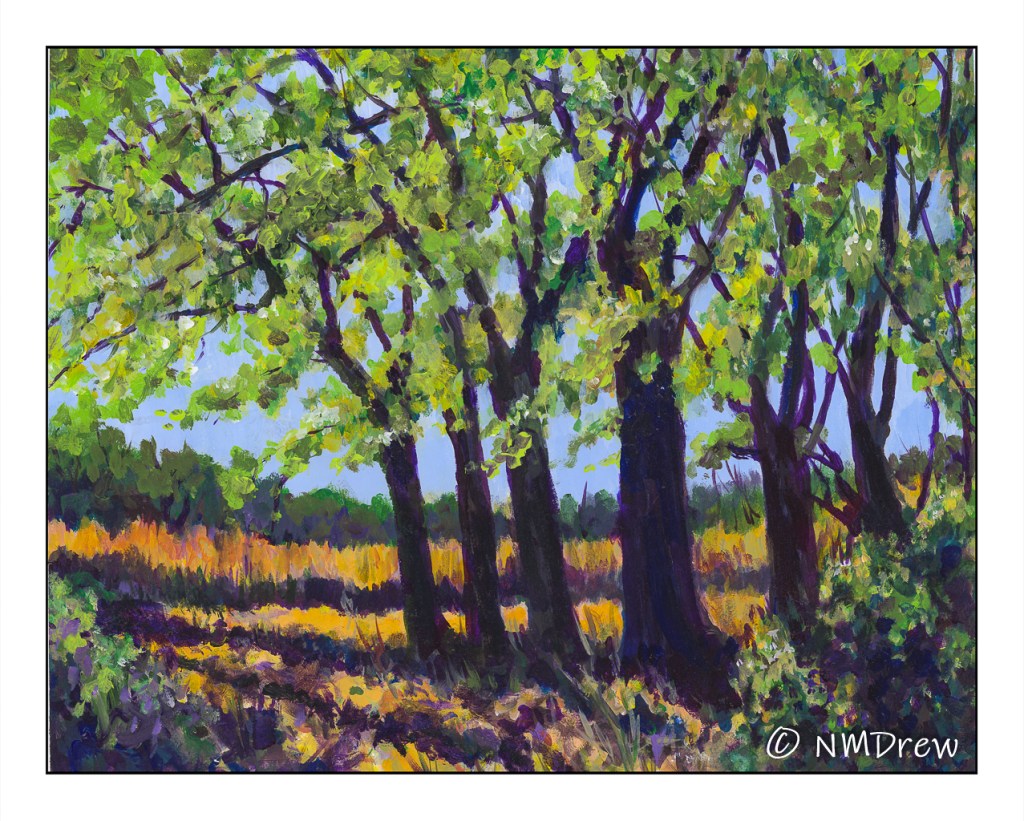
Trees, Late Afternoon

Third and last of a photo I took earlier this month in Independence, CA, before being driven back home because of Covid. I am not sure which of the three of these paintings I did of the same photo I like best (you can back track on this blog if you want to see them, or go to Instagram!), but this one, in acrylic, was by far the most time-consuming.

I used 16×20 Arches 140# CP paper and a variety of acrylic paints, but first I laid down a few layers of gesso to prep the surface of the paper. The first layer of gesso was thinned with water and brushed on quite firmly to work it into the paper itself. The paper warped as watercolor paper does, but I was really happy to see it flatten out with the second, thicker layer of gesso.

Most of my brushwork tends toward dabbing on dots, which is great for pointillism and impressionistic painting, so I worked at creating lines, as seen on the grasses in the background, along with using a flat brush and using its tip or sides to work paint in a more up / down, side-to-side manner. My next painting is going to include these types of brush strokes, just because. It never hurts to try things you don’t usually do.

Every type of media – watercolor, gouache, acrylics – has its own “language” – that is, the way you have to work with it. Acrylics are rather heavy on paper and I need to think ahead for what I want to do. I tried the slower drying acrylic paints, and just did not like them. As a result, the ones I use tend to dry rather quickly. Filling the palette with every color I think I might want to use is a waste of paint. Instead, I have to plan, not like a general, but certainly I need to anticipate what comes first, what comes next, and so on. I also have to think about brushes and brushwork. Painting can be spontaneous, but it also needs experience to allow for more success (however you want to define “success”) than failure.

One thing I considered for this painting, but did not do, was to lay down a glaze to unify it. Chicken! Maybe I will come back to it later. Now, two things are on my next painting agenda: buildings and no dabbing! And maybe a glaze . . .
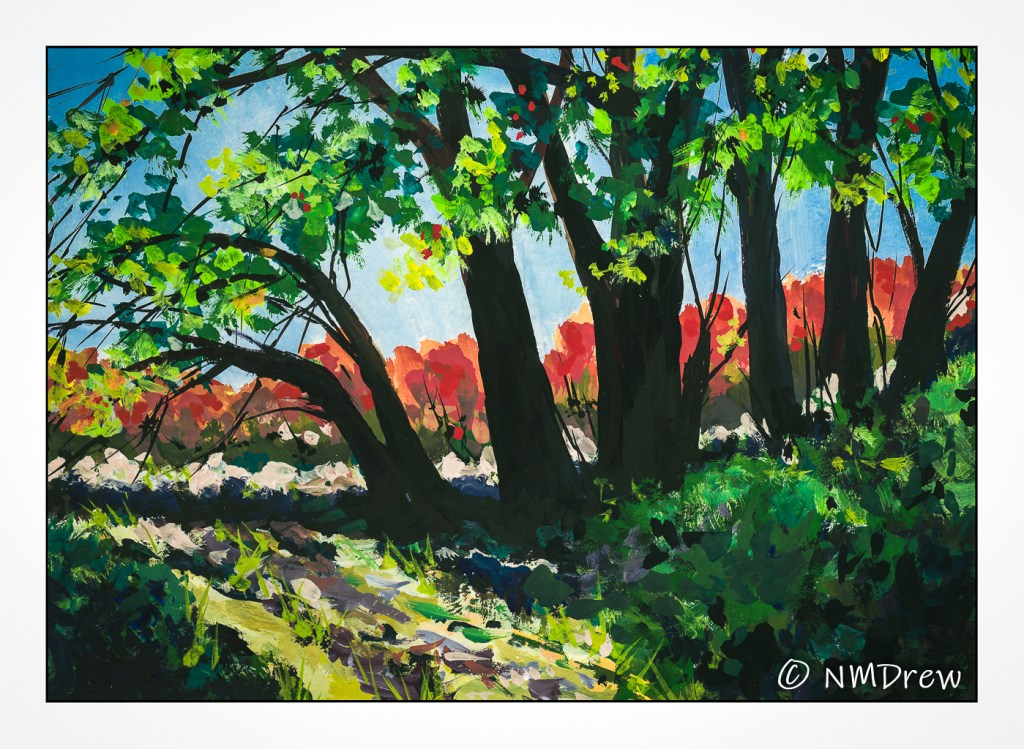
A Hint of Autumn

Independence, CA

Well . . . I got tired of pen, ink, watercolor. Watercolor just wasn’t in my head, so I dug out my gouache paints. They were rather fuzzy from mold – typical of gouache if you don’t use them often enough – so, I rinsed them off, and went to work. I really like the photo I took of these trees but did not like my earlier efforts.

I started out so klutzy – like, how do I use my colors? order or painting? All the usual stuff that goes with not doing something for awhile. The result is far better than I thought it would be!

Dry Wash

Dry Wash at Independence, CA, Botanical / Native Plant Garden

One of the nicest things about spending 2-3 nights at a place is that you get to explore. Independence, CA, is along Hwy 395 and is a town you would zip right by if your weren’t staying there. However, you really can miss a few things!

We stayed at the Winnedumah Hotel, in a room at the back. Out the door and down the road a few blocks is the local museum, and although it was closed the days we were there, we plan to go back. Outside the museum is a rather wonderful native plant garden. It faces west, so it is in the shadow of the Eastern Sierras. There is a creek running through it, complete with trickling water. Winter rains swell it and it obviously flows over its banks.

The sandy shore and rocky bottom depicted here create a dry wash. In canyon country these smooth areas are tempting for campers because the smooth soil makes pitching a tent and sleeping bag comfortable and easy, but if a rain happens upstream, a flash flood creates a swirling death trap. Even locally – where I live – people are drawn to these washes in the rainy season (if there still is one . . . ) and get washed away in the event. I had a wonderful friend who died in such a flash flood because the ground he was standing on probably got abruptly eroded from underneath. Even peaceful streams need to be treated with respect.

Stopped by the Plague

Winnedumah Hotel, Independence, CA

We had a 2 week vacation trip planned. And it ended on Day 3. I had thought my sinuses were acting up, but to be careful I decided to have a Covid-19 test. It was a 1-hour quickie. Negative. Okay! Let’s go!

Our first stop was in Independence, CA, along the eastern Sierra Nevada mountains, traveling on Hwy. 395. My husband had a cold, mild, some sniffles and a cough. On Day 3, we left Independence, and continued north. Next stop was to be Virginia City, NV. Well, as we moved further north, the air became cloudy and sooty. The smoke from the fires in NoCal was moving east, and I could smell it. So could Tom and Judy, Josh’s parents. Josh couldn’t. We had mints. We could all taste them – except Josh.

And so the decision was made: return home and have tests. It was the ethical thing to do. Josh’s test came back positive; mine was “presumed positive”, and the antigen tests Tom and Judy had came back negative. Ethical decision made, people and places were called, and now we are self-isolating until our next test on 9/13. Test results will be around 9/15.

So, stopped by the plague . . . and ethics. Neither Josh nor I felt sick other than a tad under the weather. Josh has is sense of taste and smell back about 95%.

We have plenty to do, despite being stuck at home. I have a sketchbook, planned to document the vacation, and so the first drawing is the Winnedumah Hotel, built in 1927 for the film industry back in the days when westerns were shot in the Owens Valley.

Fixing Things

I like the idea of being independent of experts as much as possible. Maybe being as self-sufficient as possible is a better way of expressing it  This way I don’t have to wait for someone to do something for me which I can do on my own. A lot of things are best left to the experts, but a lot of daily stuff doesn’t have to be that way.

The experts I absolutely insist upon are accountants for taxes (I used to get the 1040-EZ back with corrections as the English is nonsensical as far as I am concerned), auto mechanics, and doctors. Appliance repairmen are often overpriced and not as good (and inexpensive) as my husband.  He is good at figuring things out and fixing them. He can research things on the internet and then buy parts.  I am no good at fixing those kinds of things.

However, I do think about the things I can fix or figure out how to fix on my own.  I can deal with computers pretty well, software and hardware.  I can adjust small mechanical things.  I can sew clothes, cook, preserve food, garden, and jerry-rig a lot of stuff.  I can knit and weave and spin (oh, what a domestic I am!).  If I had hand-powered tools I could do a lot of carpentry, but I don’t like high speed electrical tools, except maybe drills. And handheld sanders.  Things that go too fast annoy me.

And, I do like sewing machines.  In the past few months I have bought two to work on.  One I got working, and then something went wacko, so I am going to have to get in touch with my mentor and have him help me out.  Another one had a stuck feed dog area, but that I figured out and with oil and heat got it working again.  Computerized sewing machines are not for me to fix, but the ones I have run beautifully, so I am not worried about those.  However, cam stacks and upper thread tensioners are things I might want to take a try at one day.

When I think of it, though, I don’t want to fix sewing machines a lot, like in doing it on a regular basis.  Instead. I want to know enough to make the little fixes they might need, and know enough about them to troubleshoot and fix issues.  I had to find this out by actually working on some machines.   That knowledge and experience is definitely a worthwhile skill to have.

I come from and married into a family where doing and making things is part of daily life.  My father could build a house, plumb and wire it, as well as sew and farm and build things out of metal and wood.  He was an engineer who designed air planes and fighter jets.  My mother could do a lot of things, too, more on the domestic front, but she studied engineering and was a television cameraman in the 1940s.  My married-into-family sew, knit, bead, build harpsichords and furniture from scratch, and bake and cook, manage TV news stations, do music and video editing, and build airplanes and cars from scratch.  These are all skills, old and new, that make for creativity and self-sufficiency.

Self-sufficiency and self-efficacy are intertwined and make for a happier life than relying on someone else to fix or prepare or supervise one’s life.  It doesn’t mean you are separate from everyone.  It means you are able to rely on yourself, rely on others, and others can rely on you.  Skills bring people together, and this, in turn, community and connection and interdependence.