Nothing more appealing (to some) than a sad, stray kitten, abandoned by all. However, this really is not the point of the study!
I tried the Luminance colored pencils, rather than my usual Prismacolor Premier. It is a totally different experience using them, but not better or worse. I decided to just play with the pencils, not aiming for anything other than just experience. I used a grey-brown Mi Teintes paper and a picture from Pixabay. I laid in a number of layers, ending with a brush and Gamsol (odorless mineral spirits), followed by a few quick lines for whiskers.
Poor kitty, but I didn’t stop there, either. After scanning the image, I really didn’t like the roughness of the cat’s fur. In post, I dropped the black a bit and blurred them together. This made the kitten more opaque. I also pushed colors a bit – don’t remember what I did – and ended up with a picture I prefer to the original. The poor kitty also has lopsided eyes – how pathetic is that?
Anyway, original is below. What do you think? Each has its merits, IMHO.
I cannot say that working with a computer and software is any form of art. Maybe it is, but I don’t see it. To me, the computer is a tool, and mastery of the tool is one way in which art can be created. Writing and designing the software is an art – it requires a vision and a goal, and like art, software evolves and changes, sometimes for the best, sometimes for the worst. (A lot of times, software becomes increasingly kludgy as it evolves.)
This is what I mean . . . here is an original picture, below, of water lilies taken at the Hollywood Forever Cemetery.
Water Lilies
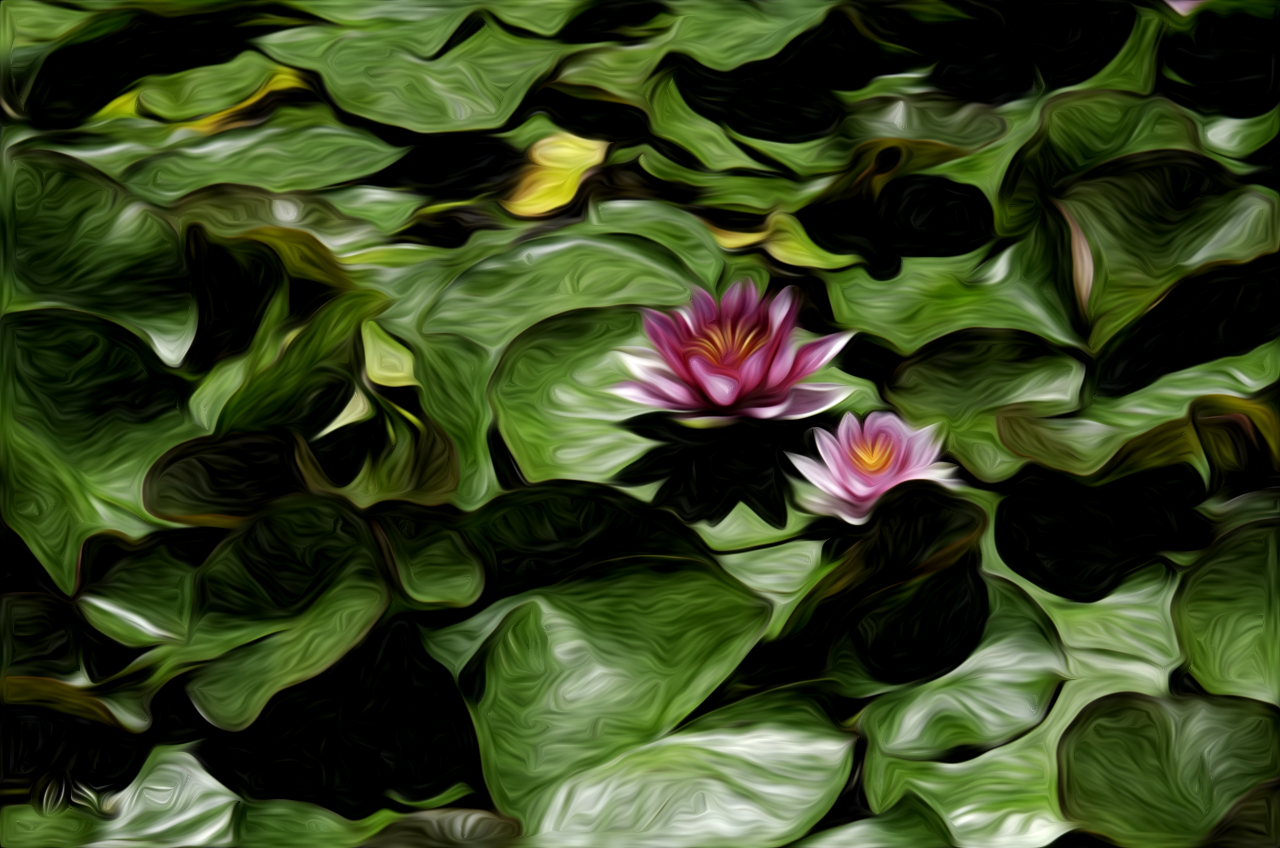
This next image is edited in the pixel bender filter in CS5.
Water Lilies and Pixel Bender Filter “Oil Paint”
Finally, this is the same image, with increased contrast added in CS5.
Water Lilies – Pixel Bender Oil Paint – Increased Contrast
Is any of this art? Or is it just manipulation? I don’t think I would ooh! ahh! over any of these, nor would I pay good money to hang these on the wall. But, they are fun to do!
One thing I find I like about HDR, if not pushed too far, is that it can create a good sense of the original light without a loss of detail. I still have 8 days left on my trial version of HDR Express, so that is the toy I chose to play with this morning. Yesterday’s picture shooting up into the tulip tree was the subject.
Manipulating images in other software, such as Photoscape or FastStone, allows me to lighten and darken them. I did this with the idea of merging multiple images in HDR Express, but HDR Express likes being boss, and reads the metadata from the same 3 images, and shuts its processes down – it realizes that you’ve got the same picture. That is a frustrating limitation. Removing all the metadata doesn’t change the situation. However! There is a work-around that is rather nice.
In Lightroom, open up the image you want, adjust the image so it is dark, and then right click on the image and export to HDR Express. It then pops open HDR Express, and HDR Express takes a few minutes, and creates 5 images, ranging from dark to light for your viewing pleasure. The differences are not immense, but if you watch the histogram on the upper right of the screen, you can see what the program is doing to your picture.
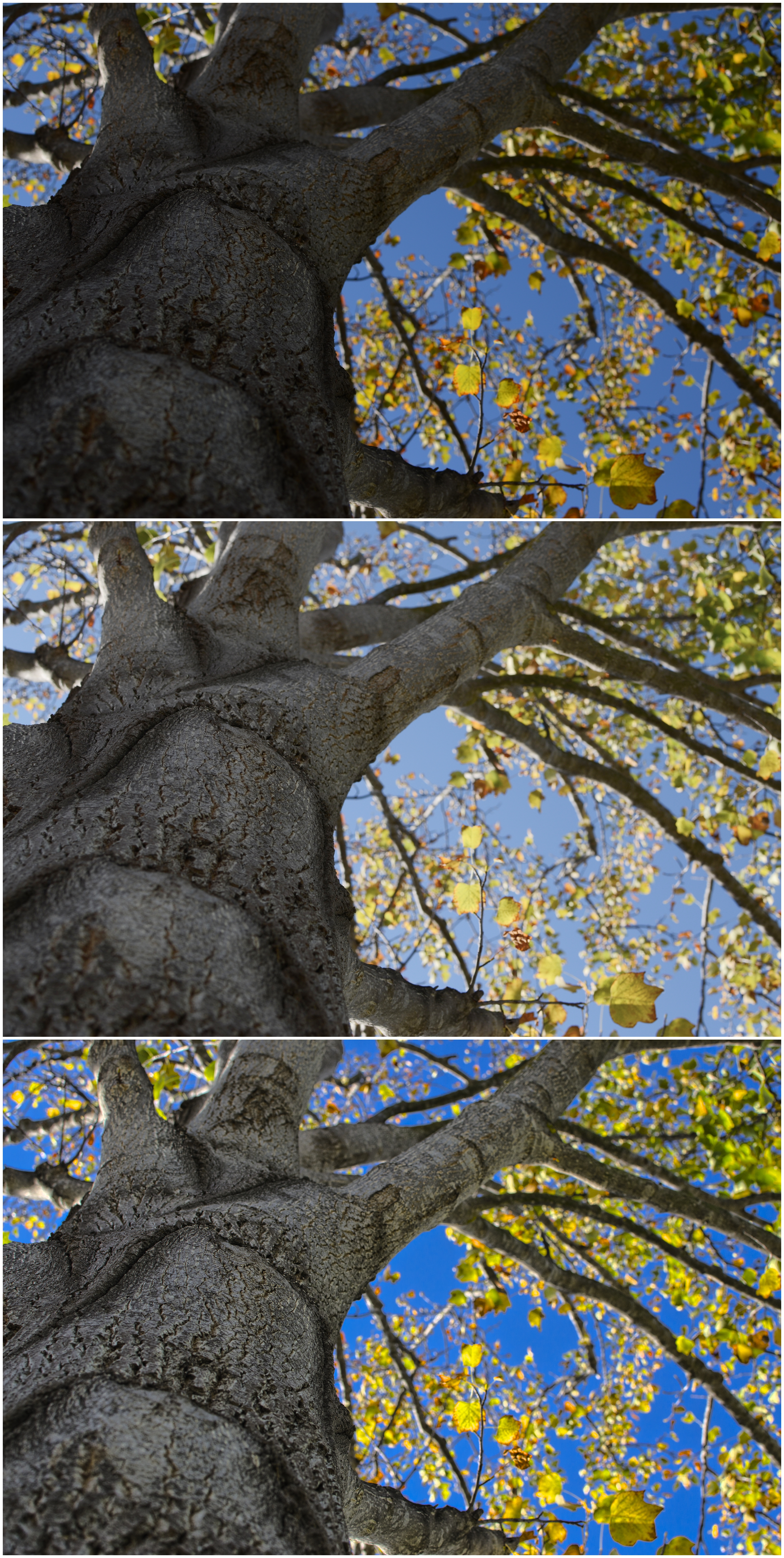
Below is a composite picture of the tulip tree out front. The top one is the original one I shot, which was dark to begin with, so I didn’t change it when I sent it to HDR Express via Lightroom. The middle one is my adjustment in Photoscape, which did a good job, but the intensity of the blue sky was a bit lacking. Finally, the bottom image is the one I exported to HDR Express, and it produced a rather pleasant image, with all the detail of the trunk, while retaining the colors of the leaves against that intensely blue sky I saw in my lens.
Top to Bottom - Original Picture - Lightened in Photoscape - HDR Express Image from Original
The Nikon Hit Man doesn’t like the idea of having to use lighting or post-processing to get the perfect image. I disagree. Post-processing is often necessary, and has been done forever by artists in the darkroom – dodging and burning are forms of post-processing. The thing is, sitting at a computer putzing with software is pretty dull stuff, so for us restless souls, it’s something of a nuisance. In a darkroom, you are moving around, not sitting at a desk. Big difference. Modern technology has its points, but movement is not often one of them!
I am in agreement, though, with the Nikon Hit Man about the original image: it should be as perfect as possible. This means you think about it before hand (if you can) by choosing the right lens, exposure settings on your camera, and so on. Not always easy to do – or remember – because there are so many things you can forget as well! And that is why programs which allow image manipulation are assets to the photographer. Nonetheless, for people who like the physical realities of art, software is more challenging than trying out a new medium, and often far more frustrating.
Below is an image of a daisy taken awhile ago alongside our house. It’s rather bland. Below is the same image, with post-processing done in Photoscape. You can see that under the top daisy, the flower’s receptacle has become nearly pure black, like a puzzle piece. Even in the original picture, it is a bit dark, and consequently distracting to the eye.
Original Photo
Daisies with Post-Processing
Neither picture above is especially spectacular, but the post-processing certainly messed up the final image. Below are two more results, the first which is sharpened only from the original. The receptacle is a bit more defined, with its ridges a bit more clear, but not darker. The second one uses the “bloom” feature (which I don’t understand – I’m a novice in post-production photography software) in combination with the sharpening. I think the result is a little better. The whiteness of the petals is more apparent. I also used the mole removal feature to get rid of the black spot on the foreground daisy.
Daisies Sharpened
Daisies Sharpened and Bloomed
One thing I have a very hard time with visually is contrast – adjacent areas and their shades of grey – when I work in color. Whenever possible, I try to take photos of any artwork I am doing to check out the contrast. High contrast has few shades of grey; low contrast has several. The degree of density in each, how dark or light, can determine the “pop” in a picture. In painting, this can cause items to retreat to the background, or move forward. This is what our mind uses to create depth and dimension in a photograph or a painting.
This next photo is the last one above, converted to greyscale. It is a soft photo, not especially dramatic. There are good areas of contrast, but the petals are lost.
Daisies in Greyscale after Sharpening and Blooming in Color
This next photo is the greyscale photo further sharpened, and the contrast increased. The petals are more apparent.
Greyscale Daisies with More Sharpening and Contrast
Finally, here are chorus lines of the photos in a row. It may be worthwhile to look at it, and thus decide which photo is ultimately the best. I set the lines up so they would span the same space, but in doing so, some of the image quality is degraded. What I am looking for is the contrast and clarity in the final image of the petals, the inside yellow part (stamens and pistils? I forget my flower sex!).
Ultimately, I am not sure about any of these photos. I think the viewer needs to determine it. Liking or disliking a photo is a personal thing. I do think, in general, the composition is rather nice, but in retrospect, I should have taken the photo from a more superior perspective, looking into the foremost daisy a bit more, but not by much. Also, to cut down on “busyness,” it would have been a good idea to remove the dropped petal on the most distant daisy, the one up against the wall. If I knew how to remove it with software, I would try it. There is some movement in the photo. The center of the daisy on the left may be a distraction, just as the receptacle on the upper daisy may be too dark.
Good, bad? I need to step back to reconsider! Too close, too much, a bit overwhelming. Later I can make a decision.
Whoopsie Daisies!
One thing which does help is turning one’s work upside down.The same can apply to a photo. Maybe I am more successful than I think, as I really like the movement in this upside down image. And, in reconsidering, I like the one of the colored daisies only sharpened a bit, with the black spot removed, the best.





 Ink, Yarn & Beer