
Overall, I am pleased with the final iteration of my SIL’s Christmas stocking. A lot of work in some ways, just because I didn’t think about what I was doing. I ripped it a few times and had to learn how to knit an “after thought” heel. Watching videos for that really helped a lot.
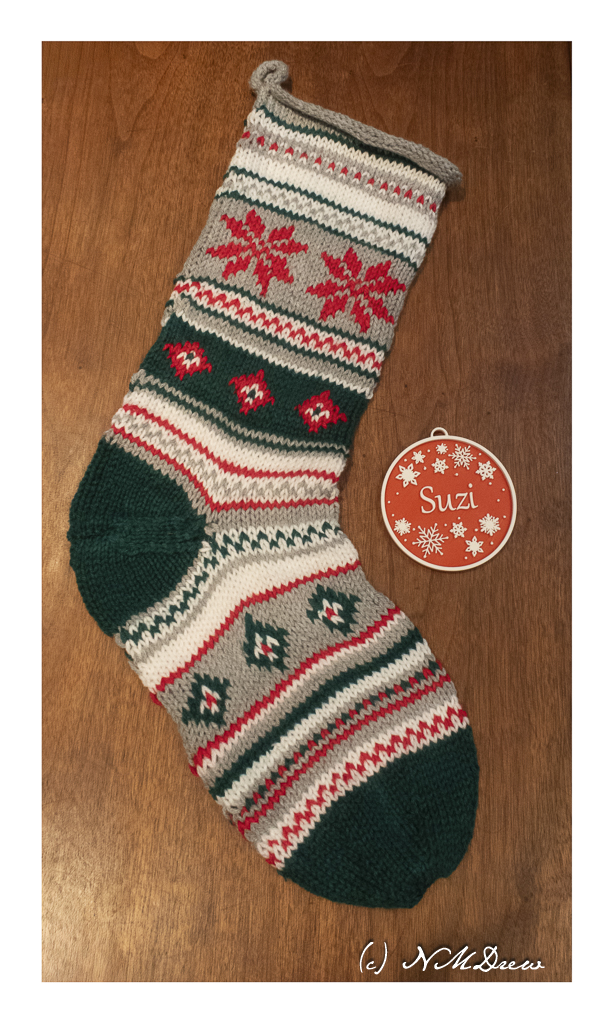
The pattern this stocking is based upon is from Yarnspirations Festive Fair Isle Stocking. I won’t say it is a difficult pattern if you are used to stranded knitting, but because on a number of occasions there are more than 5 stitches between different colored stitches, the floats can get long and the tension can get messy. As well, if you reach into the stocking with rings with things that stick out, you can catch a float, before, after, or during its making. I will putting a note about this into the package when I send it off to Wisconsin in the next few days.
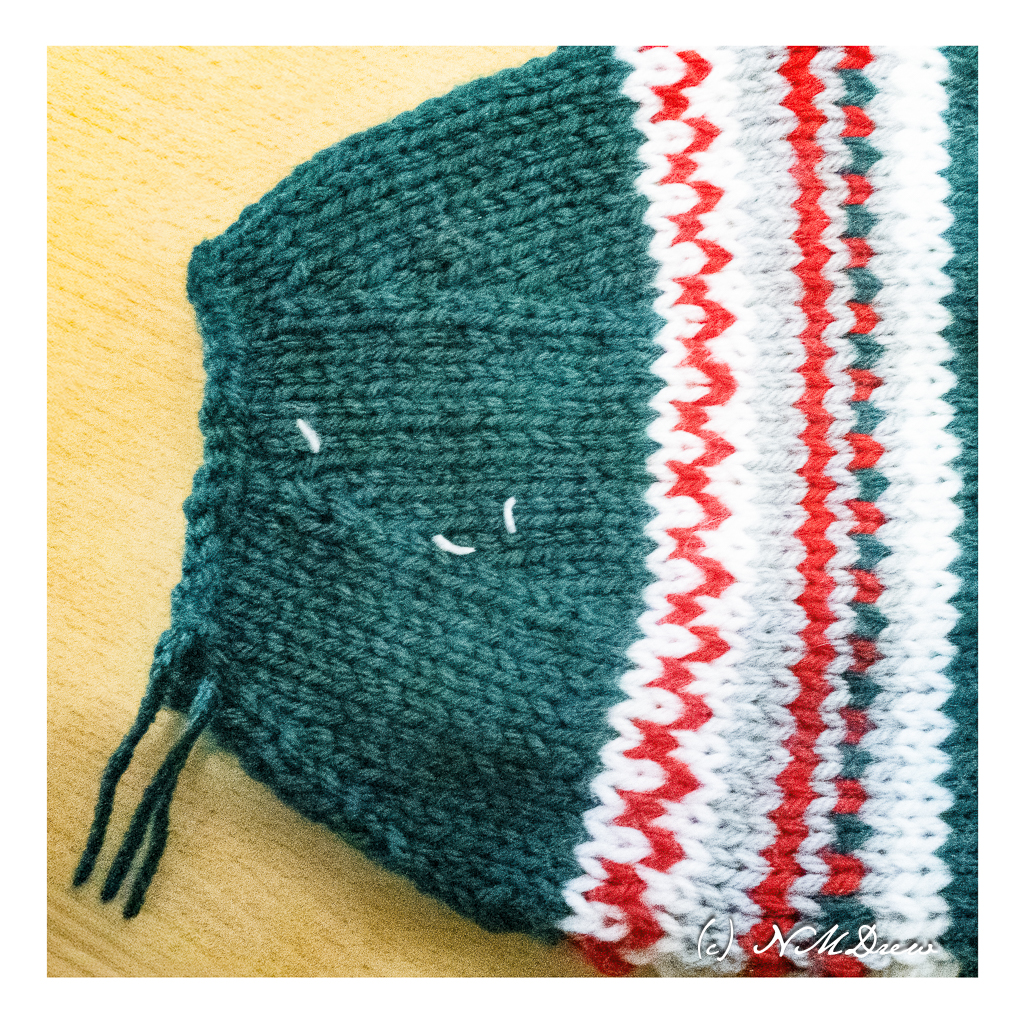
If you recall in my last post about the stocking, I had knit the foot pattern twice. It was way too long. I cut it off, and then moved into picking up the green stitches to make the toe itself, which is green. I used a circular toe decrease just because I was lazy and using circular needles, first 16 inch, and then 11 inch. You can see the decreases in the image below. I have not yet pulled in the open stitches to cinch the toe closed.
After this, it was time to clean up the mess inside the stocking itself. With all the color changes and dropped stitches here and there, I did not tie off the floats like I usually do. See how messy?
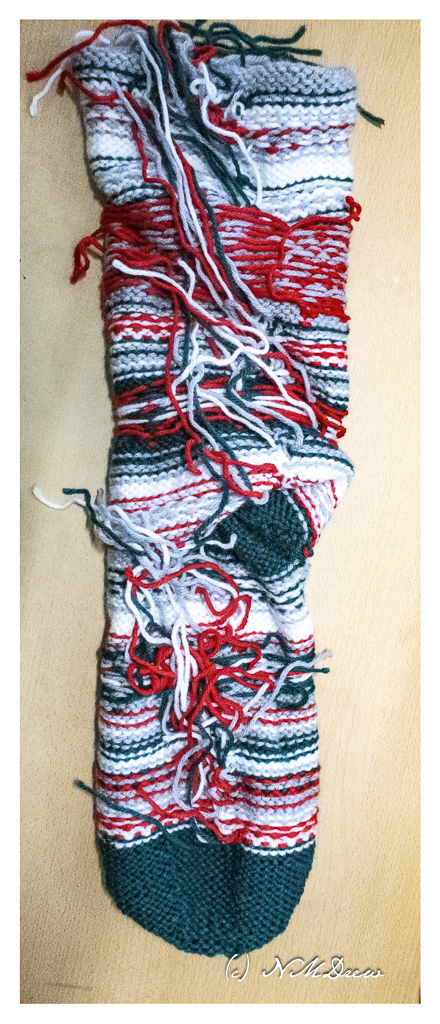
It looks pretty bad, but in reality, it was pretty easy to clean up. I tugged together the loose ends, knotting them (which I would not do if this were a sock to be worn on my foot!) for security. All the long ends were trimmed, and I worked from the top of the sock to the bottom. In the end, it worked out pretty well.
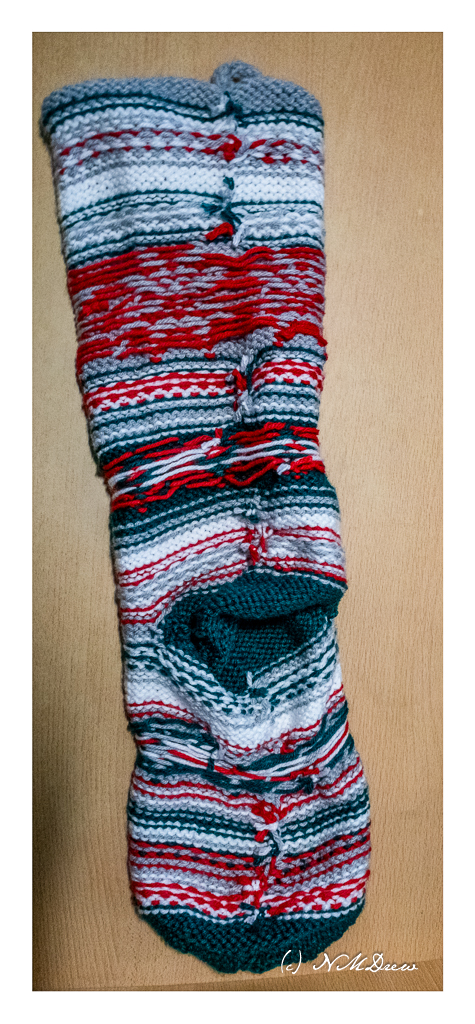
The corners of the after thought heel also needed to be cleaned up and pulled in so there were not any holes. The directions for the stocking do not give you notes that beginners (and non-attentive knitters like me) may need. Having never done this sort of heel, I was confused, but some good YouTube videos proved helpful.
If you are interested, I used size 8 US knitting needles for this project and changed some of the pattern colors and so on. The top of the stocking used a “fur” yarn which is not longer manufactured, so I made an i-cord. The i-cord was made so I could have a loop for hanging the stocking as well as picking up the 60 stitches needed for the pattern itself. The yarn is an acrylic yarn, and may colors were white, warm light grey, green and red. If I were to do this over, I would probably drop down to a 7 US needle. Because I could, I used a 16 inch circular needle, and dropped to an 11 inch needle for the toe.
I did not enjoy the after thought heel. It had me using 4 needles, which I do not like at all. The needles were aluminum and kept sliding out the of the stitches. When I knit socks, I use 3 needles, and ones made of wood or bamboo. I plan to try this heel again, but use a different methodology.
After cleaning up the inside of the sock, securing the heel and toe, and making sure I didn’t have any dropped stitches, it was time to iron the stocking to make it presentable. I sprayed it with water and then pressed it – pushing the iron down on it – between to rather heavy dish towels placed on the ironing board. I had my iron set to linen so the heat could penetrate the towels and set the stitches and shape of the stocking. This was done to both sides. I let it set overnight, to cool and give it some memory.
Years ago, when I was a kid, my mother made Christmas stockings for the four of us. I hung mine in front of the fire and it melted. I will send my SIL a note to that effect! This is also why I misted the stocking and pressed it between heavy towels – I have no desire to peel melted acrylic yarn from my very good iron.
Would I recommend doing this stocking? Yes, I would, but with caveats: know how to do stranded knitting, learn about after thought heels if they are new territory, and either find a fur yarn or make a ribbing or i-cord beginning. And then, enjoy the result.




 Ink, Yarn & Beer