Echinacea

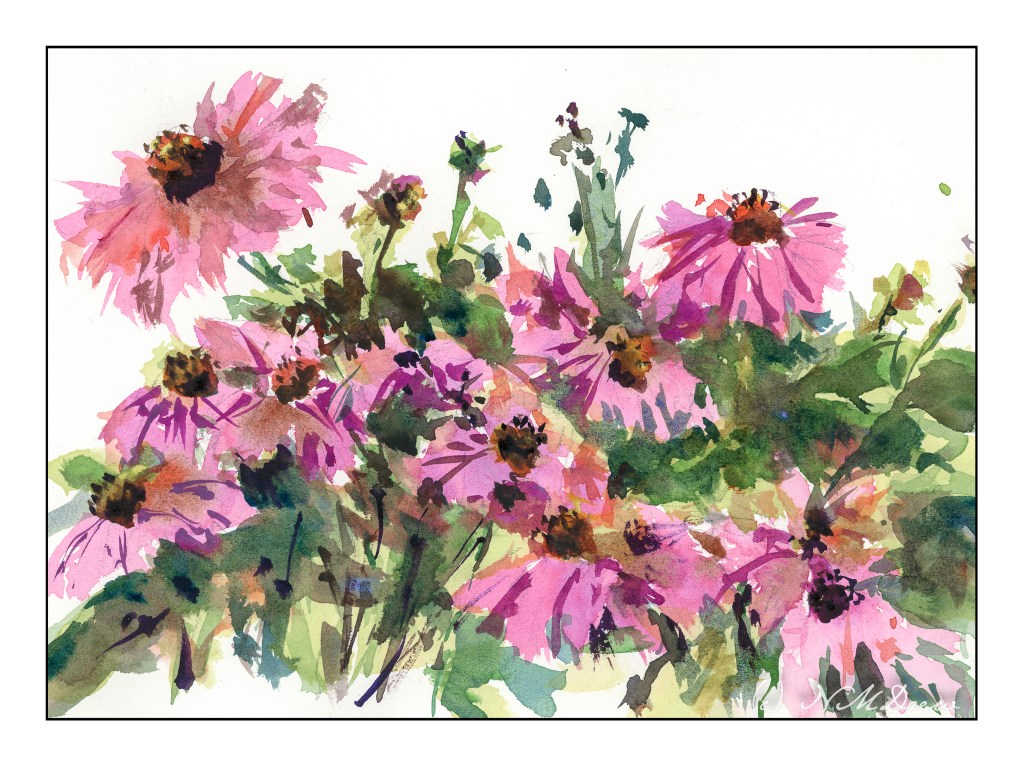
I think this is the first original flower study I am happy with. The reason is that it has the looseness of style I have been trying to get, a brightness of color, and decent contrast.

I began by wetting my paper on both sides after drawing in the basic flower shapes, some stems, and leaves. All of the pencil lines are simply guides, but it did help. From there, I did the flowers with a wet wash, more water than pigment, to suggest the basic flower petals. From there, leaves in a light yellow green with the plan to paint darker colors over petals and leaves. Once I had those general shapes in, I placed the flower center in, allowing it to bleed into the leaves and petals as it would. Then I dried it with the hair dryer.

More washes came along using more pigment and less water, but still wet. I tried to suggest leaves and shapes, painting around the flower to create indents where the petals fell over the leaves in an attempt to create some depth. Again the hair dryer, probably multiple times. Finally details with a fairly dry brush, thicker pigment slightly dampened with water. This was done for some of the stems, the flower centers, and a bit here and there.

I am using my new palette, but I don’t think I really like the alizarin crimson that much. It is the “permanent” variety and seems rather dull to my eye. I tried to liven it up with other colors, like some blue and red and orange in different areas, but it is not as vibrant a red violet I would like. I will need to do a bit of research here.

So, at last, a sense of being able to paint flowers in a manner pleasing to my sense of what a floral watercolor should look like.

9×12 CP Arches, 140 lb.

The Nikon V1 and 32mm f1.2 Lens for Botanical Photography

Multiple reasons routed me to the Nikon 1 system.  A DSLR with a big lens is heavy, so when the Nikon 1 system first came out, I looked, but did not like the initial prices, nor the lack of lenses.  Also, I wasn’t too sure if it would be successful enough to invest in.

Time passed.  When the V1 dropped significantly in price, I looked again.  Seeing images shot by Steve, by Craig Litton, Joe Marquez, Sue Wotton and others at Steve Huff Photo pushed me to look at it.  Finally I bought it.  Since then, I’ve added lenses to the bag, but when the 32mm f1.2 was announced, I was seriously interested, and bought one when I could catch it in stock.

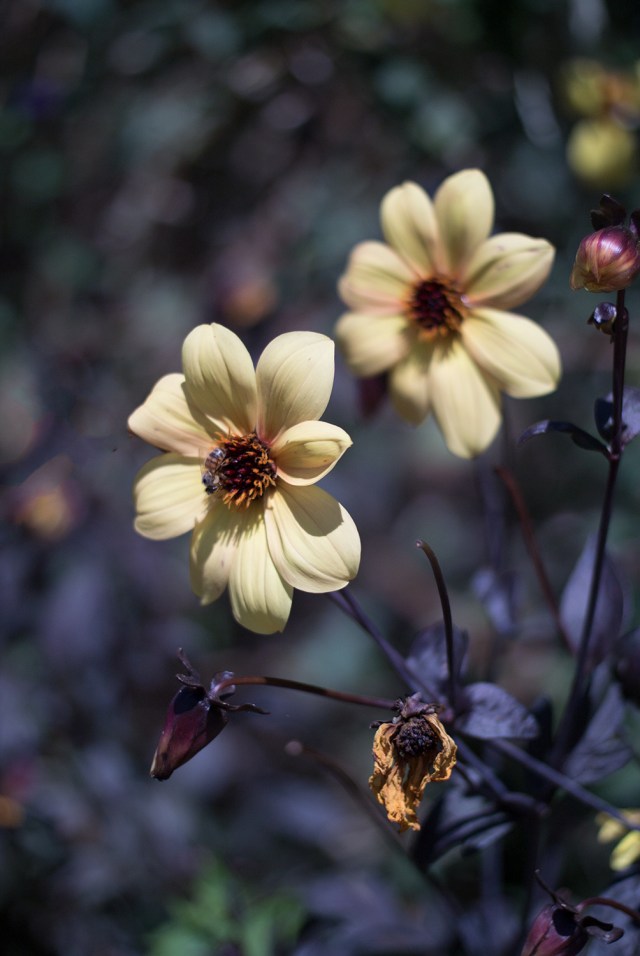
There is no one area of photography I prefer, but flowers have always given me a great deal of pleasure, especially wildflowers.  As it is late in the summer, nearly all our wildflowers are gone in the heat of Southern California, but locally we have some rather lovely gardens with flowers in bloom.  When I finally had some time to test out the 32mm lens, at f1.2 to f1.6, I shot a series of flowers and leaves, using both the auto and manual focus.

The beauty of the lens is the ability to isolate a flower from either background or foreground.  Bokeh varies with what lies in front and behind of the subject, and with the 32mm f1.2, it varies in quality.  It can be rather nervous when leaves in the background are small and fine.   Other times, distance or background blur beautiful, creating an element of serenity.  Color, contrast, and detail are well rendered.  The three pictures below show how the manual focus allows for choosing one’s focal area, and show how the foreground, middle ground, and distance can be chosen.  Click on them to see full detail.

_DSC4480

_DSC4481

_DSC4482

Altogether, I am very pleased with the ability of the Nikon V1 and the 32mm for taking pictures of flowers and other plants.  Some post-processing can add to the beauty of an image, but even just out of the camera, most images are pleasing and need little work.

Dahlia

Fallen-1500Fern-1500Hollyhock-2PurpleSaber-Lily-1500