Saturday Dyeing

Jacquard Indigo Kit

I spent all day Saturday dyeing yarn with indigo, cochineal, and quercitron (yellow oak bark).  Judy came out from Ventura with three skeins of white yarn, one of which was 100% washable merino, another was merino and nylon, and another of merino and silk.  Mine were all 100% wool, specifically the Crazy Eight yarn from Wool2Dye4. I gave Judy a skein of the Crazy Eight, so all told, we had 8 skeins of pure white wool for our projects.  I also had two skeins of Sea Wool I had dyed using cochineal, one lighter than  the other, and a skein of moorit Shetland which I had earlier dyed with quercitron.

Indigo Vat

Friday evening, I set out 15 g. of quercitron bark to soak overnight, as well as 10 g. of cochineal mixed 10 g. of tartaric acid. Saturday morning, once we got the first dye bath heating, we set up the indigo. After my earlier disaster with indigo, I decided to order a dye kit from Dharma Trading Company, in Berkeley, California. This is a very tidy little kit, well worth the small price – kind of like frozen vegetables in midwinter – a definitely good thing to have!  The only thing I needed to buy was a container with a lid – this little kit produces 4 gallons of intensely blue dye, and we certainly did not make a dent in it.  Putting the container – a commercial food storage unit – on a furniture dolly was a good thing to do, too, as that is a lot of weight to carry around.

Cochineal Skeins with Overdyed Skeins on Outside

We found out, very early, that the indigo in this vat is very strong. I dipped my two cochineal Sea Wool skeins in the vat once it was ready – and they turned deep blue violet after only a minute in the vat. Oops! I was aiming for lavender! You can see how dark the two cochineal skeins became, as well as the original shades of pink. We used this knowledge to good advantage later on, and diluted the strength of the indigo by taking a couple of cups and pouring it into water in another container. Much nicer! The lavender and greens Judy got were all done with a diluted indigo bath.

Judy's Lavender (Indigo Over Cochineal) and Green (Indigo Over Quercitron)

To get her lavenders and greens, Judy did two dye baths. The first was a purely yellow skein in the quercitron, and a purely pink skein in the cochineal. As her skeins had different fiber content in them, as well as had been treated to be washable, her colors were not as intense as the Crazy Eight yarn, which is a washable merino, but is made up of 4 2-ply strands plied together. Because of the silk in her yarn, all temperatures were carefully controlled not to exceed 180 F. – important to keep the luster of the silk, as well as to keep the yellow from drifting into drabber shades.

Indigo-Dyed Moorit Shetland

If you are unfamiliar with indigo dyeing, you might like to know that before you get the blue, it is green in the dye vat; the oxygen in the air creates the blue color. You can see that the large vat is green in color, with a bluish rim at the top. As a result, it is difficult to gauge how dark your indigo will become once exposed to the air. So, as I said, we diluted the indigo with more water. Then, to get the gradated yellow-into-green, and pink-into-lavender, Judy dipped only a part of her skein into the indigo, and slowly squeezed the dye into other areas of the skein once it was removed from the weaker solution. Doing this three or four times, she made some very nice space-dyed yarn.

For myself, I wanted to preserve most of my skeins as solid colors, and so chose to do one skein in pure quercitron, one in pure cochineal, and one in a medium indigo. My last white skein was tied off in the traditional flammegarn method. and dipped first in the cochineal, tied up some more, and then dipped in the indigo. The results were quite pleasing altogether. I was also quite pleased with the indigo-dyed moorit yarn – it took on a pleasantly greenish cast.

Left to Right: Tie-Dyed, Quercitron, Cochineal, Diluted Indigo
Judy's Indigo Overdyed Flammegarn

Saturday flew by! By and large, Judy and I were happy with our results. Judy had done a flammegarn in quercitron, cochineal, and indigo, but it was too pastel for her tastes. Rather frustrated, she dumped it into the undiluted indigo – and lost all here cochineal. However, the yarn came out really nice, despite that. In place of the yarn she didn’t like, she got one which is mulberry and teal, two of her favorite colors. The picture here is a bit too intense – the graduation between the purple and teal was far more subtle, with the teal being darker.

Our working concept was to use the lightest colors first, and then move to the darker ones. This meant yellow, then pink, then blue. I was not really pleased with the green we got using this method. Looking around, I see some people dye with indigo first, and then with a yellow overdye. I expect that the initial indigo has to be relatively pale to achieve middle greens. This is something I plan to do at a later date, and while greens are often readily available in other dye plants, the ones done with a combination of blue and yellow seem to be more vibrant. Color mixing is an art, and not knowing how something works best is frustrating, but at the same time so much fun. Since I am not a professional dyer, I am not too concerned about creating repeatable products, but I do like having control over my results a bit more. This is where a sense of adventure is important, as well as a willingness to try something. Theories often do not work with realities!

That said, here are the skeins, all hung up to dry a bit before getting dinner ready for the men.

Flammegarn

Early this morning, I got up to meet a cool, breezy morning with a clear sky and the promise of perfect weather. What more could be asked for on a day when the morning is to be spent outdoors dyeing yarn? Everything from the last pre-dyeing days was gathered together – the pans, the spoons, scales, and so on, including the skeins of pre-mordanted yarn. Today, a number of things were planned, and happened: dyeing both commercial and handspun yarn with cochineal and black oak bark, also known as quercitron.

What is flammegarn?

Today’s entry is about flammegarn, which is an old Scandinavian method of making yarn with variegated colors. A skein (or two, or three) is tied off with cord, immersed into a dyepot, and colored. The result is a “flame yarn” – so named because this was traditionally done in red over white yarn – with splotches of red and white coloring which knit up into a space-dyed yarn. Modern dyers do this – just google “flammegarn” and you will find a number of examples. Earlier this year I wrote about making flammegarn with commercial dyes, which you can read about here. Judy’s knitted up some socks out of her flammegarn – I need to get a picture of them to post.

Set up the dye materials the night before.

Last night I prepared the dye materials. Specifically, I ground up 5 g of cochineal bugs, and mixed them with an equal part of tartaric acid. Then I added hot tap water, stirred them together, and let them sit overnight. I weighed out 10 g of black oak bark, and did the same, but without the tartaric acid. I did about five dye baths this morning; out of these, two were used for the flammegarn, which is fingering weight, commercially spun blue-faced leicester in two 200-yard hanks.

Filter out the particulate matter.

The dye pot was set up by filtering out the particulate matter from the water into which I put it last night. I used an old coffee filter and a paper filter; the filter was set aside and the clear liquid placed into a large dye kettle.

Cooler dye bath temperatures are better for yellows.

Even though I was using only about 135 g. of wool (100 BFL, 35 moorit shetland), I wanted a large kettle. A larger kettle is easier to control as far as not allowing the temperature to rise very high. This is especially important with yellow as the hotter the temperature, the more the yellow can drift toward brown or greenish hues. I kept my pot around 140-150 F. The weight of dye matter to fiber (the BFL specifically) was 1:10 – 10 g. oak bark to 100 g. of BFL, which had been premordanted with alum and tartaric acid.

According to J.N. Liles, most of the black oak bark color will be taken up in the first 20 minutes of immersion. This proved to be the case. I pulled both the BFL and moorit out periodically to check the color, and once I liked it, I put in a piece of copper pipe – about a thumb’s length – and a pinch of gypsum (the chalk my husband used in beer making to change the pH of his brew, as well as increase the availability of calcium and sulfur ions). Liles recommends adding “1/2 tsp. of chalk” but doesn’t state whether it is calcium carbonate or sulfate, so I used the gypsum. The color in the pot became a tad bit brighter – a rather mellow, pale gold.

Prepare the flammegarn by tying off sections of the skeins.

While the dye bath was heating up, I took my two BFL skeins and tied string around them. The string acts as a resist, keeping the white (or lighter colored yarn) from getting dyed. After this, they were set into hot water prior to immersion into the dye bath.

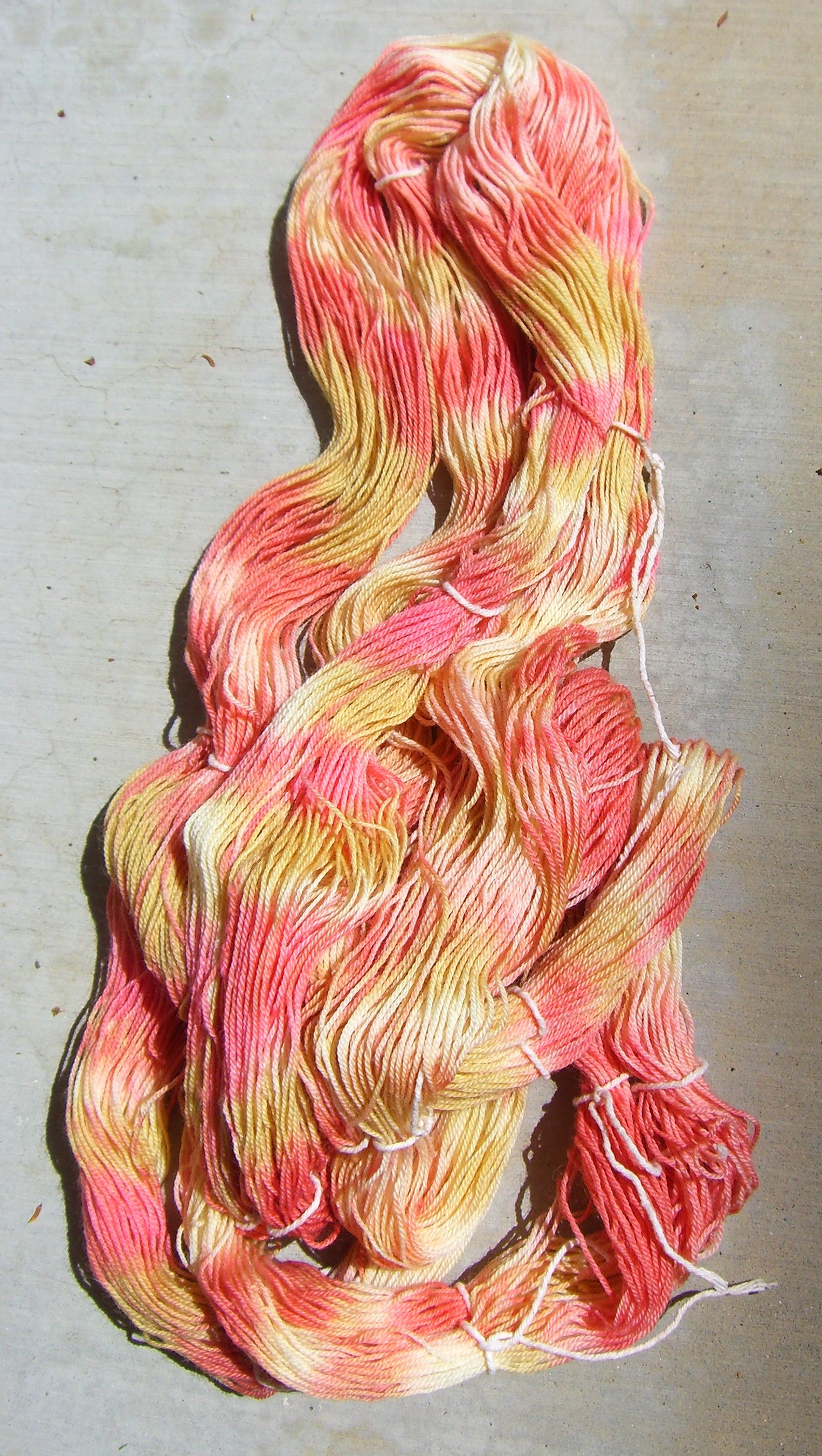
This yarn was removed from the pot and set in a basin to cool enough so it could be handled for untying and re-tying to create the flammegarn yarn. While the fibers cooled, I took the remaining particulate matter of both the quercitron and the cochineal and remixed them with water, and then filtered them again. The result was a orangish coral color. This was added to the remaining dye in the pot that had been only the black oak bark. This was slowly heated while the flammegarn was prepared with more ties. This new dye bath now contained the exhaust of the cochineal and quercitron, the tin added in the last five minutes of the original cochineal dye bath, and the gypsum and piece of copper pipe. Once this bath reached about 180 F, the flammegarn was immersed into the bath. Here it remained about 10 minutes, was removed, and then dipped into ammoniated water (about 1 part ammonia to 24 parts water – 1/2 c. to 3 qts. of water). After the dip, I rinsed the yarn in clear water and spun it out in the washer before hanging the hanks up to air dry outdoors.

It’s in the water.

The water here in Thousand Oaks has a pH of 8. This means it has a slightly alkaline quality. The use of gypsum is to move the water closer toward pH 7, which is neutral. Ammonia is alkaline, and pushes cochineal toward the purples, and the tin in the dye bath helps to promote the red qualities of the cochineal. With the golden underdye of the quercitron, the overdye of the two exhaust baths created a color similar in tone to the gold. The result is a color variation in the yarn ranging from pale gold, to darker gold, corals and pinks.

Voila!

The final results are below. The colors are a bit lighter, but the photograph does a good job of showing the true colors. My camera pushes yellows and oranges toward the reds, and makes them far too intense at times. If you click on the photo, you should be able to see the skeins in a larger photograph, which will help you get an idea about how they look in real life. Bigger is better, here! These skeins most likely will become my own pair of flammegarn socks, either with a 2×2 rib for the ankle, or plain knitting, unless I create a little scarf with some plain knitting combined with lace.

A Good Day to Dye

The weather turned this weekend from cold and windy to warm and sunny, with all the elements of spring making themselves known:  the mockingbirds in the trees, the frisky squirrels, daffodils and freesias blooming.  Thus, for a few days, the cabled beret was tossed out the window (figuratively, not literally), while the dye pots and colors and yarn came out to play.

A couple of weeks ago I sent away to Wool2Dye4, and ordered two skeins of their 100% washable merino sock yarn, their 80/20 merino bamboo combo sock yarn, and a one-pound cone of their Blue-Faced Leicester.  I also had some sock blanks from KnitPicks that have been waiting many months to turn into butterflies.  My MIL’s birthday is on the Ides of March, so this yarn and dyeing is something we do occasionally as a birthdye present for her (and for me, though I’m 7 months from now . . .).

Anyway, it was a blast!  First thing we did was to paint up our sock blanks.  We used powdered dye mixed with water – I’ll detail that in another post – and plastic syringes to place the colors.  Judy’s sock blank is below.

Judy's Sock Blank - Before Steaming

This is my sock blank.

My Sock Blank - Before Steaming

We did this out on the picnic table, on top of a plastic tarp.  Before dyeing the blanks, two long sheets of plastic wrap were stretched out beneath where each blank would go, and pressed down to make a seal.  The blanks were soaked in warm water with a tablespoon of dish soap (Dawn) for about 30 minutes.  We set up the dyeing table and colors while the blanks soaked.

Once we had our blanks painted, into the kettle they went!  We rolled the blanks up in the plastic wrap, folding over the edges and such to seal in the colors, with a final sheet of plastic wrap, like a burrito.  The kettle was set up with a vegetable steamer and plastic tray, and the blanks steamed for about an hour.  Once they were done, we pulled them out and, as quickly as possible, freed them from their coverings and set them in a basin of warm water mixed with about 4 oz. of white vinegar.  There they cooled, and while they were cooling, we got on to more dyeing!

Our “cooked” sock blanks now looked like this:

Judy's Sock Blank - After Steaming
My Sock Blank - After Steaming

One would hope that the abstract patterns would come out like the blank, but already I know they won’t.  I’ve started knitting up my socks, or gloves, or whatever they are going to be.  The colors are intensely rich, and the photos really do not show what they look like.  Judy’s will more likely show its pattern – the blanks are always described as “make your own striped socks” – so it makes sense.  Still, it is fun to knit them up to see!

The next dyeing adventure was to spread out a skein of yarn each, already soaked, and pour colors onto the skein.  We’ve done this before, and often the patterns of the colors are really enjoyable.  Judy made used multiple colors in hers, and I decided to go for a more monochrome pattern.  You can see the results to the side – the turquoise skein is mine, and the multicolored one is hers.

The results of this are really satisfying as you can create strips or areas of color and work the color into the yarn. Judy’s painted skein is very obvious in its sections of color, but where the colors overlap can become very exciting. Mine is more subtle, which is odd for me, and for once the magpie did not overtake the entire project. I really like the turquoises and blues which were the result of mushing together a few shades of blue and turquoise.  Wrapping the skeins in plastic wrap and steaming them allows for the different projects to go into the same pot without polluting each other.

The final project was to create flammegarn. This is a resist method used in Scandinavia to create randomly bicolored yarn.  White or colored wool is tied off with yarn, in sections, and the yarn is immersed into color.  The result is randomly colored and white yarn, much like our multi-colored yarns of today, but with fewer colors and shorter areas of color.  The results are always fascinating.

Judy Holding the Tied Flammegarn Skeins

We decided to use the same colors, and to utilize our knowledge of color mixing to get some results.  We dyed our entire skeins a rather lime yellow greenish color.  Once we could handle the yarn out of the dye pot, we tied ours off.  Judy is holding up the dyed, still tied, skeins.

And then you can see her holding up the now untied skeins.  Hers is on the left, and mine is on the right.

She liked her colors, but for me, the colors did absolutely nothing.  Yucko!  Just not for me.  So, I decided to overdye my flammegarn skein, and I am so glad I did.

Judy with Untied Flammegarn Skeins

I decided to continue to apply color theory to the flammegarn. The yarn was a rather yellow-green and blue-green. I could overdye the yarn with a turquoise, but then I would have two similarly colored skeins. I decided to use violet. The yellow would turn to a grey color (yellow and violet being complementary colors), and the blue would turn to a blue violet. Into an intensely purple dye pot it went!

You can see from the results, the overdye was perfect. No more putrid yellow and blue green. The overall effect of the skein is a rather purplish blueberry color – more violet than blue – and really nicely mottled. Up close, with some photoshop lightening of the picture, you can see the colors a bit more distinctly.

The long, thin picture of the skein is close to the real color, and in daylight it has that deep purply blue color.  The larger picture on the left shows you the detail of the color, which, when knitted up, should add a bit of interest to the yarn itself.

Altogether, this was an incredibly satisfying day! The random effects of dyeing are half the fun – just experimenting and playing. You can see that Judy has an eye for detail and construction. Her colors are more orderly than mine, and I tell you, I really admire that in people. She is, for example, and incredibly talented beader and needlepointer, with the patience of a saint. Her work is impeccable. Me, I am far more crazy and like the process of making a mess. Too often, a mess is just the result. However, I was really pleased with the way everything turned out, for both of us, and I know we had a lot of fun together. With spring approaching (here in California), the plants are beginning to grow, and we plan on a natural dyeing adventure pretty soon, with native plants, as well as materials from other parts of the world. Stay tuned!