Indigo Batik & Miraculously Easy Wax Removal

Warning!    A very long and windy read.  Get your coffee or tea, put your feet up, and follow along . . .

I was going through my archives thinking I might have written something up about the last time I did indigo dyeing, but I  guess I didn’t.  So, we shall begin sort of at the beginning!

Indigo is a wonderful dye, and I have used a variety of methods to extract the blue color.  Over the 40-odd years I have been dyeing, I have used urine, sulfuric acid, and finally a kit.  The kit is the best and easiest and least time consuming or hazardous.

Indigo is a plant that is used to dye fabrics of all kinds – plant and animal fibers, cotton and silk – for centuries.  In the dye bath, it is a disgusting greenish yellow – not like spring’s new leaves, but a pukey army green.  It also doesn’t smell appetizing. To create a dye bath, you can use all sorts of chemicals, save your urine, or buy a simple kit.  I like the kit that is available from Jacquard – small, easy, convenient.  For the bulk dyer, this would not be a good buy, but for a small once-in-awhile dyer, it is great.  You can buy it from Dharma Trading, Amazon, or KnitPicks, to name a few places.

Indigo Tie Dye Kit

Last year, my MIL Judy came by and we did a bunch of indigo dyeing. We dyed yarn and fabric, doing flammegarn and batik as well.

Flammegarn dyeing involves taking a skein of white yarn and tying off areas of it. The binding material acts as a resist. The yarn is then submerged into the dye bath, and the color is taken up.  Multiple colors can be used, and multiple dippings.  The result is a randomly mottled yarn. I believe this is originally a Scandinavian technique – the name implies such – but I am sure other cultures have done it as well.

Batik is the use of a resist on fabric to prevent colors from dyeing the fabric. Wax is the traditional resist. Multiple layers and colors can be built up, and complex patterns can be created. You can apply the wax with a brush or a stamp, a stencil, or a djanting tool.

Removing the string resist in flammegarn is easy, but removing the wax resist in batik is problematic. Removing the wax from the fabric is a chore. Boiling or near-boiling water is needed to melt the wax. Once that is done, by dipping the cloth multiple times into boiling water, it is then further treated. It can be sent to the dry clearer and chemical solvents used (ick!), or you can iron it between layers of newsprint using a very hot iron to remove the last of the wax. I have always done this, but it never really did the trick. There was always a residual coating of wax that never seemed to leave the fabric, even after multiple washings in hot water, in the sink, in the washing machine, and ironing. However, I have now discovered how to remove wax quite easily!

First, though, let’s back track a bit. Judy took a brush and a lot of wax to her fabric (cotton or linen or a mix thereof we are not sure). Here is her material, dyed and waxed and now awaiting wax removal. This material is very stiff, and if you want to crumple it up in a ball, forget it. Instead, you really have to fold it! The wax then cracks and falls off if it is really thick. I don’t think you want to take it to your sewing machine in this condition! The fabric measures about 40″ wide and about 1.5 yards long.

Yesterday morning, Josh and I worked on getting the wax out. Below you can see what we did. Josh pulled out his brew rig, which runs on natural gas from our home, and set up my 4-gallon pot with water on the middle burner. Behind Josh is his 15 gallon hot liquor tank that he uses to boil water in beer making. It has a temperature gauge on it along with a spigot to which you can attach a hose. You don’t want to lift this boiling water, so he uses the spigot and hose to move hot water to his other kettles when brewing. This set up worked out really well for us as from the liquor tank we could easily and safely move the boiling water into the galvanized wash tub you see next to him. (All that red stuff behind the brew rig are car panels for the 818S!)

The 4-gallon kettle took minutes to bring to a boil, and so we moved it into the galvanized tub. The indigo-dyed cloth was submerged, and stirred. The wax began to melt out of the cloth, and some of the indigo dye bled out. I used wooden dowels and spoons to lift the material in and out of the water, stirring it and mushing it around.
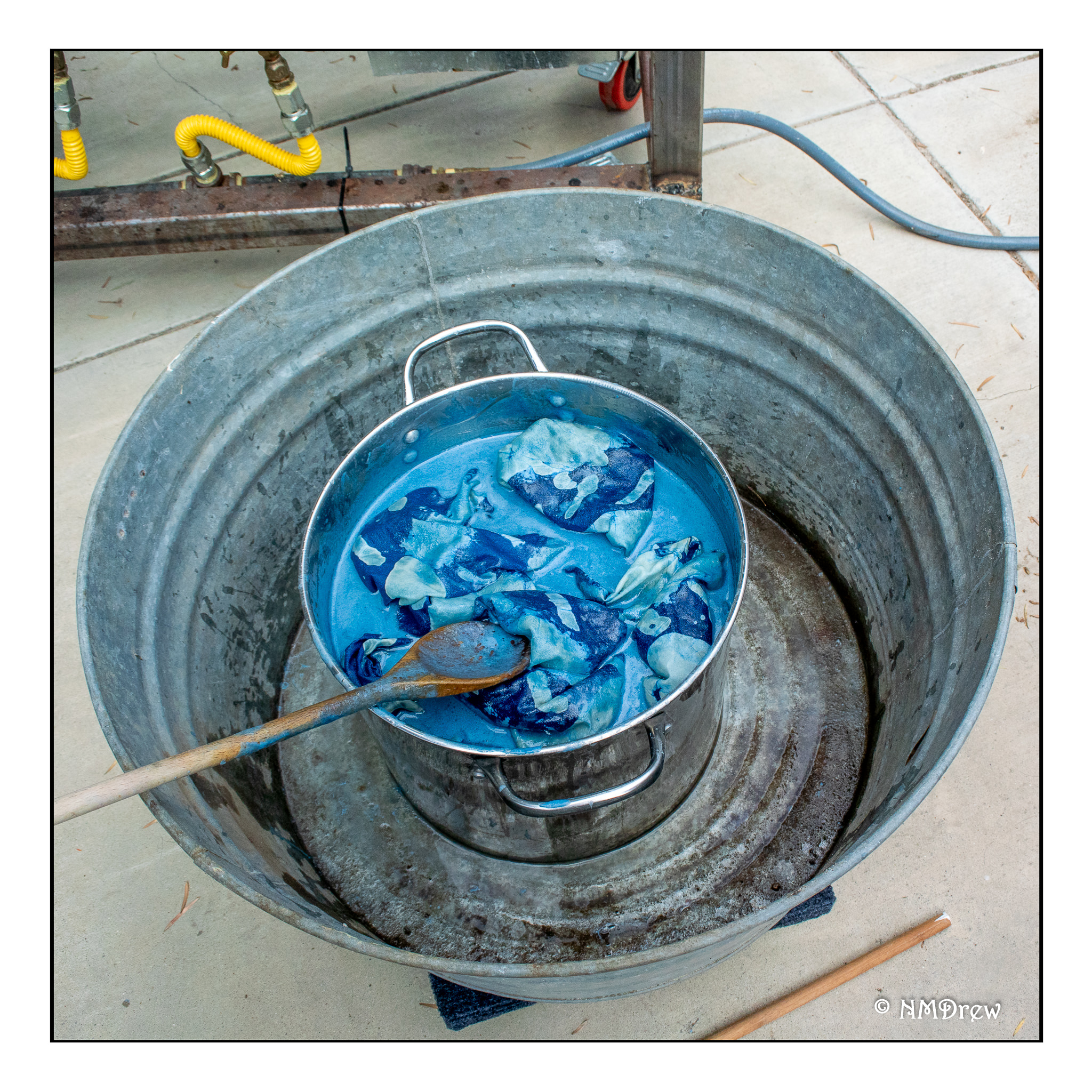
Here is a close-up of the spoon, fabric, melting wax and hot water. Water dripped and splashed into the galvanized tub – I used that to scrub out the dirt before we added the water from the liquor tank. Pretty efficient, eh?

After several dippings and stirrings, the fabric was removed from the 4-gallon kettle. Wax and murky water remained behind. You can see the liquid wax on the top of the water, and the hardened wax on the sides of the pot. It is interesting to note that the water has a greenish cast – water when you are dyeing indigo is also green. The blue color of indigo does not occur until the fabric or yarn is pulled out of the dye bath and exposed to oxygen.

Using the dowel and spoon, the fabric was lifted out of the pot and allowed to drip into the 4-gallon kettle. Here are the remains of the wax after the water was discarded. This was taken the next morning after the water had cooled and the wax had risen to the surface of the water. You don’t want to be pouring this stuff down your pipes!

The secret for easy wax removal is now revealed!  Read on, oh fans, read on!

The wash tub was then filled with hot water from the liquor tank – 15 gallons of boiling water. About 1/4 cup of dish soap (Dawn concentrate) was added to the water and stirred into the water. And that is the secret! The soap emulsifies the wax and allows it to be dispersed into the water or something.

The fabric wanted to float to the surface of the water, even after squishing out the air bubbles. I stirred and lifted the fabric again, making sure to mix it all up really well in the soapy water. Interestingly, no suds developed. Before sealing it to cool, I weighted the fabric down in the tub with some bricks to ensure it did not rise to the surface and collect any wax which had been removed. Then, we sealed if for the night! We used the wheels from the donor WRX. Our goofy dogs wanted to taste the soapy water, and I wasn’t inclined to let them indulge.

The wash tub and tires sat over night, to let the water to cool. The bricks would prevent the fabric from floating and getting re-waxed. The next morning, the tires were removed, and this is what we saw! No wax on the cold water’s surface!

I was really quite surprised. Never have I had such an easy time removing wax from fabric before. I pulled the material out of the tub, placing it into a bucket, and taking it to the kitchen sink. I wore some nitrile gloves (I didn’t want to turn blue) and rinsed and squeezed the fabric in the sink. From there, once the water was clear, the whole thing was carted to the washing machine, loaded in with hot water and laundry soap. When the cycle was done, into the dryer  for the final step of ridding the batik of wax.

And the washer and dryer are perfectly fine, thank you very much.

The fabric is now supple, easily crumpled into a ball, and ready to be sewn into a skirt of some sort. I think it would make a great sarong! Here are more pictures of the final cloth – all it is needs is a bit of ironing and styling.

A close up shows how the wax cracks and the dye seeps in, as well as how it colors areas with less wax. The thicker the wax, the less likely the indigo or dye is to seep in. Because the wax was thickly applied, cracks easily develop. Areas where thinner wax is applied and not worked into the fibers are more likely to take some dye, albeit less intensely.

Finally, a closer shot showing the weave of the fabric – and I think it is linen! The texture of the weave is more irregular that cotton, but the fine weave of the fabric made me wonder.
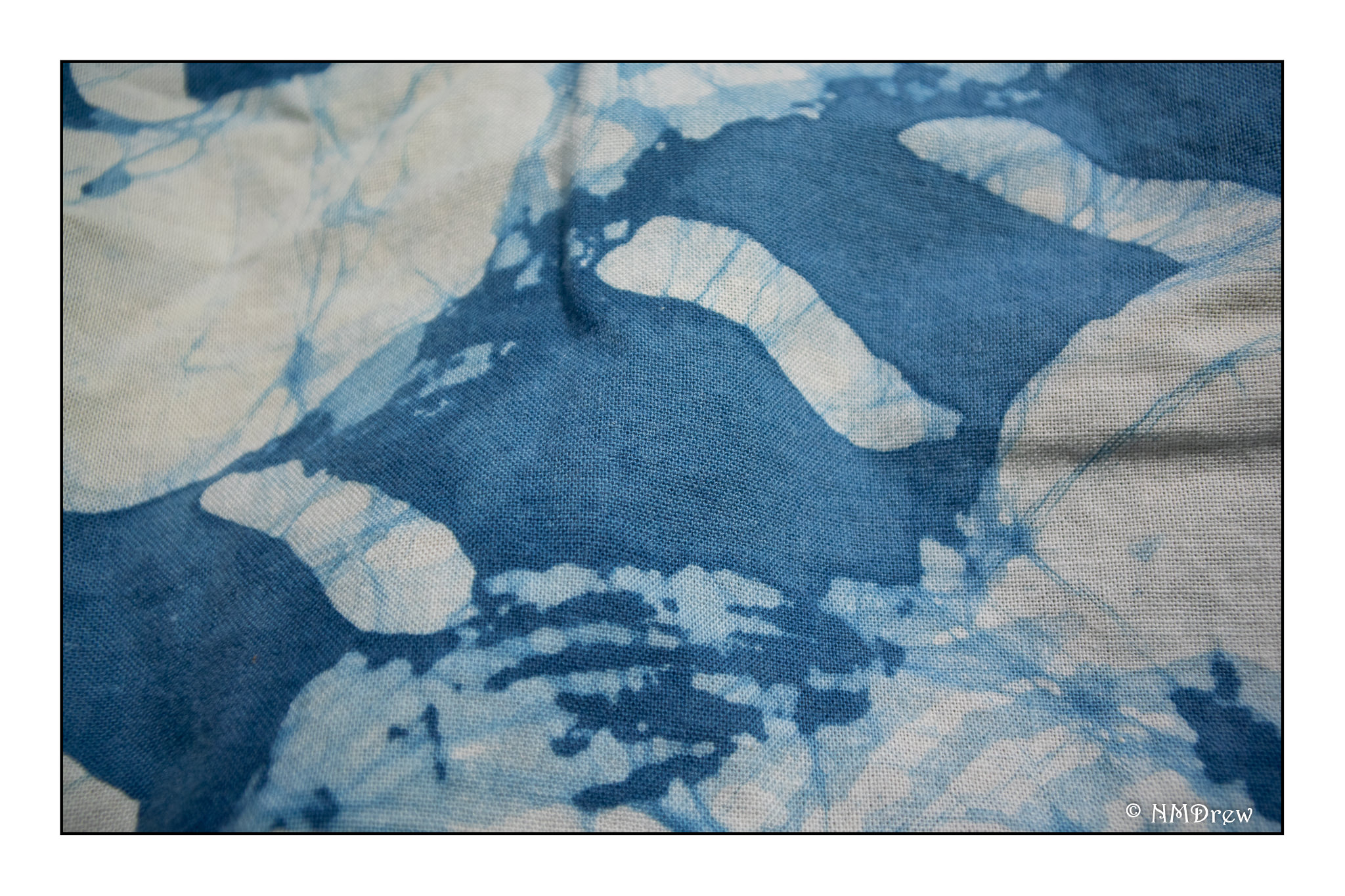
And, at last, this beautiful indigo-dyed linen fabric is crumpled up and ready for its next iteration!


Vagaries in the Real World

In my perfect world, I would paint every day.  In my real world,  I have limited time just because I have so many interests.    Little things can become big things, not necessarily bad, but in the sense of taking more time than planned.  Also, life can produce some interesting lessons.

For example, I have recently found that 3M 101+ tape is the best tape for watercolor paper borders.  Lightweight, seemingly impervious to unsticking with a lot of  water from a wash, easily removable without tearing paper even when not using a blow dryer to warm it as you pull it off . . .

We bought a motion-activated infrared trail cam to determine what critter was destroying our plants in the side garden.  Mouses!  Traps caught one with cheese –   ours seem to dislike peanut butter.  I think they have learned their lesson.  The leaves are returning to the plants they ate.  They also figured out not to go into the traps otherwise chompy chompy.   Fortunately, I don’t deal with the traps or dead things.

The 818S is going along nicely.  Brakes are the first big addition to it.  Josh has been riveting and blogging away at 805-818.com if you want to see.

I am sewing masks again, this time on my Singer 403A.   Threads need cutting, something that a computerized machine automates along with back stitching.  Technologies have changed since the 1950s for sure!

The ham will be used to iron out the masks I am currently sewing up.  Thanks to AVWalters for that suggestion!  I don’t tend to iron them, but why not as it is waiting to be used, looking very ham-like and hamsome.

I have also decided on the pattern to use and material for my 1920s dress.  Now, after the masks are done, I will dig out the pattern and determine if I have enough material in my stash for it.  If not, what?

Also, decided to do more medium format photography with my Big Beast cameras – the ones that have modular parts or interchangeable lenses.  They weigh in at 500 lbs. easily, so a neck strap and a tripod or monopod make photography life easier.

With the sewing project and photography project, as well as oodles of appointments – 3 this week, 2 next – painting and drawing of course have gone to the wayside.  I don’t see this as a bad thing, but something to return to refreshed by not being there.  I see it as a vacation.  Go away.  Come back.  Refreshed by the differences.  Eager to begin again.

Oh, and I have a sweater to dye with indigo, another one to start work on, some spinning to do, and some shibori to plan when I do the indigo dye day.

And a bike to ride.

Ciao for niao!

Iron Gall Ink – A Quick Update

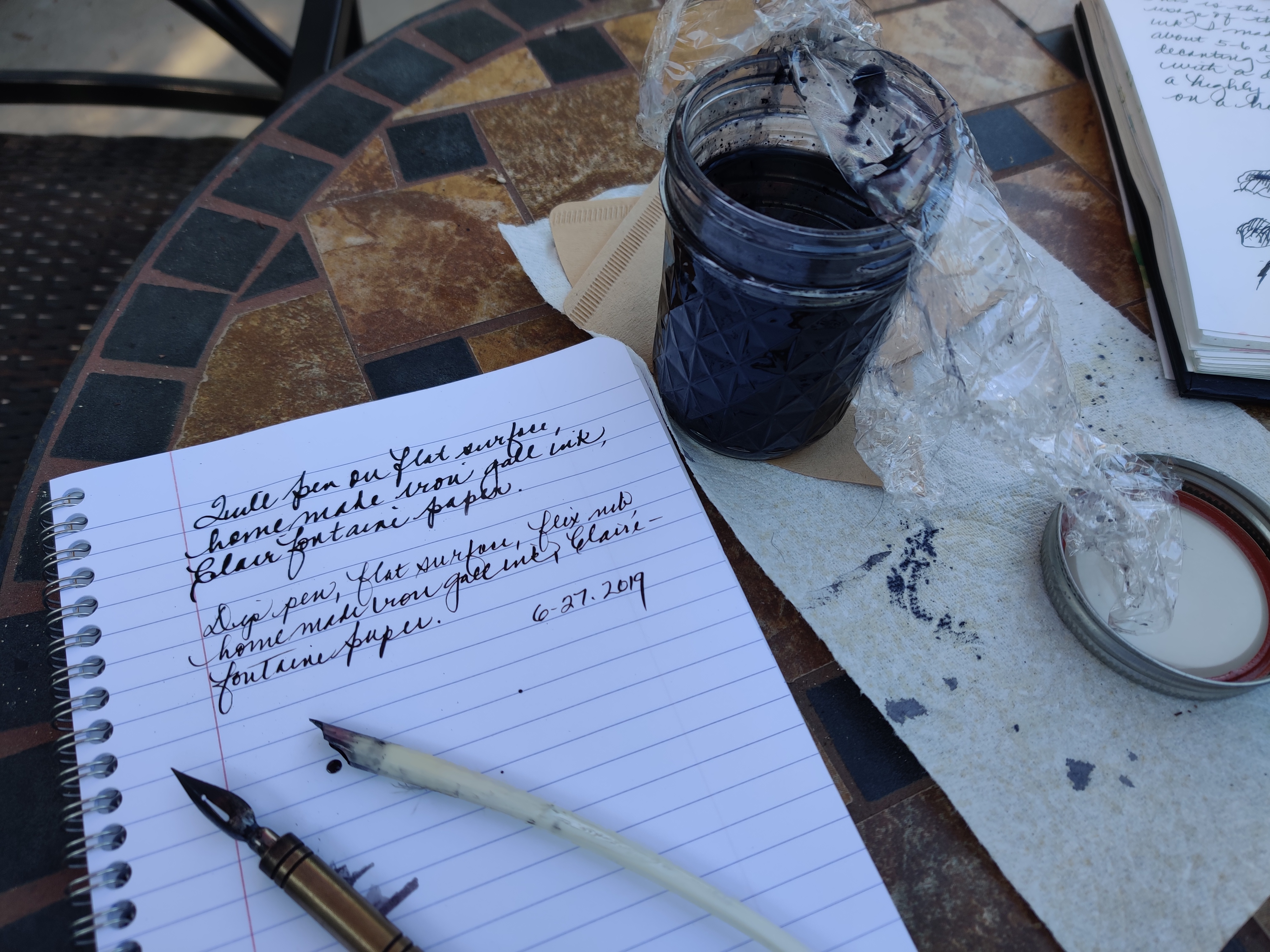
I spent most of the day dyeing with indigo on yarn . . . and some silk. A long day! But, on the list of things to do was to decant the iron gall ink I have been making over the past week.

Success! It is a really beautiful ink! It flows well off the flex dip pen nib as well as the quill I cut a few days ago. I’ll blog a bit more about it later, as at the end of a long day, I’m really tired, but really content with both the dyeing and the ink.

A Good Day to Dye

Dyeing Supplies

I have been feeling really all over the map of late – partly because the puppies do require a lot of work, such as walking, training, feeding, kissing, disciplining.  They are coming along fine.  Me, I am in need of sleep.  And a change of pace.

Today is overcast along the California central coast.  We even got a few drops of rain.  I nearly fainted.  The puppies, too, were shocked, because I don’t think they knew what it was.  And because it was dreary, what better way to pass some time than dyeing some yarn?

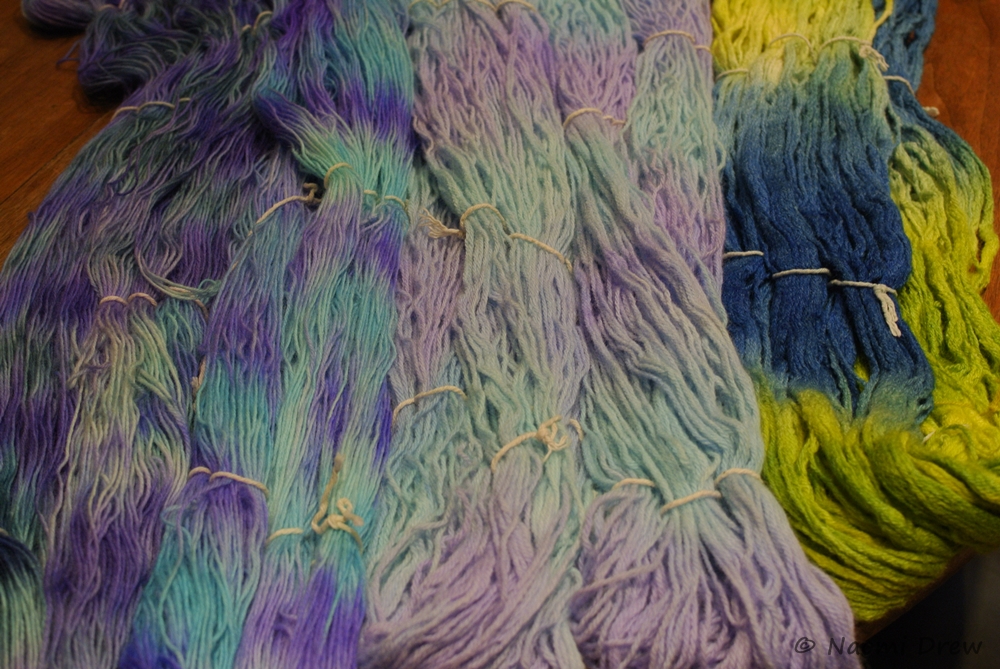
I have powdered dyes which I use; however, I need more colors in my palette as all are toward violets and teals.  There is a black and a lime green and a red, but really, not enough for a bigger variety of color choice.  I think I will order some new colors soon.

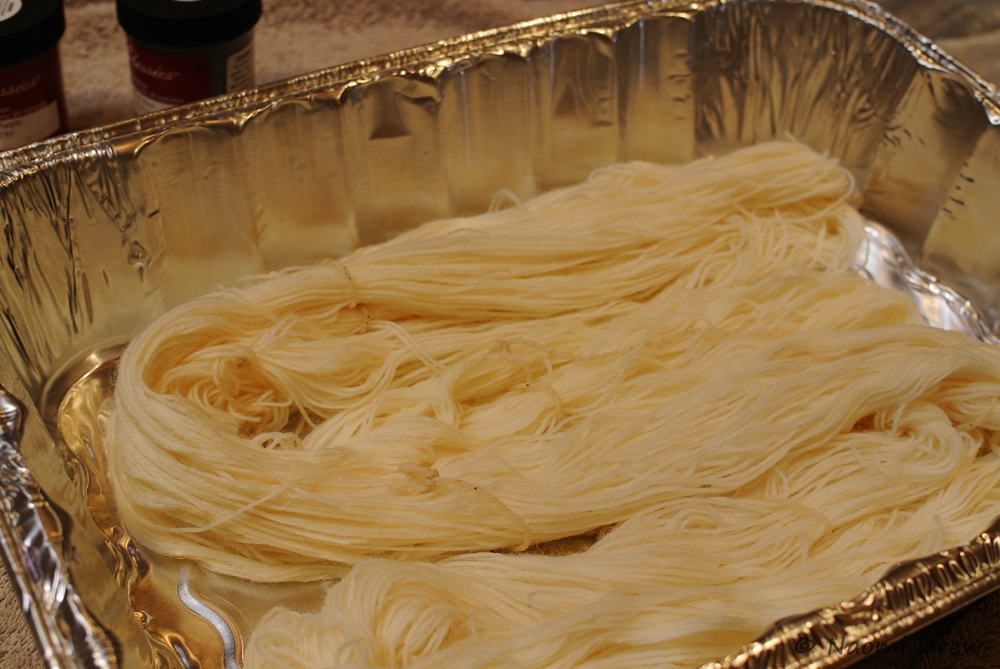
Anyway, I dug out my supplies – a couple of boxes of stuff dedicated to dyeing.  Nothing that is eaten out of is used in the process.  Pots, wooden spoons, steamers, pitchers, whatever.  I had some Bare Hare, an angora-merino blend from KnitPicks, along with their merino-silk blend.  I also had two balls of Lion’s “Sockease,” which is 75% wool and 25% nylon.

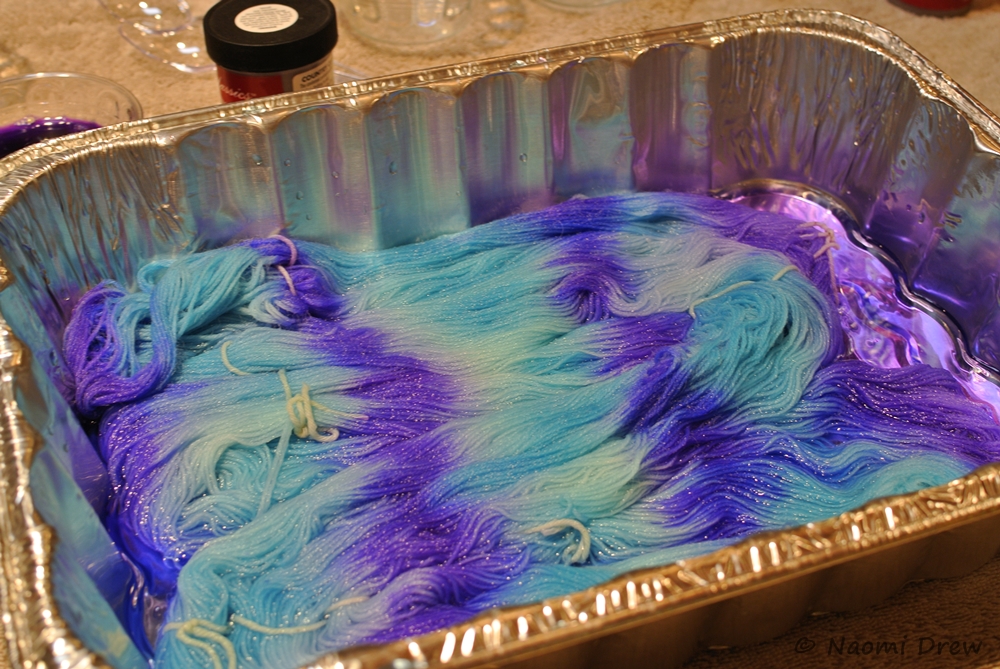
Yarn in Aluminum Pan

Stripes

The process of dyeing this yarn was quite simple.  In little plastic bowls, some dye powder, add boiling water, stir, and use a 60cc syringe to deliver the colors in stripes.  I poured some hot water between the stripes and patted the yarn to blend the colors, wearing, of course, my stylish blue nitrile gloves.

_DSC5188

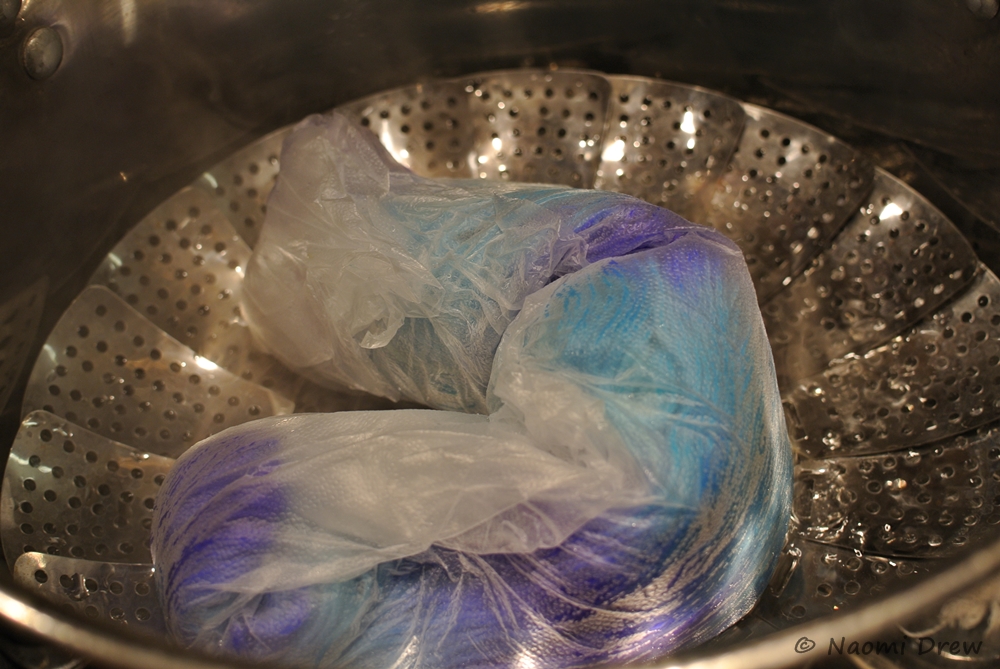
I wrapped the skeins up in plastic wrap, placed them on vegetable steamers in the boiling pots of water (water is just above the level of the steamer), and let them go to town for 30 minutes.  Then, dump onto a towel, take apart the plastic wrap, and dump the yarns into a water-vinegar rinse to cool and set the dye.  Lots of dumping.

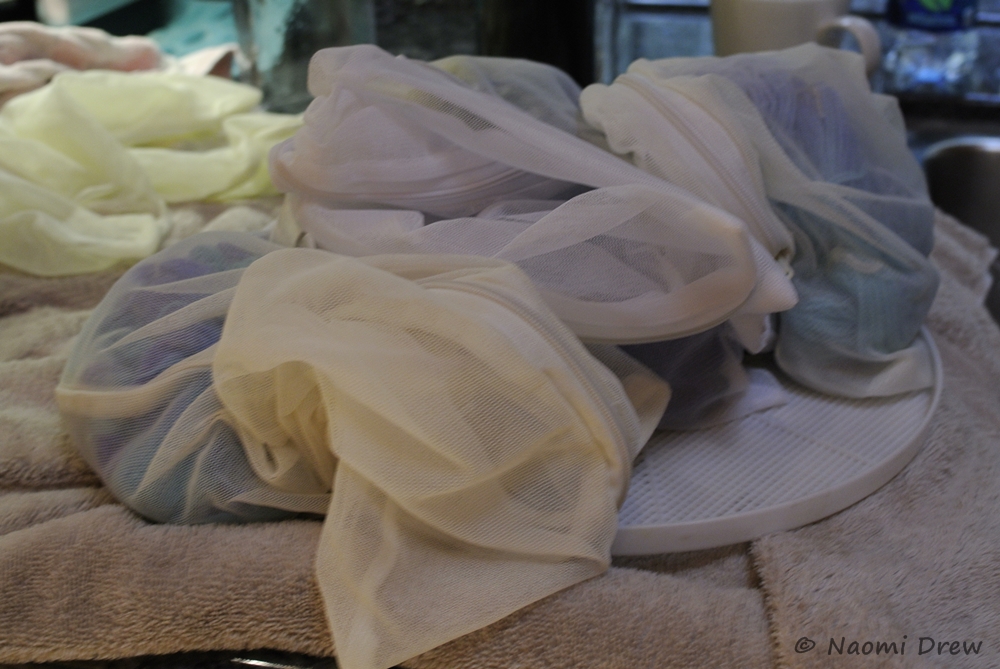
Once that is done, put them into cool, soapy water, wash, and rinse.  You can spin them out in your washing machine, but place the skeins in lingerie bags.

_DSC5199

The picture below is really bad. All the colors are actually fairly nice. And mostly violets and turquoises . . .

_DSC5204

A Good Day to Dye

The weather turned this weekend from cold and windy to warm and sunny, with all the elements of spring making themselves known:  the mockingbirds in the trees, the frisky squirrels, daffodils and freesias blooming.  Thus, for a few days, the cabled beret was tossed out the window (figuratively, not literally), while the dye pots and colors and yarn came out to play.

A couple of weeks ago I sent away to Wool2Dye4, and ordered two skeins of their 100% washable merino sock yarn, their 80/20 merino bamboo combo sock yarn, and a one-pound cone of their Blue-Faced Leicester.  I also had some sock blanks from KnitPicks that have been waiting many months to turn into butterflies.  My MIL’s birthday is on the Ides of March, so this yarn and dyeing is something we do occasionally as a birthdye present for her (and for me, though I’m 7 months from now . . .).

Anyway, it was a blast!  First thing we did was to paint up our sock blanks.  We used powdered dye mixed with water – I’ll detail that in another post – and plastic syringes to place the colors.  Judy’s sock blank is below.

Judy's Sock Blank - Before Steaming

This is my sock blank.

My Sock Blank - Before Steaming

We did this out on the picnic table, on top of a plastic tarp.  Before dyeing the blanks, two long sheets of plastic wrap were stretched out beneath where each blank would go, and pressed down to make a seal.  The blanks were soaked in warm water with a tablespoon of dish soap (Dawn) for about 30 minutes.  We set up the dyeing table and colors while the blanks soaked.

Once we had our blanks painted, into the kettle they went!  We rolled the blanks up in the plastic wrap, folding over the edges and such to seal in the colors, with a final sheet of plastic wrap, like a burrito.  The kettle was set up with a vegetable steamer and plastic tray, and the blanks steamed for about an hour.  Once they were done, we pulled them out and, as quickly as possible, freed them from their coverings and set them in a basin of warm water mixed with about 4 oz. of white vinegar.  There they cooled, and while they were cooling, we got on to more dyeing!

Our “cooked” sock blanks now looked like this:

Judy's Sock Blank - After Steaming
My Sock Blank - After Steaming

One would hope that the abstract patterns would come out like the blank, but already I know they won’t.  I’ve started knitting up my socks, or gloves, or whatever they are going to be.  The colors are intensely rich, and the photos really do not show what they look like.  Judy’s will more likely show its pattern – the blanks are always described as “make your own striped socks” – so it makes sense.  Still, it is fun to knit them up to see!

The next dyeing adventure was to spread out a skein of yarn each, already soaked, and pour colors onto the skein.  We’ve done this before, and often the patterns of the colors are really enjoyable.  Judy made used multiple colors in hers, and I decided to go for a more monochrome pattern.  You can see the results to the side – the turquoise skein is mine, and the multicolored one is hers.

The results of this are really satisfying as you can create strips or areas of color and work the color into the yarn. Judy’s painted skein is very obvious in its sections of color, but where the colors overlap can become very exciting. Mine is more subtle, which is odd for me, and for once the magpie did not overtake the entire project. I really like the turquoises and blues which were the result of mushing together a few shades of blue and turquoise.  Wrapping the skeins in plastic wrap and steaming them allows for the different projects to go into the same pot without polluting each other.

The final project was to create flammegarn. This is a resist method used in Scandinavia to create randomly bicolored yarn.  White or colored wool is tied off with yarn, in sections, and the yarn is immersed into color.  The result is randomly colored and white yarn, much like our multi-colored yarns of today, but with fewer colors and shorter areas of color.  The results are always fascinating.

Judy Holding the Tied Flammegarn Skeins

We decided to use the same colors, and to utilize our knowledge of color mixing to get some results.  We dyed our entire skeins a rather lime yellow greenish color.  Once we could handle the yarn out of the dye pot, we tied ours off.  Judy is holding up the dyed, still tied, skeins.

And then you can see her holding up the now untied skeins.  Hers is on the left, and mine is on the right.

She liked her colors, but for me, the colors did absolutely nothing.  Yucko!  Just not for me.  So, I decided to overdye my flammegarn skein, and I am so glad I did.

Judy with Untied Flammegarn Skeins

I decided to continue to apply color theory to the flammegarn. The yarn was a rather yellow-green and blue-green. I could overdye the yarn with a turquoise, but then I would have two similarly colored skeins. I decided to use violet. The yellow would turn to a grey color (yellow and violet being complementary colors), and the blue would turn to a blue violet. Into an intensely purple dye pot it went!

You can see from the results, the overdye was perfect. No more putrid yellow and blue green. The overall effect of the skein is a rather purplish blueberry color – more violet than blue – and really nicely mottled. Up close, with some photoshop lightening of the picture, you can see the colors a bit more distinctly.

The long, thin picture of the skein is close to the real color, and in daylight it has that deep purply blue color.  The larger picture on the left shows you the detail of the color, which, when knitted up, should add a bit of interest to the yarn itself.

Altogether, this was an incredibly satisfying day! The random effects of dyeing are half the fun – just experimenting and playing. You can see that Judy has an eye for detail and construction. Her colors are more orderly than mine, and I tell you, I really admire that in people. She is, for example, and incredibly talented beader and needlepointer, with the patience of a saint. Her work is impeccable. Me, I am far more crazy and like the process of making a mess. Too often, a mess is just the result. However, I was really pleased with the way everything turned out, for both of us, and I know we had a lot of fun together. With spring approaching (here in California), the plants are beginning to grow, and we plan on a natural dyeing adventure pretty soon, with native plants, as well as materials from other parts of the world. Stay tuned!